Private Label, White Label, Wholesale partnerships available - EU, USA and UK - Free shipping from €75
Carbon Neutral Shipping: A Guide for Lab Distributors
Shipping already accounts for about 2% of global CO2e emissions in 2023, and the World Economic Forum's Net Zero Industry Tracker shows shipping at 0.87 Gt CO2e in 2019 and 0.86 Gt CO2e in 2023, with only a 1.2% fall in total emissions while industry output rose 3.6%. This is the context for decarbonization of shipping in lab distribution, not a branding exercise, but a logistics discipline that has to work under emissions pressure, quality requirements, and customer scrutiny. The sector's projected path under current policy still points to 0.90 Gt in 2030 and 0.80 Gt in 2050, so any credible program has to start with measurement, then reduce operationally, then neutralize the remainder with discipline rather than convenience (World Economic Forum Net Zero Industry Tracker shipping report).
For lab distributors moving temperature-sensitive products, that matters even more because the shipment is only one part of the footprint. Warehousing, storage, handoffs, packaging, and delivery discipline all shape whether the claim is solid or superficial, and a well-run program can strengthen compliance, customer trust, and route quality without confusing offset purchases with real decarbonization. Herbilabs' broader sustainability context is useful here, especially for teams already working on lab operations and shipping expectations, as outlined in its sustainable laboratory practices guidance.
Table of Contents
- The Strategic Case for Carbon Neutral Shipping
- How Shipping Emissions Are Accurately Measured
- Practical Emission Reduction Strategies for Lab Supplies
- Choosing Your Path to Neutrality with Offsets and Fuels
- Implementing Your Carbon Neutral Program
- Understanding Regulatory and Market Trends
The Strategic Case for Carbon Neutral Shipping
Carbon neutral shipping has become a management issue because logistics emissions now sit inside the same conversation as service quality, procurement risk, and customer transparency. For a lab distributor, that means every route choice, packaging decision, and fulfillment handoff affects both operational performance and carbon credibility.
Why it matters for lab distribution
Temperature-sensitive products leave little room for sloppy execution. A distributor that consolidates shipments, limits waste, and tracks the full delivery chain is usually improving carbon performance and shipment reliability at the same time. That is why a credible program should be treated as a control system, not a marketing add-on.
The policy signal is also getting clearer. The IMO's 2023 framework sets a global baseline for annual emissions cuts from international shipping, which means distributors that depend on ocean freight and cross-border delivery are already operating inside a decarbonizing market structure (UNCTAD shipping decarbonization chapter).
Practical rule: if a distributor cannot explain where shipping emissions come from, it probably can't defend a carbon neutral claim either.
What the strategy actually is
At its best, carbon neutral shipping follows a hierarchy. First, measure the full logistics footprint. Second, cut avoidable emissions through routing, packaging, consolidation, and mode choice. Third, neutralize the residual amount with high-quality methods. That order matters because offsets can cover the remainder, but they can't fix a distribution network that wastes fuel, space, or refrigeration capacity.
For lab distributors, the commercial case is straightforward. Buyers in research and regulated environments increasingly want traceability, and sustainability claims only help when they are backed by a clean emissions boundary. A program built this way can support tenders, reduce avoidable shipping waste, and create a more defensible customer story.
How Shipping Emissions Are Accurately Measured
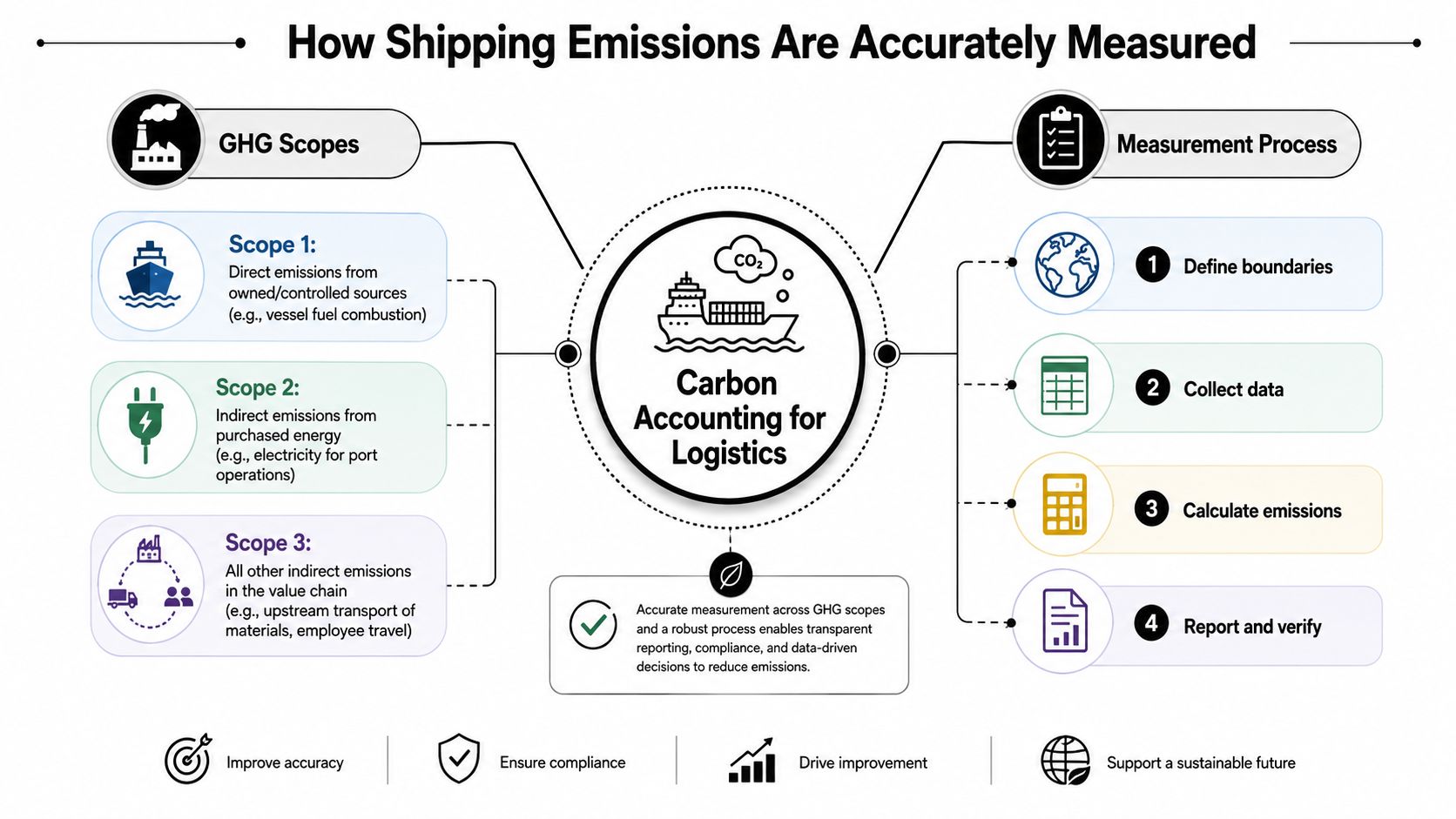
Shipping emissions accounting gets much easier once it is treated like finance. Each movement, fuel burn, and storage step becomes a ledger entry, and the main mistake is not calculation, it's defining the wrong boundary.
GHG scopes and the emissions boundary
Scope 1 covers direct emissions from sources a company owns or controls, such as fuel used in owned vehicles or vessels. Scope 2 covers indirect emissions from purchased electricity, which can matter for distribution centers, cold rooms, and port-linked facilities. Scope 3 is the broadest category, it includes other indirect emissions across the value chain, such as upstream transport, outsourced warehousing, and other logistics partners.
For carbon neutral shipping, that boundary matters more than the calculator itself. The CarbonNeutral Protocol states that a delivered product's certification boundary must cover the entire manufacturing-to-customer distribution chain, including intermediate warehousing and storage operations (CarbonNeutral Protocol). That is the right starting point for a lab distributor, because a shipment that ignores storage legs or transshipment points is undercounted by design.
A useful analogy is departmental spending. Scope 1 is the operations department spending fuel. Scope 2 is the facilities department spending electricity. Scope 3 is everyone else's spend that still lands on the company's shipment, including outsourced moves and storage.
The accounting workflow for logistics teams
A clean measurement process usually follows four steps. First, define the boundary from manufacturing to customer door. Second, collect activity data, such as shipment mode, distance, weight, and storage time. Third, apply emission factors to convert those inputs into CO2e. Fourth, report the result and verify it internally before any neutrality claim goes public.
A good carbon accounting file should read like a shipment audit trail. If a box moved through a warehouse, a courier hub, and a final-mile carrier, all three should appear in the record.
The practical challenge for lab distribution is not only transport. Cold storage, packaging, and split shipments can distort the footprint if they are tracked separately or ignored altogether. A distributor with strong supply chain visibility can usually map those handoffs faster and avoid the common mistake of counting only the visible carrier leg.
The main takeaway is simple. Measure the chain first, not just the label on the parcel. When the boundary is right, the reduction plan becomes specific instead of vague.
Practical Emission Reduction Strategies for Lab Supplies
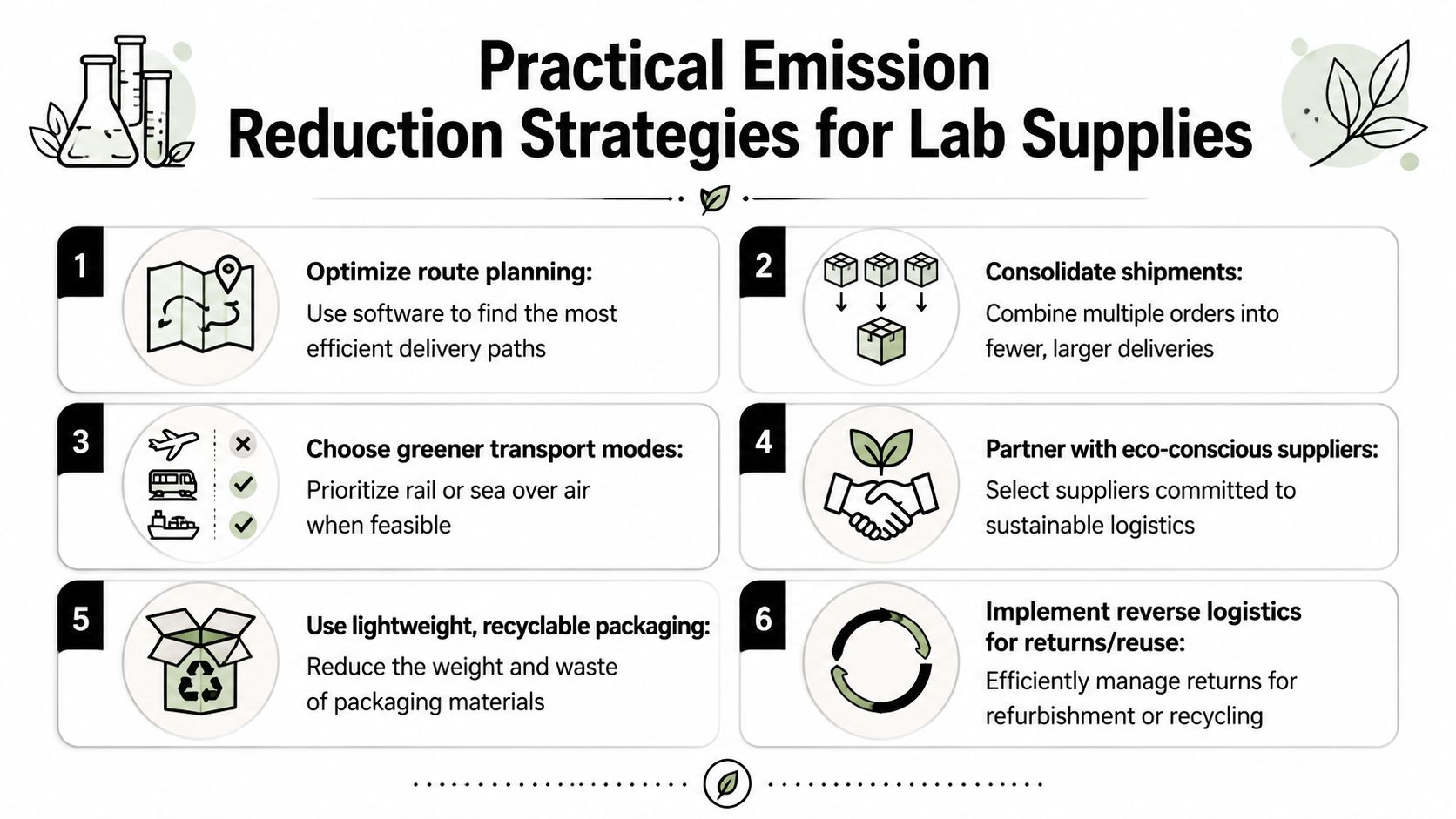
The biggest carbon gains in lab distribution usually come from removing waste before anyone talks about offsets. That means fewer partial shipments, less unused packaging volume, better delivery density, and tighter control over cold-chain handling.
Reduce movement before you neutralize it
Shipment consolidation is the first lever to pull. When orders are combined intelligently, carriers move more freight per trip and the network stops paying for repeated handling of the same customer order. That also lowers the chance of split shipments, which often increase packaging use and transit complexity.
Route optimization is the next obvious lever, especially where same-day and next-day service compete with efficiency. A practical resource on how route planning works can help teams understand how software evaluates stops, sequence, and constraints without treating every delivery as a one-off decision. For lab distributors, that matters because temperature-sensitive items need both speed and reliability, not just a shorter map distance.
Packaging deserves the same discipline. Oversized cartons, excess void fill, and heavy insulation increase shipping weight and volume, which can increase the footprint without improving product protection. A stricter packaging requirements policy helps teams standardize what goes into each lane, especially when different product classes need different protection levels.
Cold-chain choices that matter
Temperature-controlled shipping is where many carbon neutral programs get inconsistent. Insulated shippers should be selected for performance first, then for weight and reuse potential. Refrigerant use should also be managed carefully, because unnecessary cooling material adds cost and can complicate disposal.
Carrier choice matters too. Different transport modes and service levels have very different emissions profiles, so the right decision is not always the fastest one. When feasible, distributors should avoid air-heavy lanes, reduce unnecessary express services, and use carriers that can document their operational efficiency commitments.
The same logic applies to returns and reverse logistics. Reusable shippers, refurbishment pathways, and controlled return flows keep materials in circulation longer and reduce repeated packaging demand.
Operational takeaway: carbon savings usually show up first where a shipping team removes unnecessary touches, packaging volume, and rushed movement, not where it buys a certificate after the fact.
For lab distributors, environmental and financial logic line up most clearly. Better packing, denser loads, and smarter routing usually improve service consistency too, which makes the reduction plan easier to defend internally.
Choosing Your Path to Neutrality with Offsets and Fuels
Residual emissions still need to be addressed after reduction. The choice is usually between paying for offsets or changing the energy used to move the goods, and those are not the same thing.
Compare operational changes with offset claims
Independent coverage has pointed out that carbon-neutral checkout options often rely on offset projects rather than directly reducing shipping emissions, which raises the core buyer question about what portion of the payment is actual operational reduction versus accounting after the shipment is done (Wirecutter discussion of carbon-neutral checkout). That critique is especially relevant for lab distribution, where customers often care about proof, not just claims.
Operational changes have clearer mechanical value. Fuel switching, electrification for last-mile delivery, and better route design reduce emissions at the source, while offsets compensate for what remains. A program that uses both can be credible, but only if the reduction side comes first.
A useful comparison point is energy storage and grid balancing. The discussion around powering homes with sodium ion batteries shows how electrification depends on the surrounding energy system, not only the device itself. Shipping has the same problem, because low-carbon delivery depends on vehicle availability, route structure, and infrastructure maturity.
What high-integrity neutralization looks like
A strong offset program should be treated as the last step, not the main story. The quality test is whether the project has real climate value, and that means asking whether it is additional, durable, and clearly attributable to the buyer's program. If a shipping provider cannot explain those criteria in plain language, the claim is weak.
For lab distributors, the safest path is to separate the questions. What can be reduced through operations? What must remain? What is being neutralized, and how is that neutralization verified? That structure keeps the program honest and keeps customers from assuming that a carbon-neutral label means the shipment itself became zero-emission.
Implementing Your Carbon Neutral Program
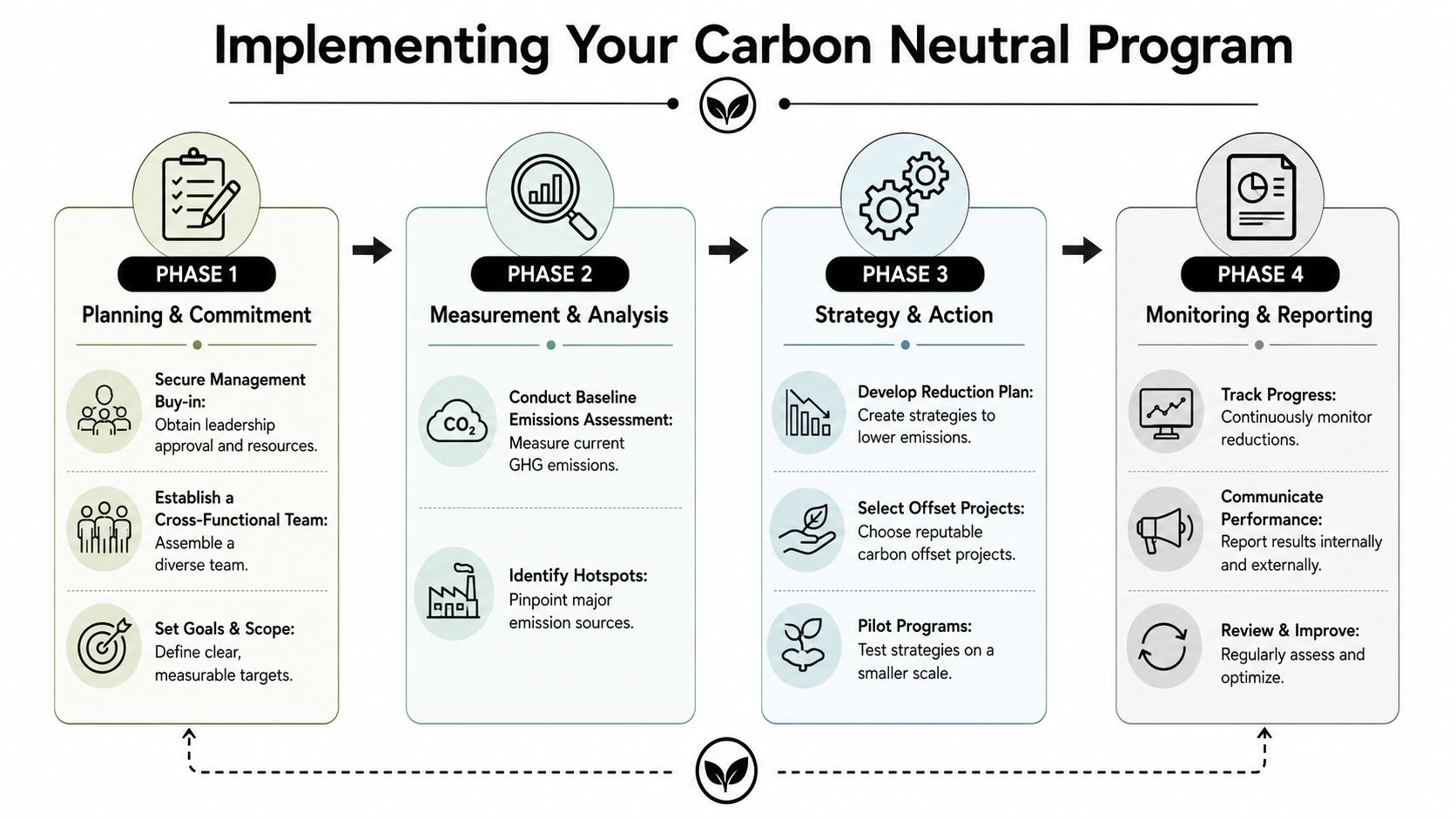
A practical rollout works best when it is phased. Distributors do not need to solve every lane at once, but they do need a system that starts with data and ends with review.
A phased rollout for distributors
Phase 1, planning and commitment. Leadership needs to approve the scope, assign ownership, and define the business reason for the program. Without that, carbon work gets trapped inside a sustainability memo and never reaches fulfillment.
Phase 2, measurement and analysis. Teams should establish a baseline, identify the biggest transport and packaging sources, and separate controllable emissions from upstream ones. That is the point where the program stops being abstract and starts becoming an operational map.
Phase 3, strategy and action. At this phase, route discipline, packaging standardization, carrier selection, and offset or fuel choices get translated into fulfillment rules. Pilot lanes are useful here because they show what changes work without disrupting every customer flow at once.
Phase 4, monitoring and reporting. Progress needs to be tracked in the same way shipment quality is tracked, with regular review and visible accountability. If emissions data sits outside the normal reporting cycle, it will drift.
Where ROI usually shows up first
The business case is usually strongest where carbon work improves service levels or reduces waste. Fewer split shipments, more predictable packaging use, and smarter routing can all reduce friction in the fulfillment process. That matters for research customers, who often value reliability as much as sustainability.
A credible program can also help with vendor selection. Large institutions often want evidence that the distributor understands emissions boundaries, supply chain transparency, and claim integrity. If those buyers are comparing suppliers, the one with a disciplined logistics program has an advantage that goes beyond marketing language.
Implementation note: the first win is rarely a headline-grabbing offset purchase. It is usually a cleaner baseline, a tighter fulfillment rule, or a shipping lane that stops wasting packaging and fuel.
The best rollout rhythm is simple. Start with one product family, one warehouse, and one delivery region. Prove the measurement process, lock the reduction rules into operations, then scale outward only after the data is stable.
Understanding Regulatory and Market Trends

The regulatory backdrop is no longer hypothetical. International shipping is already being pushed toward lower emissions, and distributors that rely on cross-border freight need to understand how that direction shapes carrier behavior, customer expectations, and claim integrity.
What rules already matter
The IMO's 2023 framework requires international shipping to cut annual greenhouse-gas emissions by at least 20% by 2030 versus 2008, with a stronger ambition of 30%. That target does not place every distributor under the same direct rule set, but it does change the operating assumptions for carriers, ports, and logistics providers.
For lab supply companies, the practical implication is clear. Carriers will increasingly separate themselves by emissions reporting, fuel strategy, and operational efficiency, and distributors that understand carbon neutral shipping will be better prepared to select partners and explain their own footprint. In other words, the market is rewarding clearer accounting, not looser claims.
How buying decisions are changing
Sustainability is now part of vendor selection in research, higher education, and corporate lab procurement. Buyers want evidence that a distributor can document the full delivery chain, not just purchase an offset and treat the job as finished. That is why a disciplined shipping program has commercial value as well as environmental value.
A useful comparison comes from Automotive shipping insights, because any sector with tight delivery windows and complex logistics eventually has to balance speed, cost, and emissions without pretending those variables are independent. Lab distribution faces the same trade-off, with colder storage, stricter handling, and less tolerance for error.
The strongest position for a distributor is straightforward. Measure accurately, reduce systematically, and neutralize the remainder with methods that can be defended. That is the standard customers, auditors, and procurement teams are increasingly using when they evaluate carbon neutral shipping.
Herbilabs can help lab distributors think through carbon neutral shipping in the context of high-purity products, temperature-controlled handling, and reliable fulfillment. Visit Herbilabs to review its lab supply range and evaluate how a more disciplined shipping model can fit into your distribution strategy.


