Private Label, White Label, Wholesale partnerships available - EU, USA and UK - Free shipping from €75
Sustainable Laboratory Practices That Actually Work
Laboratories are reported to consume 5 to 10 times more energy than an office building of equivalent size, and in some institutions they account for 60% to 65% of a university's total energy use. Add the material burden, 5.5 million tonnes of single-use plastic waste from laboratory research worldwide each year, and the topic stops looking like a side project and starts looking like an operational system with real environmental cost. Sustainable laboratory practices matter because the waste streams are large, the decisions are daily, and the trade-offs reach from procurement to cold storage to disposal. For a practical overview of how organizations frame environmental action, environmental efforts at Intech is a useful reference point for what structured sustainability reporting can look like.
Table of Contents
- Why Sustainable Laboratory Practices Are a High-Impact Priority
- Running a One-Week Baseline Assessment of Your Lab
- Cutting Waste Through Microscale Methods and Solvent Recovery
- Procurement and Sterile Diluent Choices That Reduce Footprint
- Energy, Fume Hoods, and Cold-Chain Habits That Stick
- Choosing the Right Framework for Your Lab
- KPIs and Reporting Cadence That Survive an Audit
Why Sustainable Laboratory Practices Are a High-Impact Priority
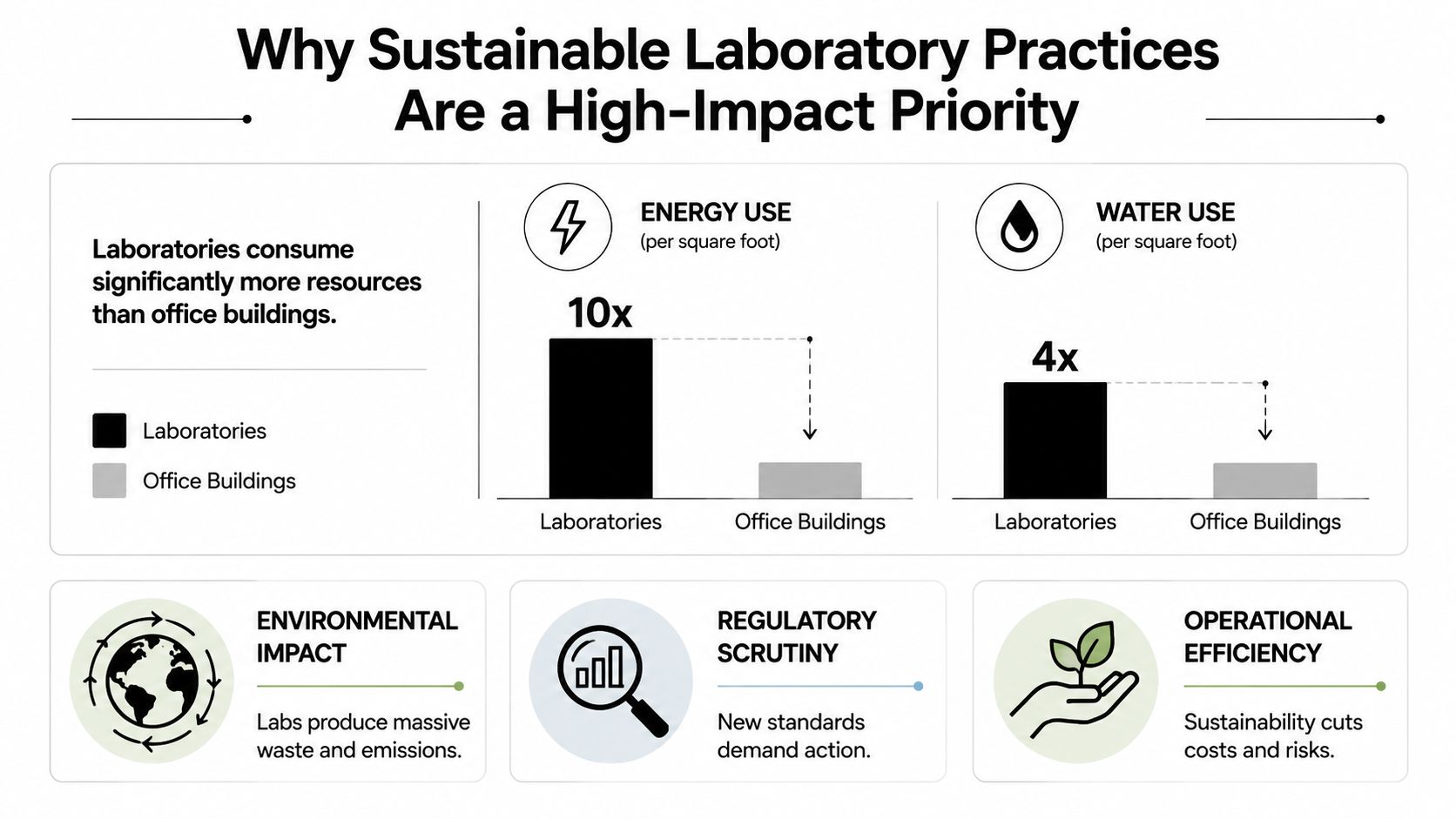
The scale of the problem is already too large for informal fixes. Laboratories can use 5 to 10 times more energy than an office building of equivalent size, and in some institutions they account for 60% to 65% of total university energy use, according to the research summary in the brief (PMC source). Water and material use sit in the same high-pressure category, because cooling, washing, and disposable plastics compound fast in day-to-day operations.
Why the numbers matter in practice
Those figures matter because they change the management question. The question is which decisions cut energy, water, and waste without breaking compliance, product integrity, or research continuity. That is why sustainable laboratory practices have moved from voluntary goodwill to a core operational priority in research-heavy institutions.
The human footprint is just as stark. The same source estimates an individual researcher's annual work-related footprint at 10 to 37 tonnes of CO2e, which sits far above the 1.5-ton annual carbon budget often used in Paris-aligned discussions. A lab cannot solve climate impact with recycling bins alone when the baseline footprint is that high.
Practical rule: if a lab is measuring only waste diversion and ignoring energy, water, and procurement, it is tracking symptoms, not the system.
That is the reason serious programs start with operations, not slogans. Energy discipline, chemical minimization, cold-chain choices, and purchasing standards all affect the final footprint, and the article's later sections treat each of those as a working lever rather than an abstract goal. The environmental efforts at Intech show the same logic from the supplier side, where procurement decisions are part of the sustainability picture rather than a separate conversation. For a sustainability team, the question is simple. Where does the lab spend the most resources, and what changes move those flows?
Running a One-Week Baseline Assessment of Your Lab
A useful baseline doesn't need a consulting-style timeline. It needs a clean snapshot of what the lab consumes, where the waste comes from, and which suppliers dominate spend. A one-week assessment can do that if it is narrow, disciplined, and tied to the way the lab already records operations.
Capture the data that already exists
Start with utility bills, meter reads, and the building's energy or facilities dashboard. Add fume-hood runtime, freezer counts, cold-room loads, and water draw from local facilities staff or the building management system. Then pull waste logs from the LIMS or waste contractor manifests, plus procurement data from supplier invoices, purchase orders, and inventory records.
A good baseline also separates consumables, solvents, sterile diluents, reagents, and cold-chain items. That distinction matters because the sustainability discussion changes when a product is sterile, high-purity, or batch-sensitive. A broad “plastic versus glass” view misses the key decision points.
Use a framework label from the start
The easiest way to keep the baseline defensible is to align it to either LEAF or My Green Lab terminology from day one. That gives the final report a familiar structure, which makes later KPIs easier to explain to leadership and easier to compare over time. It also reduces the usual argument about whether a number is “real” or just a one-off estimate.
A sensible one-page output includes current energy use, water use, the biggest waste streams, freezer and hood inventory, and procurement categories ranked by spend. It should also name the data owner for each line item. If nobody owns the number, nobody can improve it.
Useful checkpoint: if the baseline can't be recreated from meter reads, invoices, and waste records, it isn't ready for audit conversation yet.
The result is a working map, not a perfect inventory. That's enough to decide which changes can start immediately, which need supplier input, and which depend on protocol redesign. The next step is to reduce the waste generated by the work itself.
Cutting Waste Through Microscale Methods and Solvent Recovery
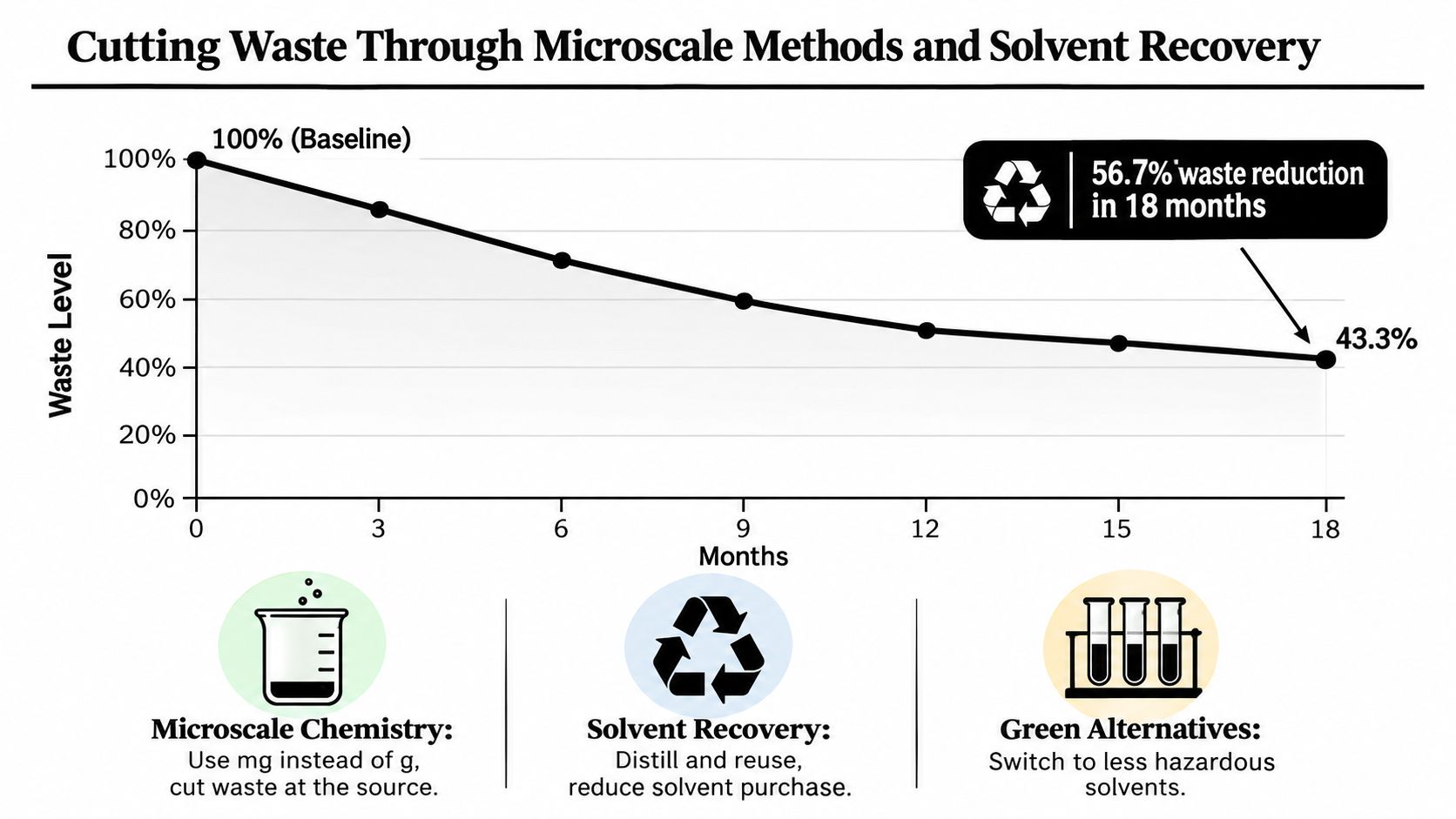
The quickest waste cuts usually come from changing how experiments are designed, not from sorting what gets thrown away. In one postgraduate chemistry department case, total chemical waste fell by 56.7% over 18 months, moving from 1,200 kg/year to 520 kg/year. Solvent recovery was a major part of that result, producing 280 kg/year of reusable solvent and saving about ₹1,20,000 in procurement costs, according to the case data in the brief.
What shifted
The strongest programs combine microscale methods with solvent recovery and tighter inventory control. Microscale adaptations of standard organic practicals reduced chemical waste by 85% to 99% without harming educational outcomes, while published institutional case studies reported 50% to 70% waste reductions and 60% to 90% E-factor improvements when protocol redesign was part of the intervention. The direction is clear. The more the procedure changes, the more the waste falls.
That is where many labs fall short. They adjust purchasing, but they leave the method itself in place. If the solvent-heavy procedure stays unchanged, the waste stream stays solvent-heavy too. End-of-pipe sorting cannot match source reduction, because the waste is already created by the time it reaches the bin.
What to change first
The most defensible sequence is simple. Reduce scale where protocols allow it, recover reusable solvent where purity can be verified, and then review substitutions for less hazardous alternatives. Some labs also use procurement controls to stop overbuying, but those controls work best when they are paired with revised methods and tighter inventory discipline.
Operational reality: the waste falls when the experiment changes. It does not fall just because the bin is labeled better.
For training environments, microscale practicals also lower exposure and handling volume. For research groups, solvent recovery can turn a recurring cost into a partially reusable stream. Both approaches matter because they attack waste at source, which is where the environmental and financial value sits.
Procurement and Sterile Diluent Choices That Reduce Footprint
Procurement is where many sustainability programs go vague, and that is a mistake. A reusable container only helps if sterilization, transport, contamination risk, and batch consistency do not erase the gain. That question matters even more for sterile diluents, bacteriostatic water, high-purity reagents, and other products where product integrity has to survive real lab use, not just a packaging comparison.
Packaging is only one variable
The useful question is which format lowers total impact without creating quality risk. In regulated or high-purity workflows, contamination control and batch consistency can outweigh simple packaging messaging. A supplier review should consider manufacturing footprint, returnable packaging, sterility assurance, lot traceability, and cold-chain requirements together.
A good procurement scorecard gives each item a place in the decision, not just a green label. It should ask whether the product is used once or repeatedly, whether reprocessing is realistic, whether shipping adds avoidable refrigerated transport, and whether the formulation tolerates a lower-packaging format. If those variables are not compared, the team is just moving waste around.
Herbilabs' own guidance on sterile water versus bacteriostatic water fits this procurement conversation because diluent choice affects both workflow integrity and disposal behavior. In practice, the right option depends on the application, the storage window, and the contamination profile. That is a procurement decision, not a branding decision.
Build the supplier conversation around evidence
A supplier review should favor partners who can document batch quality, offer clear COAs, and explain packaging choices in operational terms. For some labs, that means buying a product in glass vials because stability and handling matter more than lightweight packaging. For others, the right choice is a lower-packaging format that still meets sterility and compliance needs.
The point is to stop treating procurement as the last step in the process. It is the point where waste is either locked in or prevented. The strongest sustainability outcomes come when the lab asks suppliers to show how a product supports the workflow, not just how it ships.
Lab teams also need to account for energy use tied to storage and inventory control. A freezer full of slow-moving stock carries a footprint long after the purchase order clears, which is why buying decisions should sit alongside storage discipline and periodic inventory review. Procurement reviews can also be paired with submetering for multifamily buildings style thinking, meaning the team tracks where load sits instead of guessing from the utility bill alone. That kind of visibility makes it easier to see whether a supposedly greener product is really reducing impact, or shifting it into cold storage and holding costs.
Energy, Fume Hoods, and Cold-Chain Habits That Stick
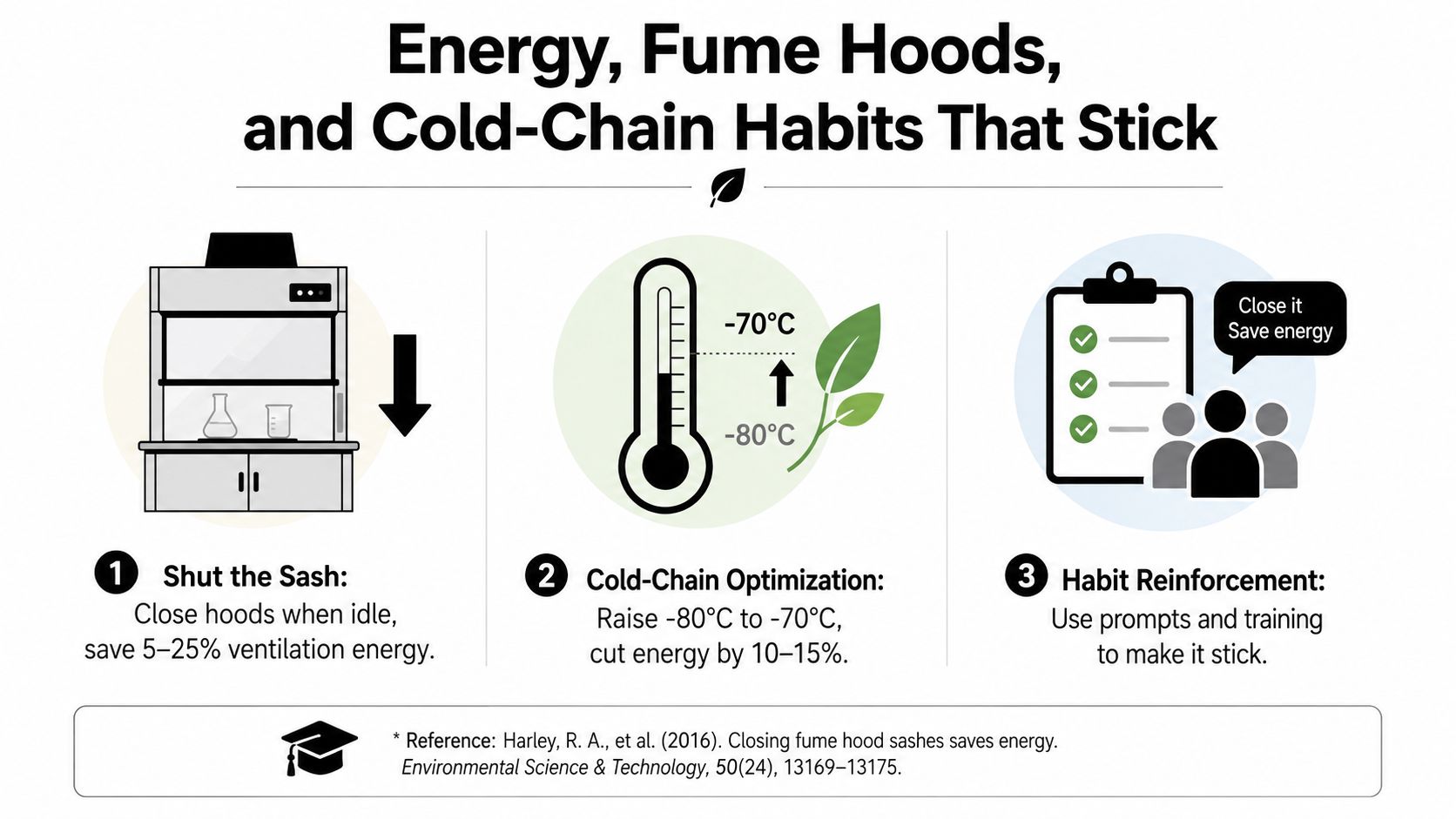
Energy savings in labs depend on habits that hold up during real work, not just in policy documents. One RSC-cited analysis found that closing fume hoods delivered annual savings of 5% to 25% of ventilation-system energy load, and Harvard-referenced reporting linked hood closure to over $240,000 in savings and 300 metric tons of carbon reduction (RSC source). Those figures are large enough to justify clear rules, because vent losses from an open sash keep adding cost every hour the hood stays idle.
Build habits around the highest-load equipment
Start with the equipment that drives the biggest load. Close fume-hood sashes whenever work pauses, and make sash position easy to see from the corridor as well as the bench. That reduces the chance that one person leaves a hood open while another assumes it is being used.
Shutdown discipline needs the same attention. The same source notes that only 44% of respondents always switch off equipment when not in use, which means idle devices remain a steady energy drain (RSC source). In practice, that means the best procedure is the one people can follow without slowing their work.
Cold-chain discipline is the next place where habits either save energy or silently add load. Freezer inventories drift, samples get duplicated, and storage temperatures are often held colder than the material needs. A clean inventory, clear ownership, and regular review of what belongs in frozen storage prevent that kind of slow expansion, which also makes supply decisions easier to defend when teams review supply-chain visibility alongside storage use.
For labs that already use meter-based oversight in other building types, submetering for multifamily buildings offers a useful parallel, because the same logic applies in labs. Measure the load at the source, then make the equipment owners responsible for what they see.
A short video can help reinforce sash, shutdown, and storage habits during onboarding and refreshers.
Make the habit visible
Framework adherence is still the weak point. The brief's survey data show only 11% of respondents always follow sustainability frameworks such as LEAF or My Green Lab, which means training by itself does not hold behavior in place (RSC source). SOPs, reminders, and accountability metrics need to sit beside the poster on the wall, not behind it.
The strongest labs make the behavior hard to ignore. They use door signs, bench prompts, weekly checks, and named owners for hood and freezer discipline. They also track the result, because a habit that is not measured usually slides back toward convenience.
Choosing the Right Framework for Your Lab
A framework only works if it fits the lab's actual operating conditions. LEAF, My Green Lab, and ISO 14001 serve different purposes, so the right choice depends on whether the team needs a practical accreditation path, a lab-specific certification, or a wider environmental management system that can support audit and procurement decisions.
Comparing the main options
| Framework | Best Fit | Time to First Accreditation | Strength |
|---|---|---|---|
| LEAF | Academic labs and institutions with structured lab-sustainability goals | Shorter implementation path for many teams | Practical lab-focused criteria |
| My Green Lab | Research teams that want a recognized sustainability certification | Varies by site and readiness | Strong lab-specific benchmarking |
| ISO 14001 | Organizations wanting a formal environmental management system | Longer, more system-heavy rollout | Broad management-system structure |
The Green Lab RUG case shows what institutional execution can look like. The team accredited 46 laboratories, with 17 silver and 29 LEAF bronze, and calculated annual savings of €398,763 and 477,107 kg CO2, or about €8,669 and 10,372 kg CO2 per lab per year (RSC source). That result matters because it shows the program can move from a label to day-to-day practice across multiple labs at once. It also gives procurement and facilities teams a stronger basis for decisions that affect waste, storage, and equipment use.
Pick the framework that fits the operating reality
LEAF usually works best where the lab wants a clear checklist and quick adoption. My Green Lab fits teams that want a recognizable certification and peer benchmarking. ISO 14001 makes more sense when the organization already manages environmental systems across multiple functions and wants a wider management framework.
The trade-off is practical, not theoretical. A framework that is too heavy for the lab's pace will get ignored, even when staff support the intent. A framework that is too light for leadership reporting will not survive the next audit cycle.
That choice also affects how teams handle tracking and follow-through. If the lab needs one place to document actions, suppliers, and verification steps, compliance tracking software can help keep the framework tied to real records instead of scattered emails and spreadsheets. For labs that need to align ITAD with sustainability reports, the same logic applies, because decommissioned equipment, surplus assets, and disposal records should sit inside the reporting process, not outside it.
KPIs and Reporting Cadence That Survive an Audit
A sustainability program fails when it relies on impressions instead of numbers. The fix is a compact KPI set tied to existing operational records, so reporting becomes part of lab management rather than a separate spreadsheet exercise. The most useful measures are the ones that connect directly to action.
Track the numbers that map to decisions
| KPI | What it tells leadership | Typical data source |
|---|---|---|
| kWh per researcher-hour | Energy intensity relative to lab activity | Utility meters, staffing logs |
| kg of solvent per assay | Protocol efficiency and chemical intensity | LIMS, waste manifests |
| Percentage of freezer space actually utilized | Whether cold storage is overbuilt | Freezer inventory, audits |
| CO2e per batch produced | Production footprint by workflow | Inventory, shipping, energy data |
| Percentage of procurement spend covered by sustainability-scored suppliers | How much of spend is under a sustainability lens | Supplier scorecards, AP reports |
Those metrics work because they're close to the work itself. A lab manager can ask a technician about assay count, a facilities lead about utility use, and procurement about supplier coverage without building a new data system from scratch. That keeps the numbers usable.
Audit-friendly rule: if a KPI can't be tied to an owner and a source, it won't hold up for long.
Use a cadence that leadership can follow
A monthly internal review keeps the program alive. A quarterly external-facing summary shows progress without forcing teams to over-report every week. Annual review then becomes a consolidation exercise, not a rescue mission. For teams looking at broader reporting structures, align ITAD with sustainability reports is a helpful reminder that disposal, reuse, and reporting need to sit in the same governance conversation.
Herbilabs' compliance tracking software is relevant here because workflow control, expiry alerts, and reorder thresholds can support the same discipline on consumables and inventory. A lab that knows what is on hand, what is expiring, and what should not be reordered reduces avoidable waste before it starts.
A quarter-long rollout that doesn't stall
Weeks one and two should capture the baseline and assign owners. Weeks three and four can focus on hood signs, freezer audits, and shutdown SOPs. Weeks five through eight should tackle procurement redesign with supplier scorecards and packaging pilots, then weeks nine through twelve can move toward framework accreditation and the first KPI report.
That sequence works because early wins create credibility for the harder changes. Leadership sees the baseline, the behavior chart, the procurement scorecard, and the accreditation roadmap, all in the same quarter. From there, sustainable laboratory practices stop being a campaign and become a management routine.
Herbilabs supports labs that want tighter control over consumables, sterile diluents, and inventory decisions that affect waste. If a team is reviewing procurement, expiry loss, or compliance tracking as part of its sustainability program, visit Herbilabs to see how its product and workflow tools fit into day-to-day lab operations.


