Private Label, White Label, Wholesale partnerships available - EU, USA and UK - Free shipping from €75

Can Bacteriostatic Water Expire? Sterility & Risks
Yes. Bacteriostatic water expires in two practical ways: the unopened vial remains usable until the manufacturer's printed expiration date when stored properly, and once punctured it should be discarded after 28 days. Those are two different issues. One is the integrity of a sealed sterile container, and the other is the limited protection provided by the preservative after the stopper has been pierced.
That distinction matters because many people find the same thing on a bench, in a drawer, or in warehouse stock: a clear vial that looks fine but has an uncertain handling history. In quality control, that's where mistakes start. Clear liquid isn't the same as verified sterile liquid, and a preservative isn't a license to treat a multidose vial as if nothing changed after the first puncture.
For researchers, the cost of getting this wrong is bad data, wasted compounds, and failed runs that are hard to troubleshoot later. For wholesalers and resellers, the issue is broader. Storage conditions, seal integrity, and traceability all affect whether a vial is still fit for use in a research workflow.
Table of Contents
- Understanding Bacteriostatic Water and Its Shelf Life
- The Two Meanings of Expiration for BAC Water
- Key Factors That Influence Shelf Life
- How to Read Labels and Certificates of Analysis
- The Risks of Using Expired Bacteriostatic Water
- Best Practices for Labs Wholesalers and Resellers
Understanding Bacteriostatic Water and Its Shelf Life
A researcher pulls a partly used vial from cold storage before a reconstitution run. The liquid is clear. The stopper is still seated. What is missing is the one detail that decides whether the vial belongs in the workflow or in the discard bin: the opening history.
Bacteriostatic water is Water for Injection containing 0.9% (9 mg/mL) benzyl alcohol as a preservative, as stated in the FDA DailyMed label for Bacteriostatic Water for Injection. That same labeling sets storage at 20 to 25°C (68 to 77°F) under controlled room temperature conditions. For quality control, that means shelf life is never just a date printed on glass. It is a combination of labeled storage, intact packaging, and documented handling.
This distinction matters because bacteriostatic water is often treated as a generic diluent. In practice, it is a controlled sterile product with a preservative system. Those are two separate protections. The vial, stopper, and seal protect sterility while unopened. The benzyl alcohol helps limit microbial growth after entry, but it does not erase contamination introduced by poor technique, repeated punctures, or weak storage control.
That is also why teams should not manage bacteriostatic water the same way they manage Water for Injection used in sterile preparation workflows. Both products may look interchangeable on the bench. Their intended use pattern and risk controls are not the same.
Why labs get tripped up
The common failure point is traceability, not appearance.
Labs often document the lot number of the compound being reconstituted and give less attention to the diluent. Then an assay drifts, recovery becomes inconsistent, or contamination appears downstream, and the root cause review has a gap. If the water source cannot be defended, the result cannot be defended either.
For wholesalers and resellers, the same principle applies at a different scale. A case can arrive well within the manufacturer date and still raise quality questions if there was a temperature excursion in transit, damaged secondary packaging, or poor stock rotation in the warehouse. In those situations, the printed expiration date is only one part of release review.
Practical rule: If the opening date is unknown, the vial is not suitable for controlled work.
What works in practice
A workable control system is simple:
- Manage unopened vials as date-controlled inventory. Verify the manufacturer expiration date, packaging condition, and storage history before release.
- Manage opened vials as event-controlled inventory. Record the first puncture date because use life changes once the container is entered.
- Treat condition changes as immediate rejection criteria. Cloudiness, visible particles, discoloration, or abnormal odor mean the vial should be discarded.
- Escalate storage deviations early. If a shipment sat outside labeled temperature conditions or warehouse records are incomplete, quarantine first and review before use or resale.
That is the practical answer behind the question, can bacteriostatic water expire. Yes. The primary quality question is whether the container still supports sterility and whether the preservative system is still being relied on within a controlled, documented handling window.
The Two Meanings of Expiration for BAC Water
A researcher pulls an unopened vial from stock that is still within the manufacturer date. A second vial on the same bench was first punctured three weeks ago. Both may look clear. They do not carry the same quality risk, and treating them as if they do is where handling errors start.
What the sealed vial date actually means
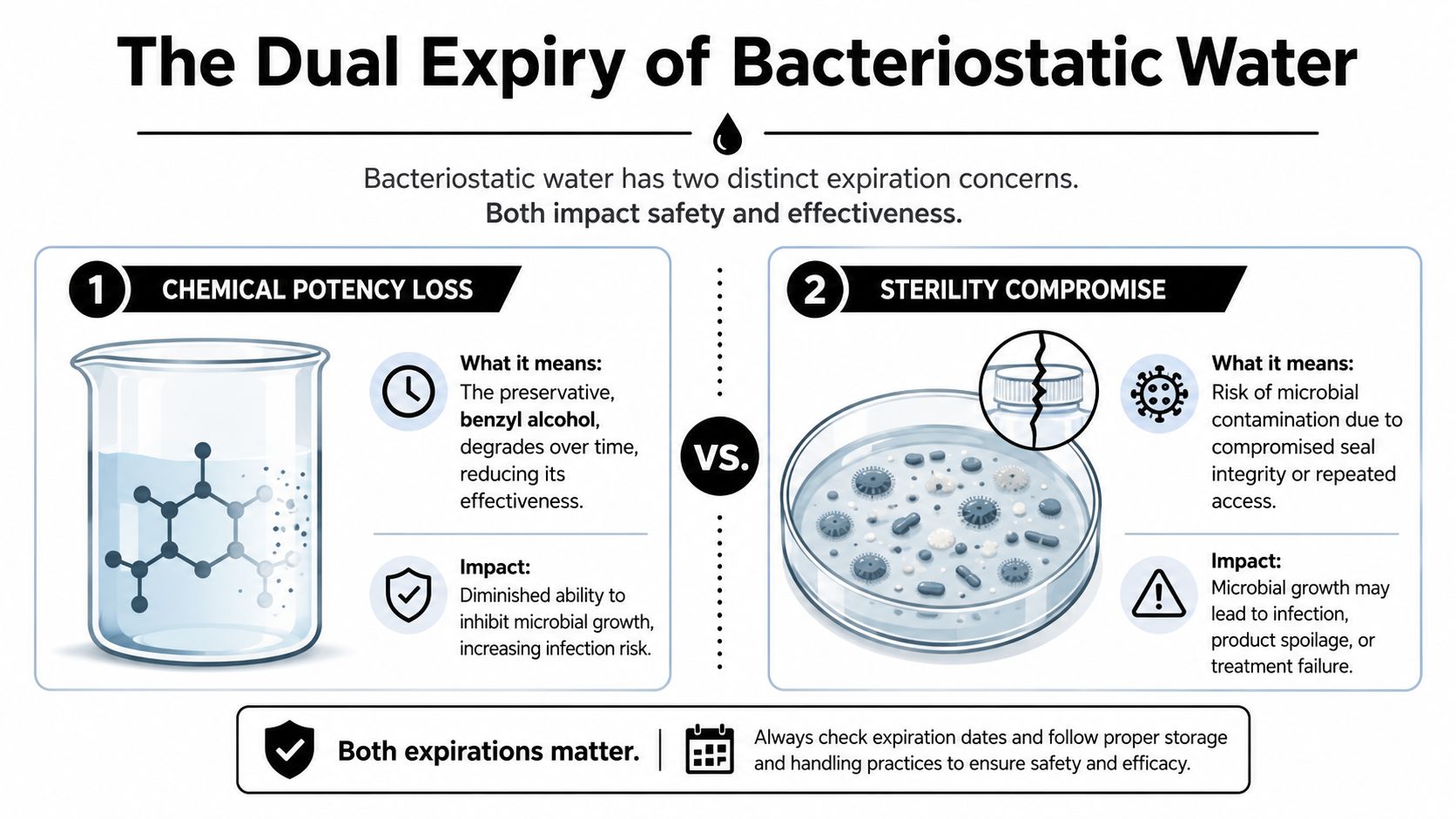
For BAC water, "expiration" has two separate meanings. The first is the labeled shelf life of the unopened vial. The second is the controlled use window after the stopper has been punctured. Good quality control keeps those two clocks separate because they answer different questions.
The unopened vial date is about the container system maintaining sterility and the product remaining within specification while sealed. If storage stayed within labeled conditions, the stopper and crimp remain intact, and there is no sign of leakage or damage, the manufacturer expiration date is the primary limit for release and use.
This distinction matters when teams compare BAC water with Water for Injection products used for single-use sterile preparation workflows. Clear liquid in a vial is not a sufficient basis for treating two products the same. Packaging design, preservative content, and intended use determine how the item should be handled once it leaves controlled storage.
Why expiration changes after first puncture
Once the stopper is entered, the question changes. The issue is no longer only whether the original sterile barrier remained intact. The issue is also whether the preservative system can still do its job within a documented handling window.
That is why the common 28-day rule exists. It is a risk-control limit for an opened multidose container, not a claim that the liquid is unchanged forever as long as it looks clear. Benzyl alcohol helps suppress microbial growth after incidental contamination. It does not restore the original sealed state, and it does not offset poor technique, repeated entries, or uncontrolled storage after opening.
In practical terms, sterility and preservative efficacy are related but different. A sealed vial can fail early if the closure system is compromised in shipping or storage. An opened vial can remain visually normal while carrying more contamination risk because it has been accessed, handled, and exposed over time.
This is the part simple shelf-life guides often miss. For end-user researchers, the control point is the first puncture date and the handling record after that point. For wholesalers and resellers, the control point starts earlier. A vial can still be within printed date and still require quarantine if there is evidence of heat exposure, broken tray packaging, stopper damage, or incomplete storage records.
Key Factors That Influence Shelf Life
Dates matter, but handling decides whether the date still means anything. Bacteriostatic water can become unsuitable before the printed expiration if the vial has been stored badly, exposed to damaging conditions, or contaminated during use.

Storage conditions can shorten usable life early
The simplest rule is still the right one. Keep the vial at controlled room temperature and away from light. Practical guidance also makes clear that cloudiness, particles, or discoloration are immediate discard criteria because they indicate loss of sterility or possible chemical instability, regardless of the date, as noted in this handling guidance for bacteriostatic water condition and storage.
That sounds basic, but it solves a large share of preventable failures. Real-world problems usually come from avoidable conditions:
- Heat exposure: Vials left near radiators, in hot vehicles, or in uncontrolled receiving areas can no longer be treated as normal inventory.
- Direct light: Light exposure adds uncertainty, especially when a vial is already being handled repeatedly.
- Seal or stopper damage: A tiny compromise in the closure system changes the sterility picture immediately.
Anyone managing stock at scale should also have written storage instructions. A concise example is this guide to essential storage practices for bacteriostatic water, which reflects the kind of operational controls distributors should expect.
Handling technique decides what the preservative must fight
Preservatives are not cleanup crews. Every time a user punctures the stopper, the user sets the level of challenge the preservative has to handle. Good aseptic practice keeps that challenge low. Poor technique raises it.
Common failure points include:
- Using non-sterile equipment: The vial becomes vulnerable before the fluid is ever withdrawn.
- Touching the stopper after cleaning: That reintroduces contamination to the access point.
- Repeated casual handling: Every unnecessary touch, move, and puncture increases exposure.
If a vial has an acceptable date but an unacceptable handling history, the handling history wins.
This is why date-based control and condition-based control have to work together. A vial can be within date and still be wrong for use. In quality control, that's not a contradiction. It's normal.
How to Read Labels and Certificates of Analysis
A receiving tech opens a new case of bacteriostatic water. The outer packaging looks clean, the vials are clear, and the printed expiration date is still acceptable. That is only the first screen. A usable shelf-life decision depends on two things the eye cannot confirm on its own: whether the container remained controlled and whether the documented lot release matches the product in hand.
What to verify on the vial label
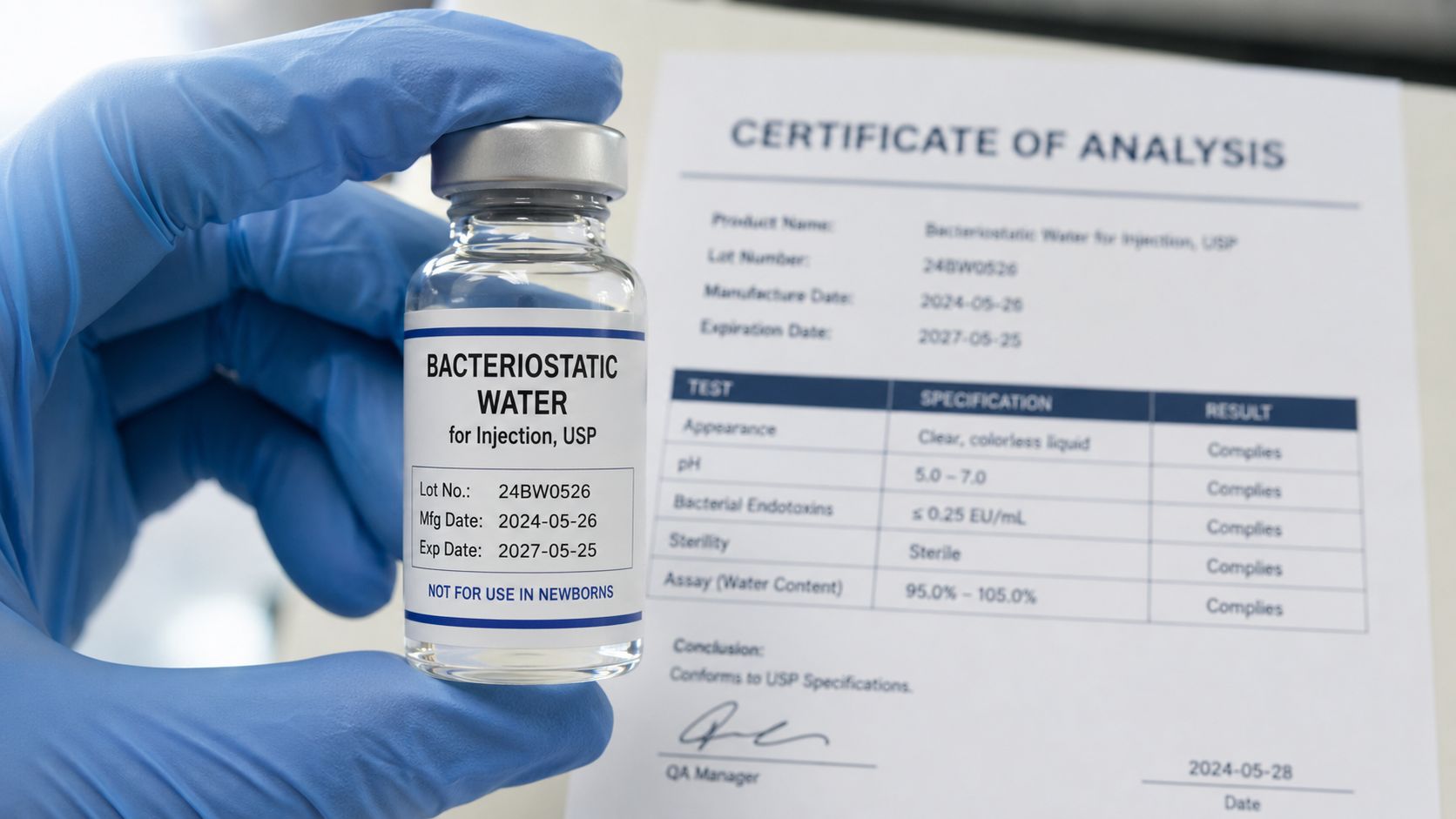
Start with the label because it establishes identity and traceability at the unit level. If the label is incomplete, damaged, or inconsistent with the purchase record, the vial should be held for review before it enters active stock.
A practical receipt check includes:
- Product identity: Confirm the vial is bacteriostatic water, not sterile water for injection or another diluent with a different use profile.
- Lot number: Make sure the lot is legible and matches the packing record, invoice, and any accompanying release documents.
- Manufacturer expiration date: Check that the date supports the planned use window, not just immediate receipt.
- Container and closure condition: Reject vials with cracks, leakage, stopper distortion, broken seals, or labels that cannot be read with confidence.
- First puncture date for opened stock: In lab use, the access date should be written directly on the vial or applied under controlled labeling practice.
Many preventable errors often begin because teams read the printed expiration date and stop there. For bacteriostatic water, this overlooks the practical distinction between unopened shelf life and in-use control after the vial enters the lab.
What a COA helps confirm
A Certificate of Analysis gives the batch-level release record that the vial label cannot hold. The label identifies the item. The COA supports the claim that the specific lot was reviewed and released against defined specifications.
For quality review, these are the fields that matter:
| Document element | Why it matters |
|---|---|
| Lot identification | Confirms the certificate matches the exact vial or batch in hand |
| Product description | Verifies that the released material is the intended diluent |
| Preservative listing | Helps confirm the stated formulation aligns with product labeling |
| Release testing summary | Shows the lot was evaluated before distribution |
| Issue date and issuer details | Supports document control and audit readiness |
Read the COA and label together, not separately. If the label says bacteriostatic water but the COA describes a different presentation, preservative system, or lot, stop the release decision until the discrepancy is resolved.
For end-user researchers, that check reduces avoidable uncertainty at the bench. For wholesalers and resellers, it does more. It protects complaint handling, supports lot-specific customer responses, and makes returns or quarantine decisions defensible.
A COA does not prove perfect handling after release. It proves what was released, under which lot, and under which documented review.
Supplier documentation quality matters too. Herbilabs, for example, provides batch documentation for sterile diluents and related lab-use products. That matters most when a customer asks for lot support after a shipping delay, a warehouse excursion, or a suspected handling issue.
Teams managing opened multidose vials should pair document review with written handling controls, including procedures to prevent cross-contamination during repeated vial access. Documentation confirms what the lot was at release. Handling controls protect what the vial remains during use.
A vial label states what the product is. A COA confirms how that lot was documented and released.
That difference matters in practice. Label review protects receiving accuracy. COA review protects traceability, investigation quality, and customer confidence when something goes wrong.
The Risks of Using Expired Bacteriostatic Water
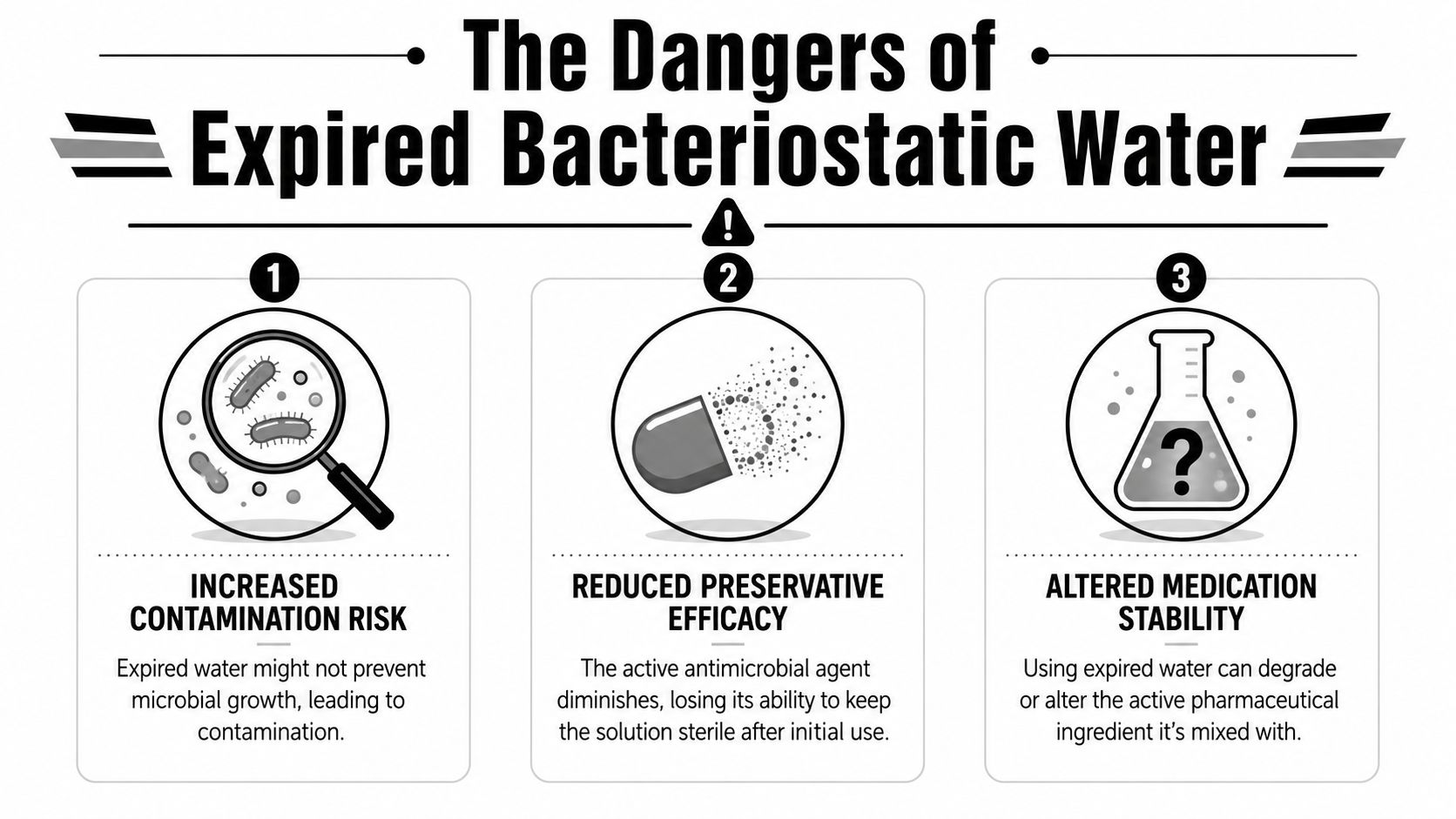
The immediate problem with expired bacteriostatic water isn't always obvious at the bench. The vial may still appear normal. The damage often shows up later in the form of inconsistent work, questionable results, or contamination events that are hard to isolate.
What goes wrong in research workflows
In research settings, an expired or mishandled vial can compromise far more than the water itself. The diluent becomes part of the whole preparation process. If it's unreliable, every downstream step becomes harder to trust.
Typical consequences include:
- Failed reconstitution: The researcher can't confidently rule out the diluent as a variable.
- Questionable repeatability: Results drift, and teams waste time chasing the wrong cause.
- Loss of expensive materials: A single compromised vial can ruin compounds that were otherwise handled correctly.
- Cross-contamination risk: Shared benches and repeated access multiply the chance that one handling error affects more than one item.
That last point deserves attention. Teams that routinely handle multidose vials should maintain clear anti-contamination routines such as those outlined in this guide on preventing cross-contamination in lab handling.
Why condition matters as much as the printed date
One of the most overlooked issues is that an unopened vial can still become unsafe before its printed expiration if storage conditions fail. Practical guidance highlights heat exposure and seal compromise as real-world failure modes that the simple 28-day rule does not address, as described in this discussion of unopened bacteriostatic water shelf-life limits and storage failures.
That distinction matters for distributors as much as end users. A product may be technically in date on paper and still be unsuitable because of transport abuse, warehouse errors, or packaging damage. Quality failures often happen in that gap between paperwork and physical reality.
Expiration control without condition control is incomplete quality control.
Outside research workflows, the stakes are even higher. Bacteriostatic water is commonly sold and discussed in contexts that blur intended use, but the product discussed here belongs in a controlled Research Use Only framework. Once users step outside validated handling and intended use boundaries, risk assessment changes immediately.
Best Practices for Labs Wholesalers and Resellers
A common failure starts with a vial that looks fine. It arrives on time, the label is in date, and no one questions it. Later, a temperature excursion shows up in a freight log, or a carton corner is crushed, or the vial enters use with no puncture date. At that point, the printed expiration date is no longer the only quality question.
For labs, wholesalers, and resellers, good practice means controlling two separate risks. One is loss of sterility from handling or container damage. The other is loss of preservative reliability after opening or after poor storage. If a team treats those as the same problem, bad product stays in circulation longer than it should.
A workable routine for research labs
In a lab setting, the highest-value habit is simple. Mark the first puncture date on the vial and enforce the 28-day post-opening limit. That rule only works if the vial was stored correctly and the stopper, seal, and solution remain acceptable on inspection.
A practical routine looks like this:
- At receipt: Inspect the carton and vial for cracks, leakage, seal disturbance, label damage, and lot mismatches. Log the lot number and printed expiration into inventory.
- At storage: Hold stock under labeled room-temperature conditions in a clean area, protected from direct light and avoidable heat exposure.
- At first use: Write the puncture date on the vial itself, not only in a notebook or electronic record.
- During use: Access the vial with sterile equipment, disinfect the stopper per site procedure, and keep repeat entries to what the protocol requires.
- At review: Remove the vial from use at once if the liquid shows cloudiness, particles, discoloration, or if handling history cannot be verified.
That last point matters in real operations. In quality review, uncertain history is a failure condition on its own. A clear liquid in an in-date vial is not acceptable if no one can confirm how it was stored, whether it was previously opened, or whether the stopper was repeatedly accessed outside controlled practice.
Operational controls for wholesalers and resellers
B2B handling failures usually happen before the end user opens the vial. They happen in receiving, warehousing, picking, packing, and customer support. The control system needs to preserve traceability and physical condition at each step.
A practical distributor standard includes the following:
- Lot-based receiving checks. Match product, lot, expiration, and package count against purchase records. Quarantine any shipment with damaged seals, wet cartons, broken trays, or unexplained relabeling.
- FIFO with age awareness. First-in, first-out helps, but it is not enough by itself. Teams should also watch remaining shelf life at the lot level so older in-date stock does not sit until it becomes hard for customers to use within their own timelines.
- Temperature-aware storage and transit review. Room-temperature products still need environmental control. Repeated heat exposure during summer freight, loading dock delays, or storage near HVAC discharge points can create condition concerns even when no visual defect appears.
- Document alignment. COAs, receiving logs, inventory records, and outbound shipment records should point to the same lot without manual guesswork.
- Clear customer instructions. Resellers should state storage conditions, inspection criteria, and post-opening handling rules in plain language. That reduces avoidable complaints and protects downstream research use.
Use one checklist across teams. Receiving, warehouse, and customer service should not be working from different assumptions.
| Stage | Action Item | Rationale |
|---|---|---|
| Receiving | Inspect seal, label, lot, and packaging condition | Confirms the shipment matches records and shows no obvious container integrity issue |
| Inventory | Rotate by FIFO and track lot-specific age | Reduces aging exposure and supports faster complaint investigation |
| Storage | Keep under labeled room-temperature conditions away from direct light and avoidable heat | Helps preserve container condition and solution stability assumptions |
| Picking and packing | Recheck vial and carton condition before release | Catches transit and handling damage introduced after receipt |
| First puncture | Require end-user date marking on opened multidose vials | Supports the post-opening use limit |
| Release decision | Quarantine or discard product with visual changes, seal concerns, or uncertain storage history | Calendar dating does not override condition failures |
The release decision is where weak systems fail. Teams often ask whether a questionable vial is probably still usable. Quality control asks a different question. Can the seller or lab still support the sterility and handling assumptions behind that vial with records and physical inspection? If the answer is no, it should not be shipped or used.
Researchers, resellers, and distribution partners who need documented sterile diluents, transparent batch information, and practical handling guidance can review current options through Herbilabs.