Private Label, White Label, Wholesale partnerships available - EU, USA and UK - Free shipping from €75

Bacteriostatic Water Guide: Uses, Storage & Differences
A vial is on the bench. Next to it sits a costly lyophilized peptide, a sterile syringe, and a protocol that only works if the reconstitution step is done correctly. At that moment, the diluent isn't a background detail. It's a control point.
That's where Bacteriostatic Water often enters the workflow. In peptide research and other lab settings, the choice of water affects how long a vial can stay usable after opening, how confidently repeated withdrawals can be made, and whether the team can trust the consistency of the preparation from day one to the last measured dose. A poor-quality vial can compromise the entire chain of handling.
Many readers arrive at this topic while trying to answer a simple question: “Is this just sterile water with a different label?” It isn't. Genuine, research-grade bacteriostatic water sits at the intersection of formulation, quality control, and regulatory labeling. That's why reliable sourcing matters as much as proper technique.
Table of Contents
- The Critical First Step in Your Experiment
- Understanding Bacteriostatic Water Composition
- Bacteriostatic Water vs Other Sterile Waters
- Key Applications in Peptide and Lab Research
- Ensuring Quality Safety and RUO Compliance
- Best Practices for Storage Handling and Ordering
- Bacteriostatic Water FAQs and Common Myths
The Critical First Step in Your Experiment
A failed experiment often gets blamed on the peptide, the assay, or the instrument. Sometimes the problem started earlier, at reconstitution.
In many labs, a new team member receives a vial of lyophilized material and reaches for whatever sterile liquid is closest. That shortcut feels harmless. The vial is sealed. The liquid is clear. The label says sterile. But sterile doesn't automatically mean suitable for repeated withdrawals, and it doesn't guarantee the same handling window once the stopper has been pierced.
That distinction matters most when the same reconstituted stock will be used across multiple pulls. If a researcher plans one withdrawal and immediate use, one type of water may fit. If the protocol requires repeated access over time, the wrong choice increases contamination risk and introduces avoidable variability into dosing or dilution steps.
Bench rule: The diluent should match the workflow, not just the ingredient list.
For peptide users, resellers, and lab managers, bacteriostatic water is often the practical standard when a multi-use vial is needed. The preservative system is the key reason. It supports repeated withdrawals from the same vial when the product is handled correctly, which is very different from treating every puncture as if nothing changed.
That's also why quality can't be reduced to “clear liquid in a vial.” A legitimate product has a defined composition, defined storage conditions, and a defined use case. Gray-market substitutes can look identical on the outside while behaving very differently where it counts: preservative level, pH control, and sterility-related quality markers.
A careful lab treats bacteriostatic water the same way it treats reference standards and critical reagents. The label, the batch record, and the intended use all matter. If the water is wrong, every careful step that follows sits on a weak foundation.
Understanding Bacteriostatic Water Composition
A new vial on the bench can look identical to a low-grade substitute. Clear liquid. Rubber stopper. Similar label language. In practice, the difference shows up later, when a stock solution drifts, a repeat run fails to match the first one, or purchasing records cannot support what was used. With bacteriostatic water, composition is not a minor detail. It is part of method control.
What it contains
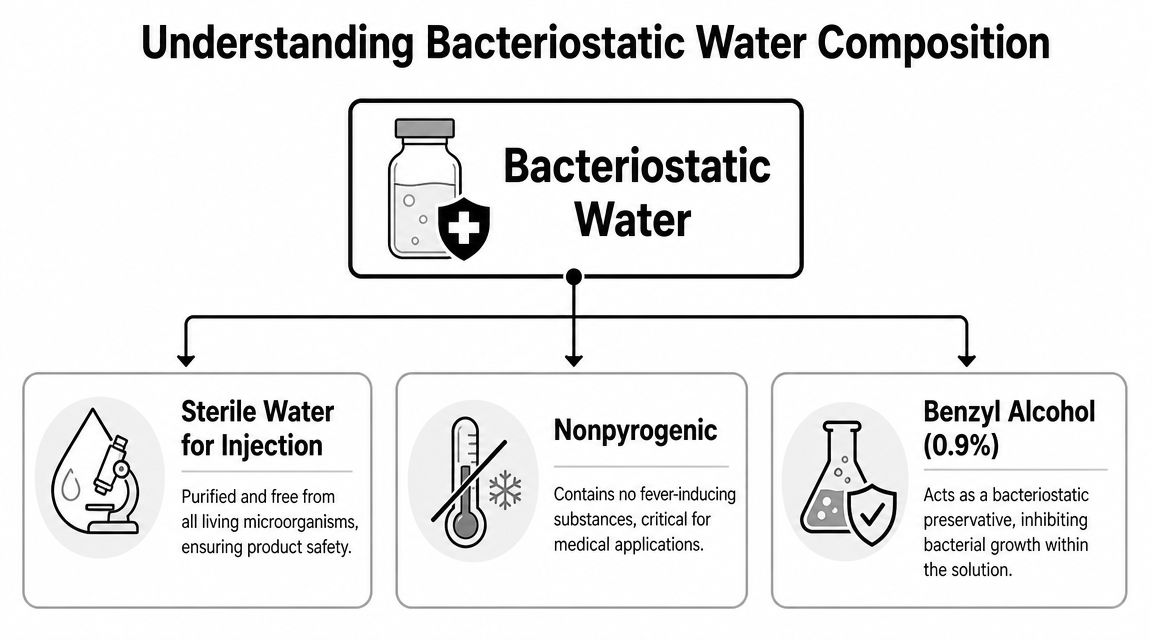
Bacteriostatic Water is defined in FDA label and USP-style product language as sterile, nonpyrogenic water for injection containing 0.9% (9 mg/mL) benzyl alcohol, with storage at 20 to 25°C (68 to 77°F) under controlled room temperature conditions, as described in DailyMed product labeling for bacteriostatic water.
Each part of that definition matters.
- Sterile means the product is prepared to be free of viable microorganisms.
- Nonpyrogenic means it is intended to be free of fever-causing contaminants such as pyrogens.
- 0.9% benzyl alcohol is the preservative system that helps inhibit bacterial growth after the vial enters use.
- Controlled storage conditions help keep the formulation within its intended performance range.
A useful comparison is a clean workspace versus a clean workspace with ongoing contamination control. Sterile water begins clean. Bacteriostatic water begins clean and includes a preservative intended to slow bacterial growth during repeated use.
That distinction is why composition needs to be verified, not assumed from appearance.
What bacteriostatic means in practice
New lab staff often read "bacteriostatic" as "safe from contamination." That reading causes mistakes. The term means the preservative helps inhibit bacterial growth. It does not mean the vial can be punctured carelessly, stored loosely, or used without aseptic technique.
A pause button is a better comparison than an erase function. Benzyl alcohol can help hold the line against microbial growth under proper handling, but it does not reverse poor bench practice.
The preservative supports multi-use handling. It does not replace disciplined technique.
This is also where quality screening matters. A genuine research-grade vial should have a defined composition, a traceable lot, clear labeling, and documentation that matches its intended Research Use Only context where applicable. Gray-market products often fail on the details that decide whether your diluent behaves predictably: preservative concentration, container integrity, storage control, and basic traceability.
For teams comparing formats, Water for Injection formats and sterile diluent differences can help clarify what changes when the preservative is absent.
A practical way to read the vial is to separate its three jobs:
- Solvent: It provides water suitable for reconstitution or dilution.
- Quality-controlled reagent: It is prepared to sterility and nonpyrogenic expectations, which protects downstream consistency.
- Preserved multi-use format: It is formulated for repeated withdrawals within the product's stated handling limits, including the commonly referenced in-use discard window noted earlier.
If any one of those pieces is missing, the workflow changes. If the preservative is wrong, repeated withdrawals become a weaker choice. If labeling is vague, RUO status is unclear, or batch records are absent, you lose confidence in the reagent before the experiment even starts.
Bacteriostatic Water vs Other Sterile Waters
Where confusion usually starts
Most purchasing mistakes happen because several products sound interchangeable. They aren't. A vial may be sterile and still be the wrong choice for a multi-use workflow.
The safest way to compare them is by function. The lab doesn't just need “water.” It needs the right diluent behavior after first puncture. That means looking at preservative content, intended use, and what the workflow expects from the vial over time.
Some buyers also confuse bacteriostatic water with saline. That substitution can create its own compatibility issues because saline is a different formulation, not a renamed version of sterile water.
For teams reviewing options, Water for Injection formats and related sterile diluent considerations can help frame the product category before ordering.
Diluent comparison for research use
| Diluent Type | Composition | Preservative | Primary Use | Discard After First Puncture |
|---|---|---|---|---|
| Bacteriostatic Water | Sterile, nonpyrogenic water with benzyl alcohol | Yes | Reconstitution or dilution where repeated withdrawals are needed | Commonly handled as a multi-use vial under the product's intended use |
| Sterile Water for Injection | Sterile water without preservative | No | Single-use preparation where no preservative is desired | Typically treated as single-use after puncture |
| Sterile Saline | Sterile sodium chloride solution | Depends on product format | Dilution or preparation where saline is specifically required | Follow product-specific labeling and intended use |
A few practical distinctions matter more than brand language.
- Bacteriostatic water fits multi-use handling. That's the main reason it's chosen in many peptide workflows.
- Sterile Water for Injection fits preservative-free situations. Once opened, it doesn't offer the same protection profile for repeated access.
- Sterile saline is compositionally different. It isn't a substitute unless the protocol specifically calls for it.
Decision logic at the bench
A senior technician usually asks two questions before picking a diluent.
First, will the vial be accessed once or multiple times?
Second, does the target material or protocol allow a preserved diluent?
Those questions prevent the most common error, which is treating all clear sterile liquids as interchangeable. In reproducible lab work, they aren't.
Key Applications in Peptide and Lab Research
Peptide reconstitution in a real workflow
A common use case starts with a freeze-dried peptide scheduled for repeated dosing or staged experimental use. The researcher needs a clean reconstitution, but also needs the resulting stock to remain workable across multiple withdrawals under controlled handling.
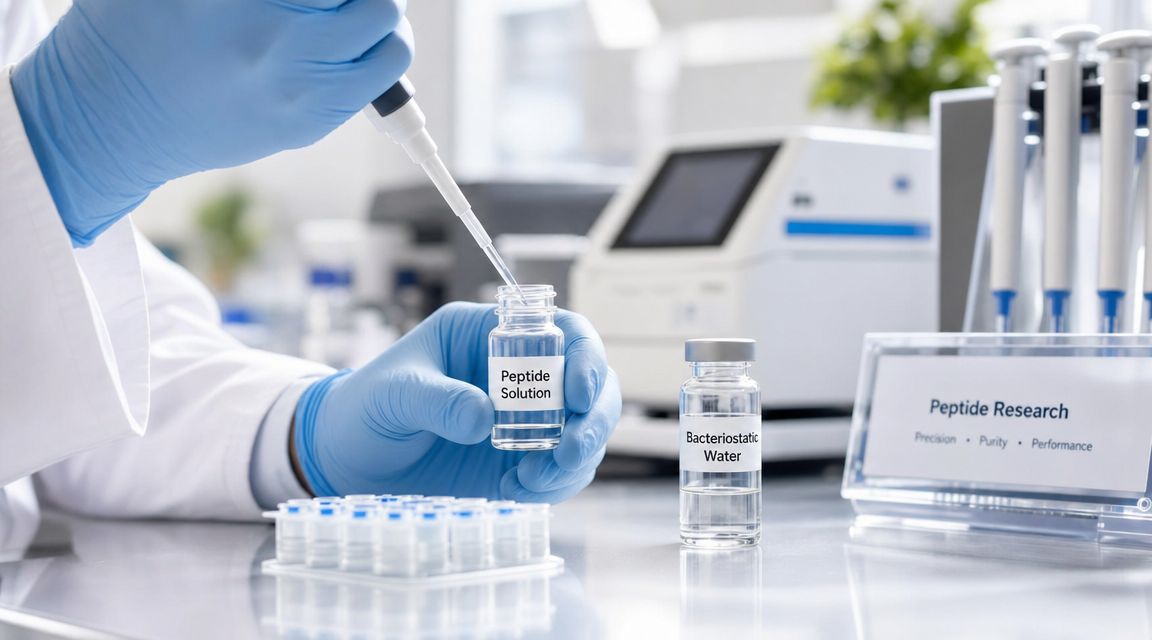
In that setting, bacteriostatic water is valued because the vial is intended for repeated access. That helps when a lab is dividing one reconstituted stock across separate time points, aliquot checks, or small-volume preparation steps. The preservative doesn't replace clean technique, but it supports the workflow in a way plain sterile water doesn't.
A careful peptide user also thinks ahead about concentration. Reconstituting with too much or too little diluent can make later handling awkward, especially when very small withdrawals are needed. Clear calculations, a steady hand, and an appropriate diluent all work together.
For teams that want a procedural reference, guidance on how to mix peptides with bacteriostatic water can serve as a workflow aid.
Other routine lab uses
Bacteriostatic water also appears in broader research settings as a sterile diluent or solvent when the lab needs a multi-use vial rather than a one-and-done container. That can include preparation of certain research compounds, intermediate dilution steps, or handling routines where repeated withdrawals from the same vial are part of the plan.
The common thread isn't the specific molecule. It's the handling pattern.
- Repeated access: The stopper will be punctured more than once.
- Small-volume withdrawals: The team needs measured pulls across several uses.
- Sterile workflow: The preparation must remain controlled throughout the use period.
A short demonstration is often easier to follow than a dense protocol sheet:
A good diluent should support the experiment, not become another uncontrolled variable.
That's why experienced labs don't treat bacteriostatic water as a commodity purchase. They treat it as part of the experimental system.
Ensuring Quality Safety and RUO Compliance
What a serious buyer checks first
The fastest way to spot a risky supplier is to ask for batch-level quality information and watch what happens next. Reliable suppliers can usually provide a Certificate of Analysis, batch identification, and documentation that shows the product is made and sold for its stated purpose.
For a research buyer, the checklist is practical rather than decorative:
- COA availability: The buyer should be able to review batch-specific documentation rather than broad marketing language.
- Formulation match: The paperwork should align with the product label and intended use.
- Quality controls: pH, preservative content, and contamination-related testing are central questions.
- RUO labeling: “Research Use Only” should be clear and unambiguous when that is the product category.
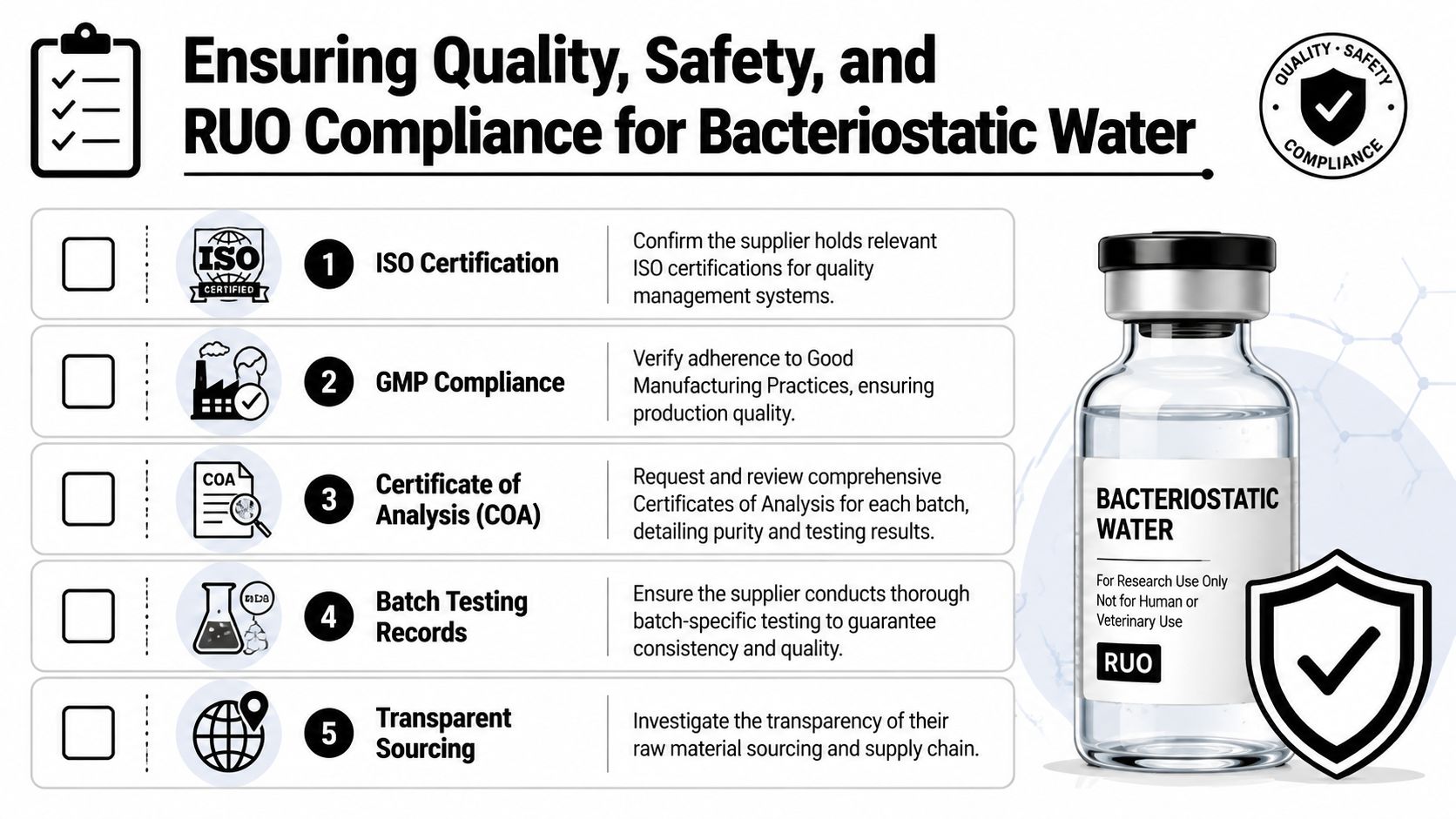
A buyer evaluating RUO products should also understand what the designation means. It marks the item as intended for controlled research settings rather than human or therapeutic use. This explanation of the Research Use Only definition is useful for distributors and resellers who need to align product handling with regulatory language.
One market example is Herbilabs, which offers RUO bacteriostatic water and reconstitution solutions in sterile vial formats for laboratory supply workflows. That matters less as a branding point than as a category example of how suppliers position these products within research-only channels.
Why gray market vials are a real problem
Quality failures in this category aren't theoretical. An independent review discussed in a 2024 explainer reported gray-market samples with zero benzyl alcohol, others with benzyl alcohol concentrations above 1.5% instead of the standard 0.9%, plus pH values outside the USP-controlled 4.5 to 7 range and endotoxins in some products, as summarized in this 2024 discussion of gray-market bacteriostatic water quality failures.
That single finding explains why serious labs scrutinize formulation and documentation. If a vial contains no benzyl alcohol, it's effectively just sterile water wearing the wrong label. If the preservative level is too high, the product no longer matches the expected formulation. If the pH is out of range or endotoxins are present, the experiment inherits a hidden variable before reconstitution even starts.
Quality warning: A clear vial can still be the wrong reagent.
For wholesalers and distribution partners, this is also a reputation issue. Every mislabeled or poorly controlled batch moves the problem downstream to resellers, labs, and end users who assume the vial matches the specification printed on the carton.
Best Practices for Storage Handling and Ordering
Handling that protects the vial
Once a vial enters the lab, routine discipline matters more than speed. Controlled room temperature handling is part of the label expectation for this product category, and the vial should be kept according to the product guidance rather than left near windows, hot equipment, or transport packaging longer than necessary.
The bigger risk usually appears during use. Every puncture is an opportunity to introduce contamination, so aseptic technique has to stay consistent from the first withdrawal to the last.
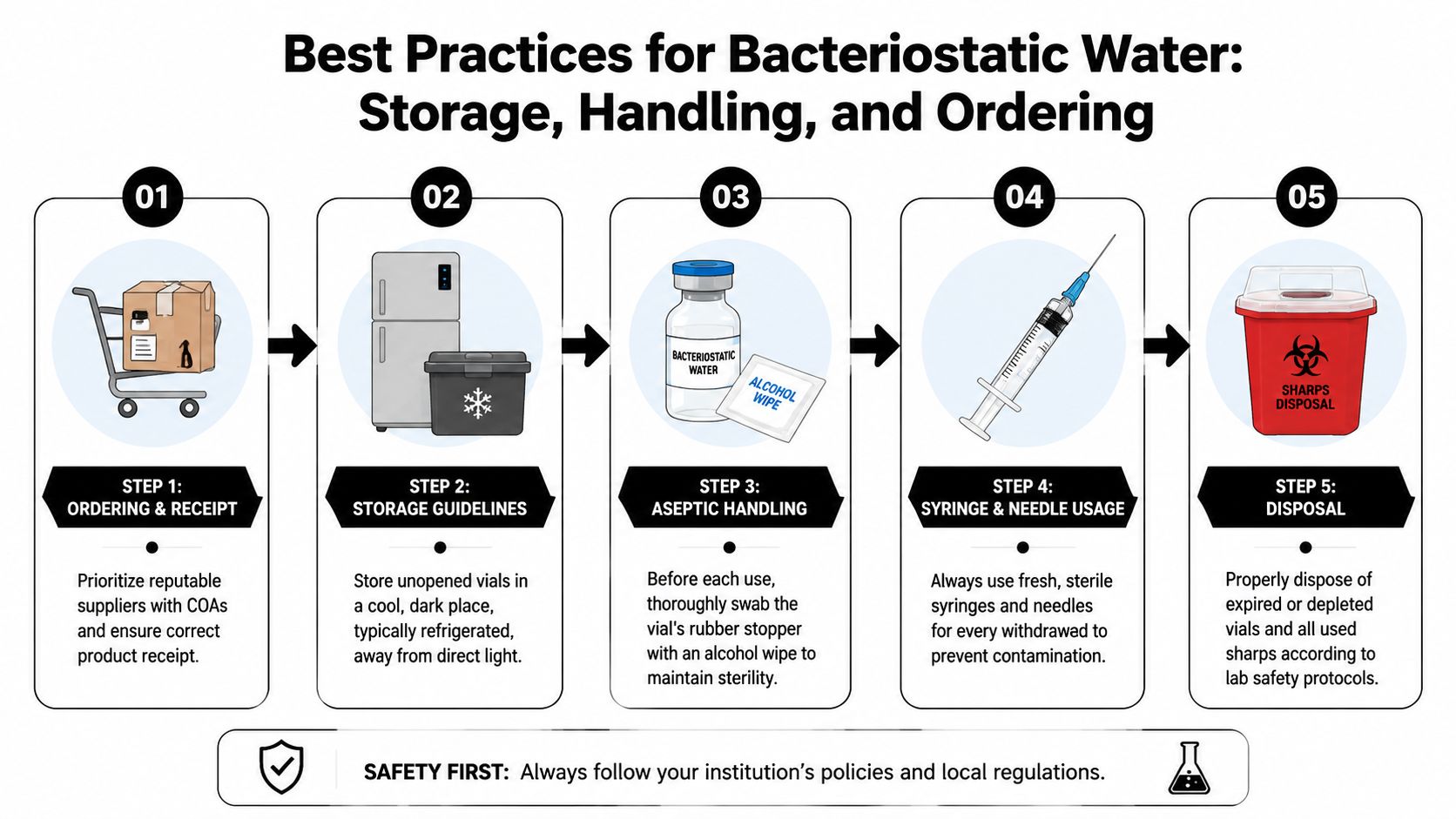
A solid handling routine usually includes:
- Inspect the vial on receipt. Check label clarity, closure integrity, and batch details before it enters active stock.
- Disinfect the stopper before each puncture. Alcohol swabbing reduces the chance of carrying surface contamination into the vial.
- Use a fresh sterile syringe and needle every time. Reuse is a contamination shortcut.
- Label the first-use date clearly. A team can't manage in-use life if no one knows when the vial was opened.
- Discard questionable vials early. If appearance, handling history, or storage conditions are uncertain, replacement is cheaper than compromised work.
Ordering decisions that reduce waste
Ordering should match the lab's actual consumption pattern. A small team doing occasional peptide work may prefer smaller vial counts to avoid opening stock that won't be used efficiently. A distributor or reseller needs the opposite focus: batch consistency, fulfillment reliability, and documentation that can travel with the product.
A practical buyer asks questions in this order:
| Ordering question | Why it matters |
|---|---|
| Does the supplier provide batch documentation? | It supports traceability and incoming quality review. |
| Is the product clearly labeled for RUO if sold that way? | It prevents misuse and labeling confusion. |
| Do vial formats match demand? | It reduces partial-use waste and awkward inventory decisions. |
| Is fulfillment consistent? | It helps labs avoid substituting products under time pressure. |
One more habit saves trouble. Teams should separate unopened stock, active in-use stock, and expired or quarantined stock physically, not just mentally. When all three sit together in the same tray, handling mistakes become much more likely.
Bacteriostatic Water FAQs and Common Myths
A common failure point looks small at first. A vial is open, still clear, and sitting on the bench with no obvious problem. Then someone asks whether it is still fine to use. That question is not just about shelf life. It is about whether the reagent still deserves a place in a controlled experiment.
Short answers to recurring questions
Can an open vial be used after more than 28 days?
Replacement is the safer call. The usual in-use window for bacteriostatic water depends on preserved multi-dose use under controlled handling. After that point, confidence drops, and confidence is what protects reproducibility.
Can bacteriostatic water be made at home?
No. Research-grade material depends on sterile manufacturing, measured preservative content, suitable container closure systems, and documented quality checks. Mixing water with a preservative in an uncontrolled setting gives you a liquid, not a validated reagent.
What suggests contamination, poor handling, or questionable product quality?
Visible particles, haze, a damaged stopper, leakage, unclear labeling, missing lot information, or an unknown first-puncture date all justify rejection. For RUO purchasing, lack of documentation is also a warning sign. A vial can look clean and still fail the standards a lab needs for traceability and consistent results.
If the team cannot verify the vial's identity, handling history, and labeling, the team should not trust it in an experiment.
Is it the same as saline?
No. Saline contains sodium chloride. Bacteriostatic water has a different composition and is chosen for different reconstitution needs.
Can it be used for contact lenses, wound cleaning, or general home use?
No. The focus here is laboratory and research handling, especially products labeled for RUO. Using a research reagent outside that context creates avoidable safety and compliance problems.
Does the preservative make sterile technique less important?
No. The preservative helps limit microbial growth after puncture. It does not correct poor aseptic practice. A seat belt reduces risk in a crash. It does not make careless driving acceptable.
Three myths drive many preventable mistakes:
- “Sterile means all sterile waters are interchangeable.” Composition, preservative system, packaging, and intended use still matter.
- “If it looks clear, it is fine.” Clarity does not confirm preservative identity, purity, lot traceability, or whether the product came through a controlled RUO supply chain.
- “A cheap vial is a smart buy.” Gray-market stock often lacks the paperwork that lets a lab verify what it received. If a reconstitution variable is uncertain, the experiment inherits that uncertainty.
The practical rule is simple. Use documented product, verify RUO labeling and batch information, treat the vial like a controlled reagent, and retire it on schedule.
For labs, resellers, and distribution partners that need documented RUO sterile diluents, Herbilabs offers bacteriostatic water and related reconstitution solutions in laboratory supply formats with batch documentation and wholesale options.