Private Label, White Label, Wholesale partnerships available - EU, USA and UK - Free shipping from €75

Bacteriostatic Water vs Reconstitution Solution: 2026 Guide
A researcher opens a cold box, places a lyophilized peptide on the bench, and reaches for a clear vial to reconstitute it. The label says sterile. Another vial also looks sterile. One may support repeated withdrawals under proper handling. The other may be suitable only for immediate use. That choice affects contamination risk, peptide handling, recordkeeping, and, for distributors, product liability.
Many workflows fail due to subtle issues. The mistake usually isn't dramatic. It's quiet. A preservative is introduced where a sensitive compound may not tolerate it, or a preservative-free diluent is reused because the vial still looks clear. The result can be compromised reproducibility, wasted material, and documentation gaps that become serious when stock moves across labs, clinics, or borders.
The practical question in Bacteriostatic Water vs Reconstitution Solution isn't just which one lasts longer. The key question is which option fits the experiment, the handling pattern, and the compliance burden attached to that product category. Labs need that answer to protect data integrity. Distributors need it to avoid oversimplified recommendations that create downstream risk.
Table of Contents
- Introduction Choosing the Right Diluent Matters
- Fundamental Differences in Composition and Sterility
- Matching the Diluent to Your Use Case and Peptide
- Protocols for Safe Handling Storage and Contamination Prevention
- Regulatory Compliance for Research Labs and Distributors
- A Practical Checklist for Purchasing High-Purity Diluents
- Frequently Asked Questions
Introduction Choosing the Right Diluent Matters
A vial of peptide powder can represent weeks of planning, expensive synthesis, and a narrow testing window. The diluent often gets treated as a minor accessory. It isn't. The wrong fluid changes the handling profile of the entire material from the first puncture onward.
In routine lab work, the confusion usually starts because both products are clear, sterile liquids and both may be described loosely as reconstitution aids. That shorthand creates avoidable mistakes. Bacteriostatic water and reconstitution solution serve overlapping purposes, but they aren't interchangeable by default.
For research teams, the decision affects three things immediately:
- Experimental consistency: repeated withdrawals require a different sterility strategy than single-run preparation.
- Peptide compatibility: some compounds are handled more conservatively when preservatives are undesirable.
- Documentation and liability: distributors and lab managers need records that match how the product is marketed, stored, and used.
Practical rule: A diluent should be chosen based on withdrawal pattern, peptide sensitivity, and product classification, not on convenience alone.
A careful buyer or lab technician also has to think one step ahead. Will the vial be entered once or many times? Will the full contents be used immediately? Is the product being purchased for internal research only, or supplied onward to other organizations that need clear instructions and compliant labeling?
Those questions separate a controlled workflow from a casual one. In this topic, casual handling is where contamination risk, vague vendor claims, and preventable disposal losses tend to appear.
Fundamental Differences in Composition and Sterility
Early comparison table
| Feature | Bacteriostatic water | Reconstitution solution |
|---|---|---|
| Core composition | Sterile water containing 0.9% benzyl alcohol | Broad category of sterile liquids with no fixed composition |
| Preservative present | Yes | Often no |
| Typical use pattern | Multi-dose handling under aseptic technique | Single-use preparation |
| After opening | May support repeated withdrawals under proper sterile conditions | Generally treated as immediate-use once opened |
| Main operational benefit | Microbial growth inhibition | Simple preservative-free dilution where appropriate |
| Main operational risk | Preservative may not fit every compound or population | No antimicrobial barrier for repeated vial entry |
What separates the two chemically
The technical distinction is straightforward. Bacteriostatic water is a sterile solution containing exactly 0.9% benzyl alcohol, which acts as a bacteriostatic preservative. Under proper sterile conditions, that formulation allows the same vial to be safely used for up to 28 days after initial opening, and the preservative inhibits bacterial growth rather than killing bacteria outright, as described by Polaris Peptides on bacteriostatic water composition.
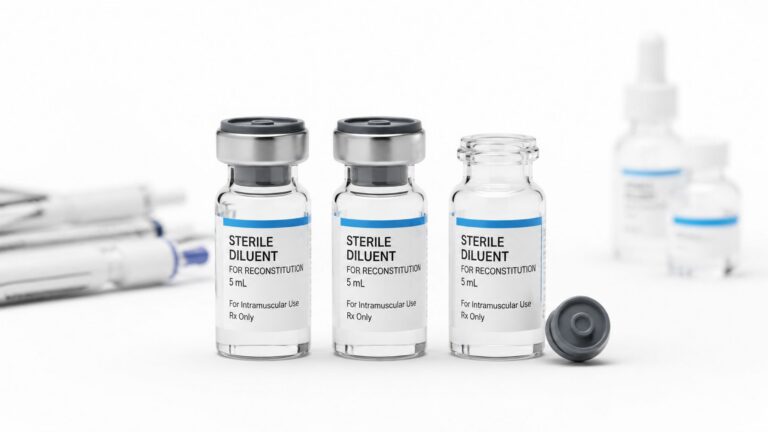
By contrast, reconstitution solution is a functional label, not a single chemical standard. It can refer to sterile water, saline, or another sterile liquid selected to dissolve a lyophilized material. In many cases it doesn't include a preservative, which changes how long the vial can remain in use after entry.

A related source of confusion comes from naming. Some suppliers use overlapping terms in product listings, and some researchers informally group all sterile diluents together. That's why buyers should read the actual formulation and intended handling notes, not just the product title. A product described as water for injection should never be assumed to behave like a preserved multi-use diluent unless the formulation explicitly says so.
Why sterility claims change after first puncture
Once a stopper is punctured, the vial moves from sealed product to managed risk. At that point, the presence or absence of a preservative matters more than the appearance of the liquid.
Bacteriostatic water has a built-in control mechanism for repeated aseptic withdrawals. Preservative-free reconstitution solutions do not. That difference affects bench practice, dating, and whether a lab can justify holding the vial for later use.
Clear liquid does not prove safe reuse. In multi-entry workflows, the formulation has to support that handling pattern.
In practical terms, Bacteriostatic Water vs Reconstitution Solution is really a question of whether the vial is expected to survive repeated access without crossing into unacceptable contamination risk. That's a chemical distinction first, and a workflow distinction second.
Matching the Diluent to Your Use Case and Peptide

A common failure point shows up after the peptide is already mixed. The lab used a sterile diluent, the vial looked clear, and the first run was acceptable. Two days later, the same vial is accessed again, the record does not explain whether reuse was appropriate, and now both the sample and the documentation are hard to defend.
That is why diluent selection should be tied to use pattern, peptide behavior, and post-opening control. The question is not which product sounds more versatile. The question is which option creates the lowest technical and compliance risk for the exact workflow being run.
When repeated access matters more than convenience
For multi-day work, bacteriostatic water is often the more defensible choice because the formulation is designed for repeated aseptic withdrawals. That matters in research settings where one reconstituted vial may support several measured pulls over time. Teams that follow a documented peptide mixing procedure with bacteriostatic water usually have an easier time aligning bench practice with labeling, dating, and inventory controls.
The trade-off is compatibility. A preserved diluent reduces one category of risk, microbial growth after opening, but it adds another variable to the formulation. For sensitive peptides, screening methods, or internal SOPs that avoid benzyl alcohol, that extra component may be unacceptable. In those cases, the cleaner choice on paper is the one that introduces fewer excipients, even if it shortens the usable handling window.
A distributor should evaluate this the same way a lab does. If the expected customer use case involves repeated withdrawals, the catalog listing needs to say that plainly. If the product is intended for single-use preparation, the listing should not imply multi-use flexibility.
When preservative-free handling is the better control
Some peptides are reconstituted for immediate use, aliquoted at once, or handled under protocols that avoid preservatives entirely. In those workflows, a sterile preservative-free solution can reduce uncertainty around peptide integrity because the diluent contributes less to the final matrix. That is often the cleaner option for method validation, one-time preparation, or customer groups with tight formulation restrictions.
The risk shifts to handling discipline and discard decisions. Once opened, a preservative-free vial gives the lab less margin for error and gives the distributor less room for ambiguous marketing language. If a seller describes that product loosely, or if a researcher treats it like a preserved multi-use vial, the liability problem starts before any contamination is visible.
A practical selection process usually comes down to three checks:
- Expected number of vial entries: repeated withdrawals favor a preserved multi-use diluent.
- Peptide and method sensitivity: preservative-free options may be preferable when added formulation components are a concern.
- Documentation burden: the more often a vial will be reused, the more important clear labeling, dating, and handling instructions become.
This short walkthrough gives a useful visual reference before SOPs are written:
A good peptide-diluent match lowers the chance of avoidable discard, stability questions, and recordkeeping gaps after reconstitution.
One supplier option in this category is Herbilabs, which offers sterile bacteriostatic diluents for research workflows. That type of product only fits when the formulation, use designation, and handling instructions match the buyer's actual bench practice.
Protocols for Safe Handling Storage and Contamination Prevention
Bench protocol that protects the vial
The safest vial is the one handled as if every entry could introduce error. That applies to bacteriostatic water and to any reconstitution solution, even though their post-opening risk profiles differ.
A practical bench protocol should include:
- Clean preparation first. Wash hands, prepare a clean surface, and organize syringes, swabs, and labels before the vial is opened.
- Disinfect the stopper every time. An alcohol wipe before each puncture reduces transfer from gloves, benches, and packaging.
- Use a sterile syringe for each withdrawal. Reusing a syringe or needle is one of the fastest ways to compromise a vial.
- Avoid contact with critical surfaces. Needle tips, stopper surfaces after disinfection, and vial openings should remain untouched.
- Label immediately after first use. Post-opening dating and product identification should happen at the bench, not later from memory.

The practical reason for strict technique isn't only user safety. Contamination changes assay behavior, creates unexplained instability, and makes troubleshooting harder because the root cause rarely stays visible in the final dataset.
Storage and discard decisions
After the first puncture, storage discipline matters as much as formulation. Teams should keep vials under the conditions specified by the supplier, separate opened from unopened stock, and make sure labels remain legible throughout the product's bench life.
A discard decision should be immediate if the solution shows visible particulate matter, cloudiness, compromised closure, or uncertain handling history. “It still looks usable” isn't a control standard. If documentation is incomplete, the vial should be treated as suspect.
Bench reminder: If staff can't confirm when a vial was opened, who accessed it, or how it was stored, the vial has already failed traceability.
Labs that write these handling points into SOPs usually reduce avoidable repeat work. Distributors also benefit when these rules appear in product inserts or order documentation, because customers are less likely to misuse a diluent because the liquid appeared interchangeable with another sterile product.
Regulatory Compliance for Research Labs and Distributors

Why labeling and contraindications matter
A preserved diluent solves one problem and introduces another. It supports multi-dose handling, but it also adds a preservative that has to be disclosed clearly and interpreted correctly by the buyer.
One of the most overlooked points in the Bacteriostatic Water vs Reconstitution Solution discussion is that sterile water for injection and preserved bacteriostatic formulations don't sit in the same regulatory and safety position. The preserved option contains 0.9% benzyl alcohol, and available reporting discussed by Arpovo Health on preservative-related adverse events and reseller disclosure states that 22% of peptide-related adverse events in LATAM and EU markets stem from preservative contamination in multi-dose vials, while 60% of resellers still recommend bacteriostatic water without stating the contraindication in certain populations such as neonates.
Those figures matter less as a market headline than as a warning for documentation practice. If a distributor markets convenience without naming preservative content, intended use, and contraindication boundaries, it creates a predictable compliance gap.
What distributors need to control
Resellers and wholesalers should treat diluent listings as controlled technical communication, not simple ecommerce copy. At minimum, product pages and shipment documents should align on formulation, intended use category, handling instructions, and storage language. Teams that sell into multiple regions should also check whether local partners are repeating the same language without removing caution statements.
A strong compliance workflow usually includes:
- Clear product identity: preserved bacteriostatic diluent versus preservative-free reconstitution fluid.
- Use classification: research-only products should be labeled accordingly and consistently across invoices, labels, and web listings.
- Contraindication visibility: preservative content must not be buried in fine print.
- Distributor training: customer service staff should know the difference between single-use and multi-use handling claims.
Companies that need a reference point for labeling boundaries often review guidance around the definition of Research Use Only products. That doesn't remove liability by itself, but it does help distributors communicate what the product is, what it is not, and how buyers should handle it.
Compliance in this category starts before the sale. It begins with how the product is described.
A Practical Checklist for Purchasing High-Purity Diluents
What to verify before purchase
A purchasing mistake with a diluent rarely shows up at receiving. It shows up later, when a peptide lot behaves inconsistently, a batch record cannot support an audit, or a distributor has to explain why the listing language did not match the vial in the box.
Start with identity and intended use. If a product is sold as bacteriostatic water, the preservative system should be stated clearly on the specification and label. If it is sold as a reconstitution solution, the documentation should state whether it is preservative-free or preserved, because that changes how the vial can be handled after first entry and how the lab should write its SOP.
The formulation is only one part of the purchasing decision. Buyers also need documentation that supports traceability, receiving control, and complaint handling if something goes wrong.
A practical purchasing checklist should include:
- Formula transparency. Confirm the exact composition, including whether a preservative is present and how the product is classified for use.
- Batch-linked documentation. Request a COA or equivalent lot record that matches the batch identifier on the shipped item.
- Packaging and closure inspection. Check vial integrity, stopper fit, seal condition, and any visible signs of compromised sterile packaging on receipt.
- Handling and storage instructions. The label and supporting documents should tell receiving staff how to store, open, and manage the product without guesswork.
- Traceable labeling. Product name, lot number, fill volume, caution statements, and use designation should all be legible and consistent across the vial, box, and invoice.
- Supplier complaint process. Confirm that the vendor can document deviations, replacements, or recalls by batch, not by general customer service note.
What a supplier should make easy to inspect
A reliable supplier makes verification easy before the order is placed. Technical documents should answer the questions QA, procurement, and lab staff will all ask separately. What is in the vial. What is the intended use category. What handling limits apply after opening. What records can be tied back to the batch.
That level of clarity matters for distributors as much as end users. If a reseller cannot show that its listing copy, shipment paperwork, and label language all describe the same product in the same way, it increases liability exposure. It also makes customer complaints harder to resolve because the technical basis for the sale is weak.
Good sourcing decisions come from alignment between chemistry, packaging, and records.
A vendor may still ship a sterile item, but if the documentation is vague, the product is harder to qualify, harder to defend during an audit, and harder to use without avoidable handling errors.
Frequently Asked Questions
Can bacteriostatic water be used past the labeled post-opening window if it still looks clear
No. Visual clarity is not proof that preservative effectiveness remains within the stated handling window. Once the supported post-opening period has passed, a controlled workflow should discard the vial rather than rely on appearance.
What documentation should a reseller include with shipments
A reseller should include batch-linked documentation such as a COA when available, clear storage instructions, and labeling that matches the product's intended use category. If the product contains a preservative, that detail should be easy to find in both listing copy and shipment paperwork. If the item is sold for research workflows, the RUO status should be stated consistently.
Can a lab make its own bacteriostatic water
That isn't a responsible workaround for a normal lab setting. A preserved sterile diluent depends on controlled formulation, sterile manufacturing, and validated packaging. Trying to prepare it informally creates obvious contamination and documentation problems.
Can sterile water substitute for bacteriostatic water
Sometimes a sterile preservative-free fluid may fit the workflow better, especially when the preparation is used immediately and repeated access is not needed. But it should not be treated as a direct operational substitute for bacteriostatic water in multi-entry use. The handling logic is different, and the compliance burden is different as well.
The useful habit is simple. Don't choose the diluent by habit, and don't let a supplier collapse two product categories into one vague sterile option. The safer decision is the one that matches the peptide, the withdrawal pattern, and the documentation standard required by the lab or distribution chain.
Researchers and distributors that need sterile RUO diluents with clear documentation can review Herbilabs for bacteriostatic water and reconstitution products used in peptide research workflows. The key is choosing a supplier whose formulation details, labeling, and batch records support safe handling and reproducible work.