Private Label, White Label, Wholesale partnerships available - EU, USA and UK - Free shipping from €75
Bacteriostatic Injection Water: A Lab & Reseller Guide
A small vial arrives from cold storage. Inside is a lyophilized peptide that may represent weeks of planning, purchasing, and assay setup. The powder looks simple. The next decision is not. The diluent chosen for reconstitution can affect sterility, repeat use, labeling compliance, and whether the material remains fit for the intended workflow.
That is why professionals don't treat this as a generic “water” choice. In research and supply environments, bacteriostatic injection water sits at the intersection of handling practice, product quality, and procurement control. Bench users care because one contaminated or poorly reconstituted vial can compromise a run. Wholesalers and resellers care because packaging, documentation, and formulation differences can create downstream complaints, returns, or misuse.
The practical questions are usually the same. Is the vial appropriate for multi-dose handling. What exactly is in it. Is the label clinical-grade or RUO. Does the certificate support the intended workflow. If a regular supplier runs short, can the product be substituted without creating a safety or compatibility problem. Those are quality questions, not just purchasing questions.
Table of Contents
- Introduction Why Your Choice of Diluent Matters
- Defining Bacteriostatic Water Beyond the Basics
- The Bacteriostatic Mechanism Compared to Other Diluents
- Primary Applications Peptide Reconstitution and Lab Use
- Safe Handling Storage and Expiration Guidelines
- Sourcing Guide For Wholesalers Resellers and Labs
- Conclusion The Foundation of Reproducible Research
Introduction Why Your Choice of Diluent Matters
A technician preparing a peptide panel rarely worries about the water until the final minutes before reconstitution. That is usually when the stakes become obvious. The peptide may be expensive, the assay window may be tight, and the material may need to support more than one withdrawal over time. A poor diluent choice doesn't just create inconvenience. It can break consistency across aliquots and create avoidable contamination risk.
In a research setting, the diluent has a job. It must support clean reconstitution, fit the product label, and align with the way the solution will be used after opening. If a vial will be accessed once and discarded immediately, the answer may differ from a vial that will be entered repeatedly under aseptic technique. That distinction is where many handling errors begin.
Practical rule: The more valuable the reconstituted material, the less sensible it is to treat the diluent as a commodity.
For wholesalers and resellers, the same issue appears further upstream. A purchasing team may receive products that look similar at a glance but differ in preservative content, storage statements, or document quality. A lab manager may ask for “bac water” while needing a specific formulation and labeling standard. If the supplier doesn't clarify those details, the burden falls on the end user.
That is why bacteriostatic injection water deserves a procedural mindset. It is part reagent, part packaging system, and part quality document. The vial, label, certificate, storage conditions, and intended use all need to agree. When they do, reconstitution becomes controlled. When they don't, even a simple dilution step can become the weak point in the workflow.
Defining Bacteriostatic Water Beyond the Basics
What makes it different
Bacteriostatic injection water is not ordinary sterile water in a nicer vial. According to U.S. DailyMed labeling for Bacteriostatic Water for Injection, it is a sterile, nonpyrogenic water-for-injection preparation containing 0.9% (9 mg/mL) benzyl alcohol as a preservative. That single formulation detail is the core distinction.
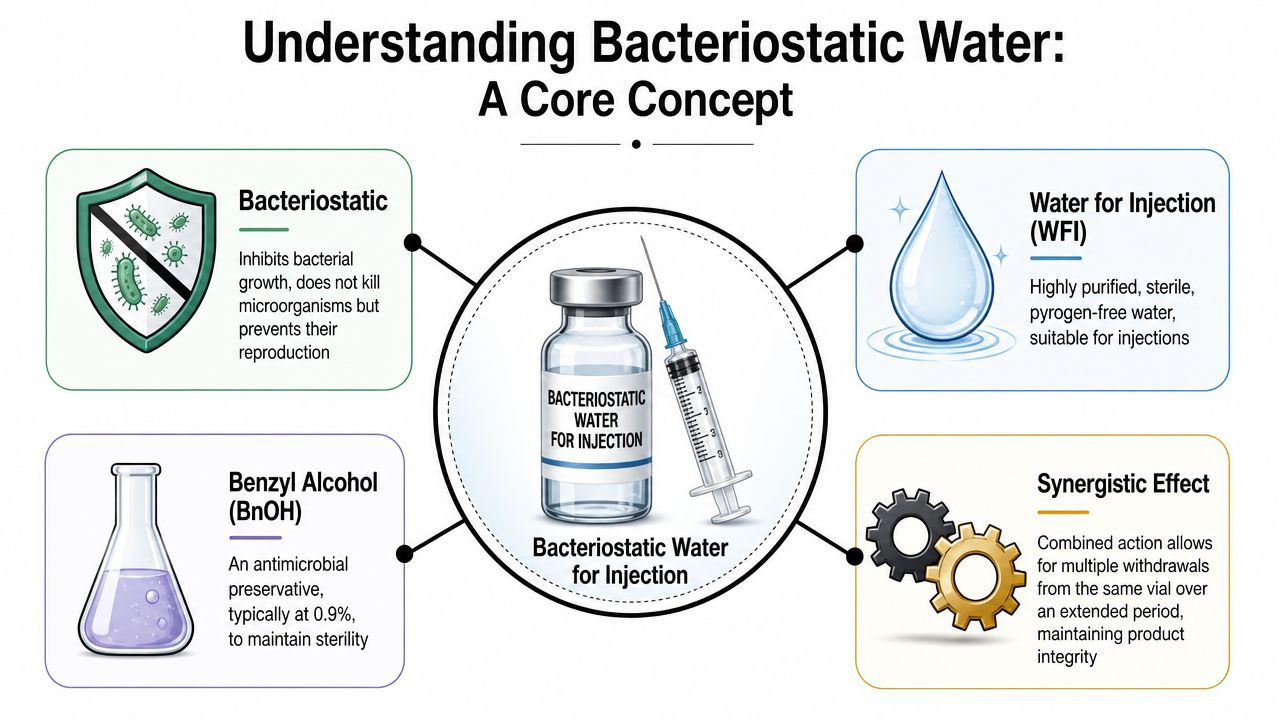
The water component provides the sterile vehicle. The benzyl alcohol provides the bacteriostatic function. A useful way to think about it is a clean room with a guard at the door. The room starts sterile. The guard does not rebuild the room if contamination has already spread inside, but it helps limit bacterial growth introduced during proper multi-dose handling.
That distinction matters because many users hear “preserved” and assume “self-sterilizing.” It isn't. The product is designed for diluting or dissolving injectable medications, not for correcting poor technique or compensating for dirty handling. If a user punctures the stopper carelessly or reuses compromised equipment, the preservative does not make that acceptable.
Why the preservative matters
The same DailyMed labeling states that the preservative is what allows multi-dose use after opening under aseptic technique, and a widely used clinical convention is to discard the vial after about 28 days once opened because the bacteriostatic effect does not remove contamination risk indefinitely. The same labeling also specifies storage at 20 to 25°C (68 to 77°F) under controlled room temperature.
A buyer or lab worker should take three immediate lessons from that:
- Formulation matters: A bacteriostatic vial is a defined product, not a generic synonym for sterile water.
- Technique still controls the outcome: Multi-dose capability depends on aseptic handling at every entry.
- Label statements matter operationally: Storage and discard practices need to follow the product documentation, not habit.
A preserved diluent extends practical usability. It does not excuse poor sterile practice.
For serious users, this marks the start of a quality mindset. The question isn't just “Is it sterile.” The question is whether the exact vial on the bench supports the intended pattern of use, and whether the label, preservative content, and storage requirements have been checked before the first puncture.
The Bacteriostatic Mechanism Compared to Other Diluents
A common failure point in reconstitution work starts at the bench, not in the assay. A vial of preserved water, a vial of sterile water, and a vial of saline can look interchangeable during receiving or setup. They are not interchangeable once protocol compatibility, repeat entry, and documentation are taken seriously.
Bacteriostatic does not mean bactericidal
Bacteriostatic water contains a preservative intended to slow or inhibit bacterial growth after proper aseptic handling. It supports the controlled use of a multi-dose container. It does not sterilize contamination that has already been introduced.
That distinction affects both technique and purchasing controls.
In practice, benzyl alcohol works like a brake, not a cleanup crew. If the vial begins as a controlled, properly handled product, the preservative helps limit microbial growth during repeated access within labeled use conditions. If handling is poor, the preservative does not reset the process back to sterile. Quality teams should train staff and buyers to read the preservative as one part of the control system, alongside container integrity, stopper disinfection, puncture technique, storage, and documented use windows.
The comparison with other diluents becomes clearer once the use pattern is defined. Sterile Water for Injection is unpreserved, so it is used where single-use handling or preservative-free requirements apply. Sterile saline adds sodium chloride, which changes both the composition and the reason you would choose it. A formulation may require isotonicity, may prohibit benzyl alcohol, or may specify plain sterile water. The correct choice comes from the product instructions and the intended workflow, not from what happens to be in stock.
For teams sorting through category names during procurement review, this overview of water for injection types and lab use cases is a useful terminology reference before approving substitutions.
Diluent comparison guide
The table below is a practical screening tool for receiving, training, and QA review.
| Diluent | Composition | Primary Use Case | Shelf Life After Opening |
|---|---|---|---|
| Bacteriostatic Water for Injection | Sterile water for injection with benzyl alcohol preservative | Multi-dose reconstitution where the formulation and intended use permit preservative-containing diluent | Follow product labeling and facility policy. Opened multi-dose handling is not indefinite |
| Sterile Water for Injection | Sterile water without preservative | Single-use or preservative-sensitive applications | Usually treated as single-use after opening |
| Sterile Saline | Sterile sodium chloride solution | Reconstitution or dilution where isotonic saline is specifically required by protocol or product instructions | Follow product labeling and intended container use |
A procurement-minded lab should ask three questions before approving any diluent: Does the formulation allow this composition? Does the container type match the intended number of entries? Can the supplier document grade, lot traceability, and product specifications clearly enough for audit and repeat ordering?
Those questions prevent a common and expensive error. Similar packaging can hide very different handling limits, compatibility constraints, and documentation requirements. For wholesalers, resellers, and serious lab users, the diluent decision is part chemistry and part quality system.
Primary Applications Peptide Reconstitution and Lab Use
Why peptides often drive the choice
Peptide work is where bacteriostatic injection water becomes a very practical decision. Lyophilized peptides are often portioned carefully, used across more than one session, and expected to perform consistently from one withdrawal to the next. In that setting, a multi-dose diluent can support more efficient handling when the formulation and protocol allow it.
The reason is straightforward. Reconstitution is often the point where a stable dry material becomes more vulnerable. Once liquid enters the vial, the user has introduced a new contamination pathway, a new storage burden, and a new labeling need. A preserved diluent helps support repeated access, but only if the user treats the vial as a controlled container rather than a casual consumable.
The practical workflow is easier to understand visually.
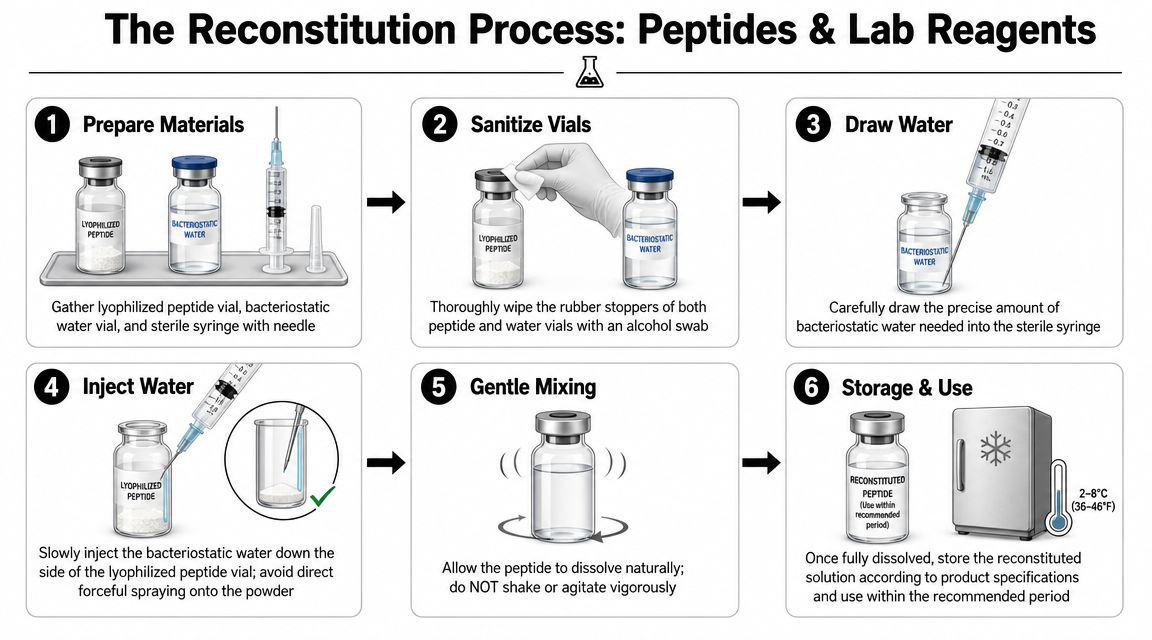
Teams that need a product-specific walkthrough often rely on peptide mixing guidance for bacteriostatic water before training new staff or publishing reseller instructions.
A careful reconstitution workflow
A sound peptide reconstitution process usually follows this sequence:
Confirm the target concentration first. The operator should decide the final concentration before drawing any diluent. That prevents avoidable over-dilution and relabeling errors.
Disinfect both vial stoppers. The peptide vial and the bacteriostatic vial should both be wiped before entry. Sterility failures often begin with skipped surface prep, not with the liquid itself.
Inject slowly against the vial wall. A direct jet onto the powder can foam or localize the wetting pattern. Slow delivery down the side of the vial is gentler and easier to control.
Swirl, don't shake. Delicate materials may dissolve best with patience. Vigorous shaking can create bubbles and complicate visual assessment of complete dissolution.
Label the reconstituted vial immediately. A professional label should identify what was reconstituted, what diluent was used, when it was opened, and any facility-specific handling notes.
For peptides, the expensive part is rarely the water. The expensive part is losing the peptide because the water was handled casually.
Beyond peptides, labs also use preserved diluents when dissolving or diluting other research materials that may be accessed repeatedly under controlled conditions. That doesn't make bacteriostatic water a universal answer. It makes it a defined tool for a defined pattern of use. The operator still has to verify compatibility, intended purpose, and documentation before the first withdrawal.
Safe Handling Storage and Expiration Guidelines
Controls that protect the vial after first entry
Good aseptic technique is what makes a preserved multi-dose vial useful. Without it, the preservative is being asked to compensate for operator error, and that is not what it is designed to do. In practical lab terms, each entry should be treated as a contamination event waiting to happen unless the handler controls it.
That means the stopper should be disinfected before access, the withdrawal device should be sterile, and unnecessary exposure to room air should be minimized. A vial that is entered repeatedly with weak technique is not “saved” by the label. It is a contaminated vial that has not been recognized yet.
The handling checklist below captures the controls that matter most during daily use.
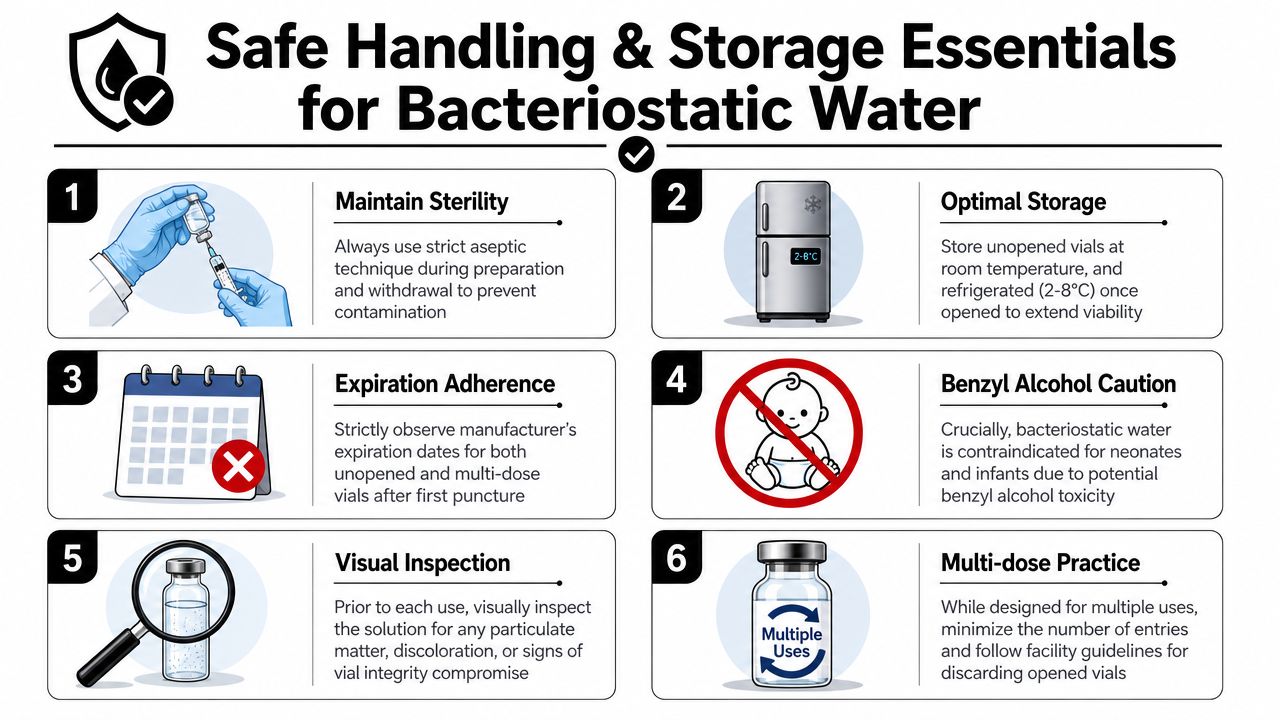
What labels and storage rules must be checked
Label review is not paperwork for its own sake. It is how a lab confirms that the vial on hand matches the intended protocol. Some marketed bacteriostatic water products use 11 mg/mL benzyl alcohol instead of 9 mg/mL, and official UK and U.S. labeling typically specifies storage at 20 to 25°C or below 25°C with a stated shelf life of 3 years for certain presentations, as described in official bacteriostatic water labeling information.
That same labeling also notes a clinical constraint that procurement teams should not ignore. Benzyl alcohol can cause hypersensitivity reactions, and some labels list hypersensitivity to benzyl alcohol as a contraindication. For QA and purchasing teams, that means the benzyl alcohol concentration, container format, and storage statement should be verified before the lot is released into use.
A concise review process usually includes:
- Check the preservative statement: Verify whether the label specifies 9 mg/mL or 11 mg/mL benzyl alcohol.
- Check storage wording: Controlled room temperature language should be read exactly, not assumed.
- Check unopened shelf life separately from opened use: An unopened vial's labeled shelf life is not the same as in-use dating after first puncture.
- Check contraindications and cautions: If benzyl alcohol sensitivity is relevant, substitution rules should be reviewed before the product reaches the bench.
Opened-vial dating and unopened shelf life are different controls. Mixing them is a documentation error that turns into a handling error.
In training environments, this is often where reproducibility improves fastest. Once staff understand that preservation, storage, and in-use dating are separate controls, fewer vials drift into undocumented gray areas.
Sourcing Guide For Wholesalers Resellers and Labs
A receiving team opens a shipment that arrived on time, in the right quantity, and with intact outer packaging. The delay starts after that. The lot number on the vial does not match the batch file, the intended-use statement is vague, and no one can tell whether the product belongs in an RUO workflow or a clinical supply chain. Procurement errors often begin at that point. The problem is rarely access to inventory alone. The problem is approving inventory before identity, documentation, and intended use are fully aligned.
For bacteriostatic injection water, the product file matters as much as the vial. Buyers should expect clear label language, batch identification, storage conditions, and a certificate of analysis or equivalent release document. In quality systems, the vial is the physical item. The file is the evidence that the item can be released into use, resale, or controlled storage without guesswork.
The first sorting question is simple. What is the product allowed to be used for, and how is it represented in commerce? A Research Use Only designation is a legal and operational boundary, not a design detail on the label. Wholesalers and resellers that treat RUO and clinical-grade supply as interchangeable create avoidable compliance risk. Two products can look nearly identical on the shelf while sitting under very different documentation and distribution rules.
A useful COA review answers the questions that usually surface later, after the shipment has already moved downstream:
- Identity and lot traceability: Can the lot number on the vial, carton, invoice, and batch record be matched without interpretation.
- Release and sterility-related documentation: Does the file state what was checked before release, and is the wording specific enough for QA review.
- Endotoxin or other QC fields when relevant: If the laboratory workflow requires that data, is it present, legible, and tied to the same batch.
- Packaging and storage details: Do the documents match the physical presentation, storage statement, and warehouse handling conditions.
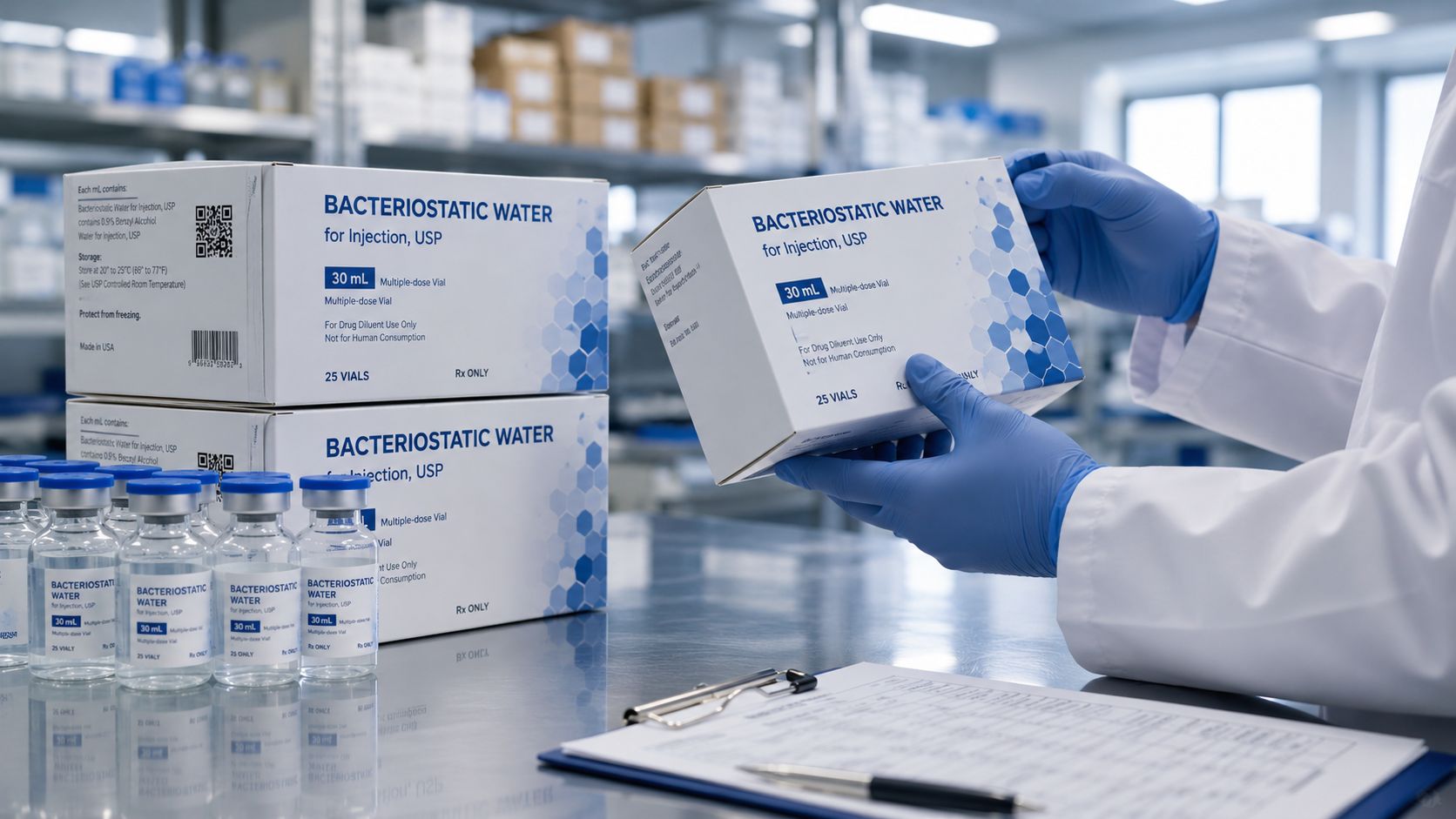
That intended-use check should also be visible at the supplier level. For example, Herbilabs wholesale supply options for RUO buyers present bacteriostatic water and related labware within a research-use framework. Buyers should expect that same clarity from any vendor under review, especially if the product may be resold across multiple jurisdictions.
Supply instability raises the standard further. During shortage periods, buyers are more likely to accept substitutions, alternate packaging, or unfamiliar suppliers under time pressure. That is when a weak approval process causes the most trouble. Sterile water products may be grouped together casually in conversation, but procurement teams cannot treat them as interchangeable. Preservative status, intended use, labeling, and release documentation all need to match the actual application.
As noted earlier, shortage conditions in related sterile water categories have been documented before. For sourcing teams, the practical lesson is straightforward. Build a supplier qualification process that still works when normal stock is unavailable. A reliable source is not just one that can ship quickly. It is one that can provide consistent paperwork, clear labeling, and answers that remain consistent from quotation to delivery.
Before approving a new source, distributors, resellers, and labs should ask:
- Is the intended use explicit: RUO, clinical supply, or another defined category.
- Do batch documents travel with the goods: Missing records slow release and create avoidable quarantine time.
- Is bacteriostatic water clearly distinguished from sterile water: That difference matters immediately during substitutions.
- Can storage and packaging details be confirmed before dispatch: Cross-border shipments often fail at the document-label interface, not at the pallet level.
Good sourcing looks routine from the outside. Inside a quality system, it is disciplined comparison work. The strongest supplier is usually the one whose labels, files, and communications agree so closely that the buyer does not need to fill gaps with assumptions.
Conclusion The Foundation of Reproducible Research
Bacteriostatic injection water is easy to underestimate because it looks simple. In practice, it is a precision reagent packaged as a process control. Its value comes from the combination of sterile water, preservative, correct labeling, and disciplined handling. Remove any one of those elements and the product becomes easier to misuse.
At the bench, the main lesson is procedural. A preserved diluent supports repeated access only when aseptic technique remains tight, labeling is immediate, and compatibility has been checked before reconstitution. In purchasing, the lesson is documentary. The vial, COA, intended-use designation, and storage conditions must all agree before the lot should move into inventory or resale.
For wholesalers and resellers, this is also a reputation issue. A customer rarely complains that a supplier cared too much about preservative content, lot traceability, or storage wording. Complaints appear when those details were ignored early and become visible only after product use. In labs, the same pattern appears as failed reproducibility, unexplained contamination, or uncertainty about whether a solution should still be in service.
Professional work often depends on ordinary-looking materials handled with uncommon discipline. Bacteriostatic injection water belongs in that category. When teams treat it as a controlled input instead of a generic accessory, they protect the integrity of the assay, the inventory, and the record behind it.
Labs and distributors that need RUO sterile diluents, batch documentation, or wholesale supply support can review the product and procurement options available from Herbilabs.