Private Label, White Label, Wholesale partnerships available - EU, USA and UK - Free shipping from €75
Bac Water Explained: A Guide for Research Use
A vial of lyophilized peptide often represents weeks of planning, careful budgeting, and a narrow window to get the reconstitution step right. The powder may be stable on the shelf, but once liquid enters the vial, the experiment shifts from storage chemistry to handling chemistry. That change is where many avoidable errors begin.
For researchers, peptide users, and resellers, Bac Water sits at that first control point. It isn't just a convenience item. It determines whether a vial can support repeated withdrawals with reasonable contamination control, whether concentration stays predictable, and whether a downstream complaint is traced back to the compound or to the diluent. That matters in a category that is already commercially significant. One market estimate placed global bacteriostatic water for injection revenue at US$2.2 billion in 2024, with a projection to US$2.61 billion by 2034, and reported that multiple-dose variants held 57.2% share in 2024, according to 2024 bacteriostatic water market coverage.
A single poor choice at reconstitution can ruin an otherwise sound workflow. The common mistake is treating all sterile diluents as interchangeable. They aren't. The right answer depends on how many withdrawals are planned, how long the vial will stay in use, and whether the supplier can prove what is in the bottle.
Table of Contents
- The Critical First Step in Your Experiment
- What Is Bacteriostatic Water Composed Of
- Bac Water vs Other Sterile Diluents
- Common Applications in Research and Labs
- Safe Handling Storage and Shelf Life
- How to Choose a Reliable Bac Water Supplier
- Frequently Asked Questions About Bac Water
The Critical First Step in Your Experiment
The most deceptively simple step in peptide work is adding liquid to powder. On paper, it looks routine. In practice, reconstitution decides whether the vial becomes a stable working solution or a contamination risk with a good label.
A common lab scenario makes the point clearly. A researcher receives a lyophilized compound in a small vial, plans to use it across several measured withdrawals, and reaches for “sterile water” without checking whether it contains a preservative. The first withdrawal may be fine. The second and third create a different situation because every puncture is a new opportunity to introduce contamination. At that point, the problem isn't sterility at manufacture. The problem is what happens after opening.
Practical rule: The diluent isn't passive. It becomes part of the handling system the moment the stopper is pierced.
That's why Bac Water is treated as the professional choice when repeated withdrawals are expected. It's built for a multi-dose context, not just for initial mixing. For wholesalers and resellers, the same logic applies at inventory level. If customers buy reconstitution supplies for repeated use, the product spec and the handling instructions have to match that reality.
Why this step carries more risk than it looks
Most failures at this stage don't come from dramatic mistakes. They come from small assumptions:
- Assuming all sterile water is the same: It isn't. Preserved and non-preserved products behave differently once opened.
- Assuming a clear solution is automatically acceptable: Visual clarity helps, but it doesn't prove correct composition or low endotoxin burden.
- Assuming the peptide gets the blame: If concentration drifts or contamination appears, the diluent may be the actual weak point.
For resellers, this first step also shapes returns, complaints, and reputation. A peptide user may think they bought a compound problem when the issue is poor-quality Bac Water, vague storage guidance, or a gray-market vial with no batch traceability.
What works and what doesn't
What works is a controlled chain: known diluent, known composition, clean technique, documented opening date, and a disposal rule that isn't negotiated downward because “the vial still looks fine.”
What doesn't work is improvisation. Cheap multi-use convenience without quality verification usually costs more later, either in lost material or in questionable results.
What Is Bacteriostatic Water Composed Of
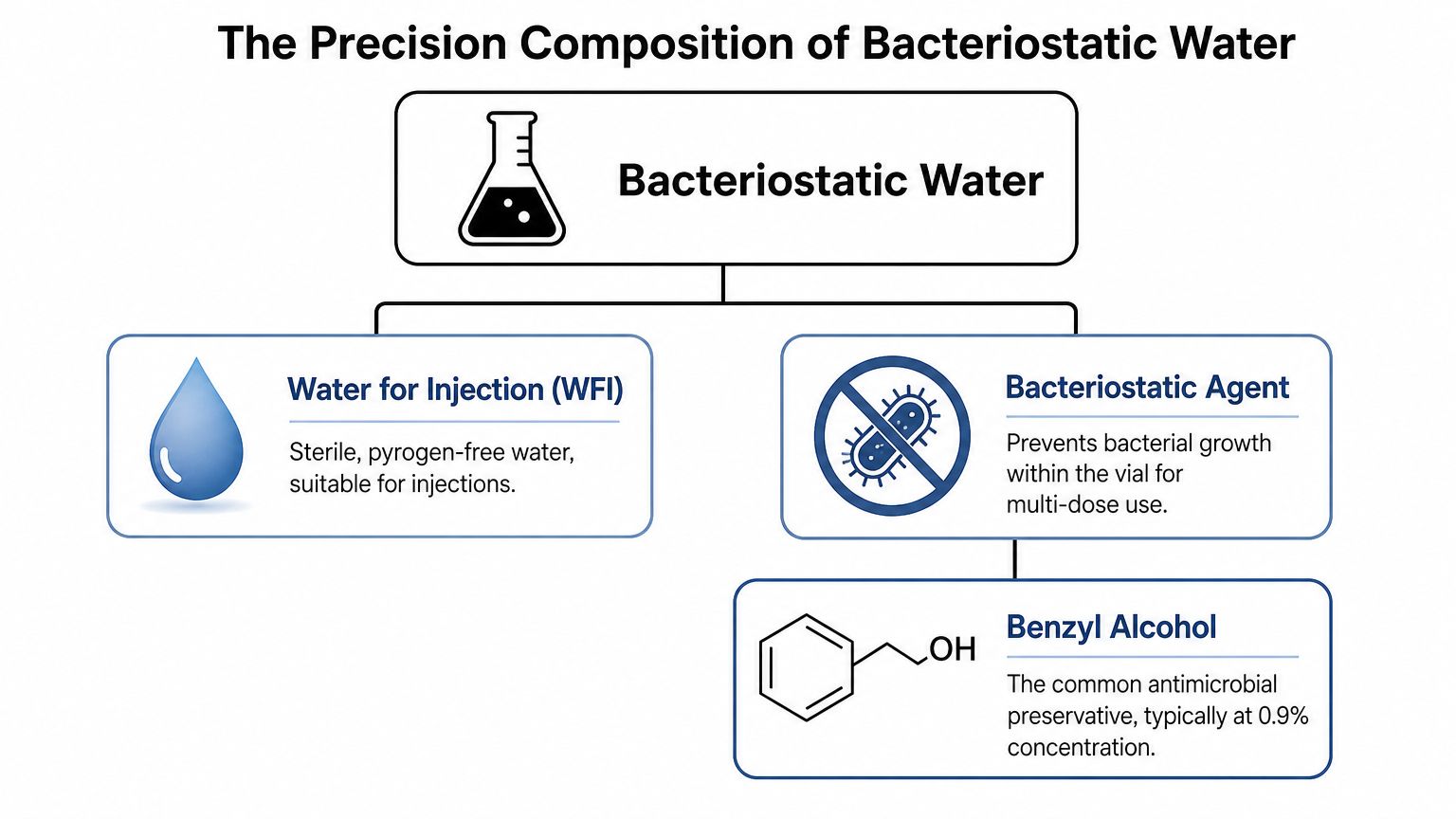
Bac Water is not just sterile water in a vial with a different label. In U.S. drug labeling, it is defined as sterile, nonpyrogenic water for injection containing 0.9% (9 mg/mL) benzyl alcohol as a bacteriostatic preservative, supplied in a multiple-dose container. The same labeling lists a pH of 5.7, with an acceptable range of 4.5 to 7.0, as shown in the DailyMed labeling for bacteriostatic water.
Two parts that matter
The first part is the water itself. It must be sterile and nonpyrogenic. Sterile means the product is prepared to avoid viable microbial contamination. Nonpyrogenic means it is produced to avoid fever-causing contaminants such as bacterial endotoxins. For research users, that matters because a solution can appear visually clean and still fail where it counts.
The second part is benzyl alcohol at 0.9%. That is what makes the product bacteriostatic. The easiest way to explain the mechanism is to think of it as a pause button rather than a demolition tool. It's there to inhibit bacterial growth between controlled withdrawals. It is not a substitute for aseptic technique, and it doesn't erase contamination introduced through poor handling.
Benzyl alcohol doesn't grant immunity to sloppy technique. It only adds a margin of control to a multi-use vial.
That distinction matters because many users hear “preservative” and mentally translate it to “safe no matter what.” That is the wrong model. A preserved vial still depends on clean stopper disinfection, fresh sterile needle use, and proper storage after first puncture.
Why pH belongs on the checklist
The pH benchmark of 5.7, with an acceptable range of 4.5 to 7.0, is more than a label detail. It functions as a quality-control reference point. Sensitive compounds don't only react to contamination. They also react to the chemical environment around them.
If pH drifts outside specification, the risk isn't only regulatory. The practical concern is reproducibility. A solution that falls outside expected chemical conditions may behave differently during dissolution, storage, or downstream use. That is why buyers who review a certificate of analysis shouldn't stop at “sterile” and “clear.” Composition, preservative content, and pH all belong in the same conversation.
Bac Water vs Other Sterile Diluents
The fastest way to create avoidable instability is to choose a diluent by habit instead of by use pattern. In labs and peptide workflows, the most common confusion is between Bac Water, sterile water for injection, and acidic specialty diluents such as acetic acid solutions. These are not interchangeable by default.
How the decision changes with use pattern
If the compound will be reconstituted and used once, the lack of preservative in sterile water may be acceptable and sometimes preferable. If the same vial will be punctured repeatedly over time, that same lack of preservative becomes a liability.
Acidic diluents create a different decision tree. They may help when a specific compound needs that chemistry for solubility, but they are not general replacements for Bac Water. Matching the solvent to the compound is part of formulation logic, not a matter of convenience.
For users who need a baseline reference on plain sterile diluent, this overview of water for injection is useful because it clarifies what a non-preserved injection-grade water product is designed to do.
Comparison of Common Laboratory Diluents
| Diluent Type | Composition | Preservative | Primary Use Case | Shelf Life After Opening |
|---|---|---|---|---|
| Bac Water | Sterile, nonpyrogenic water with benzyl alcohol | Yes | Multi-use reconstitution where repeated withdrawals are expected | Limited by handling practice and discard policy |
| Sterile Water for Injection | Sterile water without bacteriostatic preservative | No | Single-use or immediate-use preparation | Best treated as a single-use option once opened |
| Acetic Acid Solution | Water-based acidic diluent | Depends on formulation | Special solubility cases for compounds that require acidic conditions | Depends on formulation and handling controls |
A practical rule helps simplify the choice:
- Choose Bac Water when the vial will support multiple measured withdrawals.
- Choose sterile water for injection when the preparation is immediate and the solution won't be kept in service as a multi-use vial.
- Choose an acidic diluent only when the compound's solubility profile calls for it.
Where users go wrong
The most common error is trying to use a single bottle for every compound. That approach ignores two separate variables. One is microbiological control after puncture. The other is chemical compatibility with the material being dissolved.
Another mistake is deciding by price alone. A cheaper bottle of the wrong diluent isn't cheaper if it forces early discard, unstable reconstitution, or uncertainty about what caused a failed run. In practice, the right diluent is the one that reduces ambiguity.
Common Applications in Research and Labs
The main reason researchers reach for Bac Water is straightforward. Many compounds are expensive, dispensed in small increments, and not consumed in one sitting. Multi-dose handling is therefore part of the workflow, not an edge case.
Why peptide work often defaults to Bac Water
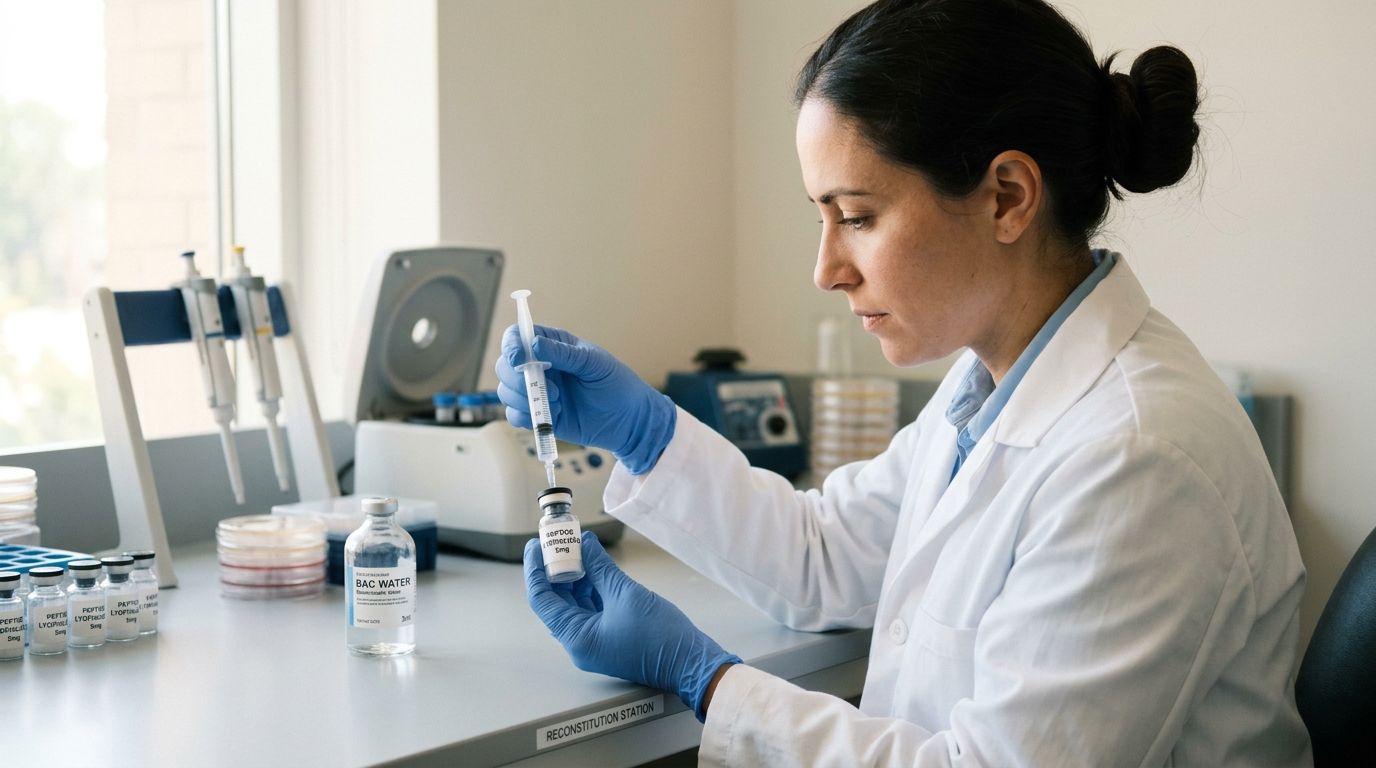
Lyophilized peptides are the clearest example. A dry powder has to be brought into solution before measured use. If the user expects to draw from that vial more than once, a preserved diluent usually makes more practical sense than non-preserved water.
The actual mechanics matter. The diluent should be introduced slowly, ideally directed against the inner wall of the vial rather than blasted directly into the powder cake. Gentle swirling is preferred over vigorous shaking, especially for delicate materials where foaming or rough handling can complicate dissolution. This practical guide on how to mix peptides with bacteriostatic water covers that workflow in more detail.
Common use cases include:
- Peptide reconstitution: Suitable when a vial is used across several withdrawals rather than a single preparation.
- HGH analogue research workflows: Helpful where a prepared solution needs repeated access under controlled conditions.
- General reagent preparation: Useful for some lab routines where a preserved multi-use water source is operationally convenient.
Where else it fits in laboratory practice
Outside peptide work, Bac Water has value anywhere a lab needs repeated withdrawals from a small vial without treating each puncture as a completely fresh preparation event. That doesn't remove the need for sterile technique. It aligns the diluent with the actual working pattern.
A brief visual walkthrough can help users who train staff or customers on these handling details:
The reseller angle is often overlooked. A wholesaler stocking peptides, syringes, and reconstitution supplies does better when the Bac Water listing explains intended use clearly: repeated withdrawals, preserved formulation, and strict handling expectations. That reduces misuse by customers who would otherwise treat a multi-dose vial as if the preservative makes it self-protecting.
Safe Handling Storage and Shelf Life
The phrase “multi-use” creates more false confidence than it should. It sounds as if the vial remains protected because it contains benzyl alcohol. In real handling, every puncture taxes that protection. The stopper is breached again, the needle path can introduce contaminants again, and storage conditions start to matter more with each cycle.
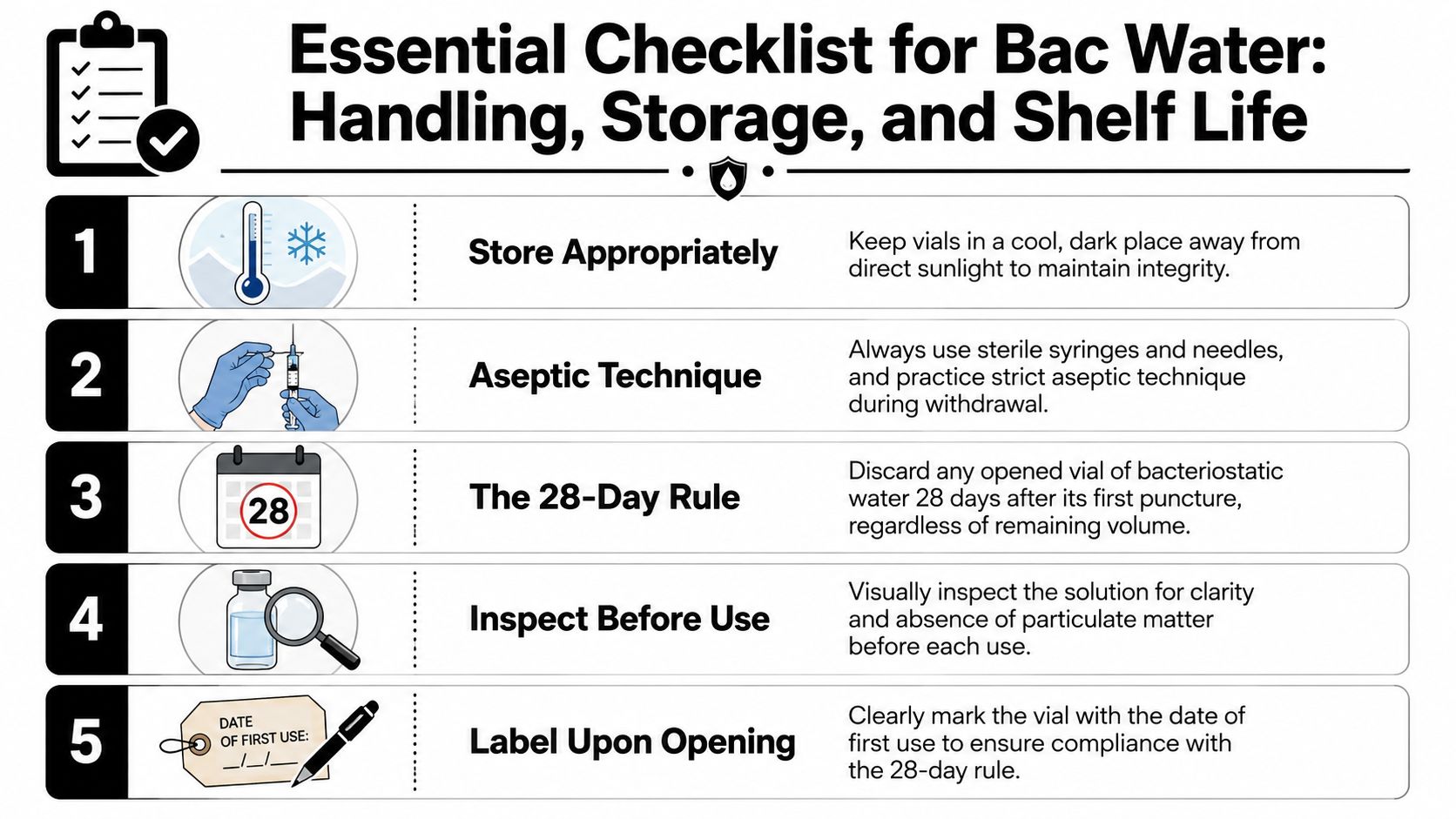
A common point of confusion is the 28-day rule for multi-use vials. Recent discussion of Bac Water often repeats the rule without explaining the reason behind it. The practical issue is that storage conditions and repeated punctures can affect the efficacy of the 0.9% benzyl alcohol preservative, which is why proper handling remains critical, as discussed in this article on the uses of bacteriostatic water and where to get it.
Why the 28-day rule exists
The rule exists because preservative performance is not infinite and because contamination risk accumulates with use. A multi-dose vial is a controlled compromise, not an open-ended one. The vial may remain clear and still no longer deserve trust.
Discard timing should be treated as part of the experiment design, not as an afterthought once the vial is nearly empty.
That is especially important for peptide users trying to stretch a vial because “there's still volume left.” Remaining volume is not the deciding variable. The relevant question is how long the vial has been open and how many opportunities it has had to pick up contamination.
A handling routine that reduces avoidable risk
A consistent routine prevents most preventable failures:
- Inspect the vial first: Don't use a vial with visible particles, cloudiness, discoloration, cracks, or a compromised seal.
- Disinfect the stopper: Swab the septum before every entry and let the alcohol dry before puncture.
- Use new sterile hardware each time: A fresh needle and syringe for every withdrawal is basic contamination control.
- Label the opening date immediately: If the first puncture date isn't on the vial, the discard date will become guesswork.
- Store under controlled conditions: Keep the vial as directed for stability and away from heat, light, and casual handling.
This guide on how to prevent cross contamination is relevant here because vial handling failures rarely happen in isolation. They usually happen as part of a chain of small shortcuts.
What should trigger disposal
Several warning signs should end the vial's use immediately:
- Visual change: Cloudiness, floating matter, or color shift
- Packaging concern: Damaged cap, stopper, or glass
- Traceability gap: No clear first-use date
- Questionable handling history: Shared use, reused needle, or uncertain storage
When there's doubt, disposal is the cheaper option. Repeating work is frustrating. Trusting a compromised vial is worse.
How to Choose a Reliable Bac Water Supplier
Supplier choice is often treated as procurement. In practice, it is quality control upstream. If the source is weak, the vial enters the lab with uncertainty already built in.
Recent supply disruptions brought that problem into the open. Independent reports highlighted gray-market Bac Water that failed checks for pH, benzyl alcohol concentration, and even endotoxin contamination, which is why verifiable, batch-level COAs matter, according to this physician-facing discussion of Bac Water shortages and quality issues.
What to verify before buying
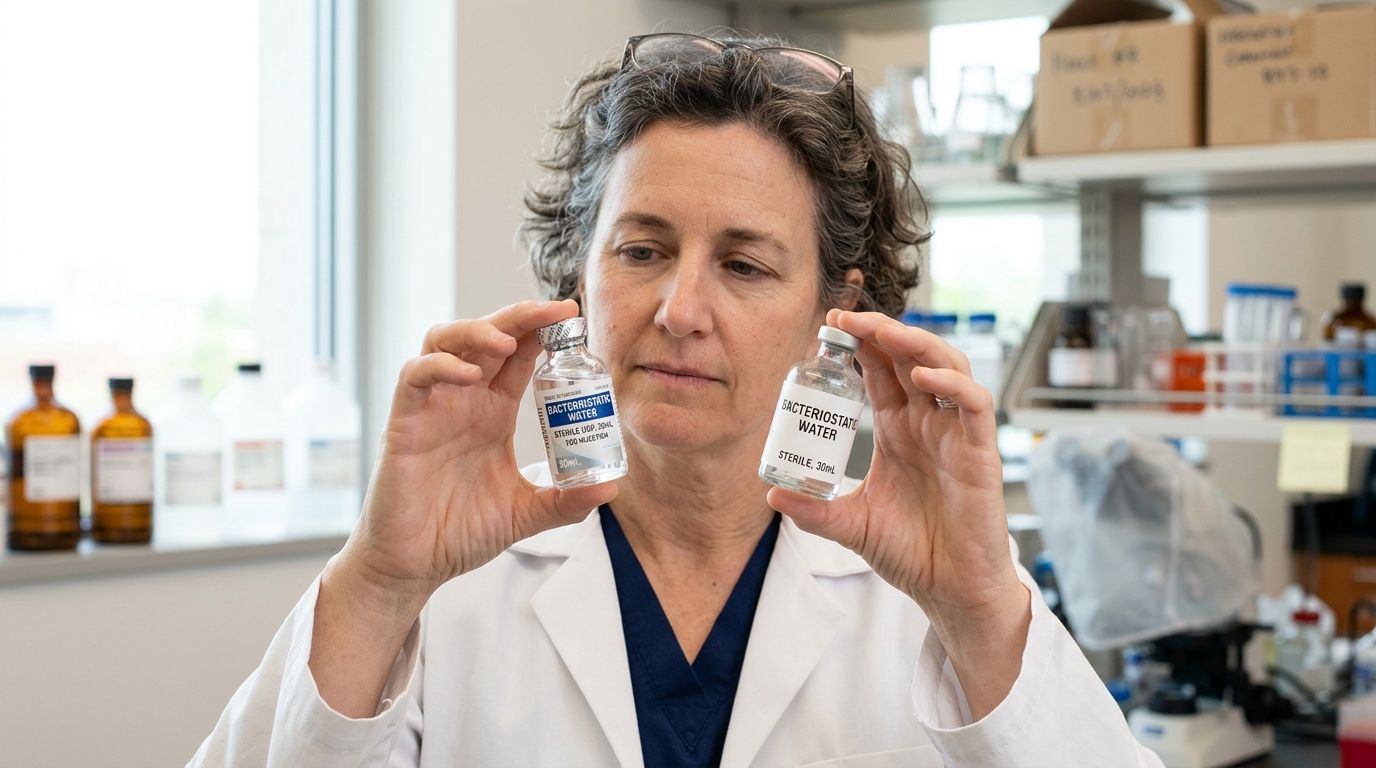
A supplier should be able to answer basic technical questions without hedging. If the answer is vague, that's already useful information.
Check for the following:
- Batch-level COA availability: The document should tie to the actual lot being sold, not a generic sample file.
- Key specification clarity: pH, preservative identity, and sterility-related claims should be clearly stated where applicable.
- Packaging quality: Sterile glass vials with intact closures are easier to trust than loosely presented product with unclear packaging standards.
- Traceability: Lot numbers, manufacturing records, and complaint handling processes matter.
- Research-use clarity: The intended market and use category should be explicit, not implied.
One factual example in this category is Herbilabs, which offers bacteriostatic water and reconstitution solutions in glass vial formats and provides batch documentation for research-use supply. That doesn't replace buyer due diligence. It illustrates the type of transparency serious buyers should expect.
Why supplier vetting is part of quality control
Instruments get calibrated. Methods get reviewed. Incoming materials should receive the same mindset. A lab that validates equipment but accepts anonymous Bac Water from a fragile supply chain is protecting the wrong end of the workflow.
The vial label is a claim. The COA, packaging integrity, and batch traceability are the evidence.
For wholesalers and resellers, this matters twice. First, low-visibility quality failures create returns and reputational damage. Second, once customers start asking whether a Bac Water vial is legitimate, the seller needs more than reassurance. They need documentation, lot traceability, and a clear answer on how the product was made and verified.
The strongest buyers don't only compare price lists. They compare the supplier's ability to remove doubt.
Frequently Asked Questions About Bac Water
Common Questions on Bac Water Usage
| Question | Answer |
|---|---|
| What makes Bac Water different from sterile water for injection? | Bac Water contains a bacteriostatic preservative and is intended for multiple withdrawals from the same vial. Sterile water for injection does not include that preservative and is better suited to single-use or immediate-use contexts. |
| Does bacteriostatic mean bacteria can't ever get into the vial? | No. It means the formulation helps inhibit bacterial growth. It does not replace aseptic technique or rescue a vial that has been handled poorly. |
| Can a clear vial still be a bad vial? | Yes. Visual clarity helps, but it doesn't confirm correct preservative concentration, pH compliance, or low endotoxin risk. |
| Why should an opened vial be dated? | Because discard timing depends on the first puncture date. Without that date, safe-use decisions become guesswork. |
| Is the 28-day rule flexible if the vial still looks fine? | It shouldn't be treated as flexible. The issue is cumulative contamination risk and declining confidence in preservative protection over time. |
| What should a buyer ask a supplier for? | Ask for a batch-specific COA, clear lot traceability, packaging details, and enough specification data to verify that the product matches its label claim. |
| Is cheap Bac Water always a bad option? | Not automatically. The real issue is whether the supplier can verify quality and traceability. A low price without documentation usually shifts risk to the user. |
A reliable Bac Water workflow starts before the vial is opened. It starts with buying from suppliers that can document what they sell, storing the product correctly, and treating multi-dose convenience as a controlled benefit rather than unlimited permission. For researchers, resellers, and distribution partners that need documented reconstitution supplies, Herbilabs provides research-use sterile diluents, Bac Water formats, and batch documentation for EU, UK, USA, and international supply channels.