Private Label, White Label, Wholesale partnerships available - EU, USA and UK - Free shipping from €75

Bac Water vs Reconstitution Solution: A Deep Dive
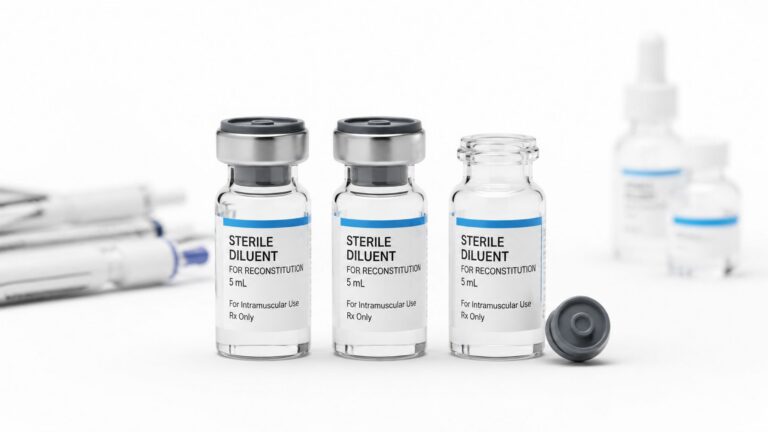
A common lab problem starts with a small vial and a large risk. A peptide arrives lyophilized. The protocol requires clean reconstitution, repeatable withdrawals, and stable handling over the life of the study. On the bench are two options: one vial labeled Bacteriostatic Water, another labeled Reconstitution Solution. The labels look similar enough that many buyers assume they're interchangeable.
They aren't.
That mistake doesn't just create a handling issue. It changes contamination risk, storage workflow, waste levels, and sometimes the interpretation of the experiment itself. For distributors and resellers, it also creates a documentation problem. If the formulation doesn't match the label, the supply chain inherits a compliance risk that should've been stopped upstream.
The practical question in Bac Water vs Reconstitution Solution isn't which name sounds more familiar. The practical question is what is in the vial, how long it remains suitable after opening, and whether the formulation aligns with the protocol, the peptide, and the purchase specification.
Table of Contents
- Introduction The Critical Choice in Reagent Preparation
- A Fundamental Comparison of Diluent Formulations
- Peptide Compatibility and Solution Stability
- Appropriate Use Cases for Each Diluent
- Navigating Safety and Regulatory Considerations
- Storage Handling and Quality Assurance Guidance
- Frequently Asked Questions
Introduction The Critical Choice in Reagent Preparation
Labs usually discover the bac water vs reconstitution solution issue when the protocol becomes more demanding than the label suggests. A single-use setup can tolerate a narrow handling window. A multi-day peptide study can't. Once repeated withdrawals enter the workflow, the formulation of the diluent stops being a minor purchasing detail and becomes part of method control.
Bacteriostatic Water and reconstitution solution often get discussed as if they're category twins. In practice, the term "reconstitution solution" is broad and sometimes unhelpfully broad. In a technical setting, buyers need to know whether the product is preservative-free or whether it contains 0.9% benzyl alcohol and functions like bacteriostatic water. That distinction drives use conditions.
Practical rule: If the label uses a broad term but the specification doesn't clearly state preservative content, the product hasn't been described well enough for controlled research use.
This matters for more than bench technique. A reseller choosing stock for EU, UK, USA, or LATAM buyers needs labeling that survives scrutiny. A lab manager needs a vial that matches the study design. A procurement team needs documentation that tells them whether the product belongs in single-session use or repeated-access workflows.
Three questions usually settle the decision:
- What is in the vial: sterile water alone, or sterile water with 0.9% benzyl alcohol.
- How will it be used: one access event, or repeated withdrawals across days.
- How will it be documented: clear COA, transparent formulation statement, and labeling that doesn't blur product identity.
A Fundamental Comparison of Diluent Formulations
The clearest way to compare these products is to strip away marketing language and look at formulation.

What each product actually contains
Bacteriostatic Water is sterile water containing 0.9% benzyl alcohol (9 mg/mL), which acts as a bacteriostatic preservative and enables multi-dose use for up to 28 days after initial opening, while sterile reconstitution solutions lack antimicrobial agents and require single-use within 24 to 48 hours after opening to limit contamination risk, as described by Bacteriostatic Waters.
By contrast, reconstitution solution is often used as a commercial label rather than a precise technical category. In many purchasing contexts, it refers to a sterile, preservative-free diluent. That makes it suitable when the protocol calls for immediate use and no preservative exposure. For buyers sourcing preservative-free product specifically, a USP sterile water for injection option is the kind of specification to look for because it identifies the formulation directly instead of relying on a vague umbrella term.
The confusion begins when sellers use "reconstitution solution" as if it automatically means sterile water only. It doesn't. The term describes purpose better than composition. Composition still has to be confirmed from the label, lot documentation, or COA.
Early comparison table
| Attribute | Bacteriostatic Water | Reconstitution solution in preservative-free use |
|---|---|---|
| Preservative | 0.9% benzyl alcohol | None |
| Intended access pattern | Multi-dose | Single-use |
| Post-opening handling window | Up to 28 days when used as specified | Generally 24 to 48 hours |
| Main operational advantage | Repeated withdrawals with lower waste | No preservative exposure |
| Main operational limitation | Not ideal when preservative sensitivity is a concern | Short handling life after opening |
A technician usually sees the difference in workflow before seeing it in chemistry. Multi-dose studies benefit from a diluent that tolerates repeated punctures under proper aseptic handling. Single-session work doesn't need that feature and may be better served by a simpler formulation.
The product name on the front label matters less than the formulation statement and the intended access pattern.
Such situations lead to procurement errors. Teams buy by habit, not by protocol. One buyer orders "reconstitution solution" expecting sterile water only. Another receives a preserved product under that same label. If the documentation isn't explicit, the same term can pull two different formulations into the same inventory category.
Peptide Compatibility and Solution Stability
The standard advice is simple: use bac water for repeated withdrawals, use sterile water for immediate single-use work. That advice is useful, but it isn't complete enough for peptide handling.

Why the preservative question matters
The preservative in bacteriostatic water solves one problem very well. It helps inhibit microbial growth during repeated access. But a lab still has to ask a second question: what does prolonged exposure to that preservative do to the peptide itself?
That question doesn't have the peptide-specific depth many users expect. The issue of diluent-driven degradation lacks data-backed, sequence-specific guidance. No existing source provides empirical data on how 0.9% benzyl alcohol interacts over time with sensitive sequences such as GHK-Cu or Retatrutide, although some guidance notes that GHK-Cu may show faint coloration, according to Palmetto Peptides.
That gap matters in real lab work. A stable peptide in a short study may perform without incident in a preserved diluent. A more delicate molecule in a longer holding period may deserve a more conservative choice. A buyer considering bacteriostatic water for peptides should match that product class to the access pattern and the molecular sensitivity, not treat it as an automatic default.
What to watch in the vial
When published peptide-specific compatibility data is limited, bench observation becomes part of quality control. That doesn't replace validated stability work, but it does help detect obvious failure.
Watch for:
- Cloudiness: A clear solution that turns cloudy raises contamination or compatibility concerns.
- Particulates: Floating matter or visible fragments suggest the vial shouldn't stay in use.
- Color shift: Some peptides may show slight color change, but any unexpected shift should be investigated against known handling history.
- Precipitation after storage: Material falling out of solution can indicate instability or incomplete dissolution.
A useful practice is to log visible condition at reconstitution and at each scheduled access point. That gives the lab a simple observational trail if a study result later looks inconsistent.
If a peptide is high value, novel, or known to be handling-sensitive, the cost of a conservative diluent choice is often lower than the cost of ambiguous data.
The oversimplified version of bac water vs reconstitution solution asks which one is better. The operational version asks which one introduces the fewest uncontrolled variables for that specific peptide over that specific time window.
Appropriate Use Cases for Each Diluent
Choosing correctly usually comes down to the access pattern, the sensitivity of the active material, and the tolerance of the study for preservative exposure.

When Bacteriostatic Water fits the protocol
Bacteriostatic water is the practical choice when the same vial will be accessed repeatedly across a study window and the peptide doesn't present a known preservative sensitivity concern.
Typical fit conditions include:
- Repeated withdrawals: Daily or scheduled withdrawals from the same reconstituted vial.
- Inventory efficiency: Teams trying to reduce waste from opening fresh diluent for every access event.
- Routine peptide workflows: Established compounds with predictable handling behavior under preserved conditions.
In those situations, the preserved formulation supports a smoother workflow. The lab spends less time replacing partially used single-use diluent and less time managing duplicate reconstitution events.
When preservative-free diluent is the safer choice
A sterile, preservative-free reconstitution solution is the more disciplined option when the experiment doesn't need repeated access or when the preservative itself may become a confounding factor.
Use that route when:
- The vial is for immediate use. Single-session preparation doesn't gain much from a preserved multi-dose format.
- The material may be preservative-sensitive. If compatibility is uncertain and the peptide is valuable, limiting variables is sensible.
- The receiving system is sensitive to additives. Some cell-based or specialized assay contexts are better served by a cleaner diluent profile.
- The product labeling specifies it. Protocol and product instructions should outrank habit.
A lot of preventable errors come from using one stock solution for every scenario. That makes inventory easier, but it doesn't make science cleaner.
The right diluent is the one that solves the actual handling problem without introducing a new one.
For distributors, this section has a commercial implication too. Different customer groups need different stock logic. A peptide reseller supporting repeat-access research may prioritize preserved multi-dose diluents. A buyer serving assay-heavy, immediate-use workflows may need preservative-free sterile water in clearly separated SKUs. Mixing those needs under one vague label invites returns, complaints, and misuse.
Navigating Safety and Regulatory Considerations
A common failure starts at receiving. A buyer orders "reconstitution solution" for a preservative-free workflow, the vial arrives with vague labeling, and nobody confirms whether benzyl alcohol is present before it enters inventory. That is not a paperwork problem alone. It can alter study conditions, create use restrictions the lab did not plan for, and expose a distributor to avoidable compliance risk.

Known safety boundaries
The clearest safety line concerns benzyl alcohol. Bacteriostatic water contains that preservative, and preservative-containing flush and diluent products have a well-documented risk in neonates. The U.S. Food and Drug Administration addresses this directly in its labeling discussion of benzyl alcohol toxicity in newborns.
That clinical warning matters outside bedside care. In research purchasing, the same principle applies. A preservative is an active formulation choice with consequences for compatibility, interpretation, and downstream use restrictions. Teams should verify the presence or absence of benzyl alcohol before approving a supplier or releasing stock to the bench.
The gray market labeling problem
The harder problem is not always contamination or handling. It is identity.
"Reconstitution solution" is not a standardized formulation name. In legitimate channels, it may refer to sterile water or another specified diluent. In gray-market channels, it can become a catch-all label that conceals whether the product is preserved, what concentration it contains, or whether the documentation matches the vial. That ambiguity is where researchers lose control of variables and distributors inherit preventable liability.
The pattern is familiar in secondary marketplaces. A catalog listing says "reconstitution solution," the vial branding suggests multi-use convenience, and the paperwork says little or nothing about composition. If benzyl alcohol is present but undisclosed, the buyer may treat the product as preservative-free. If the product is preservative-free but marketed like bacteriostatic water, users may assume a multi-dose handling profile that the formulation does not support.
Red flags include:
- No explicit preservative statement: The label does not clearly say whether benzyl alcohol or another antimicrobial agent is present.
- Incomplete lot documentation: No certificate of analysis, no specification sheet, or records that do not match the lot in hand.
- Generic naming across sales materials: The listing, invoice, and vial use broad terms instead of a defined formulation.
- Conflicting identity claims: One document says sterile water, another implies bacteriostatic use, and neither resolves the difference.
- Missing regulatory context: No indication of intended use category, manufacturer identity, or traceable quality records.
Experienced buyers do not treat that as a minor labeling flaw. They treat it as a product identity problem.
A sound screening process is straightforward:
- Match the vial label to the COA and specification sheet
- Confirm whether benzyl alcohol is listed and at what concentration
- Verify that the product name is consistent across the listing, invoice, and shipping documents
- Reject inventory with missing manufacturer traceability or incomplete lot records
- Separate preserved and preservative-free SKUs in the ERP or inventory system
For distributors, this is also a supply-chain discipline issue. Broad naming may increase short-term sales by making one SKU look universally acceptable, but it raises return rates, customer complaints, and regulatory exposure. Clear formulation labeling reduces those failures. For researchers, it protects experimental interpretation by keeping an undeclared excipient out of the study design.
The practical rule is simple. If the formulation cannot be verified, the vial should not be treated as interchangeable with bacteriostatic water or with a preservative-free reconstitution diluent.
Storage Handling and Quality Assurance Guidance
A clean COA does not protect a vial once it reaches the bench. Storage, access control, and intake checks determine whether the stated formulation remains the formulation you use in the study.
For preserved water, the usable post-opening period depends on the labeled instructions, the container system, and whether staff maintain aseptic technique on every entry. Preservative-free sterile diluents should be treated as single-use unless the manufacturer documentation states otherwise. In practice, repeated withdrawals from an unlabeled or loosely labeled "reconstitution solution" create two risks at once. Microbial introduction during handling, and uncertainty about what excipient system was in the vial to begin with.
Handling rules that protect the vial
Bench discipline matters more than the product name on the label. A bacteriostatic formulation can tolerate multi-dose handling only within the limits of its preservative system, and only if operators avoid avoidable contamination.
Use these controls consistently:
- Disinfect the stopper before each puncture: Surface contamination often starts with hurried handling, not a manufacturing defect.
- Use new sterile withdrawal hardware every time: Re-entry with previously used needles or syringes defeats the contamination control built into the vial.
- Record the opening date and operator: Without that record, no one can judge whether the vial is still inside its allowed use period.
- Store exactly as labeled: Temperature excursions and poor light protection can affect both sterility assurance and peptide stability after reconstitution.
- Retire vials with unclear history: If a vial has changed hands, sat uncapped, or lacks an opening record, remove it from active use.
Busy labs often lose control in small ways. One analyst opens the vial, another uses it later, and the batch record never captures who accessed it or how often. The result is predictable. The diluent gets blamed for variability that came from handling failure.
A preservative reduces risk. It does not correct weak technique.
What a buyer should verify before stocking
Distributors, purchasing managers, and lab leads need intake criteria that go beyond "sterile" on a listing page. The right question is whether the received vial matches the documented formulation, packaging configuration, and intended use category. A quality control testing workflow for sterile reagent suppliers is the kind of evidence serious buyers should review before approving a source.
Key QA checks should include:
| Checkpoint | What to verify |
|---|---|
| Product identity | Does the commercial name match the actual formulation on the specification sheet and vial label? |
| Preservative statement | Is benzyl alcohol declared, or is preservative-free status stated explicitly? |
| Lot traceability | Can the lot be tied to a COA, release record, and manufacturer identity? |
| Packaging integrity | Are the stopper, crimp, seal, and vial condition consistent with sterile handling expectations? |
| Use classification | Is the product described consistently as multi-dose, single-use, or research-use material only? |
Gray-market "reconstitution solution" causes preventable failures. The label may look generic enough to pass receiving, but generic naming is exactly what allows preserved and preservative-free stock to collapse into one SKU in the ERP. Once that happens, substitution errors move from purchasing into the lab.
Separate preserved and preservative-free diluents in procurement, warehousing, and picking records. Require the same formulation name on the listing, invoice, outer carton, and vial label. If any of those records drift into vague wording, quarantine the lot until the supplier resolves the discrepancy. That step protects both research integrity and downstream complaint handling.
Frequently Asked Questions
Can sterile water be used for a multi-dose vial if the lab plans to use it all in one day
It can fit a very short workflow, but the handling risk is still higher because the diluent doesn't include a preservative. If the protocol involves repeated withdrawals, a lab should evaluate whether the convenience of using one vial in one day is worth the narrower contamination margin.
What visible signs suggest contamination or peptide degradation
The most useful checks are practical ones: cloudiness, unexpected particulates, discoloration, or precipitation. A change in appearance doesn't identify the cause by itself, but it does mean the vial should be reviewed against handling records and protocol expectations before staying in use.
Is acetic acid solution the same thing as reconstitution solution
No. Acetic acid solutions are a different class of solvent system used for specific dissolution problems. In ordinary bac water vs reconstitution solution comparisons, the discussion is about sterile water-based diluents, either with or without preservative, not acidic specialty solvents.
Is the term reconstitution solution precise enough for purchasing
Usually not by itself. Buyers should ask whether the product is preservative-free or preserved, and they should confirm that with lot documentation. A broad label is acceptable only when the underlying formulation is stated clearly.
Herbilabs supports research buyers in the EU, UK, and USA with sterile diluents and reagent documentation designed for controlled laboratory workflows. Teams that need clearer product identity, lot traceability, and Research Use Only supply options can review the available catalog and contact details at Herbilabs.