Private Label, White Label, Wholesale partnerships available - EU, USA and UK - Free shipping from €75
Bac Water Hospira: A Guide for Researchers & Wholesalers
A buyer is trying to clear an inbound shipment. A lab manager is checking whether a vial can be released into inventory. A reseller is comparing labels from different channels and trying to decide which documents prove anything. That is usually the point where Bac Water Hospira stops being a simple product name and becomes a compliance question.
For wholesalers and professional users, the product only matters if its identity, labeling, storage profile, and lot documentation can stand up to scrutiny. Sterile diluents sit in an uncomfortable category. They look simple, but mistakes around sourcing, substitution, or handling can undermine downstream work very quickly. The product itself is only one part of the decision. The paper trail, temperature control, and lot traceability matter just as much.
Table of Contents
- Why Hospira Bac Water Is A Reference Standard
- Deconstructing The Hospira Formulation
- Decoding The COA For Hospira Bacteriostatic Water
- Approved Applications And Critical Safety Limits
- The Regulatory Story And Research Use Implications
- A Wholesaler's Guide To Sourcing And Quality Checks
- Choosing Your Reconstitution Solution Partner
Why Hospira Bac Water Is A Reference Standard
In regulated workflows, diluents often get less attention than the active compound. That's a mistake. Reconstitution failures, label mismatches, and storage deviations usually don't announce themselves early. They show up later as inconsistent handling, questionable repeatability, or customer complaints that are hard to unwind.
That's why Bac Water Hospira is often treated as a reference point in procurement and quality conversations. Buyers know what they're looking at. QC teams know what documents should accompany it. Distributors know that customers expect a clear identity, a recognized manufacturer trail, and packaging details that align with established pharmaceutical handling norms.
Why Buyers Use It As A Benchmark
A reference standard in the commercial sense isn't only about chemistry. It's also about whether a product creates less ambiguity across the supply chain.
Hospira's bacteriostatic water has that practical value because professionals can evaluate it against well-known criteria:
- Defined product class. It's recognized as a sterile pharmaceutical diluent, not a generic lab water.
- Clear intended role. It functions as a solvent or reconstitution medium, not as a therapeutic product in its own right.
- Recognizable packaging logic. Multi-dose presentation changes how warehouses, resellers, and end users handle inventory and documentation.
- Established compliance expectations. The product has a labeling and safety framework that procurement teams can review before release.
For a wholesaler, that reduces friction. A familiar product profile is easier to validate at intake, easier to train staff around, and easier to discuss with customers who need consistent reconstitution inputs.
Practical rule: If a sterile diluent arrives with unclear identity, incomplete lot paperwork, or packaging that doesn't match known manufacturer conventions, it shouldn't move into saleable stock.
What Works And What Usually Fails
What works is disciplined standardization. Teams that treat sterile diluents as controlled inventory usually perform better in audits and customer support because they can answer basic questions quickly. What lot was received, how was it stored, and what manufacturer documentation was reviewed?
What doesn't work is treating bacteriostatic water like an interchangeable commodity. In commercial channels, that approach creates avoidable risk. If a reseller can't distinguish between preservative-containing bacteriostatic water and preservative-free sterile water at the specification level, the problem isn't minor. It affects use conditions, customer expectations, and product suitability.
Deconstructing The Hospira Formulation
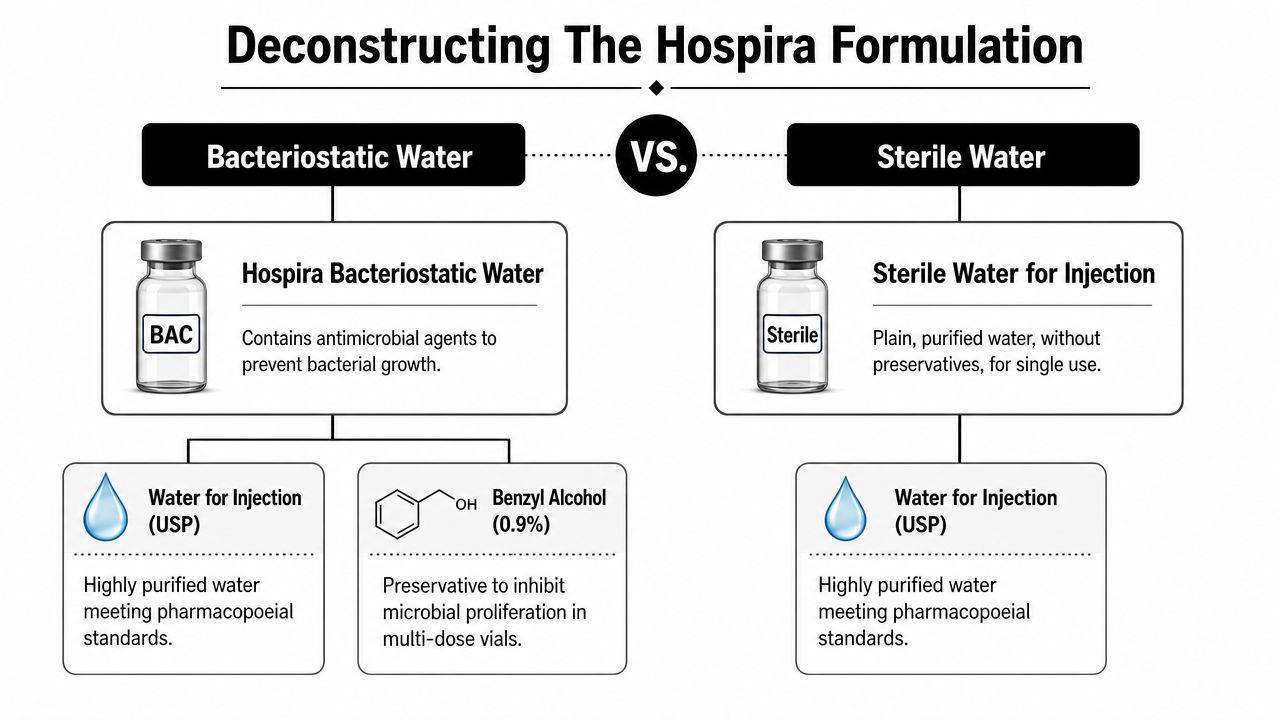
The most important thing about the formulation is also the easiest thing to miss. Hospira bacteriostatic water is not just purified sterile water in a vial. Its defining feature is the preservative system.
What Defines The Product
According to DailyMed product information for Hospira Bacteriostatic Water for Injection, the formulation is sterile, nonpyrogenic water for injection containing 0.9% (9 mg/mL) or 1.1% (11 mg/mL) benzyl alcohol as a preservative. That same labeling describes it as a 30 mL multiple-dose vial.
Each of those terms matters.
- Sterile means the product is manufactured for use where microbial contamination isn't acceptable.
- Nonpyrogenic means it's intended to avoid fever-causing contamination concerns associated with pyrogens.
- Water for injection identifies the pharmaceutical grade and intended use context.
- Multiple-dose vial signals that the preservative is part of the product's handling logic, not a side note.
A short comparison helps clarify the operational difference:
| Product type | Preservative | Container use pattern | Typical handling consequence |
|---|---|---|---|
| Hospira bacteriostatic water | Benzyl alcohol present | Multiple-dose vial | Requires preservative-aware sourcing and labeling review |
| Sterile water for injection | No preservative | Single-use context | Not interchangeable with preservative-containing diluent in multi-withdrawal workflows |
That distinction is the reason professionals spend time on the phrase “bacteriostatic” instead of assuming all sterile waters are equivalent.
A useful technical overview of preservative function in reconstitution workflows appears in this guide on how benzyl alcohol safeguards research integrity.
Why Benzyl Alcohol Changes The Use Case
The benzyl alcohol content is what separates Hospira bacteriostatic water from plain sterile water in practical use. Without that preservative, repeated withdrawals from the same vial move into a different risk profile. With it, the product is designed around multi-dose handling.
That doesn't make it casual inventory. It makes documentation more important.
For purchasing teams, the trade-off is straightforward. The preservative broadens handling utility in the intended use case, but it also creates a specification that must be checked exactly. If a listing says “bac water” but doesn't clearly state the preservative identity and concentration, the listing is incomplete for professional procurement.
The safest purchasing habit is simple. Match the vial, the label, and the lot paperwork before the item ever reaches outbound stock.
Decoding The COA For Hospira Bacteriostatic Water
A receiving problem usually starts the same way. The case count matches the PO, the labels look right, and someone assumes the paperwork can be reviewed later. For a sterile multi-dose diluent, that is backwards. Wholesalers, resellers, and QC teams need lot documents reviewed before inventory is released, because a clean label does not establish conformity.
The COA is the control point. It confirms whether the shipped lot matches the specification your customers expect and whether your records will hold up during a complaint review, customer audit, or supplier dispute. For this product category, the practical question is simple: can this lot be traced, verified, and defended?
What To Verify First
Start with identity. The product name on the COA should match the vial label, carton, supplier invoice, and receiving record without abbreviation drift or generic substitutions. “Bac water” is a warehouse shorthand, not a release description.
Then check the attributes that affect suitability in use. Earlier documentation for Hospira bacteriostatic water identifies a pH target of 5.7 within a stated range of 4.5 to 7.0. If the lot paperwork does not align with that profile, or if the document omits the specification entirely, the buyer is being asked to accept avoidable uncertainty.
A practical review sequence looks like this:
- Exact product identity. Match the full product name across the COA, vial, carton, and procurement file.
- Lot traceability. Confirm the lot number and, where applicable, the expiration date across all records.
- Specification match. Review pH and other listed release characteristics against the expected published profile.
- Sterility-related status. Confirm the lot is documented as sterile and nonpyrogenic where those claims are part of the product specification.
- Manufacturer and document control. Check who issued the document, the revision or approval format used, and whether it fits your approved-supplier file.
How QC Teams Should Read The Documents
A COA should be read as a release record, not as sales support. That distinction matters in distribution. If a reseller cannot provide lot-specific documentation, or provides a generic template instead of a lot-linked record, the issue is not administrative. It is a traceability gap.
The same applies to wording that sounds correct but avoids commitment. “Comparable to Hospira,” “pharma grade,” or “for lab use” do not substitute for manufacturer identification, lot linkage, and release data. In my view, it is at this point that experienced buyers separate usable stock from return-risk stock.
Use a short checklist during intake:
- Check exact naming. The document should identify the actual material supplied, not a broad category.
- Check lot linkage. Every page should connect cleanly to the received lot.
- Check specification relevance. pH, sterility status, and product class matter because downstream users rely on them during reconstitution.
- Check for document integrity. Missing approval details, mismatched dates, or inconsistent manufacturer names justify a hold.
- Escalate discrepancies before put-away. Once mixed into sellable inventory, a paperwork problem becomes a recall problem.
For wholesalers, the business risk is straightforward. A weak COA review process increases the chance of shipping product that cannot survive a customer quality questionnaire or post-sale audit. That leads to credits, returns, and supplier friction. A disciplined review at receipt costs less than cleaning up a traceability failure after the lot is in circulation.
A COA earns its value when it supports release, traceability, and customer audit readiness. Reassuring language is not enough.
Approved Applications And Critical Safety Limits
A common failure point appears after the sale, not at receiving. A buyer orders bacteriostatic water for a routine reconstitution workflow, then treats it as interchangeable with preservative-free sterile water. For a wholesaler or reseller, that mistake turns into returns, complaint handling, and possible exposure if the listing, sales note, or packing document blurred the product category.
Hospira bac water is used as a sterile diluent for reconstituting or diluting another drug product for parenteral preparation. That narrow use statement matters. It defines the vial as a preparation component in a controlled workflow, not a stand-alone therapeutic product.
For commercial teams, the practical requirement is precise product language. Catalog copy, invoices, and customer support scripts should identify the item as bacteriostatic water for injection in a multi-dose presentation and avoid wording that suggests universal substitution. If your customer base includes research accounts, the distinction between clinical labeling and research use only classification standards should also be stated clearly before shipment.
Where It Fits In Practice
In day-to-day handling, the approved role is straightforward:
| Question | Correct handling view |
|---|---|
| What is the product for | Diluting or dissolving another drug product during parenteral preparation |
| Is it the active treatment | No. It functions as a sterile diluent |
| Does the multi-dose format reduce handling controls | No. Aseptic technique, closure integrity, and correct product selection still apply |
That table looks basic, but it prevents expensive category errors. Distributors often see avoidable complaints because the buyer understood "sterile water" but missed the preservative status, multi-dose intent, or route-specific context tied to the downstream product being prepared.
Where The Limits Start
The preservative is the feature that makes repeated entry possible under labeled conditions. It is also the feature that creates the main safety limit. Benzyl alcohol containing diluents are not interchangeable with preservative-free options, and experienced suppliers should never present them that way.
Three controls reduce confusion and downstream risk:
- Keep formulation categories separate. Bacteriostatic water and preservative-free sterile water should never be merged in listings, pick sheets, or substitute recommendations.
- Use exact wording in sales materials. "Sterile diluent" is acceptable only if the bacteriostatic formulation is identified with equal clarity.
- Train support staff on exclusion logic. The right answer is often to stop the order and confirm the intended application, not to push a convenient substitute.
This matters for compliance as much as safety. A reseller that describes bacteriostatic water too loosely creates a documentation problem, not just a technical one. If the customer later asks why a preservative-containing multi-dose diluent was supplied for a use case that required a different category, the file needs to show that the product was described, marketed, and released accurately.
Clear category control protects the end user and the seller. In this product class, precision in application language is part of quality assurance.
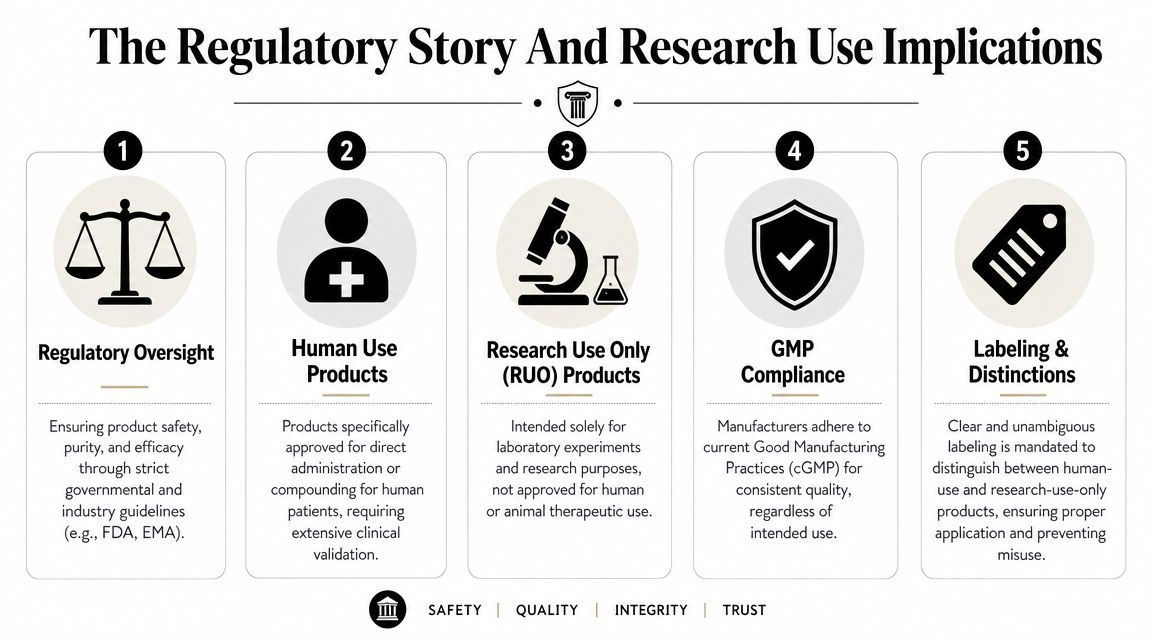
The Regulatory Story And Research Use Implications
Sterile products earn trust one lot at a time. That is why recall history matters. It doesn't only tell a story about what went wrong once. It shows how the manufacturer, regulator, distributor, and end user are supposed to respond when sterility assurance comes into question.
What The 2011 Recall Actually Showed
The FDA recall notice is still one of the clearest examples of why lot verification cannot be treated as paperwork theater. On July 29, 2011, the FDA reported that Hospira issued a voluntary nationwide recall of one lot, W20308, of Bacteriostatic Water for Injection in 30 mL multi-dose vials because sterilization could not be confirmed for some vials. The FDA stated that use of the affected product carried risk of severe outcomes including invasive bacterial infection, bacterial meningitis, and septicemia, while also noting that Hospira had not received reports of adverse events associated with that lot at the time of the notice.
That incident is commercially important for three reasons:
- Lot specificity matters. The recall wasn't a vague market event. It was tied to an identified lot.
- Sterility failures scale quickly. A small sterile product can create a large downstream problem once it enters broad distribution.
- Communication speed matters. Warehouses and resellers need systems that allow immediate quarantine when a notice appears.
If a distributor can't isolate affected inventory by lot, the recall problem has already moved from manufacturing into operations.
Why The Distinction Between Product Categories Matters
The regulatory lesson extends beyond one recall. Buyers often blur the line between products intended for clinical channels and materials sold for laboratory workflows. That confusion creates avoidable legal and quality problems.
A concise explanation of category boundaries appears in this reference on what Research Use Only means. For wholesalers, the key point is simple. Labeling has to match intended distribution. Product claims, storage instructions, and customer-facing descriptions must stay inside the actual regulatory lane of the item being sold.
What works is explicit categorization. What doesn't work is hybrid language that borrows credibility from human-use pharmaceutical products while marketing into research channels without clear distinctions.
A Wholesaler's Guide To Sourcing And Quality Checks
A preventable sourcing failure usually starts the same way. Purchasing clears a shipment before batch records are complete, receiving logs the case but not the lot, and warehouse staff place sterile inventory wherever space is available. By the time a customer asks for documentation, the problem has already moved from procurement into compliance.
What To Inspect On Receipt
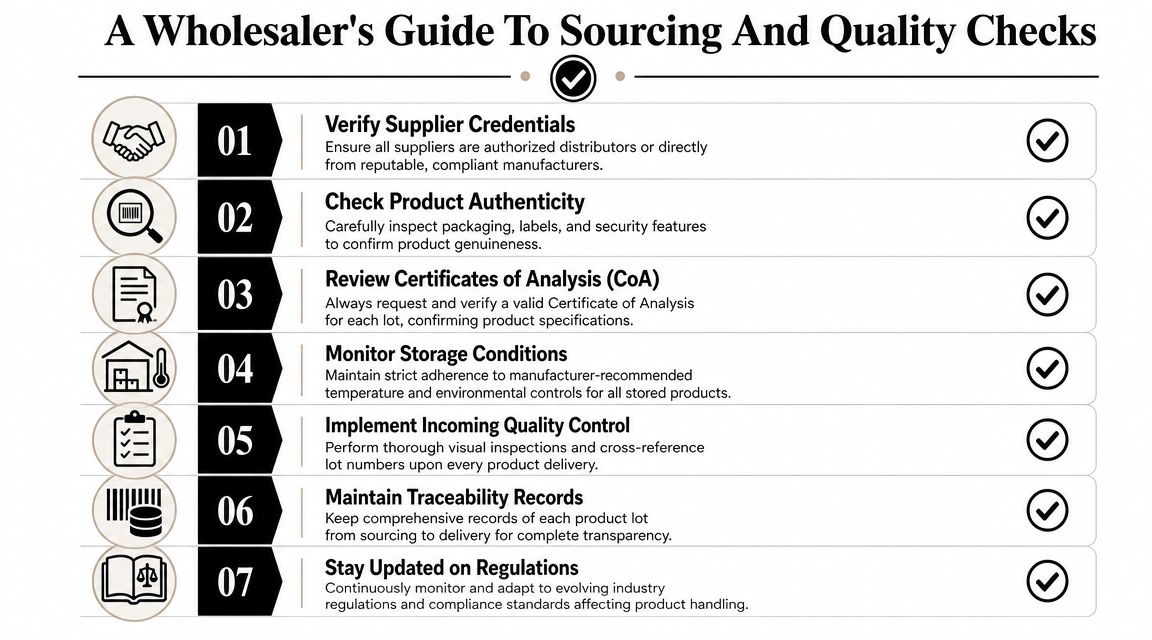
For Hospira bacteriostatic water, receiving is a quality gate, not a clerical step. Storage range, container type, labeling consistency, and lot traceability all need to be confirmed before inventory is released for sale or transfer. As noted earlier, the product is supplied as a multiple-dose container and handled under controlled room-temperature conditions. That should be reflected in both intake procedures and warehouse controls.
A proper receipt inspection covers the shipment itself and the paperwork behind it.
- Supplier authorization. Confirm that the seller is part of a traceable distribution chain with records that can stand up to an audit or customer challenge.
- Label match. Verify the product name, format, preservative statement, and lot data across the vial, carton, packing list, and internal receiving record.
- Seal and container condition. Any sign of tampering, leakage, cracked glass, or label damage should trigger hold status.
- Storage continuity. If transport history is incomplete or storage conditions are unclear, quarantine the lot until quality review closes the gap.
- Document package. Check that the invoice, batch references, and any accompanying quality documents are complete and internally consistent.
Wholesalers often lose margin on sterile products through rework, credits, and blocked shipments rather than through obvious spoilage. A disciplined receipt check prevents those downstream costs.
What Good Traceability Looks Like
Good traceability is routine and easy to audit. A lot should be traceable from supplier qualification to inbound receipt, storage location, outbound shipment, and customer record without reconstructing the file from emails.
The minimum practical record set usually includes:
| Record element | Why it matters |
|---|---|
| Supplier identity | Supports source verification |
| Lot number | Enables quarantine and recall action |
| Receipt date | Anchors inventory chronology |
| Storage location | Confirms handling control |
| Release status | Prevents accidental shipment of held stock |
That record set becomes more important in mixed markets where some buyers expect pharmaceutical-style documentation and others purchase strictly for laboratory workflows. Resellers need a clean internal rule for how the product is categorized, how it is described in listings, and what documentation is provided at sale.
Herbilabs is one example of a supplier that presents bacteriostatic water under a clear Research Use Only framework. For resellers, that kind of category discipline reduces avoidable disputes about intended use, labeling, and customer support scope. It also makes staff training easier. If your team needs a practical reference for customer-facing handling questions, a guide to mixing peptides with bacteriostatic water is more useful than improvised advice from sales or warehouse personnel.
Product integrity is protected by records, segregation, release control, and fast lot retrieval. Sterile inventory should be managed like a traceable risk item, not like general stock.
Choosing Your Reconstitution Solution Partner
A failed lot review usually shows up at the worst point in the order cycle. The stock is received, customer commitments are already in place, and then a basic question cannot be answered quickly: Does the vial label match the batch record, the COA, and the product category under which it was sold?
That is the standard to use when selecting a supply partner for sterile diluents. The right partner reduces verification time, supports release decisions, and gives resellers a clean paper trail for audits, customer complaints, and lot holds. Clear labeling, accessible batch documentation, stable fulfillment, and consistent product classification are purchasing controls, not marketing extras.
What A Reliable Supply Partner Should Provide
Start with identity control. Each unit should be easy to match to the supplier record, easy to place on hold, and easy to trace through storage and shipment. Lot visibility, consistent packaging text, and documentation that matches the physical goods are the minimum practical requirements. Cross-border buyers also need timely answers on discrepancies because a delayed response can stop relabeling, resale release, or customer fulfillment.
Category discipline matters just as much. In mixed markets, suppliers and resellers need unambiguous language around intended use so staff do not drift into unsupported guidance or create listing conflicts across channels. That protects the distributor and keeps customer communications aligned with the actual documentation set.
Educational support has value when it stays within the product's stated use and handling boundaries. A clear mixing guide can reduce avoidable errors in reconstitution practice and lower the volume of improvised advice from sales teams or warehouse staff.
For Bac Water Hospira specifically, procurement should be handled as a controlled sourcing decision. The vial carries specification, sterility, labeling, and traceability implications that affect resale quality, complaint handling, and research reproducibility. Buyers that apply those criteria at vendor selection usually spend less time on preventable holds, returns, and documentation disputes.
Herbilabs supplies sterile diluents and related research materials under a Research Use Only framework, with batch documentation, wholesale availability, and fulfillment structured for professional procurement workflows.