Private Label, White Label, Wholesale partnerships available - EU, USA and UK - Free shipping from €75
9 Benzyl Alcohol Explained for Sterile Diluents
Is “9 benzyl alcohol” a request for a nine-percent formulation, or is the intended product 0.9% benzyl alcohol? That decimal point changes the conversation from a familiar bacteriostatic sterile diluent to a materially different concentration with different safety, compatibility, and regulatory implications.
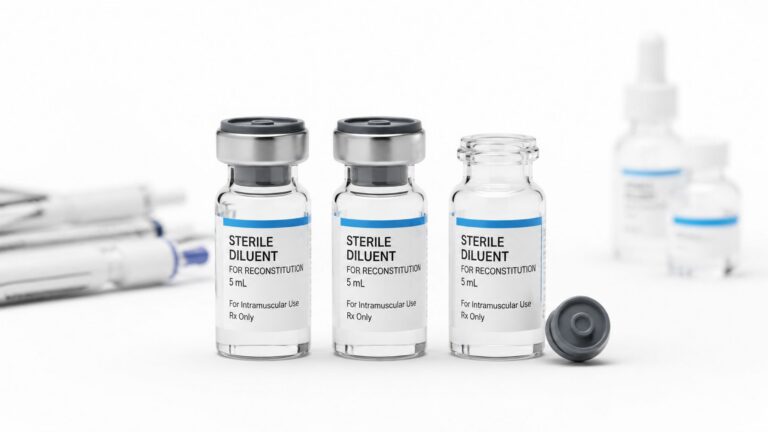
For purchasers, resellers, and research teams, the confusion often begins with a product search, a copied label, or a shortened message from a customer. A buyer may be looking for bacteriostatic water containing 0.9% benzyl alcohol, while a supplier inquiry says “9 benzyl alcohol” without making the decimal clear. Treating those terms as interchangeable can create problems with product selection, documentation, and intended use.
This guide explains what benzyl alcohol is, why it appears in preserved sterile diluents, and how concentration affects the decision. It also addresses a less familiar handling issue, the risk of increased protein aggregation after freeze-thaw exposure in benzyl alcohol-containing biologics. The focus is research-use purchasing and handling, not instructions for human administration or a substitute for an approved product label, pharmacopoeia, or qualified medical assessment.
A practical background on the role of sterile diluents is available in this guide to sterile diluents in research. The central purchasing question remains simple: does the label clearly state 0.9%, or does it specify another concentration?
Table of Contents
- Introduction to Benzyl Alcohol in Sterile Diluents
- What Benzyl Alcohol Is and Why Labs Use It
- How Benzyl Alcohol Works as a Preservative
- Compatibility With Peptides and Biologics
- Safety Toxicity and Regulatory Guidance You Should Know
- Labeling COA and Storage Best Practices for Buyers
- Key Takeaways for Confident Purchasing and Handling
Introduction to Benzyl Alcohol in Sterile Diluents
Why the decimal point matters
The phrase “9 benzyl alcohol” can hide a basic concentration error. In the sterile-diluent context, the relevant formulation is commonly described as 0.9% benzyl alcohol, not 9%. A missing decimal point isn't a cosmetic typo. It can change the preservative load, the suitability of the solution for a particular workflow, and the regulatory interpretation of the product.
A responsible buyer should therefore pause before comparing prices or pack sizes. The first task is to confirm the exact concentration printed on the primary label and supported by the product documentation. A reseller should also preserve that precision in catalog listings, invoices, product pages, and customer communications.
What this guide covers
Benzyl alcohol is used in some bacteriostatic sterile diluents because it can help inhibit bacterial growth in a multi-use container after puncture. That role doesn't make every benzyl alcohol solution interchangeable, and it doesn't mean that a preserved diluent is automatically appropriate for every peptide, protein, patient group, or route of use.
The discussion progresses from molecular identity to preservative behavior, then to compatibility, safety, documentation, and storage. This order matters because a purchaser needs more than a definition. The buyer needs to connect concentration, container use, material compatibility, and intended application before approving stock.
Purchasing rule: Treat “9 benzyl alcohol” as an ambiguity to resolve, not as a product specification.
The guide doesn't provide dosing instructions, injection protocols, or permission to use research-use-only products in people or animals. Those decisions require the applicable product information and qualified oversight. Its purpose is narrower and practical, helping laboratories and distribution partners identify what they're buying and avoid preventable handling mistakes.
What Benzyl Alcohol Is and Why Labs Use It
為什麼實驗室會在某些無菌稀釋液中使用 benzyl alcohol?答案要從它的分子結構和物理性質開始,而不是只看產品名稱或濃度標示。
Benzyl alcohol 是一種 aromatic alcohol,化學式為 C7H8O,CAS 編號為 100-51-6。它的分子由芳香環連接羥甲基組成,因此行為不同於主要用於快速揮發或表面消毒的簡單醇類。
這種化合物無色、略溶於水,揮發性相對較低。PubChem's benzyl alcohol record 列出的沸點約為 205 °C、密度約 1.04 g/mL、20 °C 時蒸氣壓約 0.003 kPa,閃點則依測定方法約為 93 至 194 °F。這些資料說明它加入配方後,不會像高揮發性溶劑一樣迅速逸散。
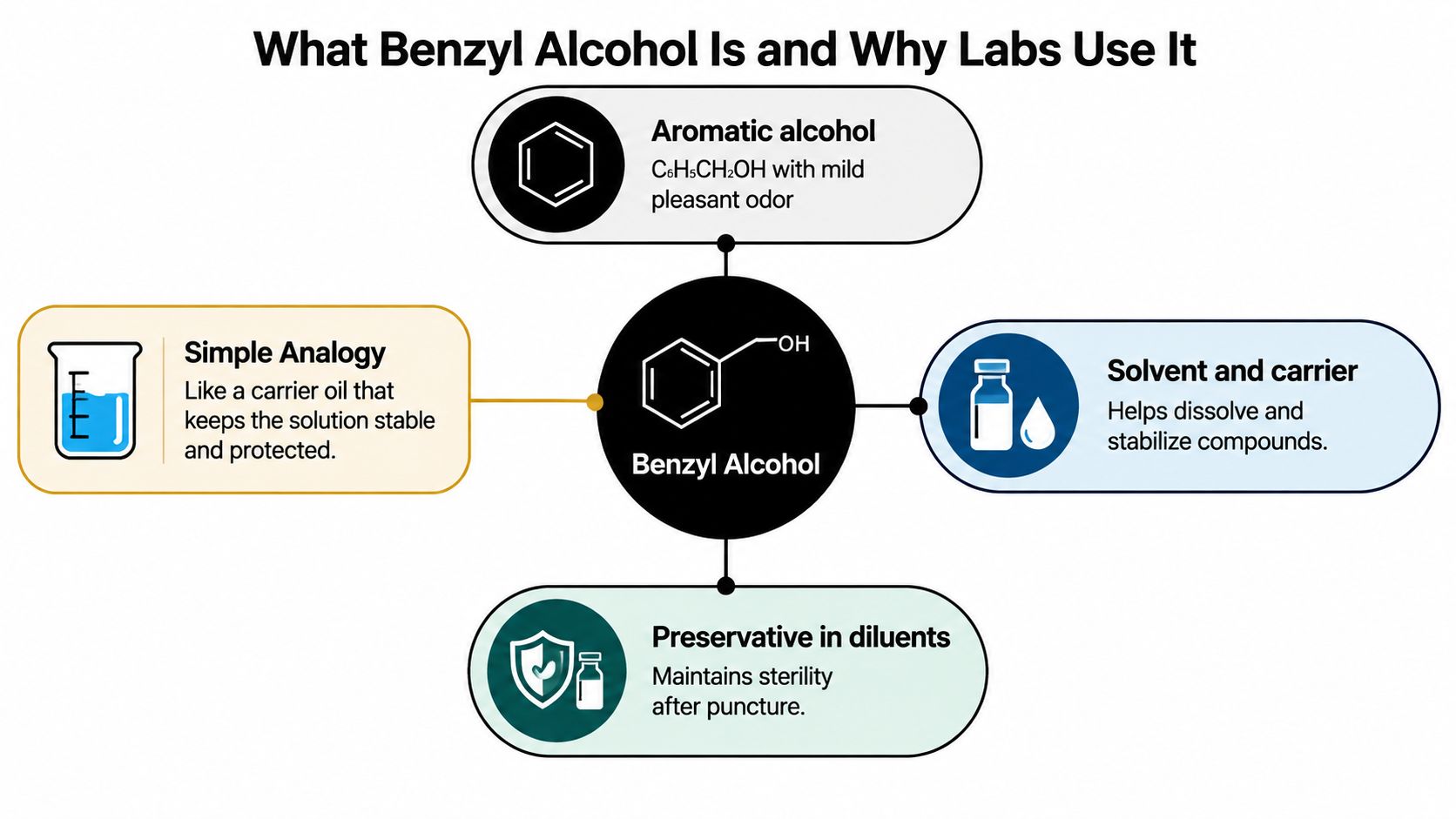
它更像液體系統中的載體
可以把 benzyl alcohol 理解成液體配方中的 受控載體。高揮發性溶劑像很快離開房間的信使,benzyl alcohol 則較長時間留在配方裡,為相容成分維持可操作的液體環境。
這個比喻不代表它能溶解所有物質,也不代表任何生物製品加入後都能保持穩定。它的價值在於揮發受限,同時具備一定的水相容性,因此可在適合的系統中充當溶劑或載體。對無菌稀釋液而言,更需要關注的是它作為防腐成分的角色,而非把它當成專門溶解目標材料的工具。
化學歷史提供了背景
Benzyl alcohol 在早期有機化學中已有重要地位。1832 年,Liebig 和 Wöhler 以苦杏仁油中的 benzaldehyde 製得 benzyl alcohol。1853 年,Cannizzaro 進一步確定其結構。International Chemical Safety Card for benzyl alcohol 也提到,Cannizzaro 的研究涉及 Cannizzaro reaction。在鹼性條件下,benzaldehyde 會歧化形成 benzoic acid 和 benzyl alcohol。
對今日的實驗室採購者而言,這段歷史主要是背景,不能取代產品核對。較實用的判讀方式是:
- Identity: 具明確化學式和 CAS 編號的芳香醇。
- Physical behavior: 揮發性低、可燃,且在水中的溶解度有限。
- Formulation role: 在相容系統中作為溶劑或載體。
- Sterile-diluent role: 在特定多次使用產品中作為防腐成分。
最後一點必須和無菌本身分開理解。Benzyl alcohol 可支援抑菌配方,但不能取代經驗證的製造流程、容器密封、無菌操作或正確儲存。採購時,應把化學身份、配方用途和產品文件放在同一張核對表上。
How Benzyl Alcohol Works as a Preservative
A preserved sterile diluent and a single-use sterile water product solve different operational problems. A multi-use vial may be punctured repeatedly, creating opportunities for accidental contamination. A bacteriostatic preservative helps inhibit bacterial growth in the formulation, but it isn't a license to ignore aseptic handling or reuse a container beyond its stated instructions.
The important word is bacteriostatic. In plain language, the preservative creates conditions that make bacterial growth and replication more difficult. That differs from claiming that the solution instantly kills every microorganism introduced into a vial. The practical benefit is growth control, not guaranteed decontamination.
Why 0.9% is not the same as 9%
The commonly discussed bacteriostatic sterile-diluent formulation uses 0.9% benzyl alcohol. The percentage identifies the concentration of the preservative in the finished solution. Writing 9% instead removes the decimal and describes a tenfold higher numerical concentration, which should never be treated as an equivalent label or a harmless shorthand.
The safety profile of a preservative depends on how much is present, how it enters the body, who is exposed, and what the formulation contains. More preservative doesn't automatically mean better protection. It can increase the chemical burden and create compatibility or toxicity concerns without making the product appropriate for a particular use.
What the molecule does in a vial
Benzyl alcohol can interfere with microbial cell functions, including membrane-related processes. That action helps slow bacterial growth in a compatible formulation. The outcome depends on the organism, the surrounding ingredients, the container, the exposure conditions, and the validated product design.
Its physical properties also matter operationally. The PubChem reference describes benzyl alcohol as slightly water-soluble, with a boiling point around 205 °C, density about 1.04 g/mL, and low vapor pressure near 0.003 kPa at 20 °C. A lower-volatility carrier can remain available in the liquid phase, but that characteristic doesn't establish sterility or prove compatibility with a sensitive biologic.
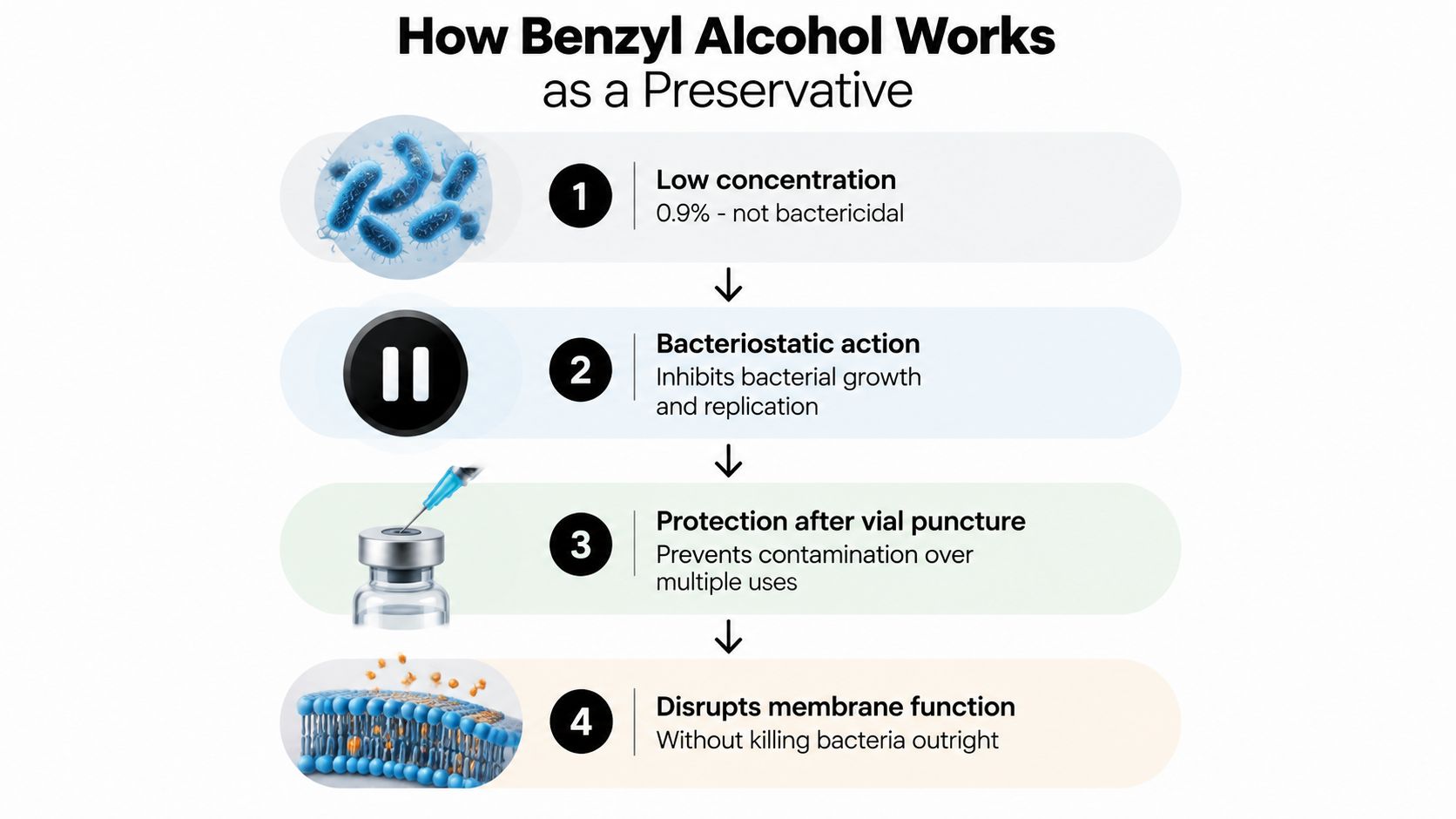
Operational distinction: Bacteriostatic means growth is inhibited. It doesn't mean contaminated material has been sterilized.
For buyers, concentration accuracy is therefore part of product identity. A vial labeled 0.9% benzyl alcohol belongs in a different decision category from a raw benzyl alcohol material, a cosmetic formulation, or a solution with an unclear concentration. A certificate of analysis, lot information, sterility documentation, and intended-use statement should support the label.
Compatibility With Peptides and Biologics
Compatibility decisions become more difficult when a diluent meets a sensitive biological material. A small peptide and a larger protein biologic don't necessarily respond to the same solvent environment, and a formulation that looks clear immediately after reconstitution may still undergo later changes.
A useful decision matrix keeps the question practical:
| Use Case | Recommended Diluent | Key Consideration |
|---|---|---|
| Research peptide where the supplier or protocol specifies a preserved diluent | A validated benzyl alcohol-containing sterile diluent | Confirm the formulation, intended use, and documented compatibility before use |
| Protein biologic or other aggregation-sensitive material | Preservative-free sterile water or another specified diluent, where appropriate | Follow the material's handling documentation and avoid assuming that a preservative improves stability |
| Single-use reconstitution with no need for repeated withdrawals | Sterile, preservative-free diluent when specified | A preservative may provide no useful advantage in a single-use workflow |
| Multi-use research vial designed for repeated access | Validated bacteriostatic diluent, if explicitly compatible | Preservative activity doesn't remove the need for aseptic technique or storage control |
The freeze-thaw issue
A recent PubMed study on benzyl alcohol and freeze-thaw-induced protein aggregation found that benzyl alcohol can exacerbate aggregation after freeze-thaw exposure in proteins. The study explicitly recommends avoiding frozen storage of benzyl alcohol-containing biologics and keeping reconstituted products at 2–8 °C.
That finding changes the usual purchasing conversation. Benzyl alcohol is often discussed only as a preservative, but the formulation can also influence how a protein behaves during a common handling error. Freezing, thawing, and delayed refrigeration can therefore create a stability problem even when the vial remains visually acceptable.
A practical comparison
For peptide workflows, the deciding factor should be the product-specific protocol and documented compatibility, not a general belief that bacteriostatic water is always preferable. For protein biologics, the threshold for caution is higher because aggregation can affect product quality without producing an obvious color or clarity change.
A methodical guide to peptide reconstitution can help teams organize the workflow, but it shouldn't override the material manufacturer's instructions. Resellers should communicate the storage requirement clearly, especially where customers may assume that a preserved diluent makes a reconstituted biologic suitable for freezing.
Safety Toxicity and Regulatory Guidance You Should Know
“Is benzyl alcohol safe?” is too broad a question to answer responsibly. The useful answer depends on route, concentration, formulation, duration, and patient group. A substance can be accepted in one product category while requiring restrictions or avoidance in another.
The modern regulatory picture reflects that distinction. The U.S. FDA approved a 5% benzyl alcohol lotion in 2009 for head lice treatment in patients aged 6 months and older, and an earlier FDA action in 2003 approved benzyl alcohol as a prescription treatment for head lice. Those approvals concern specific products and routes. They don't establish that a laboratory diluent is suitable for human treatment.
Why population changes the assessment
Neonates and premature infants require particular caution. Health Canada's discussion of benzyl alcohol notes that preservative-containing flush solutions are specifically avoided in neonates, while benzyl alcohol remains acceptable in many cosmetic and over-the-counter contexts. The same guidance describes restrictions in some Canadian natural health products and proposed maximum levels lowered from 3% to 1% for certain leave-on products, as detailed by Health Canada's benzyl alcohol guidance.
The point isn't that one jurisdiction has a universal answer. The point is that product category and vulnerable population matter. A cosmetic ingredient listing, a topical medicine, an injectable excipient, and a research-use sterile diluent shouldn't be judged by the same shortcut.
Exposure is not a single number
The literature cited by benzyl alcohol safety and pharmacology references gives a World Health Organization acceptable daily intake of 5 mg/kg for benzyl alcohol, benzoic acid, and sodium benzoate. The same reference describes possible human exposure through cosmetics, food, and drugs of up to 1.9 × 10^8 g per year, or about 400,000 pounds annually.
Those figures describe exposure assessment and broad use, not permission to apply a laboratory product to people. A buyer interpreting a label should ask whether the stated concentration, route, population, and intended use match the applicable regulatory framework.
Teams evaluating new formulations may also benefit from broader methods for safer materials with AI, especially when comparing preservatives, carriers, and alternative excipients during early development.
Labeling COA and Storage Best Practices for Buyers
A reliable purchasing workflow starts before the vial reaches the refrigerator. The label, product page, and certificate of analysis should tell the same story. If one document says bacteriostatic water, another says sterile diluent, and a third omits the benzyl alcohol concentration, the supplier should resolve the discrepancy before shipment or resale.
Read the label as a specification
The primary label should identify the product, concentration, lot or batch reference, volume, storage information, and intended-use status. For a research-use bacteriostatic diluent, the concentration should be written clearly as 0.9% benzyl alcohol, not as “9 benzyl alcohol” or an unqualified reference to benzyl alcohol.
A buyer can use this short intake check:
- Concentration: Confirm that the stated preservative level matches the purchase order and product documentation.
- Identity: Check the diluent name, manufacturer, lot number, and expiration or retest information.
- Sterility: Review the supplier's sterility documentation and inspect the container closure.
- Physical condition: Reject or quarantine vials with damaged seals, visible particles, leaks, or unexplained discoloration.
- Status: Confirm whether the product is marked Research Use Only and keep that status intact in reseller listings.
The guide to reading a certificate of analysis can help purchasers interpret lot-specific information instead of relying only on a marketing description.
Storage and multi-use handling
Storage instructions belong to the exact product, so a supplier's label takes priority over a generic checklist. A buyer should protect stock from unsuitable temperature excursions, direct light where the label advises avoidance, and repeated handling that compromises the closure.
Reconstituted biologics containing benzyl alcohol deserve special attention. The PubMed finding discussed above supports avoiding frozen storage and maintaining reconstituted products at 2–8 °C. That recommendation concerns product stability, not merely preservative performance.
Reseller safeguard: Keep the original storage language, concentration, intended-use statement, and lot information visible throughout the distribution chain.
A multi-dose vial still requires disciplined aseptic access. Preservative activity can reduce the risk of bacterial growth, but it doesn't make repeated punctures risk-free, and it doesn't extend a product's beyond-use period beyond the manufacturer's stated instructions. Buyers should never replace documented handling limits with an assumed calendar rule.
Key Takeaways for Confident Purchasing and Handling
The “9 benzyl alcohol” search phrase should trigger a concentration check. In the sterile-diluent context, the critical distinction is between a clearly specified 0.9% benzyl alcohol formulation and an ambiguous or incorrectly written 9% description. The decimal point belongs on the label, purchase order, certificate of analysis, and reseller listing.
A confident buyer also separates three questions that are often blended together:
- Does the product contain the stated preservative concentration?
- Is the diluent compatible with the intended peptide or biologic?
- Does the storage and use pattern protect product integrity?
For protein biologics, freeze-thaw exposure is a specific concern because benzyl alcohol can worsen aggregation under those conditions. Reconstituted benzyl alcohol-containing biologics should not be frozen by default, and the cited study recommends 2–8 °C storage. That decision belongs in the handling SOP, not as an afterthought once a shipment arrives.
A procurement checklist should include:
- Exact concentration and product identity.
- Lot-specific COA and sterility information.
- Clear Research Use Only labeling where applicable.
- Container and seal inspection at receipt.
- Storage instructions copied into internal records.
- Compatibility confirmation from the material's documentation.
- Customer-facing communication that avoids turning a research product into a medical-use claim.
Herbilabs offers sterile, non-pyrogenic research-use reconstitution solutions containing 0.9% benzyl alcohol, with product documentation intended to support laboratory purchasing and distribution workflows. The product should still be evaluated against the buyer's own protocol, storage capacity, and compliance requirements.
Laboratories and resellers can visit Herbilabs to review sterile diluents, product documentation, and research-use purchasing options. Before placing an order, teams should confirm the exact concentration, required storage conditions, and compatibility needs for the peptide or biologic involved.