Private Label, White Label, Wholesale partnerships available - EU, USA and UK - Free shipping from €75

0.9 Sodium Chloride Is Normal Saline: A Researcher’s Guide
0.9% sodium chloride solution, containing 9 grams per liter and 154 mmol/L each of sodium and chloride, is chemically defined as normal saline. Its calculated osmolarity is about 308 mOsm/L, making it isotonic in common clinical use, although its composition isn't identical to human extracellular fluid.
A researcher usually meets the label during a rushed preparation. A bottle sits beside a cell suspension, a dilution series, or an injection-grade supply, and the shorthand “0.9% NaCl” appears self-explanatory. It isn't. The concentration, ionic balance, sterility status, container format, and intended use all affect whether that bottle belongs in a particular workflow.
For laboratory teams, the useful question isn't only whether 0.9 sodium chloride is normal saline. It's whether the formulation matches the biological system, assay, handling conditions, and documentation requirements. The chemistry explains why the solution became standard. The practical details explain when that standard remains appropriate.
Table of Contents
- Understanding What Normal Saline Actually Is
- The Science Behind Isotonicity and Physiological Relevance
- Common Laboratory and Clinical Applications
- Storage Requirements and Sterility Considerations
- Handling Cautions and Safety Protocols for Researchers
- Supply Chain Realities and Sourcing for Lab Buyers
- Historical Origins and Why the Label Stuck
Understanding What Normal Saline Actually Is
A new graduate researcher may read “0.9% sodium chloride” and interpret the percentage as a small amount of salt in an otherwise ordinary water preparation. In technical terms, 0.9% sodium chloride, commonly called normal saline, means 9 grams of sodium chloride dissolved per liter of water. That solution provides 154 mmol/L of sodium and 154 mmol/L of chloride, with an osmolarity of about 308 mOsm/L, as described in this review of normal saline composition and clinical use.
The label becomes more useful when translated into bench quantities. Every 100 mL contains 15.4 mEq of sodium and 15.4 mEq of chloride, so a standard 1-liter bag delivers 154 mEq of each ion. Those values help researchers compare a saline product with a protocol, calculate the ionic contribution of a dilution, and identify whether a substitute has the same composition or only a similar appearance.
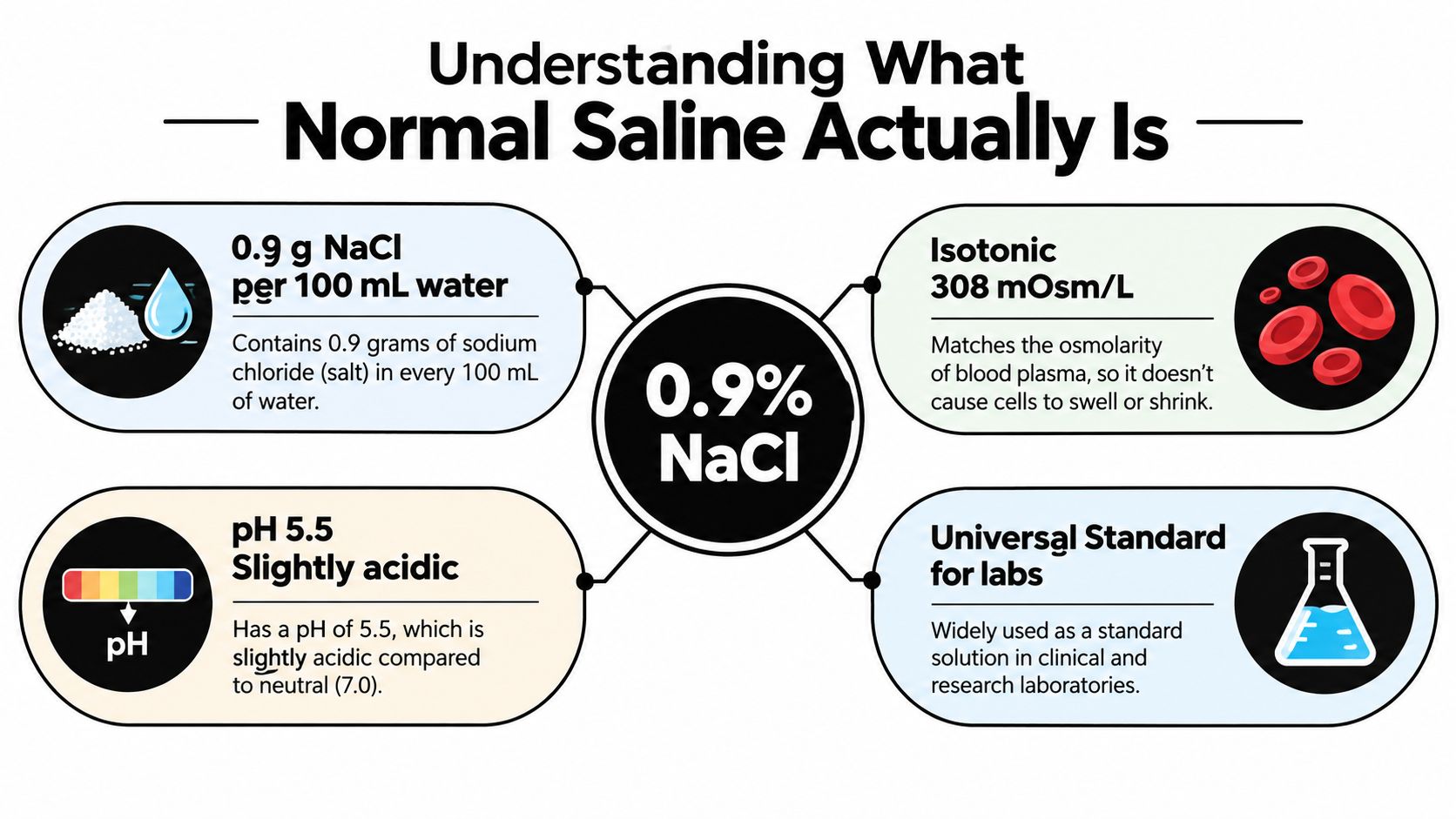
Why the percentage matters
The word normal describes a longstanding clinical convention, not a claim that the liquid perfectly reproduces extracellular fluid. Sodium chloride separates into sodium and chloride ions in solution, and those ions contribute to osmotic behavior. That predictable tonicity is why the formulation has remained useful for dehydration management, drug dilution, and chloride replacement in hospital practice.
For a lab, the most important distinction is between a chemical identity and a product specification. Two containers can both say saline while differing in sterility assurance, packaging, preservatives, grade, or intended route of use. A researcher should therefore read the full label and certificate of analysis rather than relying on the short product name.
Bench rule: “0.9% NaCl” identifies the nominal salt concentration. It doesn't, by itself, confirm that a product is sterile, injection-grade, preservative-free, or suitable for a specific assay.
The Science Behind Isotonicity and Physiological Relevance
Isotonicity describes a solution's effective osmotic relationship with cells or another reference fluid. If the surrounding solution is close enough in osmotic strength, water doesn't move rapidly into or out of cells. That reduces the risk of immediate swelling or shrinking during routine handling.
Normal saline is classified as a true isotonic crystalloid in common clinical use. Its labeled composition is 154 mmol/L sodium and 154 mmol/L chloride, and its calculated osmolarity is about 308 mOsm/L. For comparison, the typical plasma osmolality range is 275–295 mOsm/kg, so normal saline is close to plasma but slightly higher, according to the clinical reference on sodium chloride solutions.
Isotonic doesn't mean fully physiological
A frequent laboratory mistake is treating isotonic and physiological as interchangeable. Human extracellular fluid commonly contains chloride around 103 mmol/L, while normal saline contains 154 mmol/L, a difference of 51 mmol/L documented in the composition review of 0.9% saline. The solution can therefore protect against a large immediate osmotic gradient while still exposing cells or the circulation to more chloride than they normally encounter.
That distinction matters during repeated washes, large-volume exposure, or experiments sensitive to ionic strength. A cell may tolerate a brief isotonic rinse, yet a protein assay, enzyme system, or cell culture workflow may respond to chloride concentration, pH, buffering capacity, or the absence of other ions. Normal saline also has no meaningful buffering system for maintaining a defined experimental pH.
Choosing between saline and water
Sterile water and normal saline aren't interchangeable diluents. Water has a very different osmotic effect, while saline introduces sodium and chloride that can alter the final formulation. A useful saline versus sterile water comparison helps frame the decision around the biological target rather than the convenience of whichever container is closest.
When a protocol calls for isotonic handling, saline may be appropriate. When a formulation requires a defined buffer, controlled pH, calcium-free conditions, or a particular ionic environment, a validated buffer or formulation vehicle may be safer. The researcher should calculate the final composition after dilution, not assume that a small saline addition is chemically neutral.
Common Laboratory and Clinical Applications
Normal saline earns its place in routine workflows because it combines a known salt concentration with predictable tonicity. A clinical team may use it for fluid replacement or medication dilution, while a laboratory team may use it for washing, suspension, or a controlled dilution step. The same label can therefore appear across very different applications, but each application still depends on the product's grade and sterility.
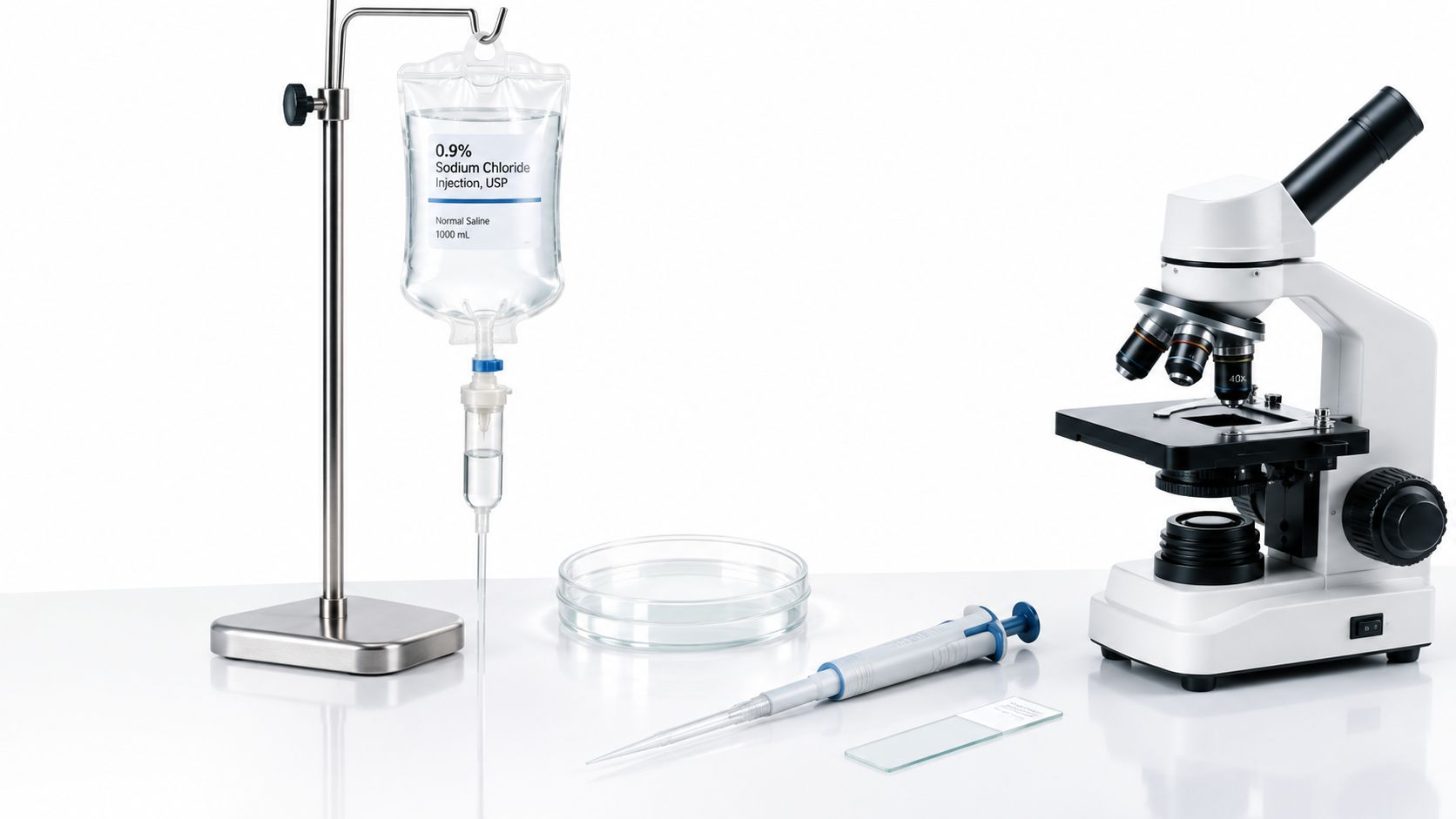
Where the formulation fits
- Cell handling: Researchers may use isotonic saline for short washes or temporary suspensions when the protocol permits sodium chloride and doesn't require nutrients or a full culture medium.
- Drug and reagent dilution: Injection-grade products can serve as diluents when compatibility, route, and manufacturer instructions support that use. The sodium chloride injection USP guidance is relevant when teams need to distinguish a clinical preparation from a general laboratory solution.
- Analytical preparation: Saline can provide a repeatable ionic environment for selected assays, but it shouldn't replace a method-specific buffer without validation.
- Clinical workflows: Hospitals use normal saline for dehydration management, intravascular volume expansion, drug dilution, and chloride replacement because its composition and tonicity are well established.
A researcher should check whether the procedure needs isotonicity alone or a more complete physiological environment. A saline wash may be suitable for a brief handling step, while cells maintained over time generally need the nutrients, gases, buffering, and additional ions supplied by a defined culture medium.
A short visual demonstration can help new staff connect the label, the container, and the workflow:
Before use, the operator should confirm the concentration, intended use, sterility statement, expiration date, container integrity, and compatibility with the protocol. The product should remain in its original container until needed, and any transfer into another vessel should preserve traceability.
Storage Requirements and Sterility Considerations
A sealed saline container is a controlled product. An opened container is a new contamination risk. That difference matters more than the apparent simplicity of sodium chloride in water.
Unopened bags, bottles, and vials should remain within the manufacturer's storage conditions and should be inspected before use. The assigned storage range, protection from freezing or excessive heat, expiration date, and packaging instructions take priority over informal bench habits. A clear solution isn't proof of sterility, but cloudiness, particles, leaks, damaged seals, or unusual discoloration are reasons to quarantine the container.
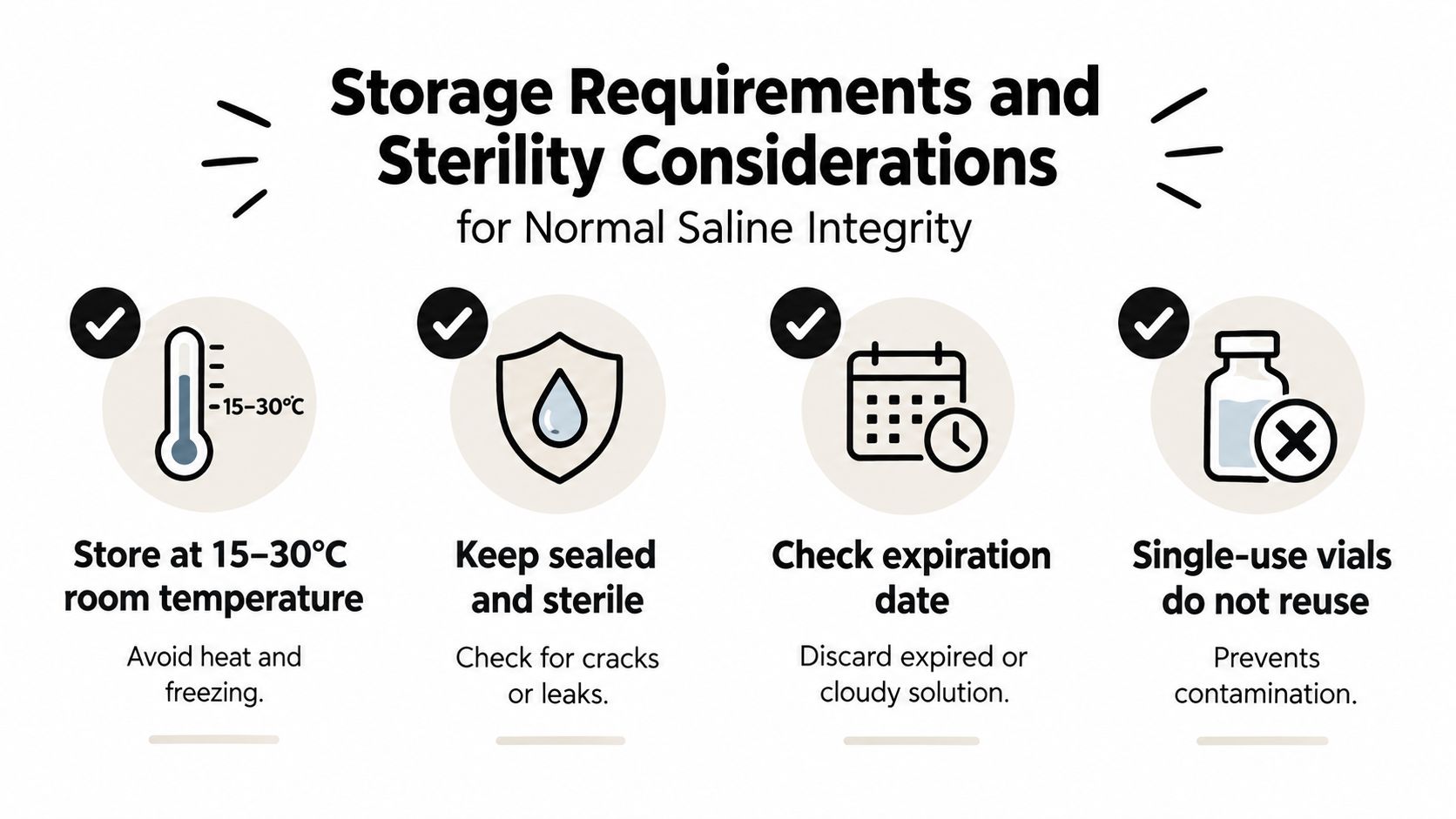
Sealed versus opened containers
| Container status | Main concern | Practical response |
|---|---|---|
| Sealed and intact | Expiration, temperature exposure, packaging damage | Verify the label and inspect before opening |
| Opened during a workflow | Microbial and particulate contamination | Record opening details and follow the product instructions |
| Accessed repeatedly | Closure integrity and aseptic failure | Prefer a validated single-use format when feasible |
| Cloudy or visibly altered | Possible contamination or incompatibility | Do not use it in a sensitive workflow |
A single-use vial often reduces ambiguity because the team doesn't need to manage repeated access. Multi-dose formats may be appropriate only when the product and procedure explicitly support them, with access controlled through aseptic technique and documented handling.
A practical inspection routine
Before dispensing saline, the researcher should check the container, solution, label, and records. The cap or stopper must remain untouched by gloved fingers, the access point should be disinfected according to local procedure, and the container shouldn't be left open between steps. If the workflow requires a specialized sterile diluent, water for injection guidance can help clarify why sterility and intended use must be evaluated together.
Practical insight: A chemically correct solution can still be unusable after poor handling. Sterility is a property of the product and its lifecycle, not just its ingredient list.
Handling Cautions and Safety Protocols for Researchers
Normal saline looks harmless because its ingredients are familiar. The risk comes from using the wrong grade, compromising sterility, or overlooking how the solution changes the final experimental mixture.
A researcher should begin with the product designation. Injection-grade sodium chloride is manufactured and labeled for a regulated clinical purpose, while a Research Use Only product belongs within laboratory research and development. Neither designation automatically makes the product suitable for every experiment. The protocol, route, sterility requirement, preservative profile, and intended biological contact still need to match.
Protecting the experiment
Aseptic handling should be routine rather than dramatic. The operator should prepare a clean workspace, wash or sanitize hands according to site procedure, disinfect the access surface, avoid touching sterile closures, and use sterile equipment when the workflow requires it. Containers should be labeled clearly after opening, with the relevant identity and handling information preserved.
Normal saline can also introduce variables that aren't obvious from its name. Its chloride-rich composition may affect acid-base status after large-volume exposure, and it may be unsuitable where a protocol requires a defined buffer or a different electrolyte profile. A saline solution can also be isotonic while still being a poor choice for a sensitive protein or cell system.
Procurement and documentation
Quality control begins before delivery. A buyer should request a current certificate of analysis when required, verify lot traceability, confirm the container format, and document substitutions rather than allowing an informal replacement at the bench. If the supplier changes packaging, labeling, or product classification, the laboratory should assess whether the change affects validation, storage, dispensing, or downstream records.
Safety principle: The safest substitute is not the product with the closest name. It's the product whose composition, sterility, grade, and intended use have been checked against the procedure.
Any use involving humans, animals, injection, or clinical care requires the appropriate institutional and regulatory oversight. Research staff should also follow the manufacturer's instructions and the laboratory's approved standard operating procedures, especially when a saline product is used in a biologically sensitive system.
Supply Chain Realities and Sourcing for Lab Buyers
Laboratory buyers face a different problem from clinicians selecting a fluid at the point of care. Procurement teams must maintain continuity, compare container formats, preserve lot traceability, and avoid substitutions that alter the experimental system.
Recent market coverage describes continued demand growth for parenteral-use 0.9% sodium chloride. One 2026 market projection estimates growth from USD 3.99 billion in 2026 to USD 5.53 billion by 2031, while another projection cited in the same market coverage estimates USD 4.17 billion in 2026 and USD 7.15 billion by 2034. These are projections, not established outcomes, and buyers should treat them as signals about market planning rather than guarantees, as detailed in the normal saline parenteral-use market analysis.
What buyers should compare
The nationwide shortage of sodium chloride 0.9% injection products had been resolved according to a 2025 FDA update, also discussed in that market source. Resolution doesn't eliminate procurement risk. Availability can still vary by country, supplier, pack size, shipping route, and product classification.
| Metric | Value | Implication for researchers |
|---|---|---|
| Projected parenteral-use market | USD 3.99 billion in 2026 to USD 5.53 billion by 2031 | Demand planning should distinguish market growth from guaranteed local availability |
| Alternative projection | USD 4.17 billion in 2026 to USD 7.15 billion by 2034 | Forecasts differ, so procurement teams should avoid relying on one estimate |
| Nationwide injection shortage status | Resolved in the 2025 FDA update | Buyers should focus on consistency, packaging, and substitution controls |
A comprehensive purchasing file records concentration, grade, sterility, container type, supplier, lot, expiration, shipping requirements, and approved use. Flushes, prefilled syringes, intravenous bags, and research vials may not be interchangeable merely because they contain sodium chloride at the same nominal concentration. Their devices, labeling, intended use, and handling instructions can differ across markets.
Herbilabs offers sterile diluents and sodium chloride products for research workflows, with product documentation and a Research Use Only framework that buyers can evaluate alongside other qualified suppliers. The deciding factor should remain documented fit for purpose, not a familiar product name.
Historical Origins and Why the Label Stuck
The word “normal” suggests a natural reference point, but the history of 0.9% saline tells a more complicated story. Early saline use in Europe was stimulated by urgent medical needs, including the 1831 cholera pandemic, although the modern 0.9% formulation didn't yet exist at that time.
The modern concentration is usually linked to late nineteenth-century physiology research. Historical reviews note that Joseph Hamburger likely formulated 0.9% sodium chloride in 1896 after observing a freezing point similar to human blood, as discussed in this historical review of normal saline.
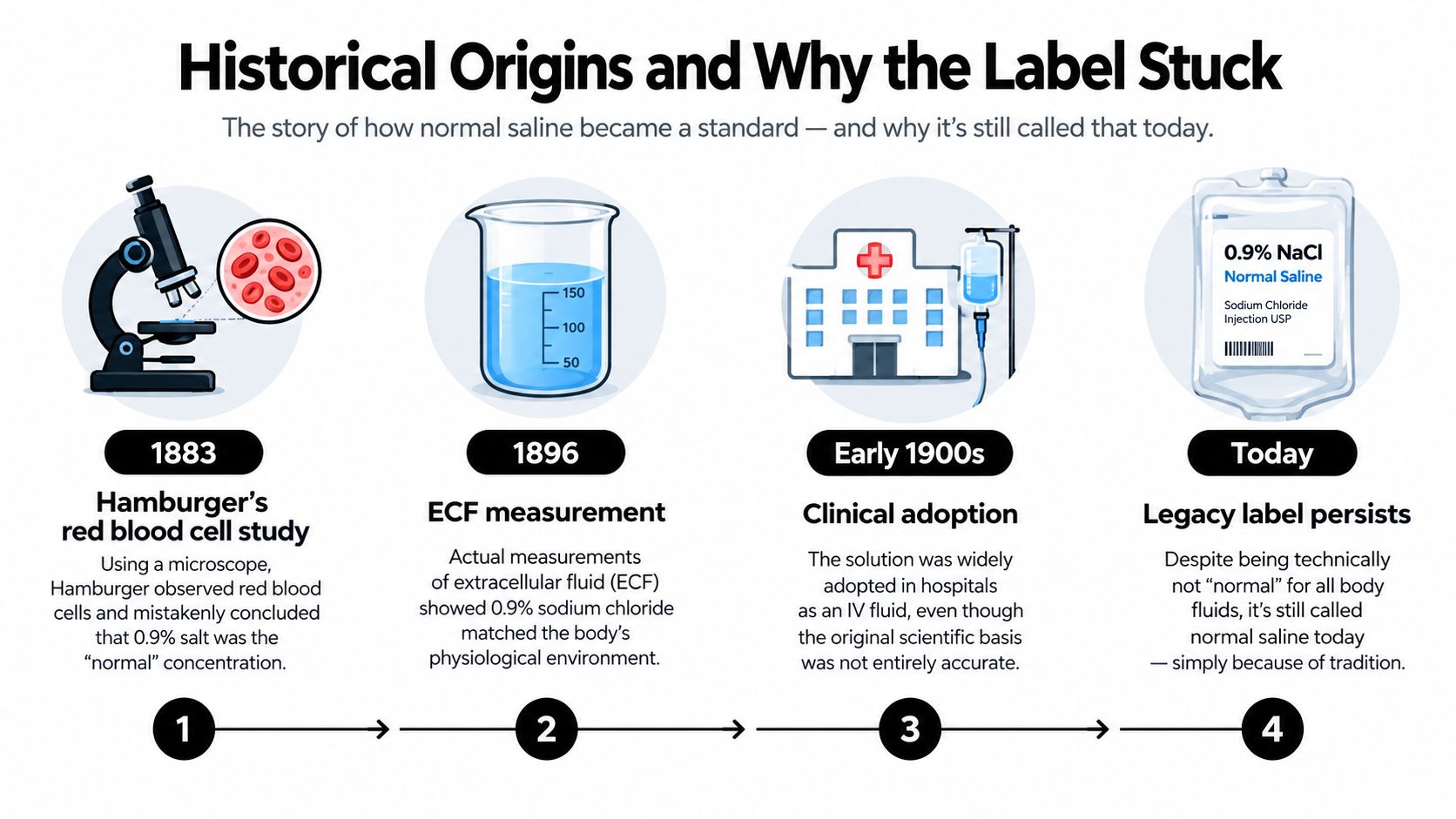
A useful historical correction
The formulation's freezing point helped establish its reputation as similar to blood in one important physical property. Later comparison showed that its electrolyte composition differs from human extracellular fluid, particularly in chloride concentration. The label therefore reflects historical standardization and clinical convention more than exact physiological matching.
That correction matters in modern laboratories. A researcher who understands the origin of the name is less likely to treat “normal saline” as a universal replacement for every biological fluid, buffer, or sterile water preparation. The solution remains highly useful, but its usefulness comes from predictable chemistry, not from being a perfect replica of plasma.
Supply-chain controls also belong in this broader picture. Laboratories, hospitals, and pharmaceutical facilities depend on secure storage, access control, and traceable handling, so teams evaluating facility risk may also review resources on security for pharmaceutical sites. Protecting the physical inventory supports the same goal as checking a certificate of analysis, preserving reliable materials for reliable work.
The informed researcher reads beyond the familiar label. That means checking ionic composition, product grade, sterility, packaging, intended application, and supplier documentation before the container reaches a sensitive workflow.
Herbilabs supplies sterile research diluents, including sodium chloride formulations, with product documentation suited to laboratory purchasing and Research Use Only workflows. Visit Herbilabs to review available formats and select a saline product that matches the laboratory's handling, sourcing, and documentation requirements.


