Private Label, White Label, Wholesale partnerships available - EU, USA and UK - Free shipping from €75

What Is Cold Chain Logistics
Cold chain logistics is the coordinated, end-to-end control of specified temperature conditions during storage, handling, packaging, transportation, and delivery of temperature-sensitive products. The worldwide market was roughly US$371.4 billion in 2024 and is projected to reach about US$1.46 trillion by 2033, at a 16.39% CAGR. Astute Analytica's cold chain logistics market estimate
A laboratory shipment can look routine on paper. A manufacturer releases a reagent, a warehouse stores it, a fulfillment team packs it, a courier moves it through several depots, and a research facility receives it. Yet every opening of a loading-bay door, transfer between carriers, delay at customs, and decision at the receiving bench can affect whether that reagent remains usable.
That's why cold chain logistics means more than putting a parcel in a refrigerator. It's a controlled process in which temperature limits, time, packaging, monitoring, handling, documentation, and accountability work together. Each handoff either preserves the product's condition or introduces a risk that the next stage must manage.
Table of Contents
- What Is Cold Chain Logistics
- How Temperature-Sensitive Products Move
- Core Components of a Reliable Cold Chain
- Temperature Needs Across Product Classes
- Regulatory and Compliance Expectations
- Best Practices for Laboratory Suppliers
- Last-Mile Risks and Operating Realities
- Conclusion and Partner Evaluation
What Is Cold Chain Logistics
A shipment of temperature-sensitive laboratory material begins long before a courier collects the parcel. At the manufacturing site, personnel release the product against its specifications and place it into qualified storage. The order team then checks the product's required condition, selects a suitable pack-out, adds monitoring equipment where appropriate, and records the batch and shipment details.
During transport, the parcel might move from a warehouse to a line-haul carrier, from that carrier to a regional depot, and from a local courier to the research facility. At each point, the people handling it need clear instructions. A box can remain physically intact while its contents experience an unacceptable temperature excursion.
Cold chain logistics is the coordinated control of a specified temperature condition across the complete product journey. It covers storage, staging, packaging, transport, delivery, receipt, monitoring, records, and responses to deviations. The required condition comes from the product label, supplier instructions, formulation, stability data, or applicable quality requirements. There isn't one universal “cold” setting that suits every laboratory product.
A basic refrigerated shipment may rely on a chilled vehicle or insulated box and a delivery target. A more mature cold chain adds validated packaging, qualified storage, calibrated sensors, documented handoffs, continuous or appropriately timed data logging, and a defined excursion process. Those controls allow a supplier and recipient to determine not only where the parcel went, but whether the product remained within an acceptable condition.
Practical rule: A cold chain is defensible only when the product's temperature history and handling decisions can be reconstructed after delivery.
The modern system developed through advances in refrigeration and transport. In 1877, Carl von Linde developed the first industrial refrigerator, and in 1938 Joseph Numero and Frederick McKinley Jones founded the U.S. Thermo Control Company. Two years later, they patented a truck-mounted refrigeration unit, making long-distance refrigerated transport practical. Statista's historical overview of the cold chain logistics market
For laboratory suppliers, the central question isn't whether a product was shipped cold. It's whether every operational handoff protected the condition that the product requires.
How Temperature-Sensitive Products Move
A useful cold chain map follows the product, the temperature condition, and the records together. The journey usually contains connected stages rather than isolated logistics tasks.
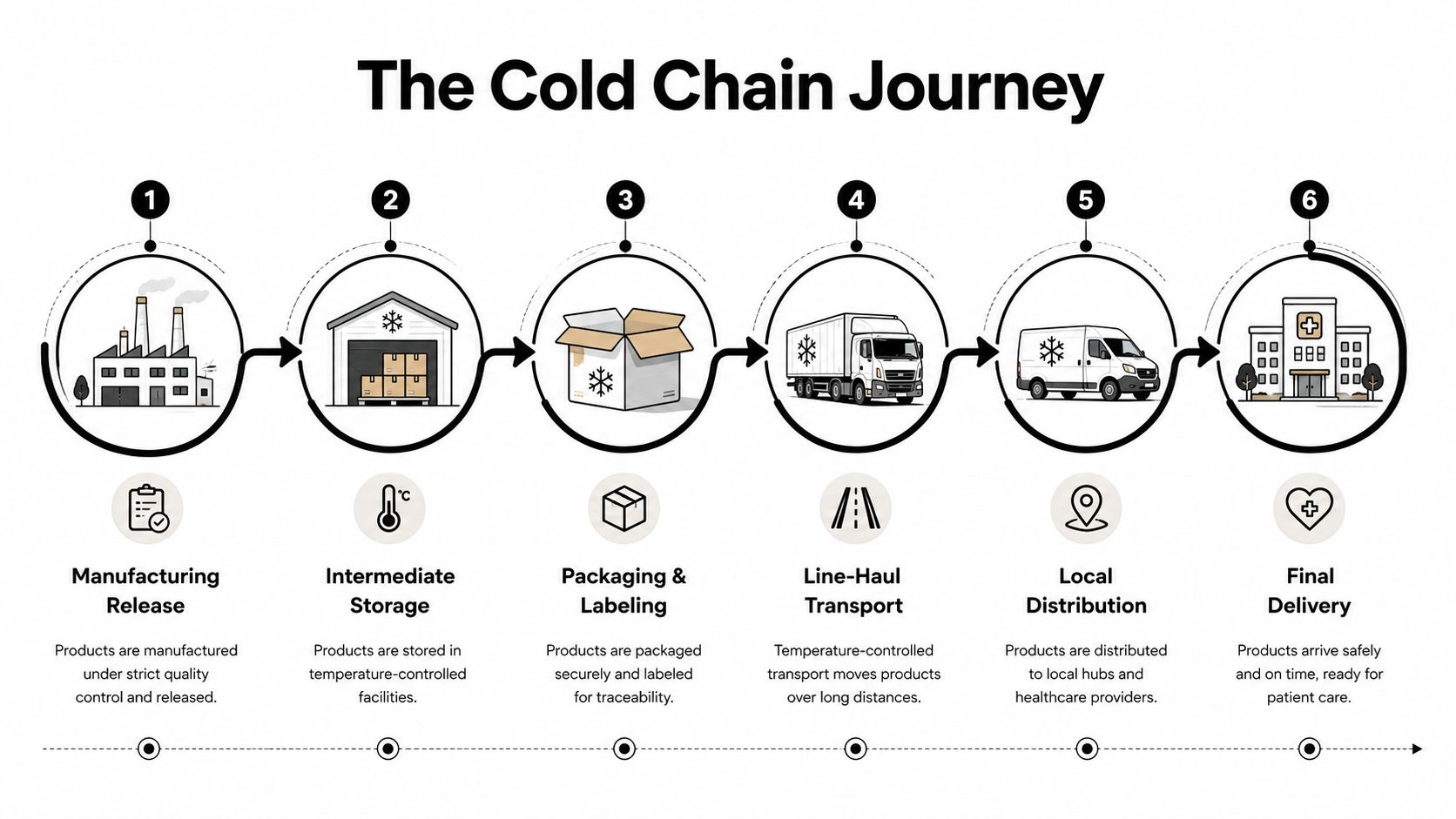
Manufacturing release and intermediate storage
The manufacturer first confirms that the product is ready for distribution. Personnel identify the batch, expiry information, storage requirement, and any special handling instruction. The product then enters qualified storage, where equipment and procedures are designed to maintain the specified environment.
Intermediate storage may occur at a distributor, third-party logistics site, customs facility, or regional fulfillment center. Every additional location creates another opportunity for a delay, an incorrect placement, or an incomplete record. The receiving team at each site should know what condition applies and what action to take if the product arrives outside it.
Packaging and line-haul transport
Packaging creates a temporary controlled environment around the product. The pack-out must match the product requirement, expected transit duration, ambient conditions, loading pattern, and selected refrigerant. Gel packs, phase-change materials, dry ice, insulated panels, and reusable containers behave differently, so a supplier shouldn't select them by habit alone.
Line-haul transport then carries the shipment between major facilities. A refrigerated vehicle can control its internal environment, but loading, unloading, door openings, equipment faults, and dwell time still need management. The shipment's logger or monitoring record should remain associated with the parcel throughout the movement.
The following video provides a visual introduction to the journey from storage through delivery.
Local distribution and final delivery
The local stage often introduces the most uncertainty. A parcel may pass from a national carrier to a regional courier, wait at a depot, or arrive when the laboratory is closed. Customs holds and courier handovers can create gaps in both physical control and temperature visibility.
At final delivery, the receiving laboratory should inspect the parcel, confirm its identity and condition, record receipt time, and review the temperature record when required. The recipient also needs a clear path for reporting damage, missing data, or a suspected excursion.
A full journey map should identify:
- Every physical handoff: Record which party accepts responsibility at each transfer.
- Every exposure point: Review docks, staging areas, customs locations, depots, and receiving rooms.
- Every evidence point: Match batch records, shipping documents, logger identifiers, and receipt confirmations.
- Every decision point: Define who can quarantine, release, reject, or investigate the shipment.
The first control question is therefore not “Which courier is fastest?” It's “Where can the product's condition change, and who has authority to respond?”
Core Components of a Reliable Cold Chain
A reliable cold chain combines equipment, procedures, people, and evidence. If one element fails, the remaining controls may not be enough to demonstrate that the product stayed usable.
Qualified storage equipment provides the starting point. Refrigerators, freezers, cold rooms, and monitoring systems need appropriate installation, maintenance, and operational checks. A supplier assessing equipment options may also choose a refrigeration vendor by reviewing service capability, documentation, response arrangements, and suitability for the required temperature condition.
The control system behind the parcel
Warehouse mapping identifies how temperature behaves in real storage space, rather than assuming that every shelf experiences the same condition. GDP storage mapping studies typically run for 48–72 hours before use, helping identify hot spots, cold spots, door-zone losses, and exposure around loading docks. Eupry's cold chain logistics guidance
Packaging qualification answers a different question. It shows whether a selected configuration can protect the product during the planned route and expected conditions. A package that performs well in a warehouse may not perform equally well during a long hold at a depot or in changing outdoor temperatures.
Monitoring devices turn an assumption into evidence. WHO guidance specifies electronic monitoring sensors accurate to ±0.5°C or better, with calibration against a certified traceable reference standard at least once a year, unless another interval is justified. WHO guidance for the storage and transport of time- and temperature-sensitive pharmaceutical products
The following table shows how the components support one another.
Cold Chain Components and Their Operational Role
| Component | Primary Function | Integrity Impact | Traceability Impact |
|---|---|---|---|
| Qualified storage | Maintains the required environment before dispatch | Reduces uncontrolled exposure during holding | Links inventory to location and storage records |
| Temperature mapping | Identifies hot spots, cold spots, and vulnerable zones | Supports appropriate placement and loading | Provides evidence that the facility was assessed |
| Calibrated monitoring | Measures temperature against a traceable reference | Helps detect excursions accurately | Connects readings to a device and calibration record |
| Qualified packaging | Protects the product during transport | Controls heat transfer and refrigerant exposure | Connects pack-out configuration to shipment evidence |
| Trained personnel | Applies procedures at each handoff | Reduces handling and decision errors | Creates accountable, documented actions |
| Deviation procedure | Controls suspected excursions | Supports quarantine and product impact assessment | Preserves investigation and CAPA records |
A shipment is strongest when those records connect. For example, a logger reading means more when its serial number, calibration status, batch, pack-out, route, and receipt time are all documented. Temperature-controlled shipping guidance for laboratory products provides a useful reference point for suppliers building that record chain.
Temperature Needs Across Product Classes
“Temperature-sensitive” describes a risk category, not a single storage instruction. A vaccine, an antibody, a cell therapy, and a clinical specimen may all need controlled handling, but their acceptable conditions and failure modes can differ sharply.
For research-grade reagents, the supplier's label and stability information should control the decision. An antibody might require refrigeration, while an enzyme or PCR component may have a different storage condition and a limited tolerance for repeated warming and cooling. A parcel that arrives cool to the touch still may not meet the product's requirement if the shipment experienced an undocumented excursion.
Product condition is more important than shipping habit
Common conditions include controlled room temperature, typically 15–25°C, refrigerated storage at 2–8°C, frozen storage at −20°C, ultra-low storage at −70 to −80°C, and cryogenic storage below −150°C, often in vapor-phase liquid nitrogen. These are reference categories, not permission to override a product label or stability protocol.
| Product Class | Typical Range | Examples | Notes |
|---|---|---|---|
| Biologics | Product-specific, often refrigerated or frozen | Proteins, antibodies, biologic medicines | Formulation and stability data determine handling |
| Vaccines | Product-specific controlled conditions | Vaccine products and components | Freeze sensitivity and excursion tolerance require particular attention |
| Cell and gene therapies | Ultra-low or cryogenic conditions may apply | Cell suspensions and advanced therapy materials | Viability can depend on strict storage and transport controls |
| Clinical specimens | Condition varies by specimen and test | Blood-derived materials, tissues, research samples | Intended analysis and collection protocol determine the requirement |
| Diagnostic kits | Refrigerated, frozen, or controlled room temperature | Assay kits and molecular test components | Individual components may have different limits |
| Research reagents | Label-specific | Antibodies, enzymes, PCR components | Freeze-thaw tolerance and assay performance should guide pack-out |
The difference between ordinary temperature-controlled shipping and a GDP-style process becomes clearer here. Ordinary shipping may preserve a general condition, while a regulated pharmaceutical lane needs documented, validated controls tied to product quality and distribution requirements.
Maintenance matters as much as selection. A refrigerator with an attractive display reading can still contain localized variation, blocked airflow, or a vulnerable door zone. Laboratory refrigerator maintenance guidance can help suppliers and research sites turn temperature requirements into routine equipment checks.
Regulatory and Compliance Expectations
GDP-style distribution treats temperature control as a quality system, not merely a transport feature. The supplier needs to show that storage, packaging, monitoring, transport, receipt, and deviation handling were designed and operated for the product involved.
The practical framework begins with validation and qualification. A supplier should establish that storage equipment performs as intended, that packaging protects the product on the planned lane, and that monitoring devices produce reliable readings. Lane qualification should account for the actual route, handoffs, seasonal conditions, dwell points, and contingency arrangements rather than relying only on a general carrier description.
What happens after a deviation
A temperature excursion creates a quality decision. The shipment should be identified and moved into controlled quarantine while the responsible team gathers the relevant evidence. That evidence can include the time-temperature profile, product stability information, shipment duration, packaging configuration, calibration record, and handling history.
WHO guidance describes a disciplined approach based on monitoring accuracy, traceable calibration, and documented handling. If the product has a narrow or undefined excursion tolerance, even a short period outside its specified condition may affect batch disposition. The response should therefore include impact assessment, root-cause analysis, and corrective and preventive action, or CAPA, rather than an informal decision based on how the parcel looks.
The distinction between GDP-style pharmaceutical distribution and general refrigerated shipping rests on evidence and accountability. A GDP-oriented process typically expects:
- Validated packaging: The pack-out has documented performance for the intended route and product condition.
- Qualified lanes: The route and handoffs have been assessed for foreseeable temperature risks.
- Calibrated monitoring: Devices are traceable, within calibration, and connected to the shipment record.
- Controlled receipt: The recipient knows how to inspect, quarantine, and report a suspected deviation.
- Audit-ready records: Logs, calibration certificates, mapping studies, batch information, and corrective actions remain accessible.
FDA and EMA expectations may apply according to product, jurisdiction, and distribution role, while ISO 9001 can support broader quality management. ISO/IEC 17025 is particularly relevant to testing laboratories that need confidence in their measurement and testing processes. None of these frameworks turns a marketing statement into proof. Compliance is demonstrated through records, procedures, training, and evidence that personnel followed the approved process.
Best Practices for Laboratory Suppliers
Laboratory suppliers can strengthen cold chain performance by treating each stage as a controlled task with a clear owner. The process starts when inventory arrives and continues after the recipient confirms delivery.
Receiving and storage
Incoming stock should be checked against the purchase and shipping records. Personnel can inspect packaging condition, confirm product identity and batch information, review any temperature indicator or logger, and record the receipt decision. Suspect or damaged stock should be segregated from released inventory, with a visible quarantine status and controlled access.
Storage equipment should undergo mapping to locate hot and cold spots before routine use. Staff should also monitor door behavior, loading patterns, alarms, and maintenance status. A nominal setpoint doesn't prove that every product position is suitable.
Packaging and dispatch
Packaging selection should begin with the product's stability information and the planned lane. The supplier can then choose insulated materials, phase-change packs, gel packs, dry ice, or reusable containers according to the required condition and expected transit exposure. Refrigerants should be pre-conditioned according to the approved pack-out, because incorrectly prepared packs can create either warming or freezing risk.
Before dispatch, personnel should verify:
- Product fit: The product condition, formulation, and freeze-thaw tolerance match the pack-out.
- Route fit: The carrier, transit plan, and contingency route suit the expected handling conditions.
- Record fit: Batch details, packing records, logger identifiers, and chain-of-custody documents travel with the parcel.
- Recipient fit: The laboratory address, receiving hours, contact details, and delivery instructions are current.
A serial-numbered data logger can connect the temperature record to the specific shipment. Tamper-evident sealing adds a physical indication of interference, but it doesn't replace temperature evidence. The chain-of-custody paperwork should identify who packed, transferred, received, and reviewed the parcel.
Practical logistics workflows sometimes borrow controls from other specialist delivery environments. For example, guidance on Boston antique movers.Html highlights the importance of planned handling, careful transfer, and protection of high-value items. Laboratory suppliers need the same planning discipline, adapted to temperature, sterility, batch control, and product usability.
Post-delivery response
After delivery, the recipient should inspect the parcel promptly and review the available temperature record. If a logger shows a deviation, the product should enter quarantine until an authorized person assesses the evidence against stability information. The supplier should notify the recipient, document the decision, and investigate recurring failures through CAPA.
Last-Mile Risks and Operating Realities
A controlled line-haul journey can still fail at the final address. Residential courier handoffs, missed deliveries, doorstep exposure, uncertain receiving hours, and depot storage can place the parcel outside the assumptions used to qualify the packaging.
The last mile also exposes a cost trade-off. Single-use insulated shippers can simplify reverse logistics, while reusable containers may reduce material waste but require collection, inspection, cleaning, and redistribution. Refrigerant weight takes space away from payload, and extra insulation can increase shipping volume. A cheaper pack-out isn't necessarily cheaper if it creates repeated excursions or avoidable replacement decisions.
Energy and labor add pressure to the operating model. The Global Cold Chain Alliance reported that U.S. refrigerated-warehouse electricity costs rose 5.18% year over year in Q3 2025, while labor costs rose 3.91%. GCCA's Cold Facts publication connects those pressures to the broader cost environment facing cold chain operators.
Last-Mile Cold Chain Risk Factors
| Risk Factor | Operational Impact | Mitigation |
|---|---|---|
| Missed delivery | Extends uncontrolled dwell time | Confirm receiving hours and use delivery appointments |
| Courier handoff | Breaks visibility or accountability | Record transfer points and maintain one communication owner |
| Doorstep exposure | Exposes packaging to ambient conditions | Use recipient instructions, timed delivery, and contingency contact |
| Refrigeration failure | Can compromise a vehicle or depot movement | Maintain equipment and define a recovery route |
| Dry-ice depletion | Removes the intended frozen protection | Set replenishment thresholds and identify replenishment locations |
| Mixed temperature zones | Creates pack-out and receiving complexity | Separate products and label each condition clearly |
Research-grade reagent distribution can be harder to standardize than a large pharmaceutical lane. Academic recipients may have limited receiving hours, smaller order sizes, multiple storage requirements, and less predictable staff availability. Suppliers should confirm the address, provide tracking, communicate delays quickly, and preserve a clear temperature record.
A carrier's equipment failure also needs an operational response, not just a maintenance note. A trucking refrigerator breakdown guide can help logistics teams think through roadside recovery, cargo protection, communication, and escalation. For shipment visibility, an order tracking system can support proactive communication before a missed delivery becomes a temperature event.
Conclusion and Partner Evaluation
Cold chain logistics protects laboratory products through qualified storage, validated packaging, calibrated monitoring, trained personnel, and documented decisions. The system succeeds when those controls remain connected across manufacturing release, storage, dispatch, transport, receipt, and post-delivery review.
A wholesaler, distributor, or research buyer evaluating a partner should ask for:
- GDP-relevant procedures and role responsibilities
- Storage mapping and equipment qualification evidence
- Packaging qualification for the intended lane
- Calibration certificates and accessible temperature records
- Courier qualification and contingency arrangements
- A written excursion, quarantine, investigation, and CAPA process
- Clear ownership at every transfer point
- Batch-level records that support traceability after delivery
The strongest partner isn't defined by one insulated box or one sensor. Reliable performance comes from integrating equipment, people, records, and accountability so that each handoff preserves the product and leaves evidence behind.
Herbilabs supports laboratory supply workflows with temperature-controlled storage, same-day dispatch, product documentation, and worldwide fulfillment for research-use laboratory products. Visit Herbilabs to review available reagents, diluents, shipping guidance, and distribution options for temperature-sensitive research supplies.


