Private Label, White Label, Wholesale partnerships available - EU, USA and UK - Free shipping from €75

Temperature Controlled Shipping: A Practical Guide for Labs
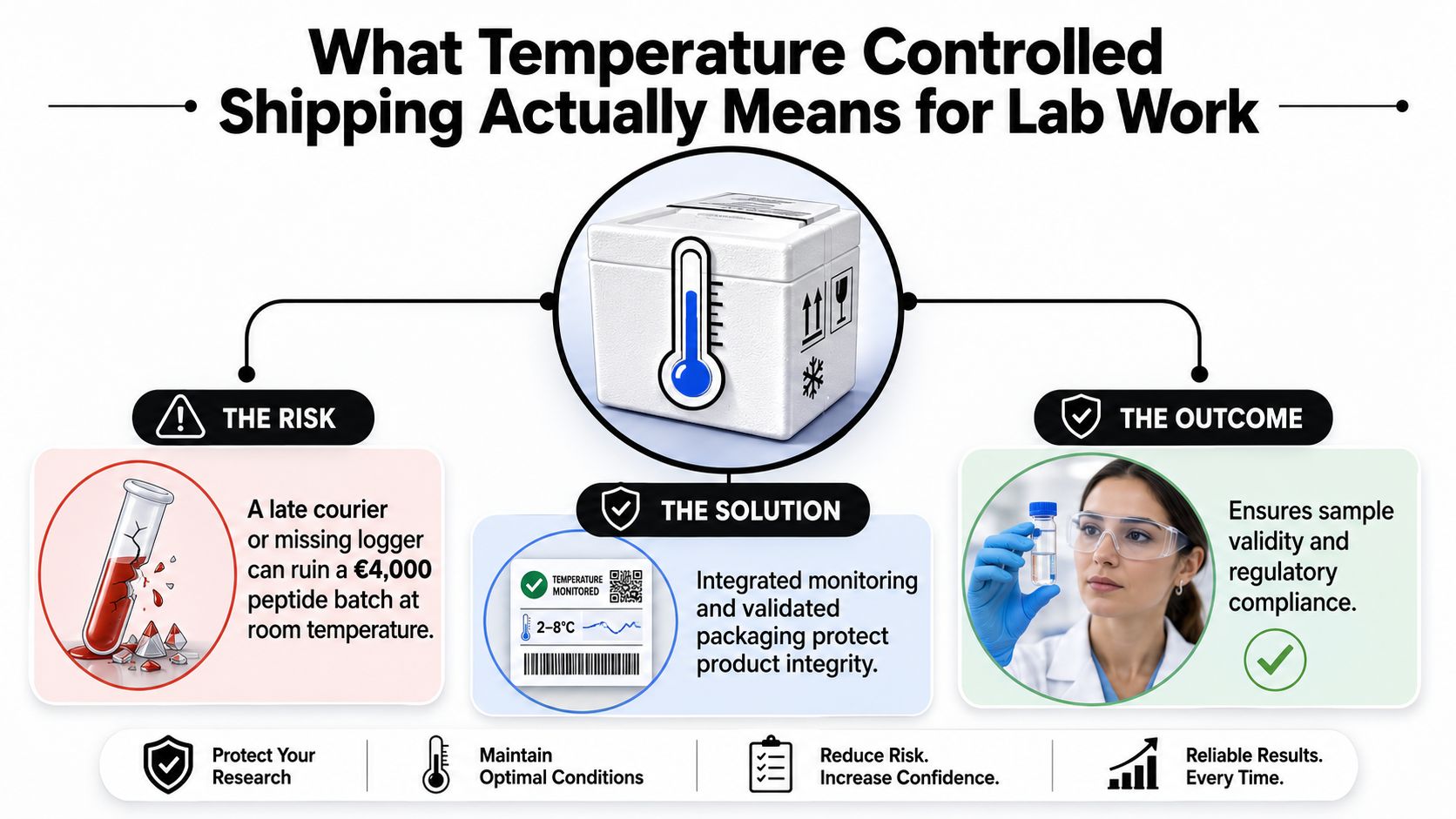
A courier is late, the receiving lab has a scheduled experiment, and the data logger that should prove the shipment stayed in range is nowhere in the carton. Meanwhile, a high-value peptide batch is sitting at room temperature, and nobody can say whether the exposure lasted minutes or hours. That situation turns a routine delivery into a quality decision.
Temperature controlled shipping is the controlled movement of sensitive goods inside a defined thermal range, supported by validated packaging, trained handling, and records that show what happened from dispatch to receipt. For laboratories, the box matters, but the evidence around the box matters just as much.
Table of Contents
- What Temperature Controlled Shipping Actually Means for Lab Work
- The Four Temperature Classes You Will Ship Against
- GDP, IATA, and ADR Requirements Without the Jargon
- Packaging and Insulation Options That Actually Hold Temperature
- Monitoring and Validation as a Data Integrity Practice
- Carrier Selection and Transit Planning for Sensitive Loads
- Cost, Risk Mitigation, and a Ready-to-Use SOP for Lab Shipments
What Temperature Controlled Shipping Actually Means for Lab Work
A temperature-controlled shipment has three requirements. The product needs a specified range, the logistics process needs to maintain that range, and the shipper needs reliable evidence at each important handoff. Insulation without records leaves a quality team guessing. A sensor without a response procedure only documents a failure after it has happened.
The need extends well beyond large pharmaceutical manufacturers. Research reagents, peptides, sterile diluents, reference standards, and biological materials may lose stability or usefulness after unsuitable exposure. The consequence isn't always visible. A vial can arrive intact while the material inside has become unreliable, forcing a lab to question results produced weeks later.
The wider market shows why this has become core infrastructure rather than a specialist add-on. One estimate values the global pharmaceutical cold chain logistics market at US$22.75 billion in 2025, with a projection of US$44.1 billion by 2033, a forecast cited in market coverage of pharmaceutical cold chain logistics. The same source identifies operating bands that include refrigerated 2°C to 8°C, frozen below -20°C, ambient 15°C to 25°C, and cryogenic conditions around -150°C.
Three decisions govern every shipment
Compliance asks whether the process meets the product's quality and transport obligations. A pharmaceutical-grade shipment may require documented procedures, qualified equipment, and traceable records.
Data integrity asks whether the records are complete, attributable, readable, and connected to the actual shipment. A logger file that can't be matched to a carton, lane, or receiving event has limited value.
Total landed cost includes freight, packaging, monitoring, validation, staff time, and the cost of a rejected or compromised load. The lowest freight quote can become the most expensive option if the lane has repeated delays or weak handoff control.
Practical rule: A cold chain isn't proven by a cold box. It's proven by a controlled process and a record that another qualified person can reconstruct.
The Four Temperature Classes You Will Ship Against
A shipment can look acceptable on the warehouse floor and still fail its specification in transit. Start with the product's Certificate of Analysis, label, stability documentation, or quality agreement. Those records define the permitted range, while the packaging and monitoring plan must show that the load can remain within it across every handoff.
A pantry analogy helps organize the choices. The freezer represents frozen transport, the fridge refrigerated transport, the cupboard controlled ambient transport, and the dry-ice or ultra-cold chest cryogenic logistics. The analogy supports training, but it does not set acceptance criteria.
| Class | Range | Typical Products | Transit Implication |
|---|---|---|---|
| Frozen | Below -20°C | Frozen biological materials and products specified for deep-freeze storage | Requires coolant or powered equipment that prevents thawing during the validated lane |
| Refrigerated | 2°C to 8°C | Many vaccines, monoclonal antibodies, reagents, and chilled peptide products | Needs protection from both warming and accidental freezing |
| Ambient or controlled room temperature | 15°C to 25°C | Materials approved for stable room-temperature handling | Requires protection from heat spikes, cold exposure, and container self-heating |
| Cryogenic or ultra-cold | Around -150°C or lower | Highly temperature-sensitive life-science materials | Usually needs specialised cryogenic equipment, procedures, and trained handling |
The four bands are 2°C to 8°C for refrigerated loads, below -20°C for frozen loads, 15°C to 25°C for controlled ambient loads, and around -150°C for cryogenic conditions, as described in pharmaceutical cold chain market data. These labels are not interchangeable. “Keep cold” does not tell a packer which coolant, logger limit, or receiving decision to use.
Why the range changes the packaging decision
A refrigerated load has a narrow operating band. A qualified shipper may use phase-change or gel-based cooling to buffer the product, but the design must control both directions of failure. Insufficient thermal capacity permits warming. Direct contact with frozen coolant can drive the payload below its minimum.
Controlled ambient loads fail differently. Sunlight, a warm warehouse, dense packing, or a delayed vehicle can raise the internal temperature even when outdoor conditions seem moderate. EU and USA lanes can expose a parcel to different warehouses, vehicles, and customs delays, so each handoff needs a recorded status and an exception path rather than an assumption that the carton remained compliant.
Before packing, the distributor should record the specified range, storage condition, packaging instruction, and any prohibition on freezing. That information becomes the logger review's acceptance criterion and gives the receiving team a clear basis to release, quarantine, or investigate the shipment.
GDP, IATA, and ADR Requirements Without the Jargon
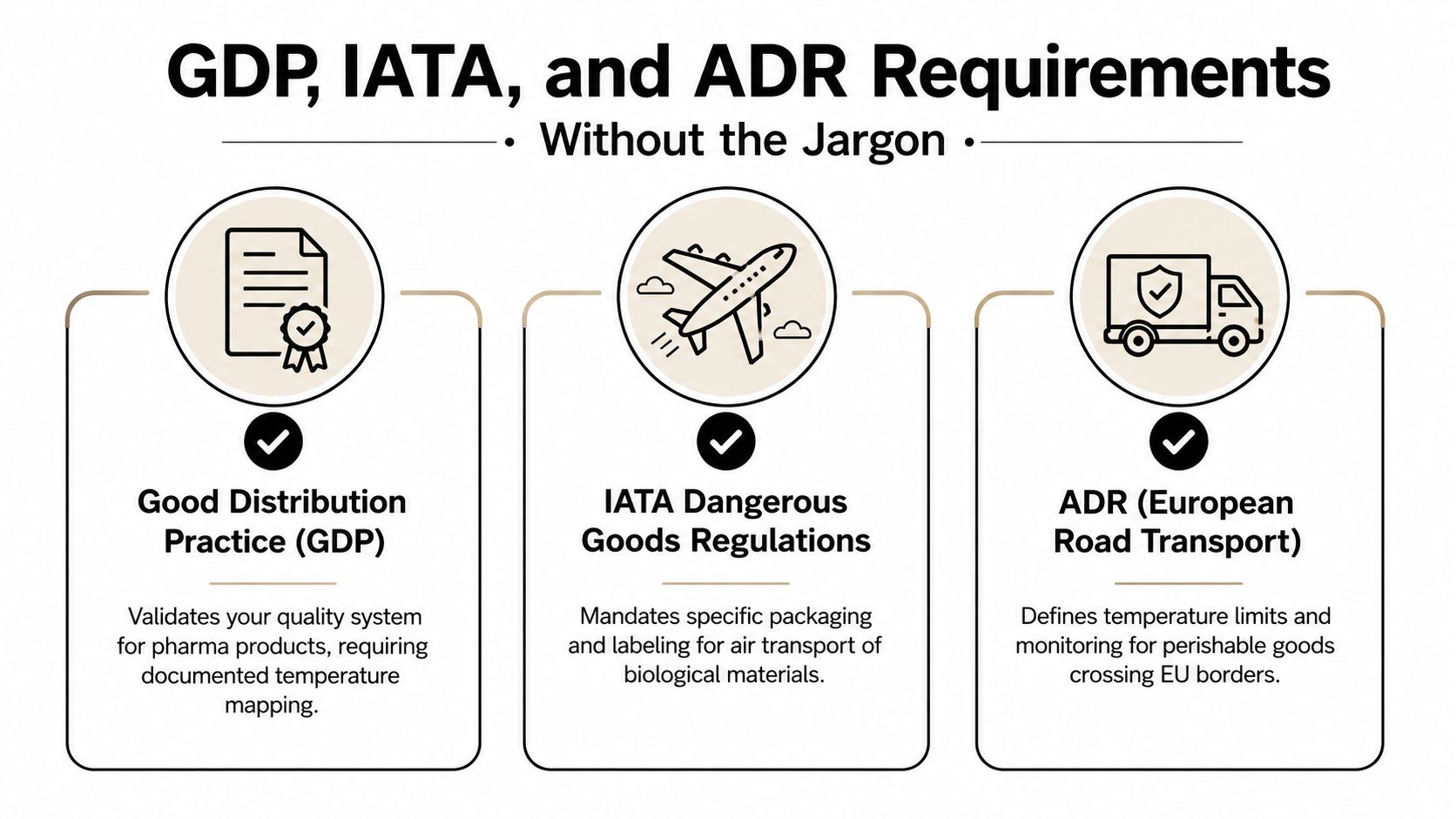
Regulatory language becomes manageable when translated into warehouse actions. GDP, or Good Distribution Practice, is the quality framework for maintaining pharmaceutical product integrity through storage and distribution. IATA Dangerous Goods Regulations apply when air transport involves regulated materials. ADR governs the road movement of dangerous goods across participating European routes.
These frameworks don't turn every lab parcel into a pharmaceutical shipment. They do require the operator to identify the applicable product and transport risks before selecting a package or carrier. A research-use-only reagent may have a different regulatory profile from a medicinal product, while biological materials, dry ice, or other classified contents can create separate transport obligations.
What the warehouse must demonstrate
For a GDP-aligned operation, auditors commonly expect a controlled quality system rather than a collection of informal habits. The practical evidence includes:
- Qualified equipment: Storage areas, packaging tools, and monitoring devices have documented suitability for their intended use.
- Written procedures: Staff know how to pack, label, release, receive, quarantine, and investigate shipments.
- Training records: Personnel handling regulated or temperature-sensitive goods can demonstrate relevant training.
- Validated processes: The packaging configuration and lane have evidence supporting the required thermal performance.
- Traceable records: Shipment identity, temperature data, handoffs, deviations, and disposition decisions connect to one another.
For air transport, the operator must confirm whether the contents fall under IATA rules and whether the package, markings, labels, documentation, and acceptance process match that classification. For European road transport, ADR review should cover the substance classification, packaging, vehicle and driver requirements, documentation, and route responsibilities where applicable.
Audit gaps usually appear between departments
A packing team may record the logger serial number, while customer service records only the courier tracking number. A quality team may receive a temperature file without the packing configuration used. These gaps make a compliant activity difficult to prove.
A stronger record set brings together the shipping manifest, product specification, packaging configuration, logger identity, temperature report, carrier events, receipt confirmation, and deviation decision. Risk assessment and change control deserve special attention. Changing a coolant type, carton size, carrier, lane, or dispatch time can alter performance, even when the finished parcel looks identical.
Audit test: Another trained person should be able to reconstruct what was shipped, how it was packed, who handled it, what the logger recorded, and why the product was accepted or rejected.
Packaging and Insulation Options That Actually Hold Temperature
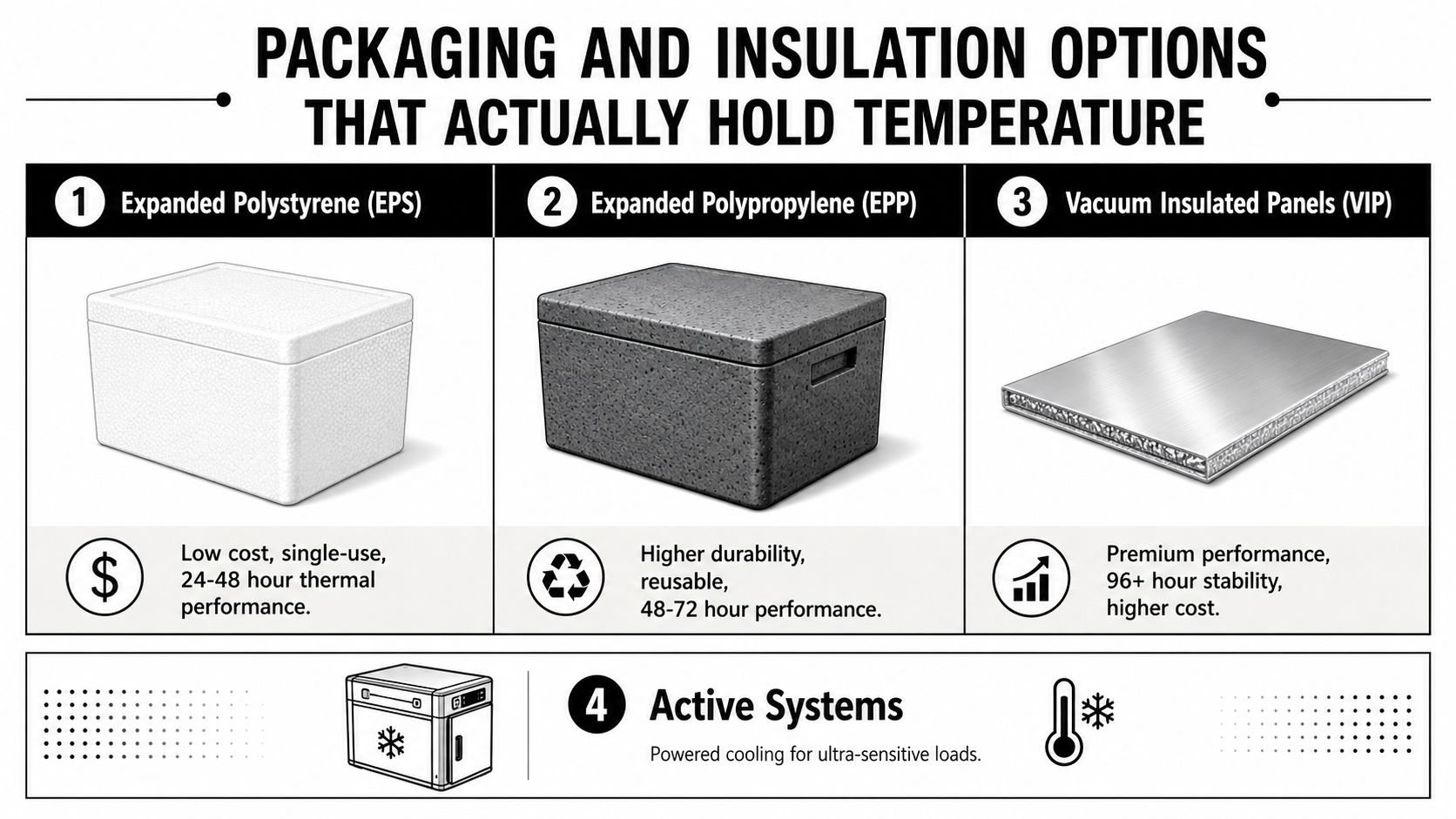
Packaging falls into two broad families. Passive systems use insulation and pre-conditioned coolant without powered refrigeration. Active systems use powered equipment to control the internal environment during transport. Passive packaging is often practical for parcel shipments, while active systems become more defensible when the product is highly sensitive, the lane is long, or recovery options are limited.
Common passive materials include expanded polystyrene, expanded polypropylene, and vacuum insulated panels. EPS is lightweight and widely available, but it can be fragile and is often single-use. EPP is more durable and suitable for repeated handling. VIP construction provides strong insulation in a thinner format, but it needs careful assembly because damaged panels can reduce performance.
Coolant selection must follow the product band. Gel packs can support refrigerated transport when conditioned correctly. Phase-change materials can be selected around a target transition temperature. Dry ice supports frozen transport but introduces handling, ventilation, and classification considerations. The packer should never place frozen coolant directly against a payload unless the validated design specifically permits it.
Validation sets the honest duration
A published clinical-trial distribution setup used three frozen gel packs and a four-hour pre-chill, maintaining an internal environment of 0°C to 8°C for up to 48 hours during autumn, winter, and spring. The clinical-trial distribution study demonstrates why pre-conditioning and seasonal conditions belong in the lane assessment.
Longer duration shouldn't be assumed from a larger box. One evaluation found that none of the tested boxes maintained temperature for the complete 96-hour test window, while another reported that only four of six configurations met 2°C to 8°C compliance. The strongest configuration in that evaluation, a large polystyrene foam box with five coolant packs, held the required range for up to 23 hours, as described in the cold-chain packaging evaluation.
The practical conclusion is blunt. A shipper marketed as “long duration” still needs lane-specific evidence. The report should show payload mass, coolant conditioning, ambient profile, pack-out, logger position, start time, end time, and acceptance criteria.
For distributors reviewing packaging requirements for reagent shipments, the key question isn't which material sounds most advanced. It's whether the selected configuration has enough validated margin for the actual transit, including weekends, customs, failed delivery attempts, and warehouse dwell.
Monitoring and Validation as a Data Integrity Practice
A sensor doesn't protect a shipment. It creates evidence and, if configured correctly, gives a team time to act. The protection comes from placing the right device in the right location, reviewing the data against an agreed specification, and assigning a named person to manage exceptions.
A single-use USB logger can suit a routine parcel where post-delivery review is sufficient. A Bluetooth logger can help a warehouse or receiving team retrieve data without opening the inner payload unnecessarily. A cellular tracker can support live intervention when the lane has uncertain handoffs, customs exposure, or a high-value load. The choice should reflect the consequence of delay, not a desire to add technology.
Build the record before dispatch
The shipper should document the product range, package identification, logger serial number, start condition, coolant preparation, dispatch time, expected delivery window, and receiving contact. Logger placement matters. A device near a coolant source may show a different profile from one in the centre of the payload, so the validated placement should be followed consistently.
At receipt, the team should check the outer condition, seal, label, logger status, delivery time, and temperature file. The receiving decision should be recorded as accepted, quarantined, or rejected, with a reason linked to the data.
For teams comparing order tracking systems for laboratory distribution, integration matters more than a dashboard alone. Shipment status, logger identity, customer notification, and deviation workflow should connect so that a late delivery doesn't disappear between the courier portal and the quality record.
Treat exceptions as controlled decisions
A shipment can remain technically within range and still create a quality problem. If the delivery arrives after the receiving lab has closed, the material may spend additional time in an uncontrolled receiving area. If the logger stops before delivery, the final handoff isn't evidenced. If a route is delayed while the product remains in range, the remaining shelf-life or stability margin may still be affected.
A useful deviation report records the event, timeline, affected units, temperature evidence, packaging condition, carrier explanation, immediate containment, quality assessment, and final disposition. The report should also identify whether a corrective action is needed, such as a different service level, revised dispatch day, improved consignee instructions, or a new lane validation.
The weakest cold-chain link is often exception governance. More sensors won't fix a process that doesn't define who reviews an alert, who contacts the carrier, and who has authority to quarantine stock.
Carrier Selection and Transit Planning for Sensitive Loads
A carrier should be chosen against the lane's failure points, not its name. A courier that performs well on a predictable EU road route may struggle with customs delays, repeated terminal transfers, or weak last-mile infrastructure. The service design must fit both the product's validated thermal tolerance and the receiver's working conditions.
Begin with three questions: How long can the validated pack protect the load? What temperatures, weather, and infrastructure will the route expose it to? Which handoffs can the process control and document? Air freight may shorten the main journey while adding airport and customs interfaces. Road transport can offer direct regional movement. Consolidated services may lower freight cost but add handling points and exception risk.
Match service design to lane reality
Review the full lane, not only the scheduled line-haul:
- Distance and duration: Count collection, export handling, customs, delivery, and receiving time.
- Ambient exposure: Check seasonal heat and cold, warehouse conditions, vehicle loading, and time outside controlled storage.
- Handoff quality: List every transfer, scan, storage location, and named owner.
- Recovery capability: Confirm who can retrieve, re-ice, repackage, or redirect a shipment after disruption.
A specialty pharmaceutical carrier may suit a high-risk route. An integrator may fit a validated parcel lane with dependable tracking. A regional carrier can work for local distribution when procedures, equipment, and escalation contacts are documented. The Peak Transport carrier checklist helps structure questions about capability, communication, and accountability before a lane agreement is signed.
For teams seeking greater supply chain visibility, review supply-chain visibility solutions that connect status updates with handoff records and exception handling. Visibility is useful only when someone owns the alert and can act before a delay becomes a temperature or delivery failure.
Emerging-market lanes need infrastructure design
Global cold-chain capability remains uneven. Coverage of cold-chain growth in emerging economies highlights infrastructure gaps, capacity constraints, climate disruption, and rising expectations for electronic traceability. A premium box cannot compensate for a consignee without controlled receiving space, an unreliable road connection, or customs holding the shipment outside the validated plan.
For secondary cities and cross-border trade, a qualified regional cold hub may provide more protection than extra monitoring hardware. Consolidation can reduce uncontrolled last-mile decisions when the hub has suitable storage, trained staff, and a dependable onward schedule. Visibility tools can show where a shipment waits, whether a handoff scan is missing, and which party must recover it. They do not replace storage or transport capacity, but they make infrastructure gaps visible early. A practical design may combine passive packaging for the final leg, local cold storage, and a documented recovery route.
For EU and USA lanes, name contacts for the shipper, carrier control tower, customs broker where relevant, and receiver. Specify delivery windows, alert thresholds, handoff scans, and quarantine authority. If a carrier cannot explain these controls, it has not provided a complete cold-chain service.
Cost, Risk Mitigation, and a Ready-to-Use SOP for Lab Shipments
A responsible cost model includes freight, packaging, coolant, logger rental or purchase, validation, quality review, customs handling, and expected loss from excursions. Product value alone doesn't determine the service level. A lower-value reagent with no replacement stock or a time-critical experiment may justify stronger control than a more expensive item with broad stability.
A five-vial peptide kit moving from an EU production site to a USA research lab illustrates the workflow. Before dispatch, the distributor confirms the Certificate of Analysis range, verifies the consignee's receiving hours, selects a validated passive configuration, conditions the coolant, assigns the logger serial number, and records the package identity. During transit, the carrier receives the handling instruction and escalation contact. At receipt, the lab checks the seal, reviews the logger file, records delivery timing, and quarantines the kit if the evidence is incomplete.
Launch checklist
- Qualify the lane: Record route, handoffs, seasonal exposure, customs points, and recovery contacts.
- Approve the pack-out: Match insulation and coolant to the product range and validated duration.
- Prepare the records: Link the manifest, product specification, logger identity, and packaging configuration.
- Control dispatch: Confirm pre-conditioning, label accuracy, pickup timing, and receiver availability.
- Review receipt: Check condition, temperature data, delivery time, and final disposition.
- Investigate deviations: Document facts, assess product impact, and update the SOP when the process changes.
The SOP catches the common failures before they become customer complaints. It prevents a missing logger, an unsuitable coolant, a Friday dispatch into a closed receiving site, and an undocumented quarantine decision.
Herbilabs supports laboratory supply workflows with temperature-controlled storage, validated packaging guidance, logger records, clear COAs, and fulfillment across EU, UK, and USA distribution needs. Distributors and research teams can review the available Herbilabs supply and contact the company to discuss packaging, tracking, and dependable delivery for temperature-sensitive reagent shipments.