Private Label, White Label, Wholesale partnerships available - EU, USA and UK - Free shipping from €75
What Is a Certificate of Analysis and Why It Matters
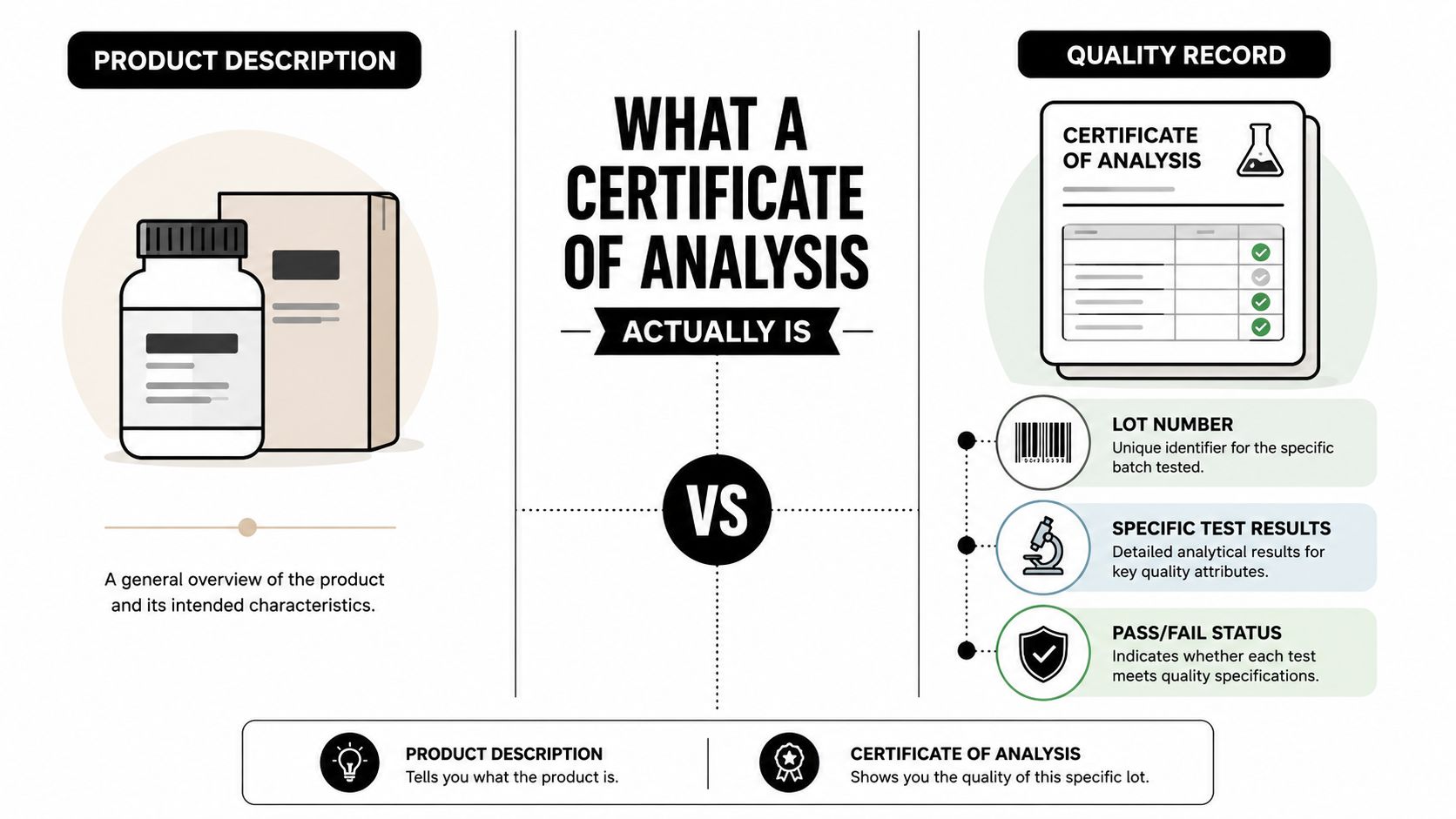
A certificate of analysis is a lot-specific quality record that reports the actual analytical results for one batch of a reagent or product against predefined specifications. It isn't a generic product description or marketing sheet, and it doesn't prove anything about a different lot.
A researcher usually encounters the document at an ordinary moment. A peptide vial comes out of a freezer, a sterile diluent arrives in a shipment, or a buffer is pulled from stock before an experiment begins. A single-page PDF sits in the box or arrives by email. The immediate question is practical: can this material be trusted for the work ahead?
The answer depends on whether the document connects the exact container to measured evidence. A polished logo can't repair a mismatched lot number. A large purity claim can't replace a stated method and acceptance criterion. An unsigned table may look complete, but it leaves the release decision difficult to attribute.
A real COA lets a buyer reconstruct the quality decision for one batch. The FDA's Q7A guidance describes an authentic COA for an intermediate or active pharmaceutical ingredient as a document containing the product name, batch number, release date, expiry or retest date where applicable, tests performed, acceptance limits, numerical results, date, authorized signature, and original manufacturer details (FDA Q7A GMP guidance). That level of detail explains why the document belongs in the lot record, not merely in a sales folder.
Table of Contents
- The Sheet That Decides Whether Your Experiment Counts
- What a Certificate of Analysis Actually Is
- Anatomy of a COA and What Each Field Means
- How to Read a COA for High-Purity Reagents and Sterile Diluents
- Regulatory and Research-Use Implications of the COA
- How to Tell Whether a COA Is Trustworthy
- Your COA Checklist Before the Next Order
The Sheet That Decides Whether Your Experiment Counts
A new researcher may treat a COA as supporting paperwork, something to file after the important work is finished. A senior quality lead sees it differently. The sheet is the bridge between the bottle on the bench and the result written in the notebook.
Suppose a researcher reaches for a vial of sterile diluent and finds a COA attached to the shipment. The vial label carries a lot identifier. The COA carries a similar identifier, but one character differs. The table lists a purity result, yet no analytical method appears, and the release signature is missing. The document may still look professional, but it doesn't establish that the reported result belongs to that vial.
Practical rule: If the physical label and the COA don't identify the same lot, the material needs clarification before use.
The same logic applies to a high-purity reagent. A product family can be manufactured repeatedly, and each production run can have its own analytical outcome. The purity, identity, contaminant profile, water content, or sterility evidence reported for one batch can't automatically be transferred to the next. Researchers who understand how purity levels define research integrity understand why the lot record matters to reproducibility.
A COA therefore functions like controlled evidence. It should tell the reader what was tested, how it was tested, what result was obtained, what limit applied, and who authorized the release. Remove any of those links and the reader has less ability to judge whether the material was suitable for the intended work.
The central distinction is simple. A lot-specific COA supports a decision about a particular batch. A decorative certificate makes a broad statement about a product while withholding the information needed to test that statement. The difference usually becomes visible within minutes when the reviewer starts with the label and works through the document field by field.
What a Certificate of Analysis Actually Is
A certificate of analysis is a formal quality record for one defined lot or batch. It reports the actual results of specified analytical tests and compares those results with predefined specifications or acceptance criteria. An authorized quality or laboratory representative dates and signs the record, creating accountability for the release decision.
A useful analogy is a birth certificate combined with a medical chart. The identity section answers, “Which exact item is this?” The analytical section answers, “What did testing find in this item or batch?” A brochure about a product family can describe intended characteristics, but it can't substitute for results tied to the particular lot.
Four properties make the record meaningful:
- Lot identity connects the document to a specific manufactured batch.
- Method disclosure shows how the laboratory generated each result.
- Numeric results reveal what testing measured, rather than offering only a broad assurance.
- Accountable approval identifies the person or quality function responsible for release.
The WHO model certificate of analysis describes the same decision logic. A COA lists the tests performed on a particular sample, the results obtained, the acceptance criteria applied, and whether the sample complies with specification (WHO model certificate of analysis).
What a COA is not
A product specification sheet describes target requirements. It may state an acceptable assay range or impurity limit, but it doesn't necessarily report the measured result for the shipped lot.
A certificate of conformity generally communicates that a product conforms to a stated requirement. Unless it also provides lot-specific tests, methods, limits, results, and authorization, it doesn't offer the same analytical detail.
A Safety Data Sheet concerns hazards, storage, handling, protective equipment, and emergency response. It supports safe handling of a chemical, but it isn't evidence of the exact purity or contaminant profile in one container.
Templates can help teams standardize layout and document control, especially when a supplier needs a consistent format. Resources such as Zandovi certificate templates can support that administrative task, but a template doesn't create test evidence. The laboratory data, traceability, and release approval still have to come from the controlled process behind the document.
Anatomy of a COA and What Each Field Means
A COA becomes easier to read when treated as an annotated identity-and-evidence record rather than a page of technical vocabulary. Consider a hypothetical high-purity reagent. The reviewer should be able to start with the header, follow the lot through the test table, and finish at an attributable release decision.
The identity block
The product name should match the material ordered and received. A catalog number, grade, concentration, or other product identifier can narrow the match further. If the product name is broad while the purchase order specifies a particular grade or formulation, the reviewer needs clarification before assuming equivalence.
The lot or batch number is the key connection to the physical material. It should match the vial, bottle, carton, or shipment record exactly. A COA without a usable lot identifier can't reliably establish which production run generated the reported results.
The dates provide time context. A COA may show manufacture, release, expiry, or retest information. The FDA's Q7A guidance specifically identifies release and expiry or retest dates where applicable, along with manufacturer identity and authorized quality approval (FDA requirements for COA content).
The analysis table
Each row should identify a test, the method or reference standard, the specification, and the actual result. Units matter because a number without its unit can be impossible to interpret. Method context matters because two methods may measure related attributes with different selectivity, sensitivity, or calculation rules.
The specification is the permitted target or boundary. The result is what the laboratory measured in that lot. If an assay specification requires a minimum and the result sits above that minimum, the result passes that criterion. It doesn't mean the lot “exceeds” every quality expectation, and it doesn't guarantee the next batch will perform identically.
A pass stamp also needs careful reading. “Meets specification” means the reported result falls within the stated acceptance range. It doesn't mean the material is superior to the specification, nor does it mean every conceivable contaminant was tested.
The release block
The laboratory or manufacturer details identify who performed or controlled the testing. A sample registration number, report number, instrument reference, or certificate identifier can strengthen traceability. The final signature, date, and release status show that an authorized person reviewed the record.
For practical guidance on connecting test records to laboratory controls, researchers can consult Herbilabs' quality control testing information. The important habit is consistent: read the result column, not just the pass statement. A careful buyer asks whether the evidence supports the intended use, not merely whether the page carries a certificate title.
How to Read a COA for High-Purity Reagents and Sterile Diluents
A high-purity reagent COA should be read as a chain of evidence. The first link is the material itself, followed by the test method, the acceptance criterion, the observed result, and the release decision.
Start with the purchase order and the container. Match the product name, catalog number, grade, lot number, and relevant pack or fill information. Then inspect the analytical panel. For a reagent, identity and assay may be central, while impurities, water content, residual solvents, particulate matter, or stability information may matter depending on the planned experiment.
Reading results without overinterpreting them
A result such as “less than” a reporting limit isn't the same as a measured zero. A notation such as “<10 ppm” communicates that the concentration was below the stated reporting threshold. The reader should check the unit, the method's detection or quantification capability, and whether the reporting limit is appropriate for the intended application.
A compliant result sits within the stated criterion. A borderline result may technically pass but deserve attention if the buyer's internal requirement is tighter or if the attribute affects a sensitive assay. A failed result falls outside the specification and should trigger quarantine and investigation rather than casual use.
A pass is a conclusion about the stated test and stated limit. It isn't a universal statement that the material is suitable for every experiment.
Sterile diluents require a broader view
For a sterile diluent, the review may involve sterility, endotoxin, pH, osmolality, particulate matter, fill volume, container integrity, and the relevant method details. The exact panel depends on the product and intended use, so a “sterile” label shouldn't be treated as proof that every quality attribute was examined.
The reviewer should ask whether the sterility claim is connected to a controlled process and lot-specific evidence. The COA should also identify the applicable acceptance criteria and release status. A sterile claim without traceable testing or process context is weaker than a documented result supported by method information.
A thorough review compares the supplier's specification with the buyer's own requirements. A batch can pass a supplier's stated limit while failing a more demanding internal application. That distinction protects researchers from treating manufacturer release as a substitute for application-specific qualification.
Regulatory and Research-Use Implications of the COA
A lot is released for use only within the evidence its COA covers. Regulatory value depends on who issued it, what was tested, why it was tested, and which quality system governed the work. The document may support manufacturing release, distribution controls, receiving decisions, and customer review. It does not, by itself, prove that the supplier or laboratory operates in full GMP compliance.
The FDA's Q7A guidance treats a COA as a formal GMP traceability document for pharmaceutical intermediates and APIs. Its expected detail includes batch identity, tests, acceptance limits, numerical results, dates, authorized quality approval, and original manufacturer information. As noted earlier, those fields make a COA traceable, rather than merely persuasive.
Understanding the quality system
ISO/IEC 17025 reporting frameworks emphasize unique report identifiers, dates, sample identification, and traceable results. Accreditation indicates that laboratory competence and controls were assessed within a defined scope. It does not automatically validate every product, method, or result printed on a certificate.
WHO-style reporting adds structure by connecting tests, results, acceptance criteria, and compliance conclusions. Review the applicable standard, method, and current revision. A label such as “pharmacopeial” or “validated” should point to a specific reference. Without that reference, the label is closer to a marketing statement than usable evidence.
Research-use boundaries
For research-use-only materials, a COA may document identity, purity, sterility, or endotoxin results. It does not confer clinical, diagnostic, therapeutic, or food-grade status. Keep the product's use designation separate from its analytical evidence.
Traceability continues beyond the PDF. Wholesalers and distributors need a usable connection among manufacturer, lot, shipment, customer, storage record, and retained documentation. Teams managing this chain may use regulatory source tracking with VarsaAI as a document-governance reference.
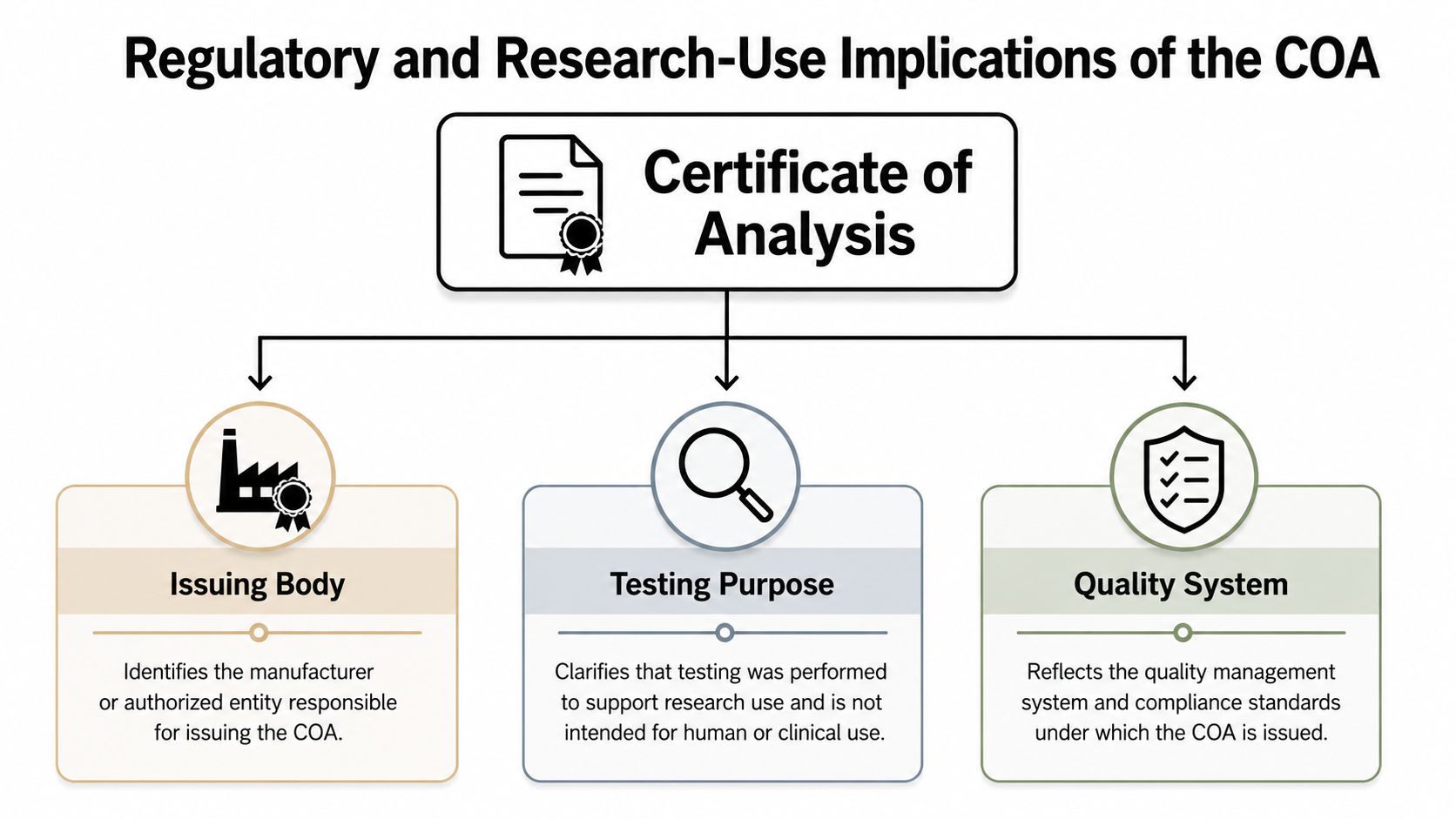
Before a regulated study uses a lot, the receiving team should match the COA to the exact container, confirm the issuer's authority, and retain it with receiving, storage, testing, and deviation records. A COA supports risk assessment and supplier qualification. It does not replace incoming inspection, independent testing where warranted, or the wider quality system.
How to Tell Whether a COA Is Trustworthy
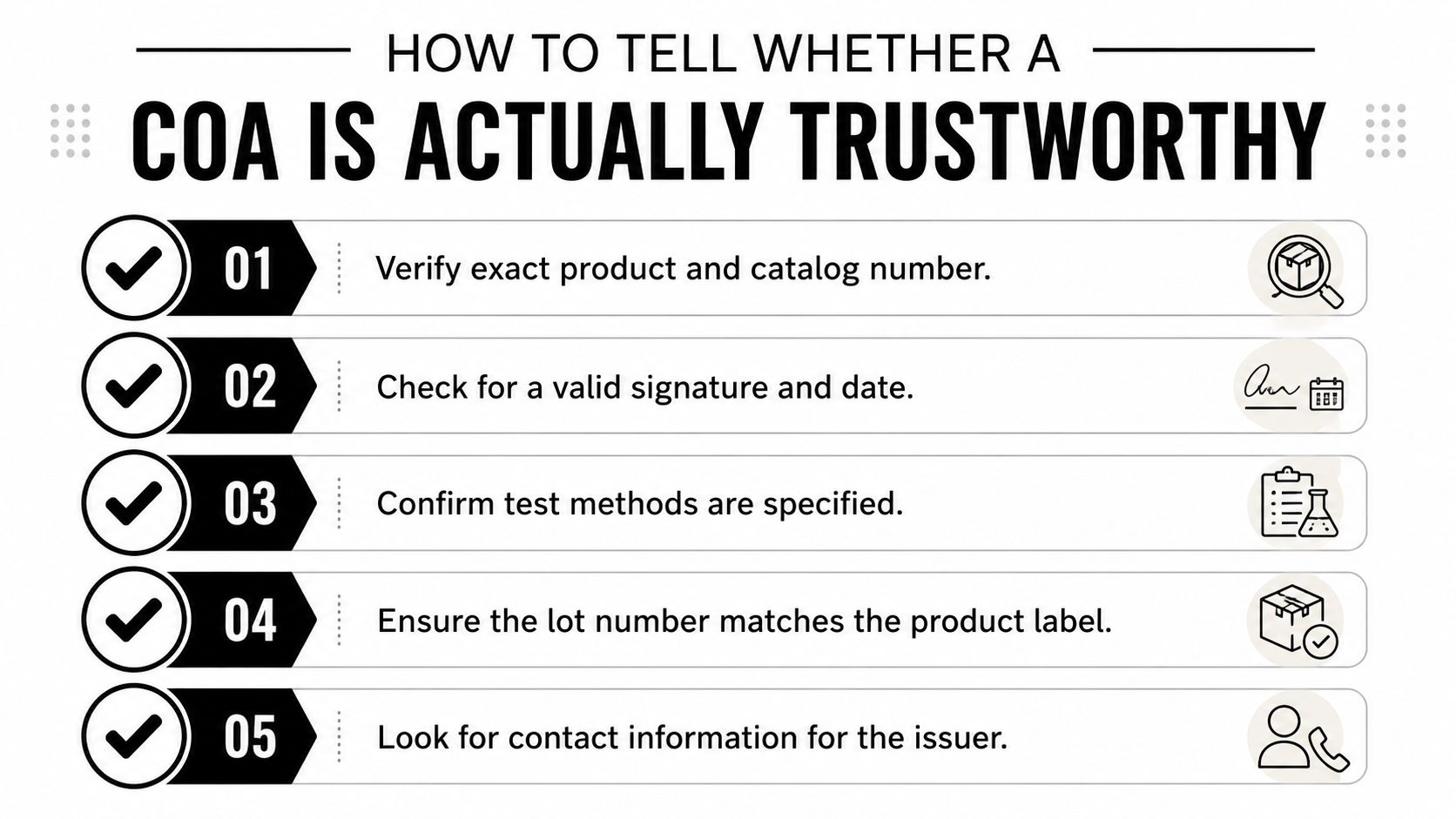
A PDF titled “Certificate of Analysis” should earn acceptance through verification. Digital generation is not suspicious by itself. Treat the document as lot-specific evidence: it should be specific, attributable, legible, internally consistent, and connected to a controlled batch record. A polished marketing sheet may look convincing while leaving the batch, method, or release decision unproven.
The authentication pass
Start with identity. Product name, catalog number, grade, pack information, and lot number should match the physical label, purchase order, shipment record, and COA. A mismatch breaks the chain between the document and the material. Pause release until the supplier provides a corrected or traceable record.
Then examine document control. A certificate number, issue date, manufacturer identity, authorized signatory, and verifiable quality contact give the receiving team a route for confirmation. An electronic signature can be valid, provided it identifies the accountable release function.
Read the analytical table as evidence, not decoration:
- Methods: Each significant test should name a method, method identifier, or clear reference standard.
- Results: Measurable attributes should show values and units, rather than only “conforms.”
- Criteria: Specifications should make the pass or fail decision understandable.
- Consistency: Lot numbers, dates, units, fonts, page numbering, and table content should agree throughout.
- Scope: Sterility, endotoxin, impurity, and similar claims should remain within the testing scope shown.
A document advertising 99.9% purity without an identity test, assay method, impurity profile, reporting limit, or calculation basis provides an incomplete basis for acceptance. Missing pages, altered fonts, duplicated text, blurred tables, unexplained revisions, and conflicting results require escalation.
Authentication rule: Professional design supports readability. It does not prove authenticity.
For high-risk materials, request the original record from the manufacturer or authorized quality unit, compare it with supplier lot records, and arrange independent testing when the risk warrants it. A document comparison tool can help see changes between PDFs when a revised file arrives. Visual comparison still cannot replace issuer verification or laboratory review.
Third-party verification can strengthen confidence, but it does not remove the need to confirm the sample, method, specification, and lot relationship. The evidence must connect to the material in hand, like a key cut for one lock rather than a generic key that fits any door.
The following video provides an additional visual example of document review:
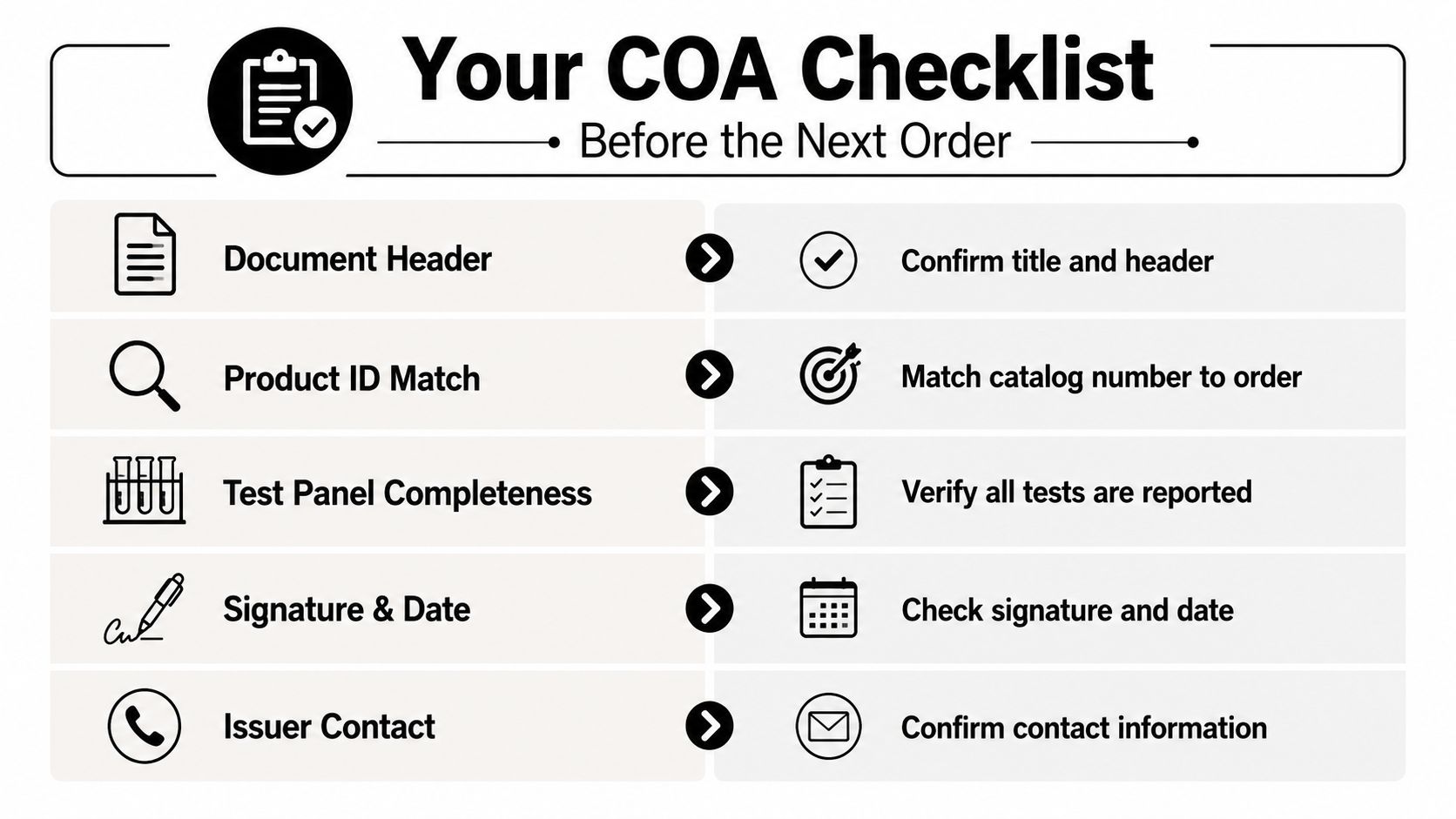
Your COA Checklist Before the Next Order
A procurement lead or researcher can turn the review into a repeatable receiving control. The checklist should be applied before the lot enters active inventory, not after an experiment raises questions.
| Review point | Required action |
|---|---|
| Document header | Confirm the certificate identity, issuer, document number, and issue date. |
| Product match | Match the product name and catalog number to the purchase order and container. |
| Lot traceability | Confirm that the lot or batch number is identical across the vial, shipment, and COA. |
| Test panel | Check that relevant tests, methods, specifications, and acceptance criteria are stated. |
| Measured evidence | Look for actual results with units, reporting qualifiers, and a clear disposition. |
| Release approval | Confirm the authorized signature, approval date, and release status. |
| Issuer contact | Record the manufacturer or laboratory identity and a route for verification. |
Some findings are immediate deal-breakers. A missing lot number prevents a reliable connection to the container. A missing method makes the result harder to interpret. Generic “conforms” language without numerical results limits trend review. An unsigned document leaves the release decision unattributed, and a COA that can't be matched to the shipment shouldn't be accepted as evidence for that shipment.
The record should remain linked to the lot throughout its useful life. File the COA with the receiving record, storage information, testing documentation, deviations, and any experiment or production record that used the material. That practice preserves the chain of evidence when a result needs investigation later.
A trustworthy COA isn't judged by its title or graphic design. It earns confidence by tying a specific lot to methods, criteria, measured results, responsible approval, and traceable records.
Herbilabs provides batch-level COA documentation for its research-use-only laboratory supplies, including high-purity reagents and sterile diluents, so wholesalers, distributors, and researchers can connect product records to the lots they receive. Visit Herbilabs to review its laboratory supply range and COA documentation before the next order.


