Private Label, White Label, Wholesale partnerships available - EU, USA and UK - Free shipping from €75
Supplier Risk Management: Protect Your Lab Supply Chain
A lab shipment looks fine on paper until one cold-chain lane slips, one sterile diluent lot fails release, or one “backup” supplier turns out to be the same factory under a different label. Then the phone starts ringing from warehouse, customer service, and a researcher who has already scheduled a study around the delivery date. That's the moment supplier risk management stops being a procurement exercise and becomes a continuity problem.
For lab-supply distributors and peptide resellers, the hard part isn't identifying that risk exists. It's separating the harmless noise from the few hidden dependencies that can stop revenue, damage trust, and leave critical customers waiting on a replacement that never arrives. A practical framework has to turn supplier signals into decisions, not just dashboards, and it has to fit the realities of RUO labeling, cold-chain handling, and cross-border fulfillment.
Table of Contents
- Why Lab Distributors Face Outsized Supply Chain Risk
- Building a Risk Taxonomy and Segmenting Your Supplier Base
- Scoring Suppliers and Converting Signals into Decisions
- Mitigation Strategies for Quality, Continuity, and Cold Chain
- Monitoring, KPIs, and Incident Response That Actually Works
- Implementation Roadmap and Ready-to-Use Templates
Why Lab Distributors Face Outsized Supply Chain Risk
A distributor can carry hundreds of SKUs and still be exposed to a tiny number of failure points. If a single-source bacteriostatic water supplier misses sterility criteria, the issue doesn't stay inside procurement. It spills into delayed outbound orders, customer exceptions, replacement sourcing, and the uncomfortable question of which client commitments were made off an inventory assumption that no longer holds.
That kind of disruption is expensive because it hits more than one line item. Equifax's 2022 resilience survey found organizations experienced three significant supply chain disruptions in the prior year, with an average combined cost of $182 million in lost revenue, equal to 1.74% of annual revenue. It also showed that disruption cost varies by risk type, with financial failure such as a supplier bankruptcy averaging $42 million, while ESG-related risk such as human-rights compliance fines averaged $35 million. Equifax's resilience report makes the point plainly, the cost isn't theoretical once critical suppliers go sideways.
Why the risk is not evenly distributed
The bad habit in many distributor networks is treating risk as if it tracks supplier count. It doesn't. Risk tracks the number of places where a failure can't be substituted fast enough, cleaned up easily enough, or explained credibly enough to the customer. That's why cold-chain reagents, sterile diluents, glass primary packaging, and courier lanes often matter more than the long tail of routine spend.
PwC Australia's supplier risk study shows how often organizations miss that distinction. 81% of respondents said they had an inventory of suppliers, but only 51% had evaluated the relative risks each supplier posed to the organization. More than half had experienced a significant disruption in the previous three years, and those disruptions increased costs for 42% of respondents and affected customer service levels for 39%. The PwC study is a useful reminder that visibility on paper is not the same thing as defensible control.
For lab distributors, the hidden exposure often sits in the last mile of complexity. A Research Use Only product can be compliant in labeling terms and still be fragile in practice if the storage window is tight, the re-packaging step is outsourced, or the courier's handling rules are inconsistent across borders. That's where a practical resource like assess supplier risks for business continuity can help frame the continuity question in operational terms instead of abstract risk language.
Practical rule: if one supplier failure can halt a customer promise, the supplier is critical regardless of spend size.
The board-level point is simple. When a small group of inputs controls delivery, compliance, or potency, supplier risk management becomes a resilience function. For lab-supply businesses serving the EU, UK, and USA, the exposure is defined less by how many vendors exist and more by how many of them can't be replaced without triggering a chain reaction.
Building a Risk Taxonomy and Segmenting Your Supplier Base
A useful risk taxonomy starts with the product, not the supplier file. A peptide reseller does not need the same lens for a vial supplier, a courier, and a lyophilized active manufacturer. Each one fails differently, and the failure mode should determine how thoroughly the team investigates, how often it reviews the relationship, and which controls sit in the contract.
Build a taxonomy that matches the product, not the org chart
The cleanest model has three layers. The first is financial risk, which covers supplier distress, currency exposure, or an acquisition that changes the service model. The second is operational risk, which includes lead-time variability, capacity constraints, and single-source dependency. The third is quality and compliance risk, the area where lab distributors need the most discipline, because it is here that CoA deviation, cold-chain breach, expired potency, labeling errors, and documentation gaps turn into customer-facing failures.
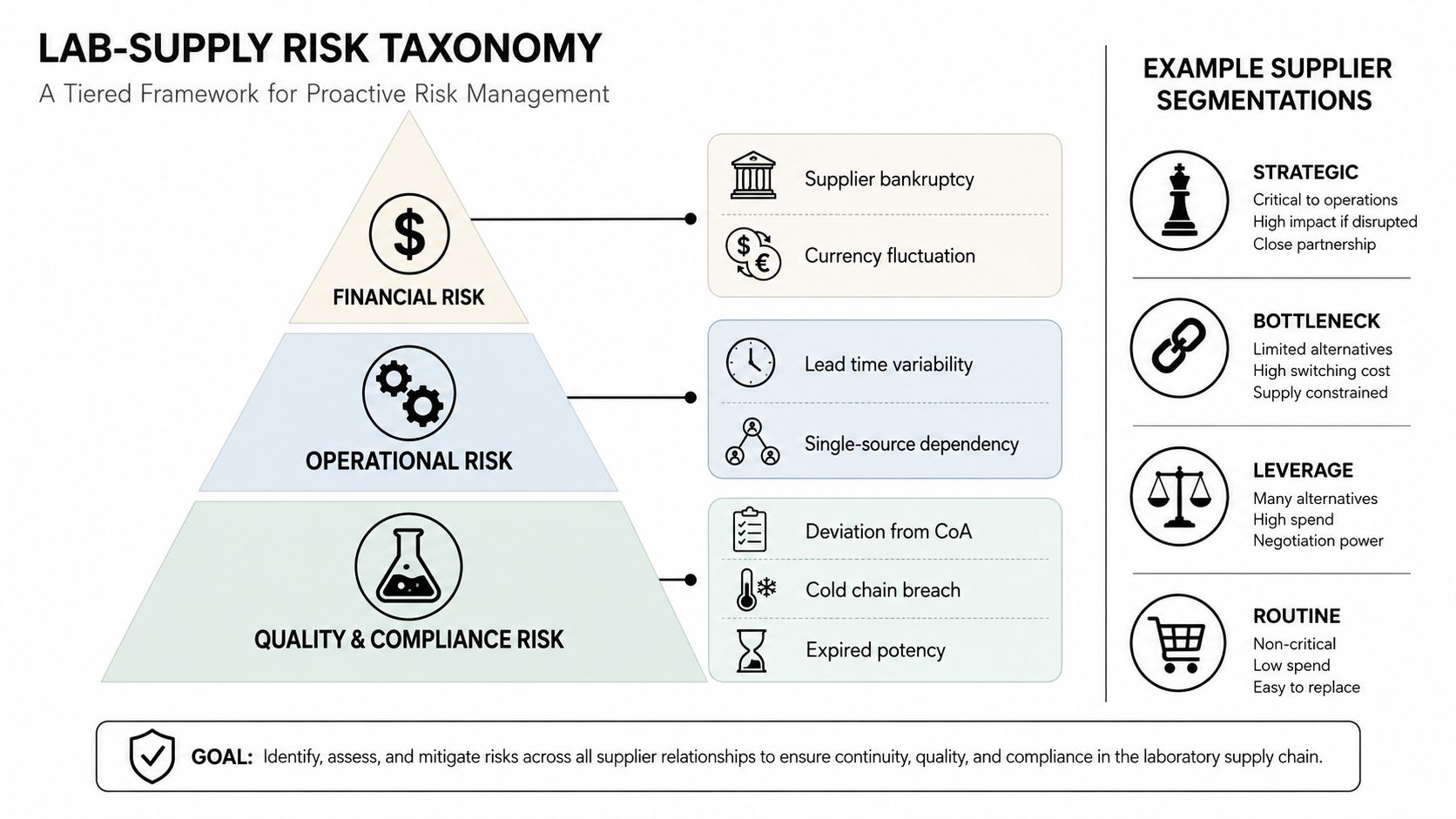
The next step is segmenting suppliers by criticality, not by spend alone. A courier can be a lower-spend supplier and still sit in a high-criticality tier if it controls cold-chain integrity. A glass vial vendor may look routine until it becomes the only qualified source for a format tied to a premium sterile line. A lyophilized peptide manufacturer usually deserves the strictest tier because substitution is hard, validation time is long, and downstream impact is immediate.
The internal logic should be consistent. Critical suppliers get deeper due diligence, tighter change notification, and more frequent review. Lower-risk suppliers still need oversight, but not every vendor deserves the same audit depth. The point is to reserve scarce attention for the relationships that can interrupt customer service.
For a broader compliance lens on shipping-linked risks, how to assess shipping compliance risk is a useful companion resource. It fits best when cross-border movement is part of the failure mode, which is often the case in EU, UK, and USA distribution.
A supplier should land in the highest tier driven by the toughest failure to recover, not the largest invoice.
That approach also avoids a common trap. Teams sometimes classify by category, then forget that category risk and supplier risk aren't the same thing. A routine item from a fragile source can be riskier than a strategic item from a resilient one. Good segmentation lets procurement, quality, and operations talk about the same supplier with the same language.
Scoring Suppliers and Converting Signals into Decisions
A scorecard only works if it changes what people do on Monday morning. Too many teams build a rich dashboard, then leave the actual decision rules in someone's inbox. Supplier risk management gets practical when each score band maps to an action, such as monitoring, escalation, dual-sourcing, or exit planning.
Use thresholds, not endless commentary
A simple weighted scorecard can be enough. Start with the signal types that matter most in a lab-supply context, then assign weights based on the supplier's criticality. Financial health, audit findings, delivery performance, complaint trends, change-control discipline, and temperature-handling performance belong in the model. The trick is not measuring everything, it's deciding which signals deserve authority over inventory, sourcing, and customer commitments.
| Supplier Risk Scorecard Example | |||
|---|---|---|---|
| Risk Dimension | Weight | Score 1-3 (Low Risk) | Score 4-6 (Monitor) |
| Financial stability | High | Stable filings, no distress indicators | Slower payments or unusual credit signals |
| Quality performance | High | Clean batch history, timely CoA delivery | Isolated deviations or repeated clarifications |
| Cold-chain control | High | Validated packaging, stable lane performance | Minor excursions or incomplete lane evidence |
| Regulatory compliance | High | Clear RUO labeling, complete documentation | Missing updates or slow change notifications |
| Delivery reliability | Medium | Predictable lead times | Recurring misses or partial fills |
The next question is what to do when the score crosses a boundary. That's where risk appetite matters. A critical reagent supplier with a rising score should trigger a review of safety stock, backup qualification, and contract language. A packaging vendor with similar signals may only need escalation if its failure would block a release, a repack, or a customer-specific kit build.
Herbilabs' own supplier qualification criteria is a useful internal example of how qualification logic can be documented before a relationship becomes operationally messy. The value is not the template itself. It's the discipline of making the decision criteria visible before a buyer is under pressure.
A strong scorecard also protects against alert fatigue. Every supplier issue does not deserve the same response. A late invoice or an administrative paperwork miss should not trigger the same workflow as a cold-chain deviation on a single-source item. If the threshold rules aren't explicit, the team will overreact to noise and underreact to the events that threaten continuity.
Decision rule: the score is useful only when it tells procurement whether to hold, watch, escalate, or replace.
That's the practical value of a weighted model. It links the supplier signal to a business outcome. It also makes review conversations shorter, because the team isn't arguing over whether a risk exists. It's arguing over the correct operational response, which is where the value sits.
Mitigation Strategies for Quality, Continuity, and Cold Chain
Mitigation has to match the failure mode, or it just adds paperwork. A distributor does not need the same controls for a commodity packaging item as for a temperature-sensitive reagent or a cross-border sterile product. The most useful programs separate quality, continuity, cold-chain, and regulatory controls, then assign each supplier the clauses and checks that reduce loss.
Match the mitigation to the failure mode
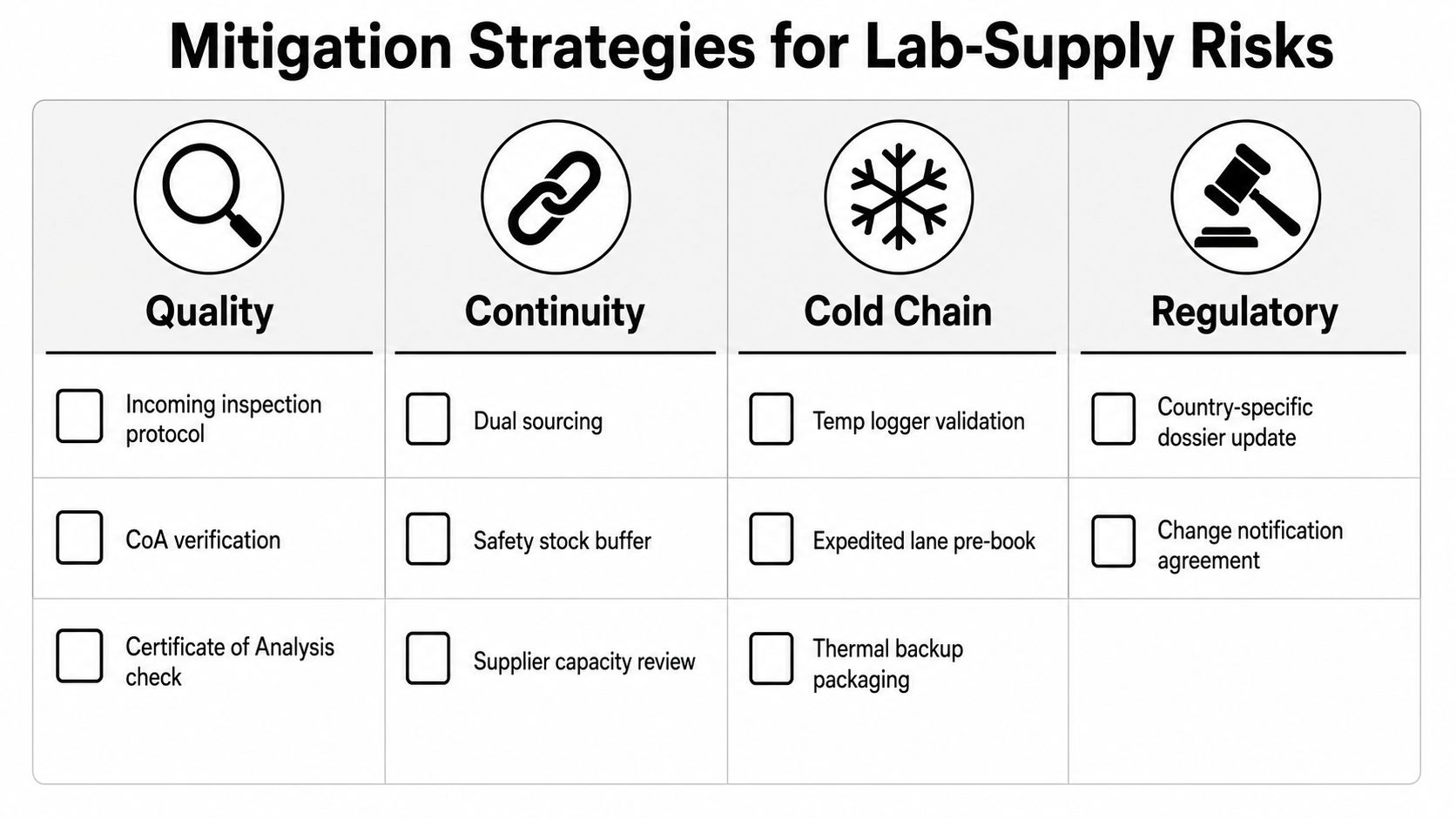
For quality risk, the starting point is incoming inspection. That doesn't mean testing everything to death. It means verifying the right attributes, confirming the Certificate of Analysis, and defining batch-release rules for products where a documentation gap is a release blocker. If a supplier's historical performance drifts, the right response is often more inspection at the point of receipt, not a vague “watch list” note.
For continuity risk, dual sourcing matters only if the second source is qualified before the first source fails. A backup supplier that hasn't been validated is not a backup. Safety stock should be set around substitution difficulty and lead-time sensitivity, especially for temperature-sensitive items that can't sit in a warehouse indefinitely.
For cold-chain risk, the controls need to be concrete. Courier qualification, packaging validation, and temperature-monitoring expectations should be written into the supplier file and the freight SOP. If the lane is delicate, the team should know which packaging system is approved, which logger data is acceptable, and who owns the escalation when a parcel lands outside tolerance.
For regulatory risk, the contract should require change notification, document ownership, and audit access. RUO labeling, country-specific dossiers, and cross-border paperwork are not admin details. They are release conditions. If a supplier can change a material source or storage method without notice, the buyer can end up holding product that is technically in stock but operationally unusable.
The contract language should be direct. Clauses that work usually say the supplier must notify of formulation, process, site, or packaging changes before implementation. Clauses that don't work bury the buyer in generic “reasonable efforts” language and leave no enforceable escalation point. Audit rights matter too, but only when the team is willing to use them on critical suppliers, not just file them away.
Herbilabs' order tracking systems fit naturally into the continuity conversation because visibility is part of mitigation. Tracking doesn't remove risk, but it helps the team catch the point where a delay becomes a customer escalation rather than a warehouse surprise.
Exit a supplier relationship when the residual risk is still higher than the business can absorb, even after the controls are in place.
A good mitigation package ends with a decision, not a comfort statement. Keep the supplier if controls reduce exposure to an acceptable level. Exit if the supplier's process, lane, or quality behavior keeps forcing the team back into exception handling. In lab distribution, the cheapest supplier can become the most expensive once the hidden failure modes start showing up.
Monitoring, KPIs, and Incident Response That Actually Works
Monitoring only helps when the team knows what each metric means and who acts on it. A dashboard full of green lights can still hide a supplier that is drifting toward a serious problem. The right operating rhythm uses a small set of KPIs, a clear escalation path, and a response playbook that brings procurement, quality, and customer service into the same room fast.
Build a rhythm that the team can keep
For lab-supply distribution, the most useful indicators tend to be on-time-in-full delivery, temperature excursion rates, audit finding closure time, and compliance incident frequency. These are not vanity numbers. They show whether the supplier can fulfill the promise the sales team is making to customers. Quarterly business reviews with critical suppliers should focus on trend changes, corrective actions, and upcoming process changes, not just a retrospective score.
The best digital tools are the ones that reduce manual chasing. Supplier portals, shared incident logs, and controlled document repositories can help when they remove ambiguity around approvals, updates, and proof of action. The wrong tools create clutter by collecting data that no one is assigned to review or act on.
An incident response playbook should be short and operational. It should define who contains the issue, who validates the root cause, who contacts the customer, and who decides whether stock, sourcing, or transport needs to change. A supplier's financial downgrade should trigger a different sequence than a single batch failure, because the first is a continuity problem and the second is usually a quality containment problem.
If a metric can't trigger a named action, it belongs in a report, not in a control tower.
That's also where business impact sorting matters. Alerts should not arrive in the same order they were generated if the consequences are different. A cold-chain deviation on a critical SKU deserves immediate review. A minor administrative miss on a low-risk item can wait for the weekly queue.
The monitoring stack should support the decision framework, not replace it. Herbilabs' supply chain visibility is a relevant example of how visibility can be treated as an operational capability rather than a standalone dashboard exercise.
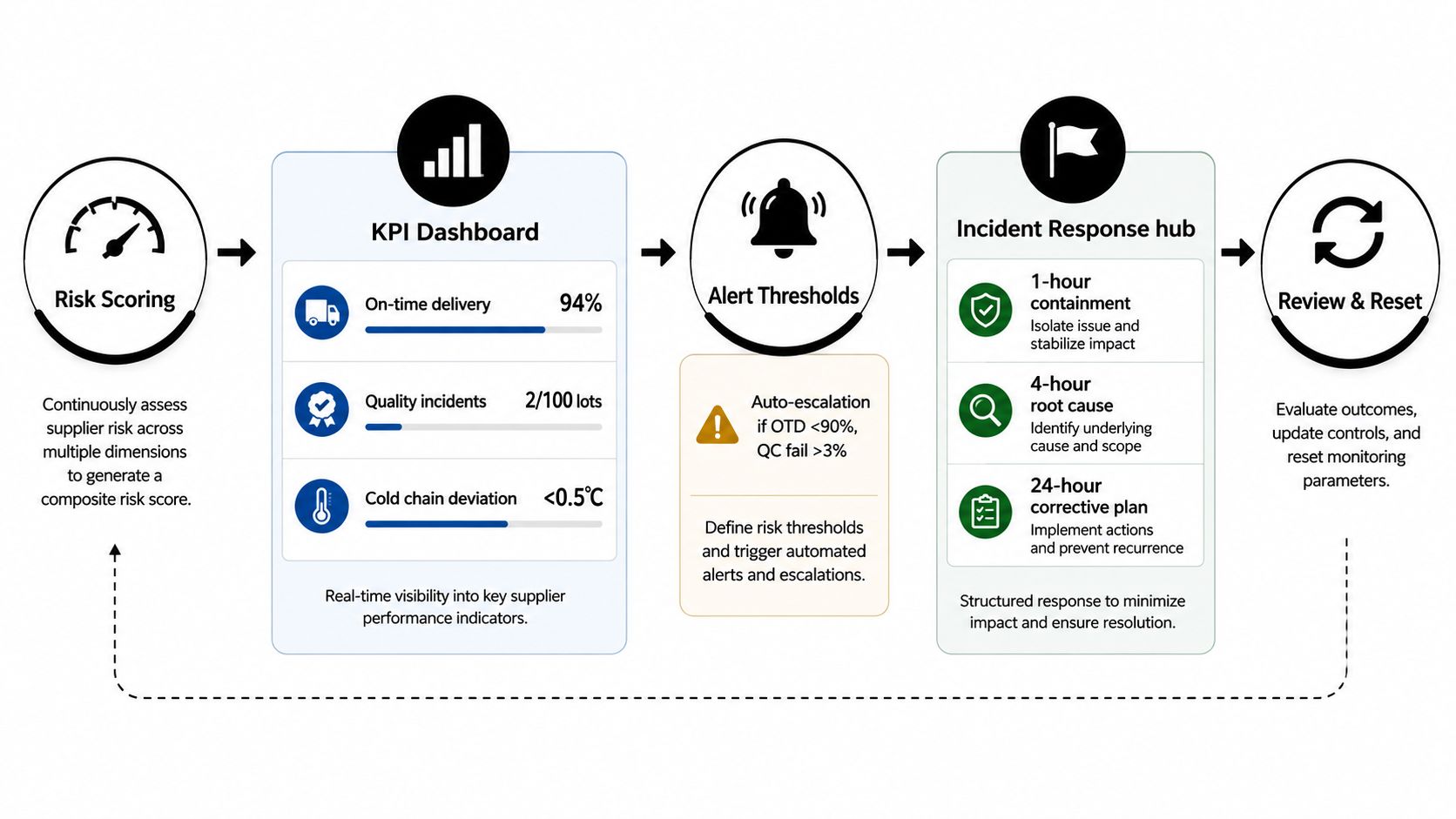
The process is only effective when it stays lean. Overbuilt monitoring creates noise, and noise makes teams slower at exactly the moment speed matters most. The goal is a calm response path, a small number of trusted KPIs, and a record of what happened that can be reviewed without a war room.
Implementation Roadmap and Ready-to-Use Templates
A 90-day rollout works better than a sprawling transformation plan because it forces prioritization. Lab distributors in the EU, UK, and USA don't need to assess every supplier on day one. They need a controlled sequence that finds the critical items first, then adds governance where the exposure is highest.
A 90-day rollout that avoids overengineering
Days 1 to 30 should focus on mapping the supplier base and marking the critical SKUs. The deliverable is a live supplier inventory with criticality tiers, failure modes, and owner assignments. This is the point to identify where substitution is hard, where the cold chain is fragile, and which suppliers sit behind customer-facing commitments.
Days 31 to 60 should build the risk taxonomy, the scorecard, and the contract updates. That means turning the segmentation logic into a questionnaire, a review checklist, and a standard set of clauses for change notification, audit rights, and corrective action timing. The model should stay simple enough that buyers can use it without a separate analyst.
Days 61 to 90 should lock in monitoring and test the incident response playbook. That includes KPI thresholds, escalation paths, QBR cadence for critical suppliers, and at least one tabletop test involving procurement, quality, and customer service. If the test surfaces confusion, the process still needs work.
A practical template set usually includes three documents. The first is a supplier risk assessment questionnaire with sections for financial health, site controls, cold-chain handling, and regulatory change management. The second is an audit checklist that separates routine suppliers from critical ones. The third is an incident playbook that names the trigger, the owner, and the first response window.
The most common implementation mistake is trying to make the model perfect before it is used. The second is scoring too many suppliers with too many dimensions, then discovering that no one trusts the output. A usable program beats a complex one that stalls in review.
Use the first cycle to prove the method on the suppliers that matter most. Once the team sees fewer surprises, faster escalation, and cleaner customer communication, the rest of the portfolio becomes easier to bring into line.
Herbilabs supplies labware for distributors and research buyers across the EU, UK, and USA, including high-purity reagents, sterile diluents, and RUO products that need careful handling and dependable fulfillment. If supplier concentration, cold-chain exposure, or release control is creating friction in your network, visit Herbilabs to review products, documentation, and distribution options that fit a tighter operating standard.


