Private Label, White Label, Wholesale partnerships available - EU, USA and UK - Free shipping from €75

Sodium Chloride 0.9 Vial Guide for Lab Use and QA
A lab team receives a fresh shipment of saline vials. The label looks familiar, the concentration seems routine, and someone reaches for one to reconstitute a compound that failed to dissolve cleanly the day before. Hours later, the result still looks off. The problem often isn't dramatic. It's a small mismatch between what the workflow needed and what the vial was.
That's why a Sodium Chloride 0.9 vial deserves more attention than it usually gets. In research settings, it isn't just a basic salt solution. It's a defined diluent with specific osmotic behavior, a specific sterility profile, and a specific packaging intent. For lab staff, peptide researchers, wholesalers, and distribution partners, those details affect reproducibility, handling, and purchasing risk.
A useful way to think about it is simple. The label tells only part of the story. The rest lives in vial format, preservative status, lot documents, closure integrity, and whether the product fits the workflow it's entering.
Table of Contents
- Introduction to Sodium Chloride 0.9 Vials in the Lab
- What Makes 0.9 Percent Sodium Chloride Isotonic
- Why 0.9 Percent Became the Standard and What Normal Really Means
- Common Research Applications and When to Use This Diluent
- Preservative Free Versus Bacteriostatic Vials and How to Choose
- Sterility Storage and Safe Handling in Practice
- Quality Assurance COAs and Supply Reliability for Buyers
Introduction to Sodium Chloride 0.9 Vials in the Lab
A common lab error starts with a reasonable assumption: saline is saline. A researcher needs a sterile diluent, sees a sodium chloride vial in stock, and uses it without checking whether the protocol expected a preservative-free single-dose product, a bacteriostatic format, or a buffered alternative. The label may still say 0.9% sodium chloride. The workflow outcome can still change.

In practical lab work, the Sodium Chloride 0.9 vial sits at the intersection of chemistry and process control. It's often chosen because the solution is isotonic and widely used as a diluent and infusion fluid. But in research use, “widely used” doesn't mean “interchangeable.” A peptide reseller, a university lab, and a sterile-packaging distributor may all buy the same concentration for very different reasons.
That's where written process matters. Teams that implement SOPs in the lab usually catch these differences earlier because the procedure forces a check on vial type, intended use, and post-puncture handling before anyone starts reconstitution.
Why this small vial creates big confusion
Several questions come up repeatedly:
- Concentration confusion: Staff know it's 0.9%, but may not translate that into what the vial is delivering.
- Sterility confusion: “Sterile” on the label gets mistaken for “safe to re-enter repeatedly.”
- Supply confusion: Buyers see “available” and assume that means lot-level confidence is settled.
- Use-case confusion: A plain saline vial and a bacteriostatic saline vial may look similar in procurement lists but behave very differently in real handling.
A saline vial is easy to buy and easy to misuse. Most errors happen after the label is read, not before.
Who needs to care most
This topic matters most for:
- Lab staff handling reconstitution: They need the right carrier for the protocol.
- Peptide researchers: They often work in small volumes where repeated access decisions matter.
- Resellers and distributors: They carry quality risk if container integrity or lot traceability is weak.
- Procurement teams: They need fit-for-use decisions, not commodity assumptions.
The safest habit is to treat every Sodium Chloride 0.9 vial as a documented input, not a generic consumable.
What Makes 0.9 Percent Sodium Chloride Isotonic
A researcher opens a fresh vial to reconstitute a compound, and the label looks simple: 0.9% sodium chloride. The easy mistake is to treat that number as routine. In practice, it is a concentration choice with direct effects on cell water balance, protocol fit, and even lot acceptance for buyers who need traceable, repeatable inputs.
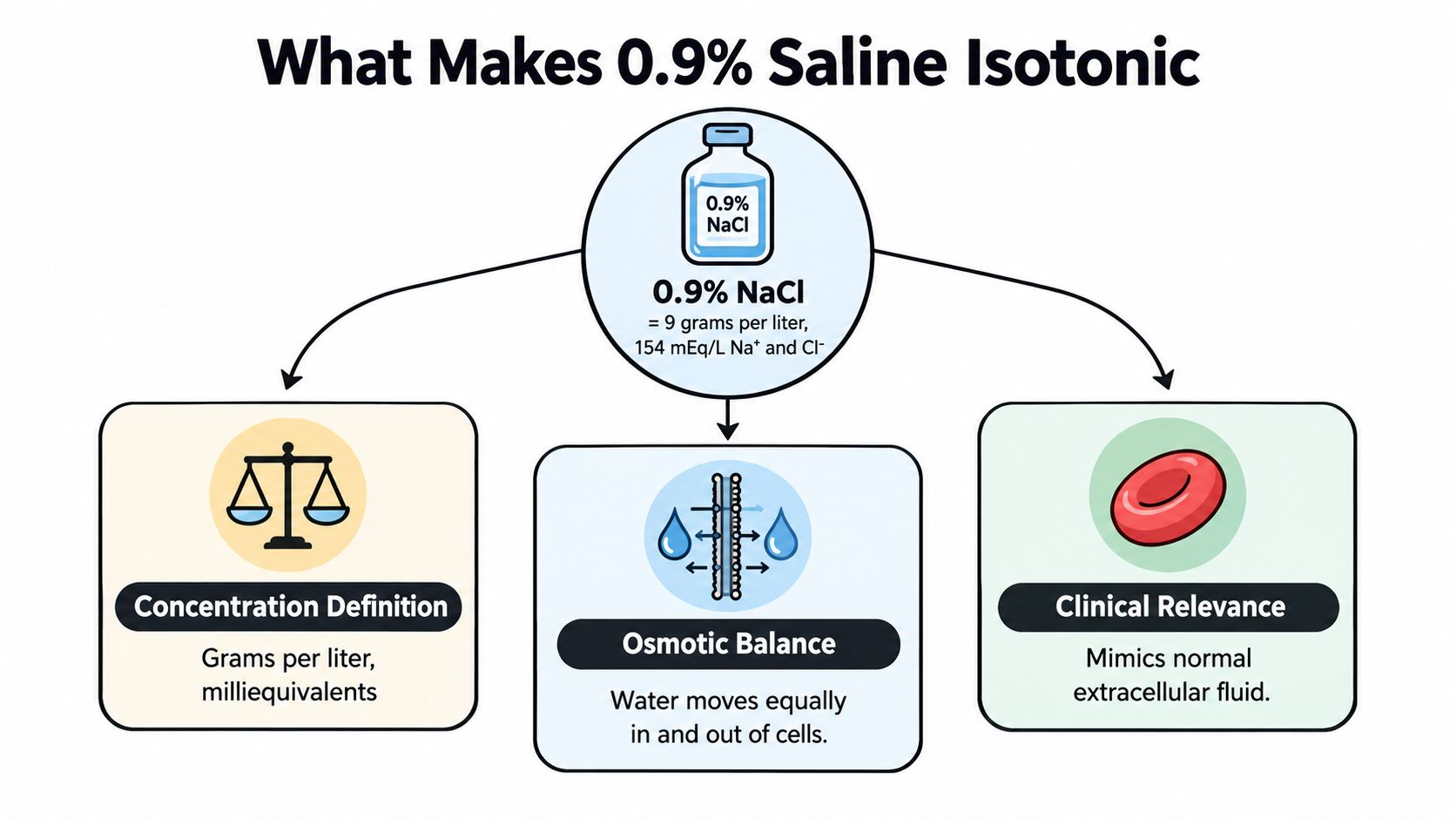
A 0.9% sodium chloride solution contains 9 g/L sodium chloride, or 9 mg/mL. Product labeling for sodium chloride injection lists 154 mEq/L sodium, 154 mEq/L chloride, and a calculated osmolarity of about 308 mOsmol/L, according to DailyMed labeling for sodium chloride injection.
Start with the concentration
The word “isotonic” points to balance. Here, it means the fluid has a dissolved particle level close enough to body fluids that it does not strongly drive water into cells or pull water out of them.
A simple lab picture helps. A cell works like a water-filled pouch with a selective membrane. If the surrounding liquid is too dilute, water moves inward and the cell swells. If the surrounding liquid is too concentrated, water moves outward and the cell shrinks. At 0.9%, saline sits near the range used to avoid that osmotic push in routine handling.
For readers who want a plain-language explanation of the naming, this overview of why 0.9 sodium chloride is called normal saline gives helpful context.
Isotonic does not mean identical to plasma
This point trips up new staff. “Isotonic” does not mean the vial copies plasma in every respect. It means the overall osmotic effect is close enough for the solution to behave as a practical neutral carrier in many settings.
That is why 0.9% saline is widely used when a protocol needs a sterile diluent that is less likely to create osmotic stress. In research and distribution, that makes the vial more than a commodity fluid. It becomes a lot-level quality decision, because the expected concentration has to match the label, the container has to protect sterility, and the paperwork has to support traceability if a result or shipment is questioned later.
Practical rule: Isotonic means “water movement is kept near balance,” not “appropriate for every formulation.”
Why this matters during reconstitution
During reconstitution, the goal is often to let the active material define the experiment, not the carrier. A Canadian product monograph describes sodium chloride 0.9% injection as a sterile, nonpyrogenic isotonic solution with 9 mg/mL, 154 mEq/L of each ion, and approximately 308 mOsmol/L osmolarity, and notes its use as a diluent or solvent for injectable drugs in single-dose vial formats, as shown in the product monograph PDF.
For lab staff, this means isotonicity is one part of fit-for-use. For buyers and distributors, it also means checking whether the vial is preservative-free or bacteriostatic, whether the lot documentation matches the ordered specification, and whether the COA supports the concentration and sterility claims attached to that specific batch.
Why 0.9 Percent Became the Standard and What Normal Really Means
The word normal has misled generations of buyers and trainees. It sounds physiological, settled, and scientifically final. The history is messier than that.
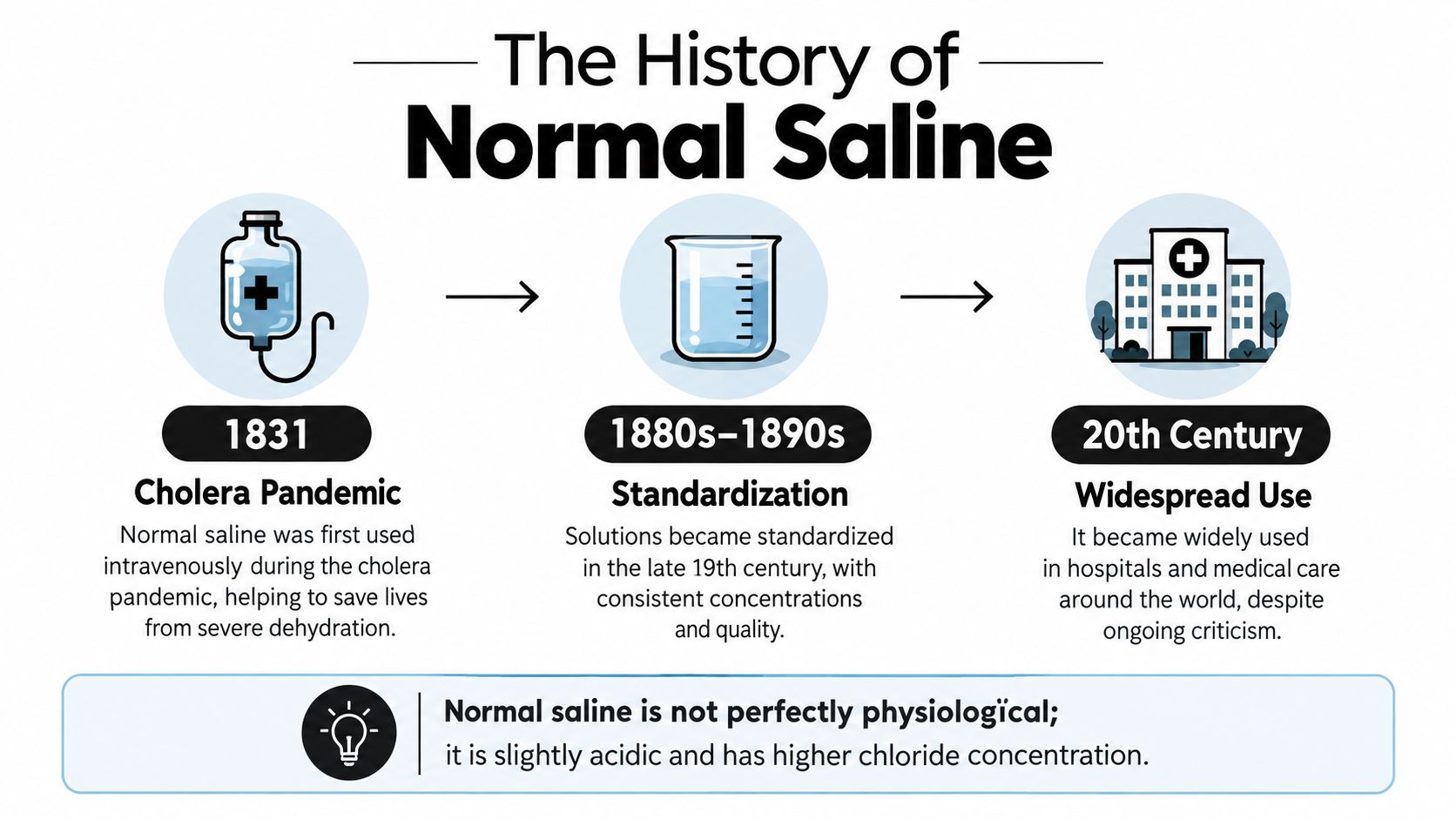
A historical review traced the roots of saline use back to the 1831 European cholera pandemic, then concluded that the modern 0.9% formulation has “very little scientific or historical basis” as a “normal” or physiological fluid. The same review also notes that 0.9% saline did not become the accepted concentration until the end of the 19th century and remains in global use despite having about 10% more sodium and 40% more chloride than plasma, according to the PubMed historical review.
What “normal” actually means in practice
In current usage, “normal saline” is mostly a naming convention. It does not mean the fluid matches plasma perfectly. It means the concentration became standardized and widely adopted.
That distinction matters because many buyers still assume a Sodium Chloride 0.9 vial is the most physiological option by definition. It isn't. It is a conventional standard that remains useful because it is familiar, available, and operationally predictable.
Why the standard stuck
Standards often survive because they work well enough across many settings. Labs value consistency. Pharmacies value recognized formulations. Distributors value clear specifications. Once a concentration becomes embedded in labeling, training, and procurement systems, it tends to stay in place.
A second reason is practical. Even if alternative fluids exist for some specialized uses, a defined sterile saline vial remains easy to specify in workflows that need a simple isotonic carrier.
“Normal” in this context is historical language, not a claim of perfect biological matching.
Why researchers should care about this history
This history prevents a common reasoning error. If a protocol requires a specific diluent, using saline because it sounds standard may be the wrong move. The fact that 0.9% became customary doesn't make it universally ideal.
For new researchers, that's an important shift in thinking:
- Standardized doesn't equal universally optimal
- Commonly used doesn't equal compatible with every compound
- Normal doesn't equal identical to plasma
That perspective makes later decisions easier, especially when choosing between saline, sterile water, bacteriostatic products, or buffered systems.
Common Research Applications and When to Use This Diluent
A technician is ready to reconstitute a research material, the purchasing team has two vial formats on hand, and the protocol only says "use sterile saline if compatible." That is the moment a Sodium Chloride 0.9 vial stops being a routine item and becomes a quality decision.

In the lab, this diluent is usually chosen for one reason. It provides a sterile salt-and-water environment that is gentle enough for many handling steps where plain water would be too disruptive. A simple way to picture isotonicity is this: the solution sits close to the salt balance that many biological materials tolerate, so it acts more like a neutral carrier than a shock.
That makes it useful in several common research tasks:
- Reconstitution work: Some materials are easier to handle in an isotonic diluent than in sterile water, especially when the method is built around saline contact.
- Vehicle controls: If the test article is prepared in saline, the control often needs the same background solution.
- General sterile dilution: Teams may need a plain, unbuffered diluent for transfer, mixing, or preparation before a later step.
- Sample handling workflows: Saline can serve as a holding or rinse medium when the method calls for a simple sterile salt solution rather than a buffered system.
The key is fit. Saline is a good carrier when the protocol benefits from isotonicity, does not require buffering, and allows this specific diluent.
It is less helpful than some buyers expect. A 0.9% sodium chloride vial does not automatically improve solubility, and it does not control pH the way a buffer does. If a compound only remains stable inside a narrow pH range, saline may be too plain. If the method requires a salt-free environment, saline is the wrong choice even if it is sterile and familiar.
This is also where lot-level thinking matters. Two vials may both say 0.9% sodium chloride, but the right purchasing decision depends on how that lot will be used, documented, and handled. If your lab needs traceable release records for incoming materials, the value is not just the label claim. It is the ability to match the vial in hand to the lot paperwork used in QA review and downstream records.
Container format affects bench use in practical ways. As noted earlier, these vials are supplied in multiple sizes and presentations. A small vial may reduce leftover volume and waste in single-preparation work. A larger vial may look efficient on paper but become a poor fit if the workflow only needs small one-time withdrawals. Glass and plastic can also change how a team stores, transports, and stages the product during routine work.
Use cases become clearer with a few side-by-side examples:
- Choose 0.9% sodium chloride when the method calls for a sterile isotonic diluent and no buffer is required.
- Choose a buffered diluent when pH stability is part of the method.
- Choose sterile water when the protocol requires no added salts.
- Pause and review the vial category when repeated access is expected, because the chemistry may fit while the presentation does not.
For labs and distributors, this section is really about reducing avoidable mismatch. The science question is whether isotonic saline fits the method. The supply question is whether the vial format, lot documentation, and product type support the way the material will be used.
A short visual refresher can help teams train around that distinction.
A quick bench-level checklist
Before selecting a Sodium Chloride 0.9 vial, check:
- Method fit: Does the protocol call for isotonic saline, or does it require sterile water or a buffered diluent?
- Material behavior: Does the compound tolerate a plain salt solution without added pH control?
- Use pattern: Will the vial be opened for a single preparation, or is the team planning repeated access?
- Format choice: Does the container size match the actual withdrawal volume, storage setup, and expected waste tolerance?
- Lot traceability: Can the buyer and lab match the vial lot to the required QA documentation and receiving records?
Those checks help researchers choose saline because it fits the work, not because it is the default.
Preservative Free Versus Bacteriostatic Vials and How to Choose
Many purchasing mistakes begin here. A team asks for “saline vials” when what it really needs is a decision about single-dose preservative-free use versus repeated-access bacteriostatic use.
ASHP's shortage listing treats bacteriostatic 0.9% sodium chloride vials as a distinct supply category with their own availability dynamics, which is why treating all saline vials as interchangeable can distort both sterility practice and procurement planning, as shown in the ASHP shortage detail for bacteriostatic sodium chloride.
The key difference
Standard 0.9% sodium chloride vials contain no bacteriostat, antimicrobial preservative, or added buffer and are intended for single-dose use, according to DailyMed product information on sodium chloride injection. That is the most important handling fact in this whole guide.
Bacteriostatic saline is a different product category. Buyers usually choose it because the workflow expects repeated access under labeled conditions. That does not make it a blanket replacement for plain saline.
Choosing Between Preservative Free and Bacteriostatic 0.9% Vials
| Feature | Preservative Free 0.9% Vial | Bacteriostatic 0.9% Vial |
|---|---|---|
| Preservative status | No bacteriostat or antimicrobial preservative | Includes a preservative for bacteriostatic function |
| Typical access pattern | Best matched to single entry and prompt use | Better matched to repeated withdrawals when labeled for that use |
| Workflow fit | Reconstitution and one-time sterile dilution tasks | Small-volume repeated-access workflows |
| Main risk if chosen incorrectly | Staff may re-enter a single-dose vial and assume sterility remains protected | Staff may use it where preservative-free product was required |
| Procurement question | “Do we need a sterile single-dose diluent?” | “Do we need repeated-access convenience with the right labeling?” |
A practical way to decide
A purchasing team can simplify the choice with three filters:
- Start with the protocol. If the method calls for preservative-free saline, that ends the debate.
- Look at bench behavior. If the lab tends to make several small withdrawals over time, repeated access needs to be acknowledged at procurement stage, not improvised later.
- Check training risk. If users may not distinguish single-dose from multi-dose handling, the wrong vial type can create a compliance problem.
Readers comparing carrier options may also find this sterile water versus bacteriostatic overview useful because it sharpens the same workflow question from another angle.
The correct vial isn't the cheapest vial. It's the one whose labeling matches how the bench will actually use it.
Sterility Storage and Safe Handling in Practice
A clean vial can become a questionable one in a single careless minute. A technician wipes the stopper poorly, makes one withdrawal, sets the vial aside, and later another person assumes it is still fresh stock. The fluid has not changed its look, but the risk profile has changed completely.
That is why storage and handling should be treated as part of lot control, not just bench etiquette. For labs and distributors, a sodium chloride 0.9 vial is only as dependable as the chain that protects it from release through final use.
Standard sodium chloride injection is sterile, single-dose, and commonly supplied without preservative or added buffer. FDA labeling also lists a mildly acidic pH range of about 4.5 to 7.0, with pH adjustment by hydrochloric acid and/or sodium hydroxide, according to DailyMed product details.
What sterility means in daily use
Sterility works like a sealed door. While the closure remains intact, the manufacturer's validated process is protecting the contents. After puncture, the vial depends on your handling steps instead.
That distinction causes confusion. Staff may look at a clear, unchanged solution and assume it is still low risk. Visual clarity does not confirm sterility after access. A single-dose vial also does not gain repeated-use protection just because only a small volume was removed.
The pH range can also be misunderstood. It helps keep the product within specification during manufacture and shelf life. It is not a built-in defense against contamination after the stopper has been entered.
Storage and bench controls that reduce avoidable mistakes
Use a simple rule. Protect the lot before opening, then protect the workflow after opening.
- Inspect on receipt: Check the label, lot number, expiration date, closure condition, and solution clarity before stock is released.
- Store by label instructions: Keep vials under the stated storage conditions and avoid damage during internal transport or repacking.
- Treat first puncture as a status change: Mark or segregate accessed vials immediately so they cannot drift back into unopened inventory.
- Use clean access technique every time: Disinfect the stopper and withdraw with sterile equipment on a prepared work surface.
- Match handling to vial type: Single-dose stock should support one access sequence and prompt use, not bench-top reuse by habit.
- Document lot use in controlled settings: If a problem appears later, the team should be able to trace which batch was used, where, and by whom.
Buyers and lab managers connect science to supply reliability. A low-cost vial from an inconsistent source can create extra relabeling, uncertain storage history, or weak lot traceability. Those are handling risks before the stopper is ever pierced.
What sealed-product stability can and cannot support
Published stability work has shown that 0.9% sodium chloride solutions can remain stable in intact containers under a range of storage conditions, including extended storage examined in the pharmaceutical literature, as described in a review of solution stability and compatibility in the Handbook on Injectable Drugs record at ASHP. That supports confidence in the sealed product when packaging integrity is maintained.
It does not justify repeated use of an opened single-dose vial.
For new researchers, the practical takeaway is simple. Sealed stability belongs to the manufacturer and the lot. Post-puncture sterility belongs to the people, the storage discipline, and the records that show what happened.
Quality Assurance COAs and Supply Reliability for Buyers
Availability is only the first screening question. The harder question is whether the lot in hand is one a lab or distributor can trust.
The FDA stated that the nationwide IV saline shortage ended on 2025-08-08, yet the same product category continued to see recalls in 2025 to 2026 for particulate matter, fiberglass, and even product mix-ups in which a saline-labeled container may contain potassium chloride instead, according to the FDA statement announcing resolution of the IV saline solutions shortage. That changes the buyer's mindset. “In stock” is not the same as “low risk.”
What a serious buyer should request
A lab, wholesaler, or reseller should ask for:
- Lot-specific COAs: The document should match the exact batch being shipped.
- Sterility documentation: Especially important for sterile diluents entering controlled workflows.
- Traceability records: Receiving teams need a clean chain from supplier to local inventory.
- Recall-response procedures: A supplier should be able to identify affected lots and communicate quickly.
- Packaging controls: Closure integrity and shipping protection matter as much as the fluid itself.
For teams training buyers on document review, this guide to reading a certificate of analysis is a useful practical reference.
Why packaging discipline belongs in QA
Supply reliability isn't only about manufacturing. It also includes transport and pallet control. In regulated product handling, secondary damage during movement can undermine an otherwise acceptable lot, which is why packaging and load security practices such as pallet stabilization solutions for food are relevant examples of the broader discipline around shipment integrity in sensitive supply chains.
One practical market example is Herbilabs, which states that it tests batches to 99%+ purity and uses temperature-controlled storage and fulfillment for research supplies. For buyers, that kind of supplier information is useful only when it is paired with lot documents, clear RUO labeling, and a defined response process if a batch question appears.
The best buying framework is simple. Confirm fit-for-use first. Confirm sterility and documentation second. Confirm price after that.
Labs and distributors that need sterile reconstitution solutions, bacteriostatic formats, and lot-specific documentation can review the RUO supply options available from Herbilabs. The useful standard for this category isn't just whether a Sodium Chloride 0.9 vial is available. It's whether the vial, the paperwork, and the handling model all match the workflow it's entering.


