Private Label, White Label, Wholesale partnerships available - EU, USA and UK - Free shipping from €75

Same Day Delivery UPS: Lab Shipping Coverage and Options
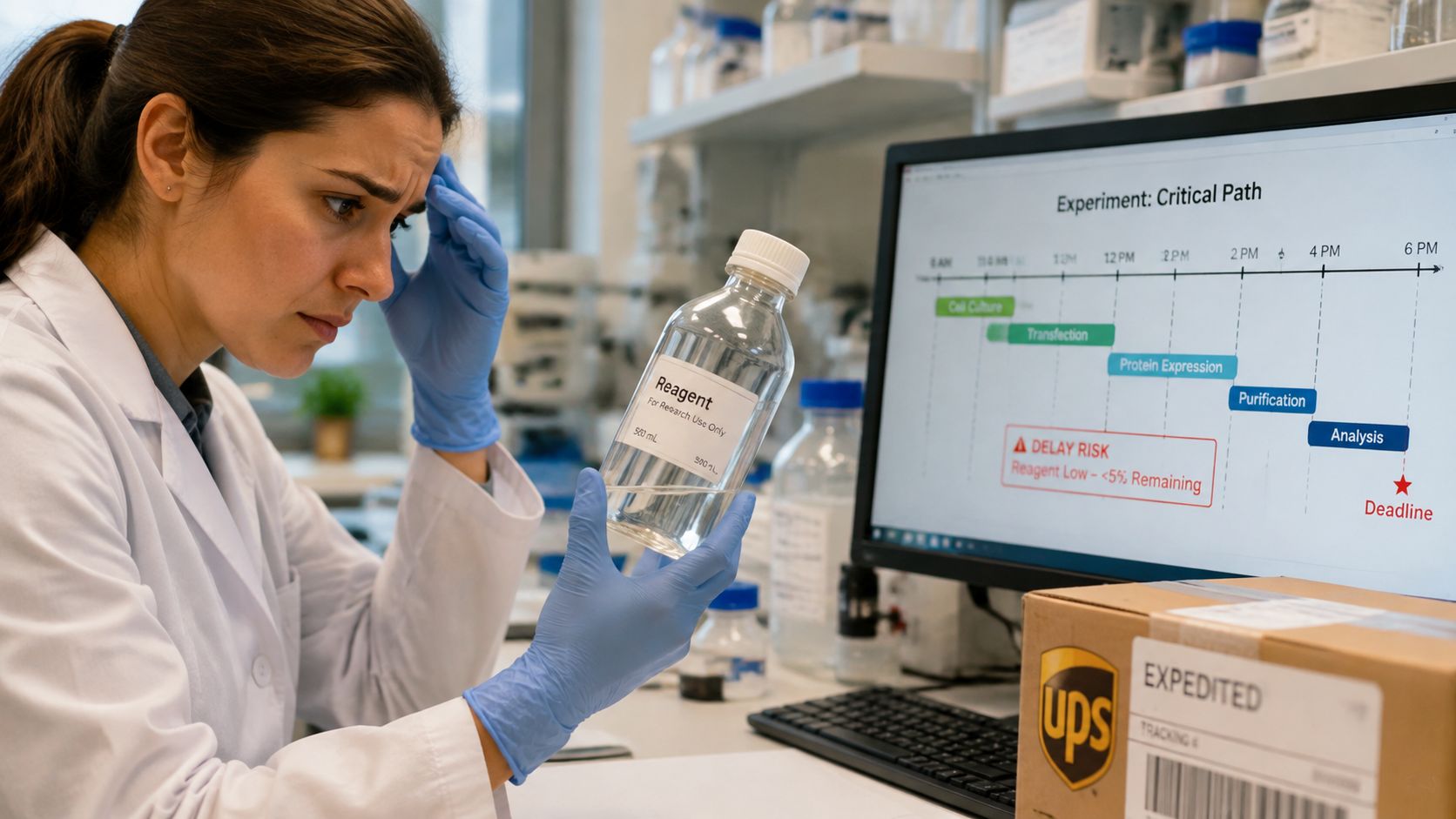
A researcher discovers that a critical reagent is nearly depleted halfway through an experiment. The supplier has stock, but a standard shipment arrives too late, and the laboratory's schedule can't absorb another day of delay. The immediate question is often phrased as “same day delivery UPS”, but that wording hides an important operational distinction: UPS doesn't treat every same-day shipment as the same type of move.
For laboratory suppliers, the practical choice usually sits between UPS Express Critical, designed for urgent freight and high-value shipments, and Roadie, used for localized same-day delivery. The correct service depends on the shipment's urgency, origin and destination, packaging requirements, route availability, and the condition the material must maintain in transit. A same-day label alone won't protect a temperature-sensitive reagent or guarantee that a late dispatch can still meet the requested window.
Table of Contents
- When Same Day Delivery Becomes a Lab Necessity
- Express Critical Versus Roadie for Lab Shipments
- Coverage, Cutoffs, and Network Constraints
- Preparing Temperature-Sensitive Reagents for Same Day Dispatch
- Cost Trade-Offs and Service Level Decisions
- Common Misconceptions About UPS Same Day Delivery
- Your Same Day Lab Shipping Checklist
When Same Day Delivery Becomes a Lab Necessity
A university lab may need a replacement reagent before a time-sensitive run reaches its next stage. A distributor may receive an urgent order from a research group whose work is already scheduled and whose receiving staff will leave soon. In both cases, the shipping problem isn't just “deliver quickly.” The true requirement is to move a specific material through a suitable route, with enough time for pickup, transport, receipt, and controlled storage.
UPS positions Express Critical for urgent same-day shipments, including time-sensitive, emergency, and high-value goods. UPS states that most shipments arrive within 2 to 12 hours, and the service is available 24/7/365. For a laboratory, that around-the-clock operating model can matter when an incident occurs outside ordinary business hours or when a receiving window falls outside a conventional weekday schedule.
The second model is localized delivery through Roadie, a crowd-sourced delivery platform. UPS says Roadie reaches 97% of U.S. households and provides delivery windows of 2 hours, 4 hours, or end of day through its local delivery offering. These options are more relevant to a short-distance move within a metro area than to an urgent freight movement between distant facilities.
Why the distinction matters
Same-day delivery has become a structured logistics product rather than a vague emergency promise. The shipper can select a delivery window based on urgency and cost sensitivity, but only after confirming that the shipment fits the service and that the route is supported.
A local courier may be suitable for a sealed package moving from a nearby supplier to a research campus. A shipment requiring urgent freight coordination, broader route planning, or a tightly measured delivery window may need Express Critical instead. Treating both as interchangeable can lead to the wrong booking, inadequate packaging, or an unrealistic expectation at the receiving dock.
For practical guidance on keeping research work moving when supplies run short, laboratory teams can review same-day lab supply planning. The central lesson is straightforward: same day delivery UPS is a service family, not one universal product.
Express Critical Versus Roadie for Lab Shipments
Which service fits the shipment, Express Critical or Roadie? The answer depends on the route, handling profile, and receiving commitment. Express Critical serves urgent, time-sensitive, emergency, or high-value shipments. Roadie supports localized last-mile delivery. Same-day availability alone does not make them interchangeable.
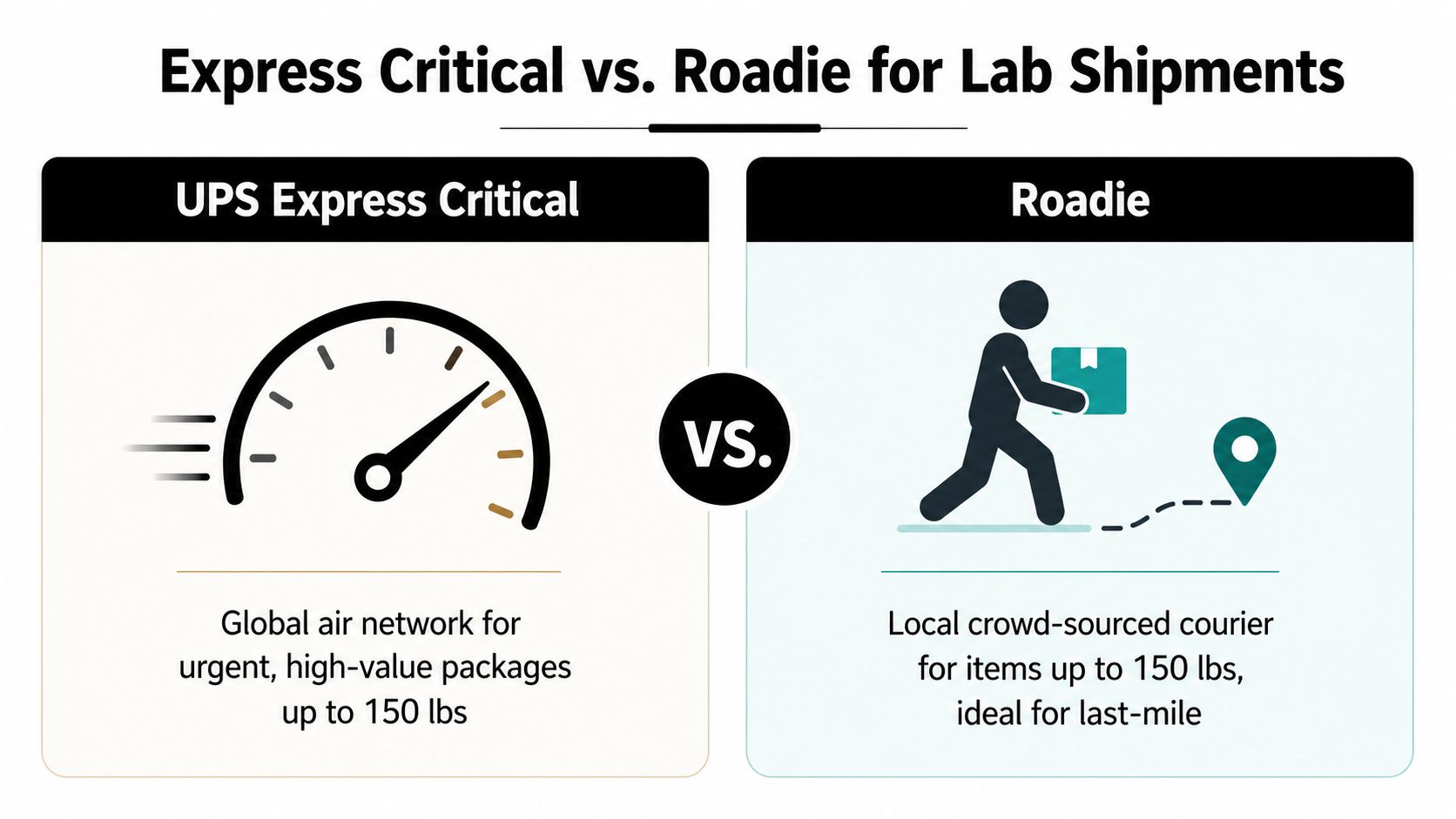
| Feature | UPS Express Critical | UPS Roadie |
|---|---|---|
| Primary role | Urgent freight and high-value shipments | Localized same-day last-mile delivery |
| Delivery promise | Most shipments in 2 to 12 hours, according to UPS service information | 2-hour, 4-hour, or end-of-day windows for localized delivery |
| Operating model | Coordinated urgent transportation | Crowd-sourced local courier network |
| Best operational fit | Emergency replenishment, critical materials, and shipments requiring an hours-based window | Local parcel moves within a supported metro area |
| Coverage signal | Route and transportation availability determine feasibility | UPS states that Roadie reaches 97% of U.S. households |
| Main caution | A missed dispatch opportunity or unavailable lane can remove same-day feasibility | Local availability, timing, and package suitability still need confirmation |
When Express Critical makes sense
Choose Express Critical when a reagent must move urgently between facilities and the receiving team needs an hours-based arrival expectation. It also fits shipments with high replacement value, limited experimental timing, or consequences that extend beyond ordinary delivery inconvenience.
The service does not replace shipment preparation. The reagent still needs suitable packaging, correct labeling, required documentation, and enough thermal protection for the route. The destination must be ready to receive it. A fast transport option cannot correct an incomplete label or a package released without the required handling information.
For a shipment crossing regions or requiring coordinated urgent freight, the operational priority is control of the transport plan. That can matter more than selecting the shortest advertised delivery window.
When Roadie is the better fit
Roadie generally fits a local handoff between a nearby supplier and laboratory. Its 2-hour, 4-hour, and end-of-day windows let the shipper match urgency to a metro-area courier move without automatically choosing an urgent-freight service.
Local delivery still requires confirmation. Check courier availability, pickup timing, package dimensions, temperature-control requirements, and the receiving dock's hours before tendering the order. A temperature-sensitive reagent may be suitable for this model when the distance is short and the packaging can maintain the required range through handoff.
For wholesalers comparing fulfillment routes, expedited shipping options for laboratory orders can help frame the choice around timing, distance, and handling requirements. The practical question is which network is designed for the shipment's actual journey.
The following video illustrates the physical handling differences between coordinated freight and crowd-sourced courier models, giving teams visual context for the service split.
Coverage, Cutoffs, and Network Constraints
Same-day eligibility is determined by operational timing, not by urgency alone. A laboratory may be willing to pay for a rapid move, but the shipment still needs a viable route, a ready package, an available pickup, and a destination that can accept delivery within the requested window.
UPS Express Critical is intended for situations where delivery must be measured in hours. UPS states that most Express Critical shipments arrive within 2 to 12 hours, as described in this overview of UPS same-day delivery. That window depends on dispatch latency, route availability, and network proximity. A missed pickup opportunity or a constrained lane can move the order outside same-day eligibility before the carrier ever collects it.
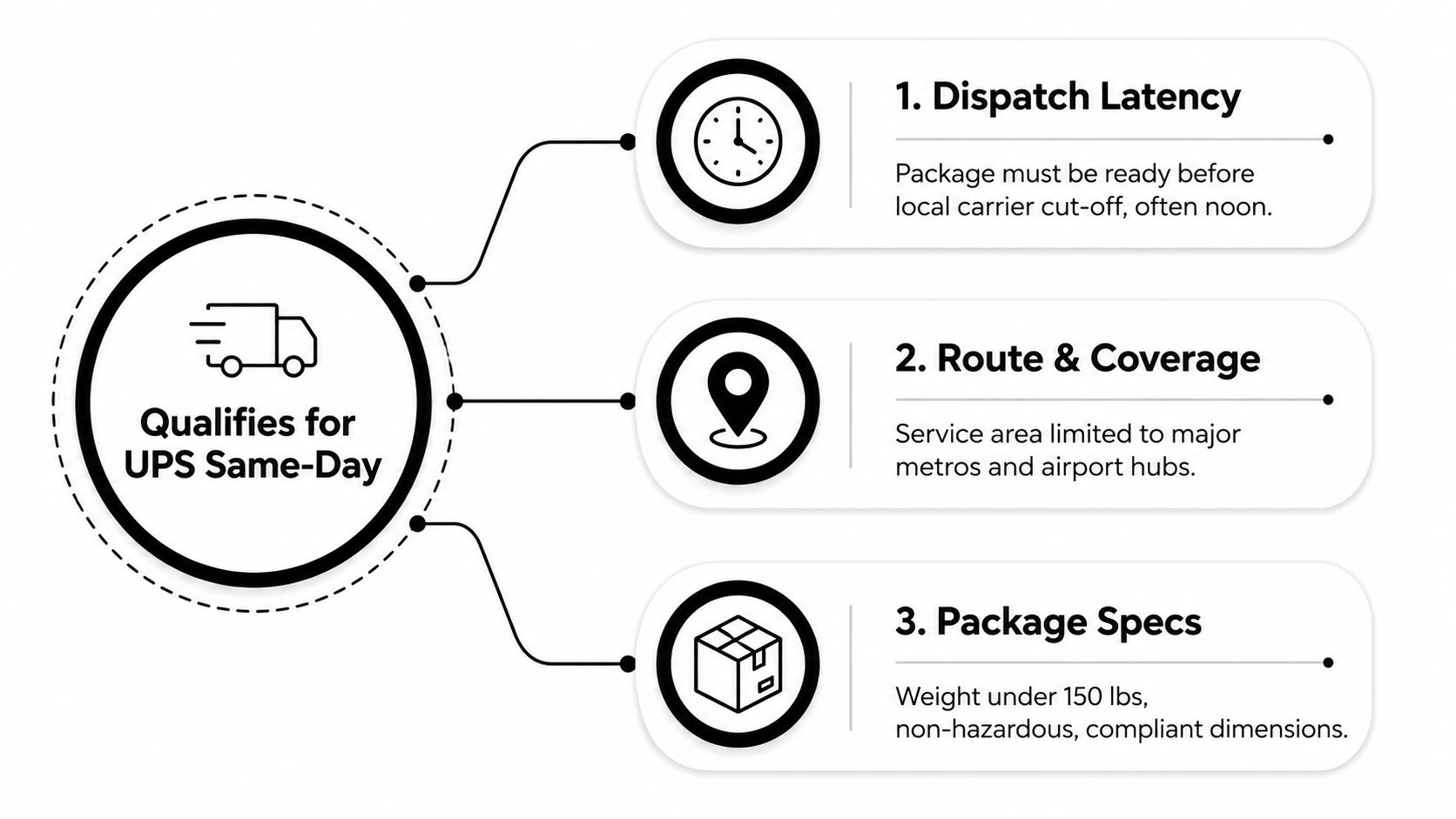
The three checks before booking
Dispatch latency comes first. The package must be fully prepared before the available local pickup opportunity. A reagent that still needs labeling, documentation, or final cold-pack preparation isn't operationally ready, even if the product is physically in stock.
Route coverage comes next. Same-day service depends on the connection between the specific origin and destination. Major metropolitan areas, airport-linked locations, and dense local delivery markets are more likely to offer workable options, but no general assumption should replace a route-specific confirmation.
Package suitability closes the assessment. The shipper needs to verify whether the material, packaging, dimensions, and handling profile meet the selected service's requirements. Hazardous, restricted, or temperature-sensitive materials may require additional review, and service availability doesn't remove the need for compliant preparation.
UPS's express history helps explain the current structure. UPS Next Day Air launched in 1985 for all 48 contiguous U.S. states, helping establish time-definite premium parcel delivery as a familiar part of the U.S. shipping market, according to UPS background information summarized by Statista. The company's current same-day approach combines urgent freight through Express Critical with localized delivery through Roadie, rather than relying on one network for every use case.
Operational rule: A same-day request should be treated as a route validation exercise. The destination ZIP code, pickup timing, package condition, and receiving schedule matter more than the label attached to the order.
Teams handling frequent urgent movements can also look for systems that streamline logistics workflows by organizing dispatch information, shipment status, and exception handling. Better workflow control won't create network capacity, but it can reduce avoidable delays before the carrier is contacted.
Preparing Temperature-Sensitive Reagents for Same Day Dispatch
A same-day vehicle doesn't guarantee that a reagent will arrive in usable condition. Temperature-sensitive materials need a packaging plan that matches the product's storage requirements, the expected route, the delivery window, and the possibility of handling delays.
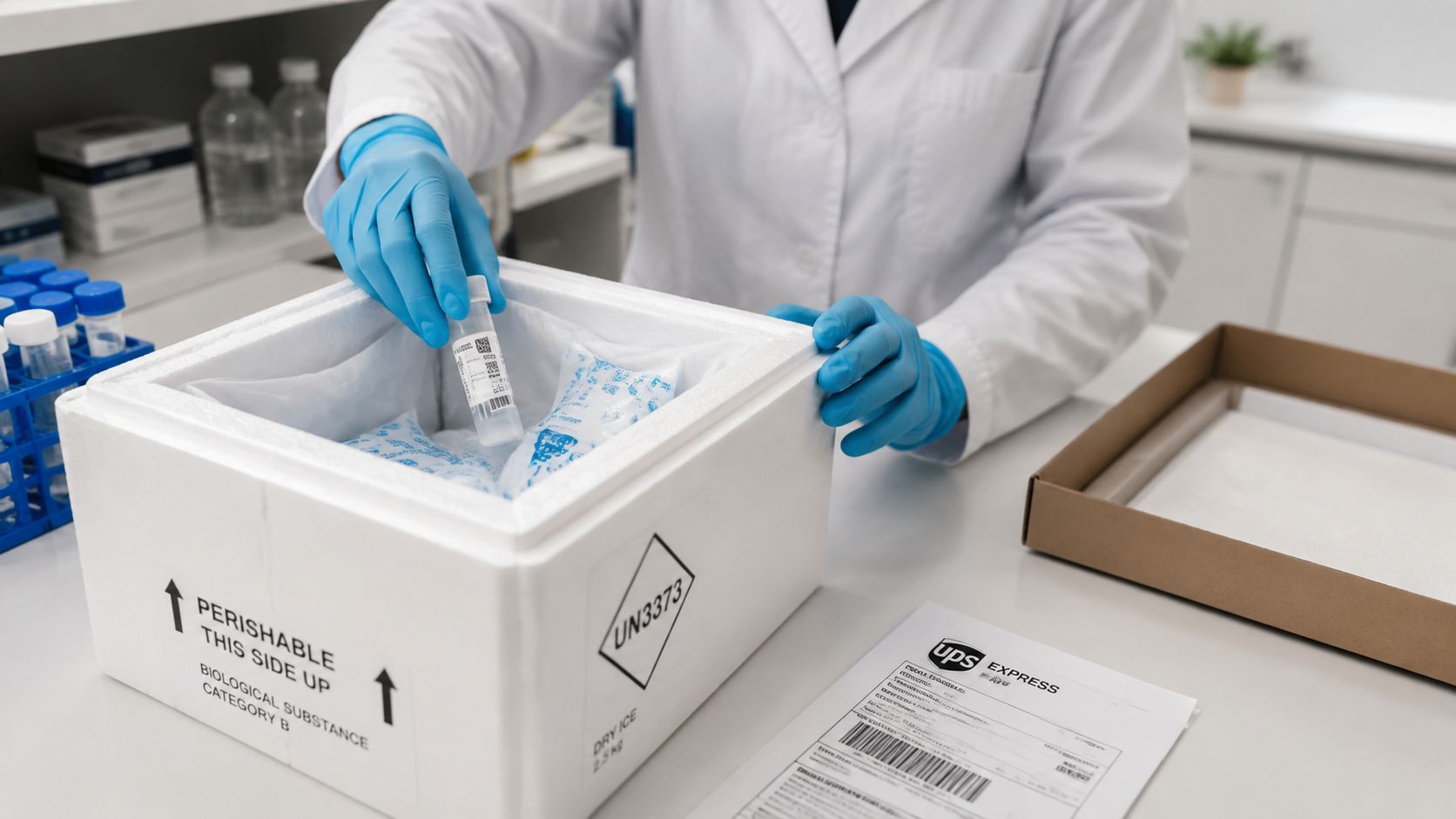
Build the pack before requesting the vehicle
The fulfillment team should stage the reagent, verify the label, and prepare the insulated container before requesting collection. A typical controlled-temperature workflow may include an insulated shipper, appropriate cold packs, absorbent material where required, a secure secondary container, and a temperature monitor when the material or quality system calls for one.
The packaging should prevent movement inside the outer container. Loose vials can break, labels can become unreadable, and cold packs placed directly against sensitive containers may create an avoidable freezing risk. The shipper should also confirm whether the selected transport method has specific restrictions for the material class, packaging design, or declared handling requirements.
Document what the receiver needs
The outer label should identify the consignee clearly and include the relevant handling instructions. The receiving laboratory should know the expected arrival window, the number of containers, and the immediate storage action required after delivery.
A useful dispatch record includes:
- Product identity: Record the reagent name, lot information, quantity, and any applicable Research Use Only designation.
- Temperature instructions: State the required storage condition and whether the shipment must remain chilled or frozen.
- Chain of custody: Note who released the package, who collected it, and who is expected to receive it.
- Exception contacts: Give the carrier and receiver a working contact who can authorize a safe response if access or timing changes.
- Quality documents: Include the certificate of analysis and any handling documentation required by the supplier's quality process.
Same-day service can reduce transit time, but it doesn't replace compliance. Research Use Only materials should remain clearly identified and handled under the supplier's stated terms. The receiving team also needs a documented process for inspecting the package, checking the temperature indicator if present, and recording any visible damage or delay.
Teams that ship regularly should establish a written temperature-controlled shipping process rather than improvising around each urgent order. The strongest workflow separates product release, packaging, carrier booking, and receipt confirmation, so a rushed request doesn't remove a quality-control step.
Cost Trade-Offs and Service Level Decisions
The premium for same-day transport is justified when delay creates a larger operational consequence than the shipping charge. That consequence might be a lost experimental run, a missed instrument booking, an interrupted production schedule, or an urgent customer escalation. It shouldn't be assumed for every small parcel just because a faster option exists.
Express Critical is designed for the most urgent category, with delivery measured in hours. Roadie's localized model can be more proportionate when a nearby courier can meet a 2-hour, 4-hour, or end-of-day window. The decision should compare the required arrival time with the cost and complexity of the selected service, while also considering whether the receiver can accept and store the material.
A practical decision filter
Define the latest acceptable arrival. If the reagent must arrive during a narrow experimental window, an hours-based urgent service may be appropriate. If end-of-day arrival is acceptable, a local Roadie option may meet the requirement without using a more intensive freight model.
Measure the cost of failure. The team should estimate the operational impact of a late or compromised shipment in qualitative terms, including staff time, wasted samples, and rescheduling pressure. The point isn't to create a false precision. It's to avoid comparing only the carrier quote against the product price.
Confirm the service level in writing. Wholesalers and distributors should document which shipments qualify for same-day handling, which party pays for the service, what information the customer must provide, and how exceptions are escalated.
Protect the material first. A cheaper service is not economical if packaging fails or the receiver can't accept the delivery. Product integrity remains the baseline decision criterion.
For teams refining dispatch policies, an external delivery efficiency playbook for 2026 can provide useful process ideas. Service-level agreements should still remain specific to the supplier's products, routes, packaging standards, and customer receiving procedures.
Common Misconceptions About UPS Same Day Delivery
The first misconception is that UPS same-day delivery is one universal product. It isn't. UPS separates localized same-day shipping through Roadie from urgent freight through Express Critical, so the correct service depends on the shipment's route and purpose.
The second misconception is that paying more guarantees availability everywhere. Same-day delivery remains constrained by geography, pickup timing, network density, and route capacity. A service may exist in a broad market while still being unsuitable for a particular origin, destination, package, or requested time.
What searchers actually need to verify
Many people searching for same day delivery UPS are trying to answer practical questions about small parcels, freight eligibility, and geographic coverage. UPS's domestic shipping service information reflects a portfolio of options rather than one blanket same-day promise.
A lab supplier should verify:
- Shipment fit: Is the order a local parcel move or an urgent freight requirement?
- Route fit: Can the selected service support the exact origin and destination?
- Timing fit: Is the package ready early enough for the available pickup?
- Handling fit: Can the selected service accommodate the material and its packaging?
- Receiving fit: Will an authorized person be available to accept and store it?
Another common mistake is to treat same-day delivery as a consumer convenience without examining the receiving process. Laboratories often have controlled access, limited receiving hours, cold-storage requirements, and staff who need advance notice. Delivery speed has little value if the package arrives after the receiving team leaves or sits unrefrigerated at a loading point.
The practical promise is therefore narrower and more useful: same-day delivery can work well when the service model, route, package, and receiving plan align.
Your Same Day Lab Shipping Checklist
A repeatable checklist keeps an urgent order from becoming an avoidable exception.
Classify the shipment. Decide whether the move calls for local Roadie delivery or urgent-freight coordination through Express Critical.
Confirm the route. Check the exact pickup and delivery locations, available service window, and destination access requirements before packing against an assumption.
Set the arrival requirement. Choose an hours-based target when the experiment depends on rapid receipt. Use a broader local window when the laboratory can accept delivery later in the day.
Release the product. Verify identity, lot information, quantity, Research Use Only status, and the documents that must travel with the order.
Pack for the material. Use suitable insulation, cooling media, containment, cushioning, and monitoring. Don't treat fast transport as a substitute for validated handling.
Call with complete information. Give the dispatcher the package description, pickup readiness, destination contact, handling instructions, and any access constraints.
Track the exception, not just the label. The fulfillment team should monitor progress, respond quickly to missed access or route changes, and notify the receiver before arrival.
Close the chain of custody. Record delivery, inspect the package, check temperature evidence where applicable, and move the reagent into the required storage condition.
For wholesale partners, these steps should sit inside the fulfillment SLA, with clear responsibilities for the supplier, carrier, and research customer. Same-day shipping works best as a controlled operating procedure, not as an improvised promise made after the standard cutoff has passed.
Herbilabs supplies high-purity reagents and sterile diluents with temperature-controlled storage, same-day dispatch, clear certificates of analysis, and Research Use Only handling policies. Visit Herbilabs to review laboratory supply options for urgent research workflows and distribution partnerships.


