Private Label, White Label, Wholesale partnerships available - EU, USA and UK - Free shipping from €75
Root Cause Analysis: Lab Guide 2026
The sterility test comes back dirty again. The team has already replaced a reagent lot, retrained the analyst, and checked the incubator, yet the same contamination pattern keeps showing up. That's the moment when root cause analysis stops being paperwork and starts becoming the only way to stop the cycle from repeating.
In labs, the pressure usually tilts toward speed. Someone wants the batch released, someone else wants the deviation closed, and the easiest move is to fix the most visible thing and move on. That approach often calms the room for a day, then the same failure returns with a new lot number, a new date, and the same unresolved weakness underneath.
The practical value of RCA is simple. It forces the team to reconstruct what happened, when it happened, and why it happened, instead of guessing from the loudest symptom. In safety and reliability work, that means tracing a causal chain from evidence, not from intuition, and then proving that the chosen corrective action would have prevented the failure in the first place AHRQ's root cause analysis primer.
Table of Contents
- When Contamination Strikes and Quick Fixes Fail
- The Technical Foundation of Causal Chain Reconstruction
- Comparing Common RCA Methods for Laboratory Use
- Executing a Complete RCA Investigation
- Why Finding the Root Cause Does Not Guarantee Prevention
- Documentation and Compliance for Audit-Ready Investigations
- Common Pitfalls and Your Implementation Checklist
When Contamination Strikes and Quick Fixes Fail
A contamination alert rarely arrives with a neat label attached. One day the plate count is off, the next day a reconstitution solution looks suspect, and by the time the discussion starts, three different people are offering three different explanations. The lab can swap consumables, adjust a SOP, or refresh training, but those moves only help if they target the actual failure path.

A good investigation starts by resisting the urge to fix the first visible problem. If the contamination came from handling, the team may need to examine transfer steps, operator sequence, gowning, and environmental exposure. If it came from the process itself, changing one reagent or reissuing one instruction will not prevent recurrence, because the underlying system weakness is still active. The investigation has to separate the symptom from the source, then show which control failed first.
Practical rule: if a correction can be described as “try this and see,” it is not yet a defensible corrective action.
RCA turns that uncertainty into a structured question set. What failed, where did it fail, when did the deviation appear, and who touched the material or equipment along the way? That sequence matters because it separates the event from the speculation. A structured method also keeps the team from drifting into blame, which is common when the contamination appears after a busy shift or under production pressure.
For labs that need a focused reference on preventing repeat contamination, laboratory cross-contamination prevention is useful because it keeps the discussion centered on source control, handling discipline, and environmental checks instead of isolated cleanup steps.
The most important shift is philosophical. RCA is not a compliance checkbox, it is a diagnostic method. When it is done well, the investigation ends with evidence-backed actions that address the system condition, not just the latest symptom. That difference shows up in recurrence rates, because a closed deviation that never changed the process still leaves the next contamination event waiting to happen.
The Technical Foundation of Causal Chain Reconstruction
Strong root cause analysis works backward from the failure, not forward from assumptions. The event is broken into a causal chain, starting with the observed defect and tracing through immediate causes, contributing factors, and deeper system conditions until the team reaches the point where the chain can be credibly interrupted. That approach is aligned with safety and reliability practice, where investigators decompose the event into top-event and secondary-cause layers and keep tracing backward until the factual endpoints are reached the causal-chain method described by DataOps.
Facts before theories
The first job is fact collection. In formal RCA guidance, investigators are expected to establish what happened, where, when, and by whom before they start applying tools to explain how and why the event occurred IEC-style fact collection and backward tracing. That sounds obvious, but many investigations skip straight to fishbone diagrams or 5 Whys while the timeline is still incomplete.
In a laboratory setting, the evidence often sits in several places at once. Equipment logs show temperature excursions or alarm silence. Environmental monitoring records show whether the room stayed inside expected limits. Batch documentation shows who handled which step and when. Personnel records, maintenance notes, and sample chain-of-custody data can all matter if the event involves contamination, mix-up, or instability.
A strong RCA file therefore has two layers. The first layer is the factual record, what was observed and preserved. The second layer is the interpretation, what those facts mean when arranged as a sequence. If the file is missing timestamps, lot numbers, or change records, the team may still draft a narrative, but the conclusion will stay weak because it can't be tested against the event itself.
When enough evidence is enough
The practical test is simple. If removing the suspected cause would have prevented the failure, the hypothesis is getting close to a real root cause. If the team cannot say that with confidence, it probably has a contributing factor, not a true root cause. That standard is why RCA in SRE-style workflows is increasingly treated as an evidence-backed diagnostic method rather than a brainstorming exercise.
The best investigations don't ask, “What sounds likely?” They ask, “What can be shown from the record?”
This is also where many teams misread “information gaps.” Missing evidence does not mean the investigation should stop. It means the conclusion has to stay provisional until the gap is closed or explicitly documented. Mature RCA practice, including newer guidance in regulated settings, treats those gaps as part of the analysis itself, not as an inconvenience to ignore.
For a complementary operational view on documentation and lab controls, the laboratory quality assurance overview is relevant context, because the same discipline that supports QC also supports RCA evidence integrity.
Comparing Common RCA Methods for Laboratory Use
The method has to fit the incident. A straightforward reagent mix-up does not need the same depth of analysis as recurring contamination across multiple rooms, shifts, or product families. Lab teams usually reach first for 5 Whys, a fishbone diagram, or Fault Tree Analysis, but each one works best under different evidence conditions.
| RCA Method Comparison for Laboratory Investigations | Best For | Evidence Required | Time Investment | Regulatory Acceptance |
|---|---|---|---|---|
| 5 Whys | Straightforward deviations with a clear sequence | Basic event record, operator input, line of sight evidence | Lower | Acceptable when the causal path is simple and documented |
| Fishbone diagram | Multi-factor problems with several possible contributors | Broader team input, process notes, equipment history, environmental clues | Moderate | Commonly accepted when paired with factual records |
| Fault Tree Analysis | Complex or high-consequence failures where multiple paths can combine | Strong event definition, dependencies, and structured evidence | Higher | Strong when rigor and traceability matter most |
A 5 Whys discussion can work well when the team is disciplined and the problem is contained. It can also fail fast if the group mistakes a symptom for a cause, or if each “why” is answered with opinion instead of evidence. The method is useful because it is quick, not because it is automatically deep.
A fishbone diagram is better when the incident may involve people, methods, equipment, materials, environment, and measurement at the same time. It gives the team a broader field of view, which helps in contamination, drift, and repeat deviation cases. The weakness is that a fishbone can become a wall of possibilities unless each branch is tied to records, logs, or direct observation.
Fault Tree Analysis is more structured and more demanding. It fits serious or intertwined failures where the lab needs to understand how several conditions can combine to create one event. The trade-off is effort, because the team has to define the top event precisely and map the dependency logic carefully. That discipline is often the difference between a defensible analysis and a clever-looking diagram.
For teams standardizing their investigation workflow, a strong laboratory SOP guide can be a useful reference point for keeping the method aligned with documented process control.
Use the simplest method that can still explain the failure without hand-waving. Complexity should come from the incident, not from habit.
Executing a Complete RCA Investigation
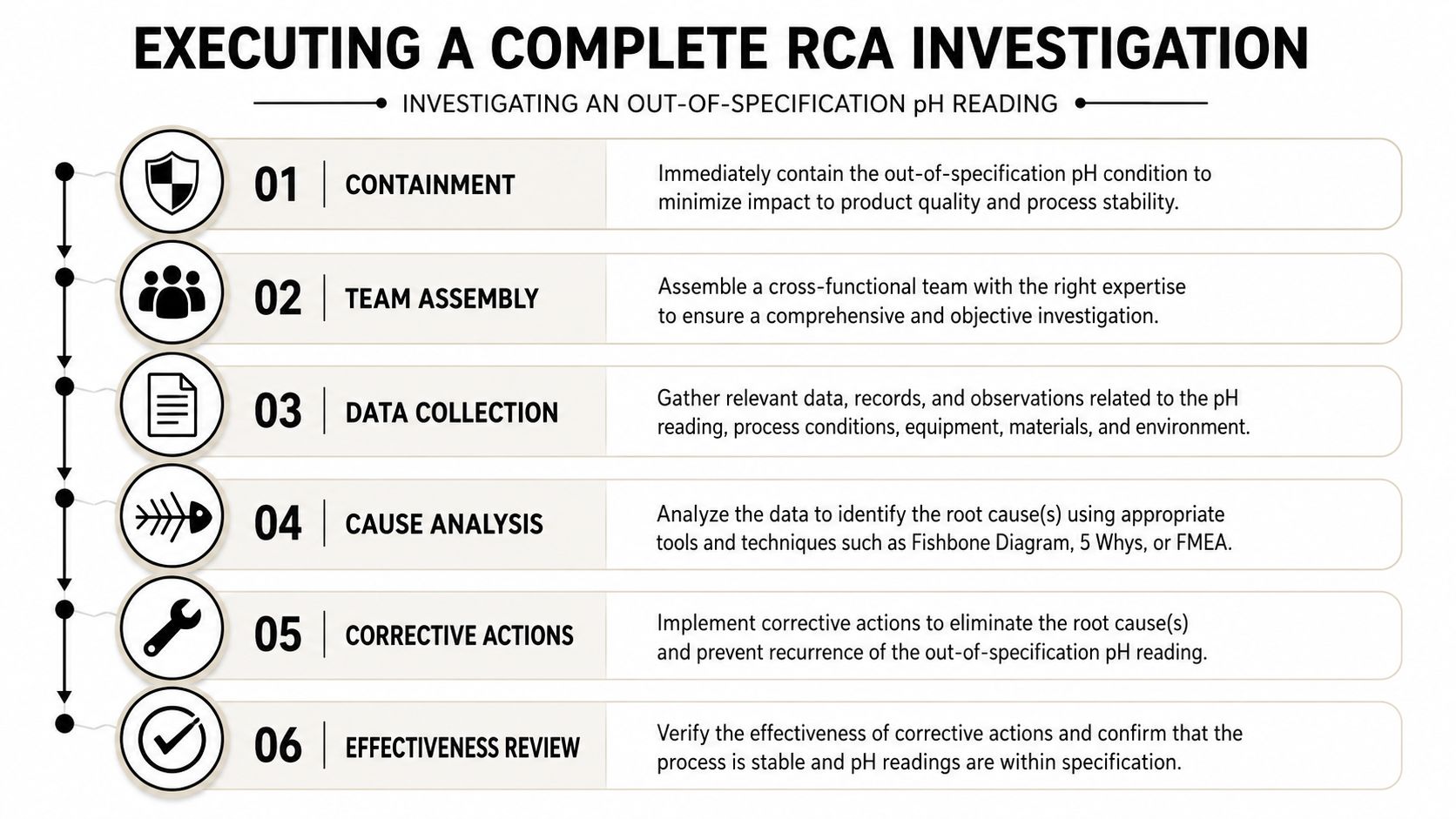
A complete investigation begins with containment, not conclusions. If the batch is questionable, the material gets isolated, the affected equipment is identified, and the team protects downstream users while the facts are gathered. Only then does the analysis move into reconstruction, because a rushed theory can contaminate the thinking as badly as a dirty bench contaminates a sample.
Build the event timeline first
For an out-of-specification pH reading in a reconstitution solution, the timeline usually starts before the measurement itself. The team should capture batch prep time, operator sequence, instrument calibration status, room conditions, sample hold times, and any changes that occurred during the run. The point is not to collect everything imaginable, but to collect the data that can explain the failure path.
Separate evidence from inference
The strongest investigations distinguish facts from interpretation in the notes themselves. A log entry may show that an instrument was checked, but it does not prove the check was done correctly unless the supporting record shows calibration status, date, and result. The same principle applies to staff actions, environmental conditions, and material handling. If the team cannot point to a source record, the claim should stay provisional.
A useful discipline is to ask whether each suspected cause is necessary, sufficient, or only contributing. If a condition was present but the failure still would have happened without it, that condition is not the root cause. If removing the suspected cause would have broken the chain, the hypothesis becomes much stronger.
Validate the action, not just the theory
The investigation is not complete when the root cause is named. It ends when the corrective action is tied to the cause and the lab has a way to verify that the fix worked. That is why RCA guidance in reliability and failure analysis emphasizes hypothesis validation, defined impact windows, and corrective-action tracking, not just story writing.
For labs that want a parallel framework in failure analysis, the Forge Reliability RCFA guide is a helpful reference because it reinforces the discipline of linking cause, action, and verification rather than treating them as separate exercises.
Why Finding the Root Cause Does Not Guarantee Prevention
A completed investigation can still fail the organization if the corrective action is weak. That's the uncomfortable truth. RCA can identify an underlying process flaw, but if the fix is only a memo, a reminder, or a retraining session with no verification step, the same failure often returns in a different form.
A 2020 systematic review found that only 2 studies (9%) in the included evidence could establish that RCAs contributed to improved patient care to some extent systematic review of RCA effectiveness. The important lesson for laboratory leaders is not the number by itself, but the implication. Identifying causes does not automatically create prevention. Prevention depends on whether the corrective action changes the system and whether the change is measured.
Why corrective actions miss the mark
Many labs stop at the most convenient fix. They retrain the analyst, update a form, or issue a caution note, then call the issue closed. Those actions can help, but only if the failure was caused by a knowledge gap or a procedure gap. If the issue was equipment drift, weak segregation, unclear handoff logic, or a process that invites error under time pressure, a procedural reminder won't be enough.
That gap is especially visible in complex, multifactorial failures. Healthcare safety scholars have argued that the classic RCA model can oversimplify events because many adverse outcomes emerge from interacting system conditions rather than a single root. That critique matters in labs too, because contamination, mix-ups, and out-of-specification results often emerge from several modest weaknesses acting together.
Measure whether the fix worked
The difference between a real corrective action and a symbolic one is verification. Mature RCA practice now includes explicit identification of information gaps, team-based analysis, and measurement of whether the fix worked. Without that last step, the investigation only documents history. It does not improve reliability.
A corrective action is only real when the next similar event fails to happen, or when the metric that should move actually moves.
That's why the review phase matters as much as the analysis phase. If a batch issue was caused by a specific handling step, the lab needs evidence that the revised control now prevents the same path from recurring. If the failure was caused by a broader system weakness, the lab may need redesign rather than retraining. RCA gets the team to the door. Verification decides whether the team walked through it.
Documentation and Compliance for Audit-Ready Investigations
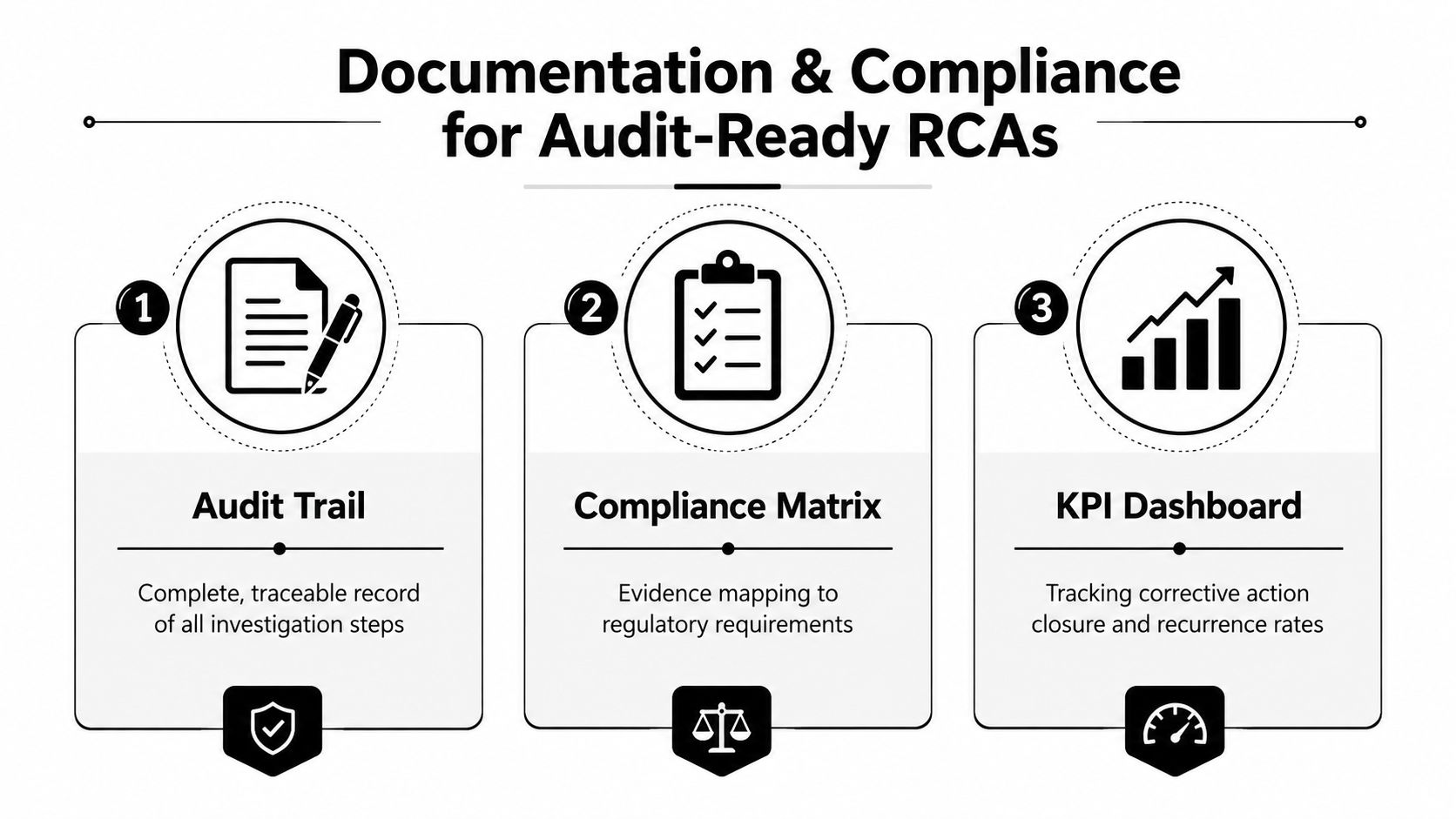
Auditors do not want a dramatic story. They want a traceable record. An audit-ready RCA shows what happened, who reviewed it, what evidence was gathered, which hypotheses were tested, and how the team proved the corrective action was effective. In regulated lab environments, that structure is as important as the technical analysis itself.
Build the file so someone else can follow it
A defensible RCA report should preserve the event summary, raw evidence references, timeline, team members, decisions, and follow-up actions. If a reviewer cannot retrace the logic from the original deviation to the final corrective action, the file is not fully audit-ready. The record should also capture what the team did not know at the start, because information gaps are part of the investigation, not a weakness to hide.
Map the record to the requirement
Regulatory expectations in the EU, UK, and USA increasingly favor structured fact gathering, team-based analysis, and measurable evidence that a fix worked. That means the report should link each corrective action back to the specific failure condition it addresses. It should also show whether the action is preventive, detective, or both, because those categories have different implications for ongoing control.
For a practical compliance-oriented reference, the regulatory compliance documentation guide is a useful anchor for building a system that keeps evidence, action tracking, and quality records aligned.
Track the result, not just the closure date
A closed ticket is not the same as a controlled process. The better metric is whether the recurrence pattern changed after the action was implemented. Teams should also watch whether corrective actions stay open too long, whether verification was completed, and whether the same issue starts appearing in another process step.
A simple internal dashboard can help, even if the visual is basic. The point is to keep the investigation connected to operations, not archived in a folder. When RCA becomes part of routine quality review, the organization can see whether its fixes are reducing repeat events or just producing neat reports.
Common Pitfalls and Your Implementation Checklist
The most common RCA failures are predictable. Teams rush to a conclusion, stop at the first proximate cause, assign responsibility to a person instead of a process, or approve a corrective action without any follow-up measurement. Those errors are easy to make because they feel productive in the moment.
Red flags that the investigation is too shallow
- The timeline is thin: key timestamps, changes, or handoffs are missing, so the team is guessing at sequence.
- The conclusion names a person, not a system: that usually means the analysis stopped too early.
- The fix is only training or a reminder: helpful sometimes, but rarely enough on its own.
- The report doesn't show verification: no metric, no check, no evidence that the action changed recurrence.
- The same issue keeps returning: that's the clearest sign the “root cause” was a proximal cause.
A working checklist for lab teams
- Preserve the evidence first: quarantine affected material, save logs, keep documentation intact, and avoid changing the scene before the record is secured.
- Build the causal chain from facts: start with what happened, then move backward through contributing factors and system conditions.
- Separate causes from symptoms: an observed failure is not the cause, it's the outcome.
- Choose the method to fit the problem: use a simple method for a simple deviation, and a more structured one when the event is distributed or multifactorial.
- Assign an owner and a due date for each action: if no one owns the fix, it won't stick.
- Define the verification step before closure: the team should know what evidence will prove the corrective action worked.
External expertise becomes useful when the team keeps hitting the same failure, when multiple departments are involved, or when the evidence base is too thin for confident conclusions. That's especially true for contamination events that cross process, environment, and equipment boundaries.
Strong root cause analysis is not about producing the longest report. It's about producing the shortest defensible path from event to evidence to action. Labs that build that discipline stop repeating the same deviations and spend less time arguing over what went wrong.
Herbilabs supports laboratory teams that need reliable, quality-focused supply choices for sensitive workflows. For labs building stronger RCA and quality systems, visit Herbilabs to review its laboratory supply offering, documentation approach, and fulfillment support for regulated research environments.


