Private Label, White Label, Wholesale partnerships available - EU, USA and UK - Free shipping from €75
Laboratory Quality Assurance: A Practical Guide
A routine assay can look familiar at the bench and still come apart by the time results are ready to release. The tubes are labeled, the instrument runs, and the numbers still miss the mark because the problem was upstream, downstream, or hiding in the supply chain long before a single QC point was plotted. Laboratory quality assurance exists to catch those weak points before they turn into repeated work, bad decisions, or unusable data.
That is why modern QA is bigger than a control chart on a wall. It covers procurement, sample handling, documentation, training, equipment, result review, and the reagents that shape every run. Standards such as ISO/IEC 17025 and ISO 15189 frame this as a full quality management system, not a paperwork exercise, because competence, traceability, validated methods, and controlled reporting all have to work together to reduce error sources across the workflow WHO guidance on laboratory quality management.
For a lab lead stepping into this for the first time, the practical question is simple. What has to be in place so the lab can trust its own data, defend it under review, and keep small failures from becoming expensive ones? The answer starts with understanding where QA differs from QC, then building the operating pieces that make the whole system hold together.
Table of Contents
- Why Laboratory Quality Assurance Matters More Than Most Labs Realize
- Laboratory Quality Assurance vs Quality Control in Plain Language
- The Core Elements Every Laboratory QA Program Needs
- Reading QC Data With Control Charts and Westgard Rules
- SOPs, Training, Calibration, Validation, and CAPA Working Together
- Vetting Reagent Suppliers as an Upstream QA Control
- Step-by-Step Implementation for a Research Laboratory
Why Laboratory Quality Assurance Matters More Than Most Labs Realize
A familiar assay can fail in a way that feels almost personal. The instrument behaves, the method has worked before, and then the data lands wrong enough that the team has to rerun samples, recheck the setup, and explain lost time to everyone waiting on the result. That kind of failure rarely comes from the analytical step alone, because the actual cause often sits in specimen handling, result review, or the way materials were received and stored.
That broader view is exactly why laboratory quality assurance matters. A widely cited Clinical Chemistry review reports that 68 to 87% of laboratory medicine errors occur in extra-analytical phases, while only 13 to 32% occur in the total testing phase that analytical work alone can influence Clinical Chemistry review. The same literature also notes that laboratory statistics support method comparison, diagnostic accuracy, and reference intervals, which means QA is not limited to one chart or one instrument.
QA is the system around the assay
QA protects the full workflow, from procurement and receipt through reporting and archival records. That shift matters because a method that looks precise can still produce poor decisions if the sample was mishandled, the result was transcribed badly, or the output was released without proper verification. A lab lead who treats QA as a floor-to-ceiling system is already ahead of the common mistake of focusing only on the bench.
Practical rule: if a failure can start before the sample reaches the analyzer or after the result leaves it, QA has to cover it.
The official guidance in the lab world keeps pushing in that direction. WHO-linked material frames quality management as a coordinated system with both management and technical controls, not just instrument checks WHO guidance on laboratory quality management. For labs that struggle with documentation and traceability, a resource such as regulatory compliance and documentation guidance can help connect policy language to the records that need to exist at the bench.
By the end of a solid QA program, a lab should be able to do more than say its assay works. It should be able to show how the method was chosen, how people were trained, how reagents were verified, how QC was reviewed, and how problems were contained before results went out the door.
Laboratory Quality Assurance vs Quality Control in Plain Language
A sample can pass every control check and still produce a bad decision if the wrong tube was logged, the reagent was stored outside spec, or the report moved forward without review. That is why quality assurance and quality control need to be separated clearly.
Quality assurance is the planned system that keeps defects from entering the workflow. Quality control is the measurement activity that spots defects after they show up. QA covers the rules, roles, and checks that shape how the lab works. QC checks whether the work is behaving as expected at a specific point in time.
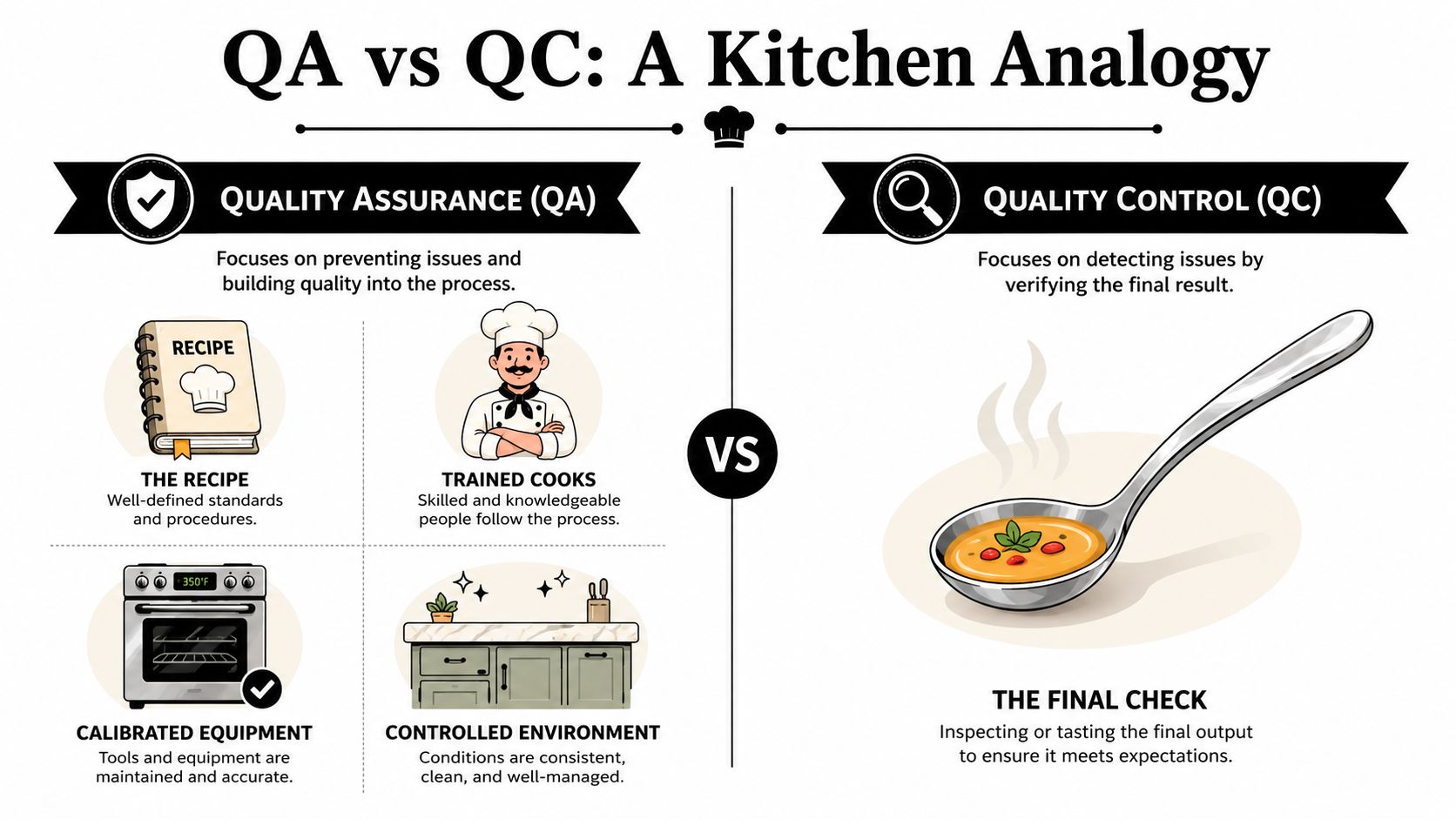
Where each one fits in the testing workflow
The pre-analytical phase is where QA does most of its quiet work. Approved suppliers, sample receipt rules, labeling practices, and storage conditions all shape whether the material entering the lab is fit for analysis. QC usually has little to correct here, because many failures happen before a control material is ever run.
The analytical phase is where QC becomes visible on the bench. Control materials, chart review, and rule violations show whether a run is behaving normally or drifting off course. QA still sits behind that result, because validated methods, calibrated equipment, and trained staff make the QC signal meaningful instead of misleading.
The post-analytical phase brings QA back to the front. Reporting templates, result verification, data integrity, and correction procedures decide whether a technically sound result becomes a trustworthy decision. For labs using a digital workflow, the laboratory information management system is a useful reference for seeing how records, traceability, and output control fit into the larger system, while quality control testing guidance helps clarify how routine checks support that workflow.
QC tells the lab what is wrong right now. QA makes the next wrong result less likely.
This distinction shifts the team's focus from fixing errors after the fact to designing systems that prevent them.
The Core Elements Every Laboratory QA Program Needs
A working QA program is built like a house with load-bearing layers. Policy sets the direction, documents keep everyone aligned, records prove the work happened, and daily checks stop a small error from spreading into the rest of the lab. In practice, each layer only works if the one below it is already stable.
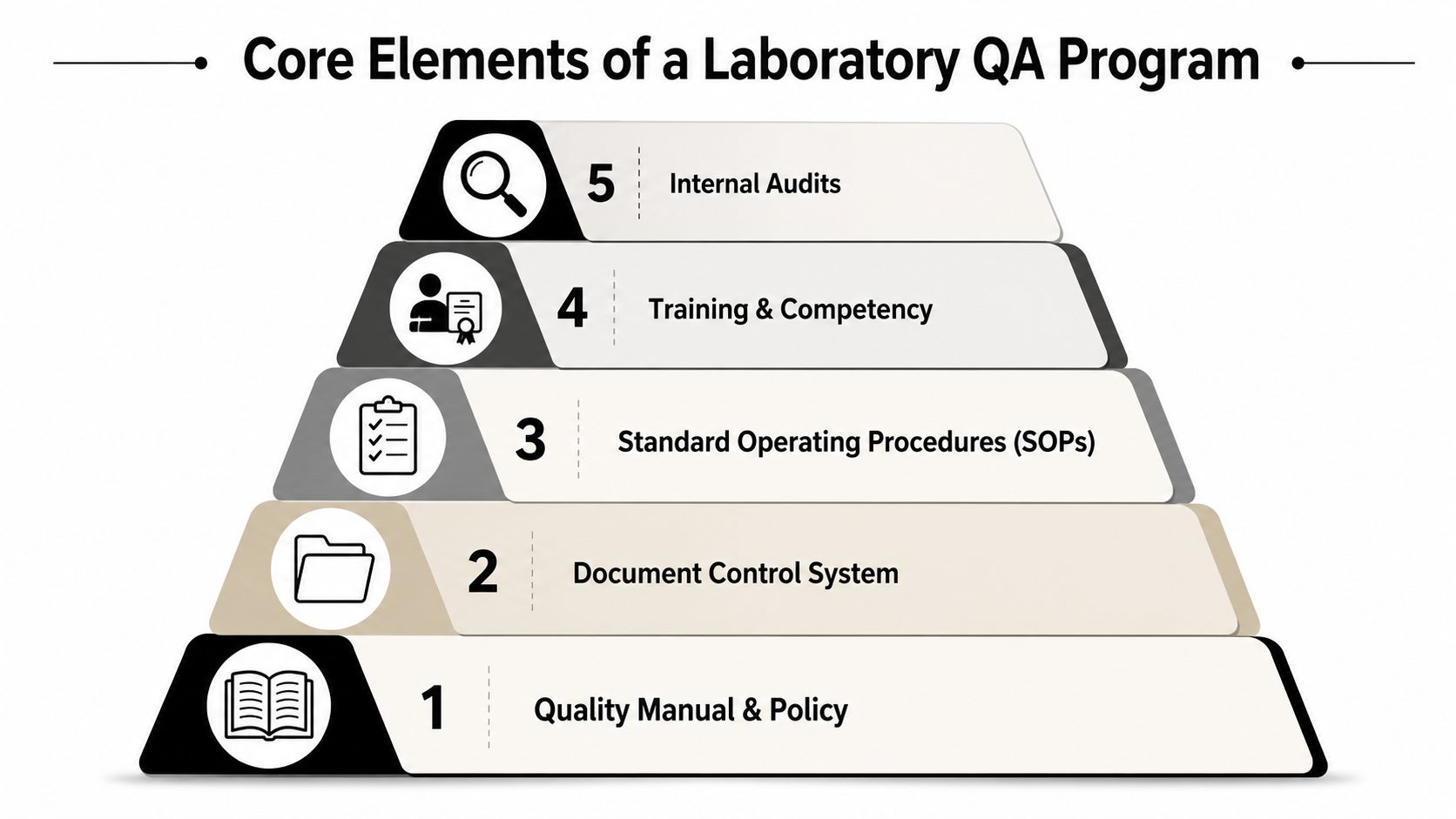
The documents that hold the system together
The quality manual and policy define what quality means in that lab and who is responsible for it. Document control keeps the current version in circulation, so a technologist does not follow an outdated method because an old PDF is still on a shared drive. SOPs turn policy into bench-level instructions, and training and competency records show that staff can perform the work the same way each time.
Equipment belongs in the same chain. Calibration, verification, and maintenance confirm that an instrument is fit for use, while method validation or verification shows that the method performs as intended in that specific setting. WHO guidance on quality management places these controls alongside traceability, sample handling, and formal reporting WHO guidance on laboratory quality management.
The controls that keep the lab honest
Sample handling rules protect chain of custody, stability, and identity from the moment material enters the lab. Reporting and release procedures decide when a result can leave the lab and who must review it first. Internal audits then check whether the system works in real use, not just whether the binder looks complete.
A good laboratory quality assurance program also needs information control. Quality management standards treat documents, records, information management, occurrence management, customer feedback, and continual improvement as parts of the quality system, not as side tasks WHO-aligned laboratory quality management material. That matters because paper-heavy workflows make version control and traceability harder to keep straight.
For teams comparing options, quality control testing guidance is a practical companion to this framework because it shows how routine checks are carried out, not just named. The point is not to collect every possible form. The point is to make each form do a job the next step depends on.
If a document, record, or check does not change a decision, it is probably busywork.
That test helps a new lab lead separate useful structure from compliance clutter. A complete program feels connected because each piece protects the one after it.
Reading QC Data With Control Charts and Westgard Rules
QC numbers only matter when someone knows what to do with them. The classic way to read them is a Levey-Jennings chart, which plots QC results against the expected mean and standard deviation bands so trends become visible instead of buried in a table. The statistical landmarks are simple: when a process is in control, about 68% of QC results fall within ±1 standard deviation, 95.5% fall within ±2 standard deviations, and 99.7% fall within ±3 standard deviations. In practical terms, only about 0.3%, or 3 out of every 1,000 QC points, should fall outside the ±3 SD limits if the process is stable QC and QA statistical benchmarks.
That is why Westgard-style rules matter. They turn a chart into a decision tool for spotting random error and systematic error before patient or research results leave the lab. A single out-of-limit event does not automatically explain the failure, but it does force the team to ask whether the run is still trustworthy.
What the lab does when a rule is broken
A proper response starts with containment. The analyst should stop release, review the control material, check the run conditions, and document the event so the lab can trace what happened and why. If the run is rejected, the underlying method, reagent lot, instrument status, and recent maintenance history all become part of the investigation.
The key limitation is easy to miss. Control charts only work if QC material is treated like a real sample, run on a realistic schedule, and reviewed by trained people instead of being auto-passed by software. External guidance also recommends blind check samples, analyst competency assessment, and scheduled monitoring of bias, precision, contamination, and analytical interference, with QC samples analyzed at least annually and preferably semi-annually or quarterly Standard Methods guidance.
The YouTube overview below is useful for seeing the chart logic in a visual form.
A chart is not a shield. It is a warning system that only works if someone is actually watching it.
That is the point most new labs miss. The chart does not certify quality on its own, it tells the team when to look harder.
SOPs, Training, Calibration, Validation, and CAPA Working Together
A strong QA program feels like one loop, not five separate chores. The SOP tells staff how the work should be done, training proves they can do it, calibration and validation prove the tools and methods are fit for purpose, and CAPA closes the loop when something goes wrong. Labs often fail when these pieces are managed by different people in different folders with no shared discipline.
From written procedure to consistent execution
A good SOP does more than describe steps. It states the control points, acceptance criteria, required records, and escalation path if something does not match expectations. Training then turns that written procedure into repeatable behavior, while competency checks show whether the person can still perform it correctly after the initial sign-off.
Calibration and validation are not the same thing. Calibration keeps equipment aligned to a known standard, while validation or verification checks that the method works as intended in the lab's own setting. That distinction matters because a perfectly calibrated machine can still support a weak method, and a well-designed method can still fail if the instrument drifts.
For labs that need a systems view of linked processes, how ERP unifies production and finance is a helpful analogy. The point is not manufacturing software itself, but the way separate functions become easier to control once records, responsibilities, and triggers live in one connected flow.
CAPA turns problems into controls
CAPA starts when a deviation appears, an out-of-control QC point is flagged, or an audit finding reveals a gap. The team contains the issue first, then traces the root cause, then applies a corrective action, and finally adds a preventive action so the same failure does not recur. A missing reagent label, for example, should not end with a reminder email if the underlying cause was a confusing storage layout and no clear receiving log.
That is where scheduled challenge testing matters too. Routine check samples, competency checks, and tracked bias or contamination data make the lab notice slow drift before it becomes a reportable failure Standard Methods guidance. QA gets stronger when those checks are treated as normal operations, not emergency events.
CAPA works when the fix changes the process, not just the mood in the room.
Once a lab team sees these tools as one operating loop, compliance stops feeling scattered. The system starts behaving like a chain of controls rather than a pile of forms.
Vetting Reagent Suppliers as an Upstream QA Control
Reagents are not passive inputs. They are the first materials a lab handles, and a weak supplier can undermine every downstream control even when the bench work looks tidy. That is why supplier vetting belongs inside laboratory quality assurance, not outside it.
What to inspect before the box reaches the bench
A serious supplier review begins with the Certificate of Analysis. The document should identify the product clearly, show the batch or lot level information the lab needs, and give enough test detail that purity or impurity questions can be answered with confidence. A useful companion is how to read a Certificate of Analysis, because COAs only help if the reviewer knows where to look.
Purity testing matters because it tells the lab what was released, not what marketing copy implied. Identity testing, contaminant testing, and storage conditions matter for the same reason. If the supply chain cannot protect the material from manufacture to bench, the lab is inheriting an uncertainty it cannot fully fix later.
Herbilabs is one example of an upstream control point built around those expectations. Its published product information describes its own production facility, batch-level contaminant testing, 99%+ purity benchmarks, temperature-controlled storage, same-day dispatch, clear COAs, and a Research Use Only policy. For a lab buying reagents, those are the kinds of factual signals that make a supplier easier to audit and a lot easier to trust operationally.
Reagent supplier QA checklist
| Evaluation Area | What to Look For | Why It Matters |
|---|---|---|
| COA content | Batch or lot traceability, test results, product identity | Confirms the exact material received |
| Purity and impurity data | Clear purity claims and contaminant testing | Reduces hidden variability in assays |
| Storage and transport | Cold-chain or temperature control when needed | Protects reagent integrity before receipt |
| Fulfillment and traceability | Clear dispatch process and batch tracking | Helps resolve lot-to-lot questions quickly |
| Policy clarity | Research-use labeling and transparent terms | Prevents misuse and compliance confusion |
The same logic applies to any vendor, not just a named one. If the supplier cannot show traceable testing, stable storage, and consistent fulfillment, the lab is accepting risk before the first sample is even opened. A supplier audit should feel like QA work, because it is.
Step-by-Step Implementation for a Research Laboratory
A small or mid-size research lab does not need to build everything at once. The practical order is to assign one owner, write down the rules that matter most, and add controls in the places where mistakes would hurt the most. A simple rollout keeps the system usable instead of overwhelming the team.
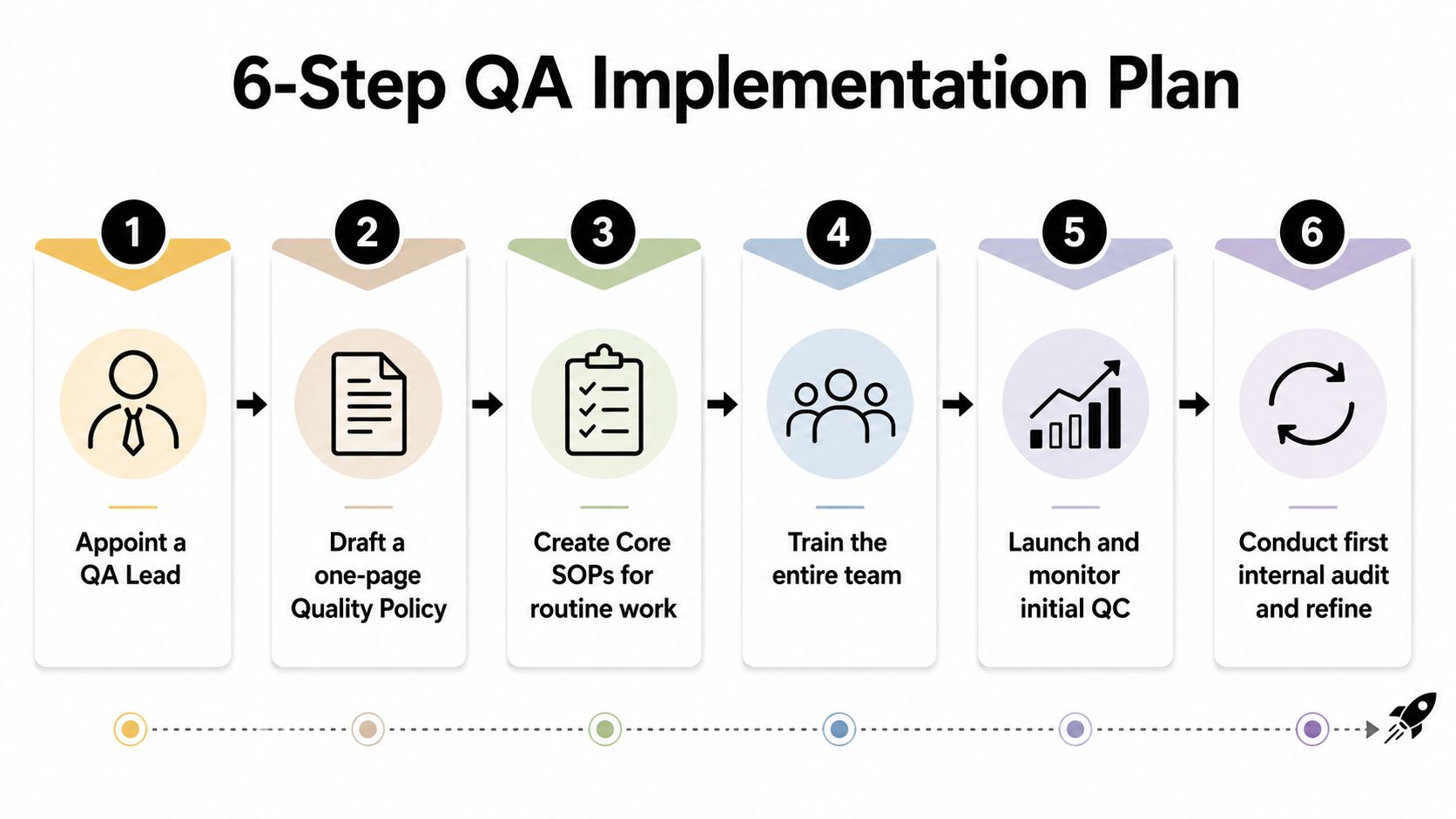
- Appoint a QA lead. One person needs clear ownership of documents, deviations, and follow-up, even if the role is part-time.
- Draft a one-page quality policy. Keep it short enough that the team can read it and repeat it.
- Create the first SOPs. Start with the high-risk routines, the ones that affect sample receipt, reagent handling, reporting, and equipment checks.
- Train the team. Pair each SOP with sign-off and competency review, not just a one-time orientation.
- Launch QC and track it. Start with the core method controls and a chart the team can review without guessing.
- Run an internal audit and refine. Use the findings to fix the system, not to punish the people working inside it.
The mindset shift matters more than the paperwork. Laboratory quality assurance is the system that lets a lab trust its own data, defend its decisions, and catch problems before they spread into wasted time or bad science. Once that becomes the operating habit, quality stops feeling like an audit event and starts feeling like normal lab work.
Herbilabs supplies high-purity reagents, sterile diluents, clear COAs, and RUO-labeled labware that fit into a controlled QA workflow. If the lab needs upstream materials that are stored, tested, and dispatched with traceability in mind, visit Herbilabs to review the current range and see how the supply side can support day-to-day quality control.


