Private Label, White Label, Wholesale partnerships available - EU, USA and UK - Free shipping from €75
Good Laboratory Practice: A Complete Guide for Modern Labs
A lab can run flawless experiments and still fail the one question that matters: can the work be trusted, reconstructed, and defended under audit? That gap usually shows up when a study director asks for the original run sheets, a procurement lead can't prove a reagent lot matched the prior one, or a client wants the COA trail and the storage record behind a shipment. Good laboratory practice exists to stop that moment from becoming a crisis, because it turns scientific activity into evidence that can survive review.
For lab leads in the EU, UK, and USA, the value of GLP isn't abstract. It's the difference between a study that feels complete and a study that can be accepted, traced, and repeated when regulators or customers ask hard questions. The practical side matters just as much as the definition, especially in peptide, reagent, and distribution workflows where batch verification, supplier due diligence, and documentation discipline often decide whether the data holds up.
Table of Contents
- Why Good Laboratory Practice Matters More Than Ever
- The Origins of GLP and Why It Was Created
- What GLP Actually Controls in a Laboratory
- Regional GLP Frameworks in the EU, UK, and USA
- Practical Implementation of GLP in Daily Operations
- The Hidden GLP Risks in Reagents and Consumables
- Preparing for GLP Audits and Avoiding Common Pitfalls
- What Procurement Teams Should Demand From GLP Suppliers
Why Good Laboratory Practice Matters More Than Ever
A researcher can have excellent technique, clean data, and a convincing result, then discover too late that the study can't be rebuilt from the record. Maybe the notebook is incomplete. Maybe the reagent labels are inconsistent. Maybe the storage history is missing for one critical batch. That's the point where good laboratory practice becomes more than a compliance phrase, because it gives the lab a structure for proving what happened, not just remembering it.
Trust is built before the result, not after it
GLP matters because regulators don't review scientific confidence in the abstract, they review whether the work is reliable, traceable, and reproducible. OECD guidance describes GLP as a system encompassing the full nonclinical lifecycle, from planning through archiving, with defined responsibilities for management, the study director, study personnel, and quality assurance personnel, plus written SOPs and retained raw data and archives OECD GLP principles. This is the function of GLP: it makes the work defendable.
For a new lab lead, that means the standard isn't “did the experiment look right.” The standard is “can another qualified person follow the trail and reach the same conclusion without guessing.” In practice, that trail includes the protocol, the actual materials, the instrument state, the person who did the work, and the record of what changed along the way.
Practical rule: if a result can't be reconstructed from the record, it isn't audit-ready.
Who needs this guide most
This matters most for lab leads, QA coordinators, procurement teams, and research operations managers working across the EU, UK, and USA. Those roles carry different burdens, but they all touch the same risk points, study documentation, consumable control, supplier qualification, and review readiness.
The biggest confusion usually comes from treating GLP like a narrow paperwork rule. It isn't. It's the operating system that lets scientific work move from a bench result to regulator-ready evidence. That's why the guide leans into the practical side, because the failures that hurt teams most often show up in ordinary places, not in dramatic scientific errors.
The Origins of GLP and Why It Was Created
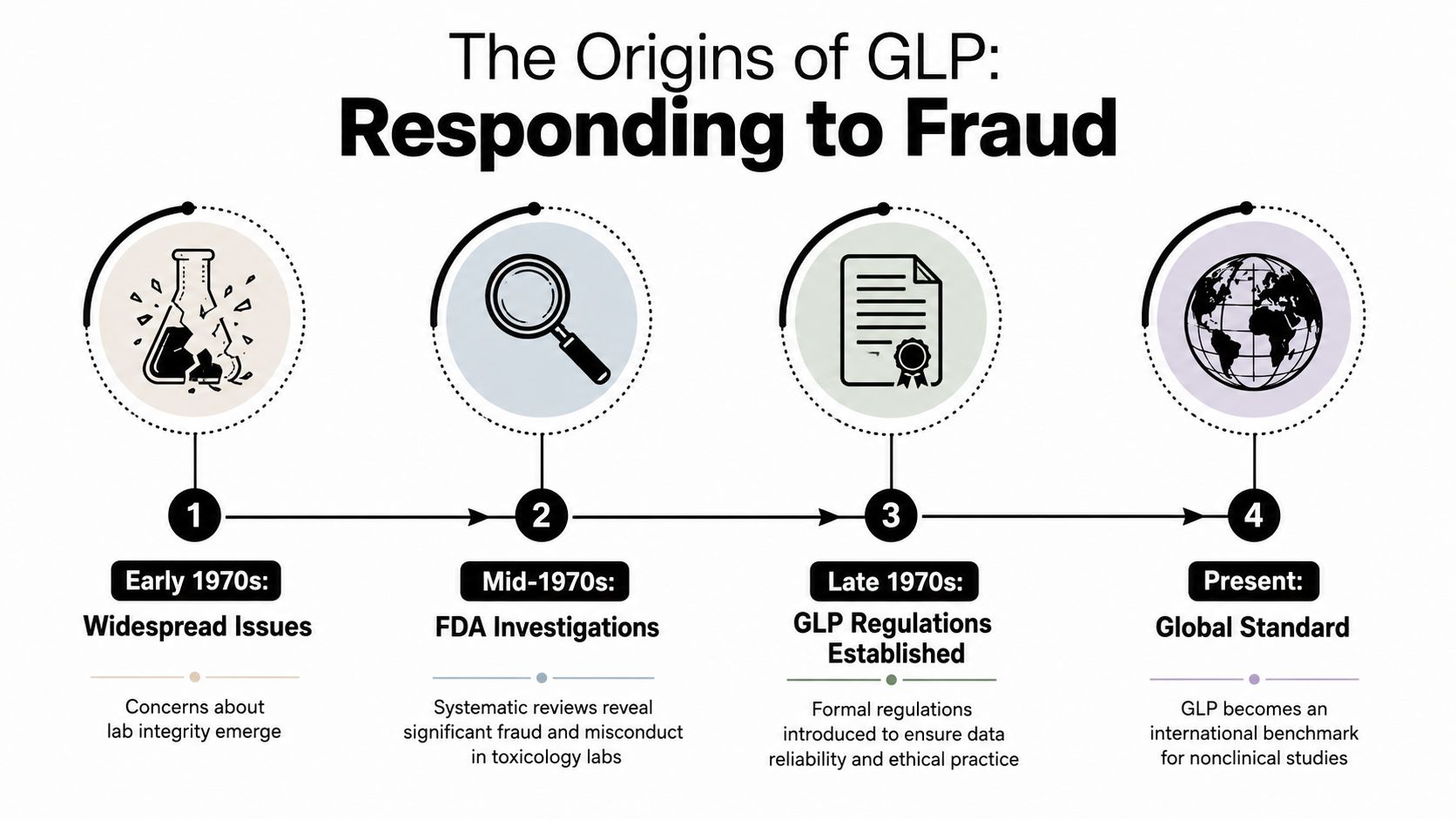
A lab can have polished notebooks, tidy benches, and still produce data that cannot be trusted. GLP was created because regulators found that some toxicology studies did not stand up to scrutiny, and the consequences reached far beyond paperwork. The FDA investigated 40 toxicology labs, found numerous fraudulent activities, held hearings in 1975, 1976, and 1977, proposed GLP regulations on 19 November 1976, published the final rule on 22 December 1978, and put 21 CFR Part 58 into law on 20 June 1979 FDA historical timeline. That history explains the purpose of GLP: quality controls were a response to evidence that safety data could be unreliable without them.
From U.S. rulemaking to global harmonization
Once the U.S. established enforceable GLP standards, the framework became a reference point beyond America. The OECD adopted its Principles of GLP in 1981, then updated them in 1997 with a revision that replaced the original consensus document OECD GLP principles186/FINAL/en/pdf). That shift turned GLP into a shared quality language for nonclinical safety studies across major markets.
A study that follows a common GLP framework is easier for another authority to assess without starting from zero. That matters in practice because it can reduce duplicated testing and support cross-border acceptance of safety work in the EU, UK, USA, and other OECD economies.
Why the history still shows up in audits
Auditors still care about that history because they are checking whether the modern lab has learned the lesson behind it. GLP exists to make sure a claim about safety can be traced to real work done under controlled conditions. The focus is not whether the science sounds convincing in a report, but whether the record can support the conclusion when someone follows the trail line by line.
A team that understands that origin usually makes better day-to-day decisions. It stops asking whether a form is merely required and starts asking whether the study can survive scrutiny if the original analyst is unavailable and the customer asks for the underlying trail. That is the right frame, and it is the one regulators expect to see in practice.
What GLP Actually Controls in a Laboratory
A GLP laboratory is being asked to prove control, not just to produce a neat report. The quality system reaches across the whole study lifecycle, planning, performing, monitoring, recording, reporting, and archiving, with clear responsibilities for management, the study director, study personnel, and quality assurance personnel OECD GLP guidance. That structure is what separates a lab where work merely happens from a lab where evidence can stand up to review.
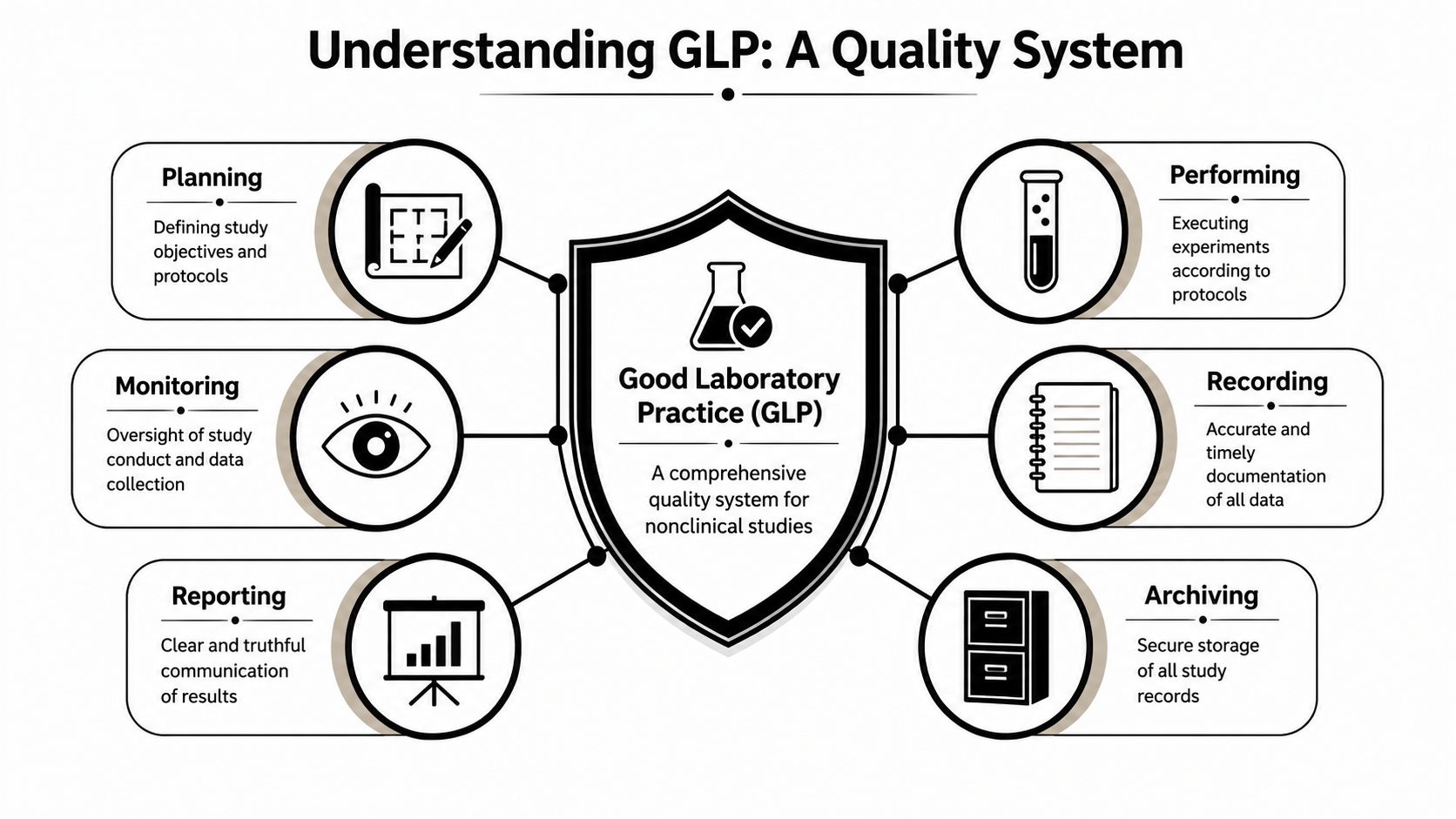
A useful way to read GLP is to ask a simple question at each stage, who is responsible, what was done, and how can it be shown later. Regulators care about that chain because the work has to be traceable from the first plan through to the archived record. That is why GLP reaches into day-to-day execution, not just the final paperwork.
The core roles are not interchangeable
Management is responsible for the working environment, the resources, and the expectation that the system will be followed. The study director owns the conduct and integrity of the study. Study personnel carry out the work according to the approved plan. Quality assurance personnel stay independent from the test activity and check whether the study is following GLP.
The cleanest analogy is a film set. The study director is responsible for the finished production, the study personnel are the crew that makes each scene happen, and QA is the gatekeeper who can stop the process if the record gets sloppy or the evidence chain breaks. That separation is not decorative. It is one of the main reasons the system can be trusted.
Practical rule: if the same person is designing, performing, and signing off without independent review, the control system is too weak.
What the record must show
GLP expects written SOPs, raw-data retention, and archived records as baseline controls. The lab should be able to show not only the final report, but the underlying material that proves the report was built from actual work, not reconstructed later from memory. A notebook line that says “sample ran fine” leaves too many gaps. It does not show who ran it, on which instrument, under which procedure version, or how a deviation was handled.
That gap matters most in the places people often overlook, consumables, reagents, batch verification, and supplier due diligence. A peptide run can fail for reasons that never appear in the final summary if the wrong batch was used, a reagent had not been checked against its certificate, or incoming materials were accepted without enough review. Regulators tend to look for those weak links because they are where real control either exists or falls apart.
The control question is straightforward. Can the lab prove that the work was planned, executed, checked, recorded, and preserved in a way another reviewer could follow? If the answer is weak, the study may look acceptable on paper while remaining fragile under scrutiny.
Regional GLP Frameworks in the EU, UK, and USA
The principles are harmonized, but the inspection structures aren't identical. For a transnational buyer or distributor, that distinction matters because the lab or supplier has to know which authority will inspect, what the local framework emphasizes, and how the study is expected to travel across borders. A useful consumer-level overview of water and filtration terminology can also help teams understand how quality language becomes messy in practice, which is why resources like filtration standards made simple can be helpful when procurement teams are comparing supplier claims.
| Framework | Primary Authority | Scope | Notable Emphasis |
|---|---|---|---|
| United States | FDA under 21 CFR Part 58 | Nonclinical studies intended for regulatory submission | Enforceable GLP rule tied to study integrity and inspections |
| European Union | EU GLP directives and OECD-aligned monitoring | Nonclinical safety studies across member states | Mutual acceptance, inspection coordination, and harmonized principles |
| United Kingdom | National GLP compliance monitoring aligned with OECD principles | Nonclinical studies submitted in the UK | Continued OECD-aligned compliance after Brexit |
The practical difference is in oversight, not the scientific logic
The U.S. framework is built around the FDA rule, which is why American auditors often focus heavily on whether the study record matches the conduct of the study under 21 CFR Part 58. The EU system is tied to OECD-aligned directives and mutual acceptance, which helps one study be used across member states without repeating the same nonclinical work. The UK remains OECD-aligned, so the core quality language stays recognizable even though the administrative route differs.
That matters for study planning. A multi-market team should not write one protocol and assume the regulatory path is identical everywhere. The study design may be accepted broadly, but the documentation and inspection expectations still need to fit the authority receiving the data.
Why this matters for buyers and distributors
For suppliers and distributors, regional alignment is a commercial advantage only if the paperwork supports it. A batch record that looks fine internally but lacks traceability, storage evidence, or stable documentation can still fail a customer's downstream audit.
So the decision isn't “Which region is stricter?” It's “Can the supplier's quality system stand up to review in the region where the product or data will land?” That question is especially important in reagent and peptide workflows, where the batch story often matters as much as the end use.
Practical Implementation of GLP in Daily Operations
A GLP system only works when people can use it on a busy bench. That means the control points have to be specific enough for real life, not just impressive in a binder. WHO guidance says calibration should be traceable to national or international measurement standards, and peer-reviewed GLP literature recommends that instrument calibrations be done by authorized personnel and documented, with new reagent lots validated against control or reference materials before use WHO GLP guidance.
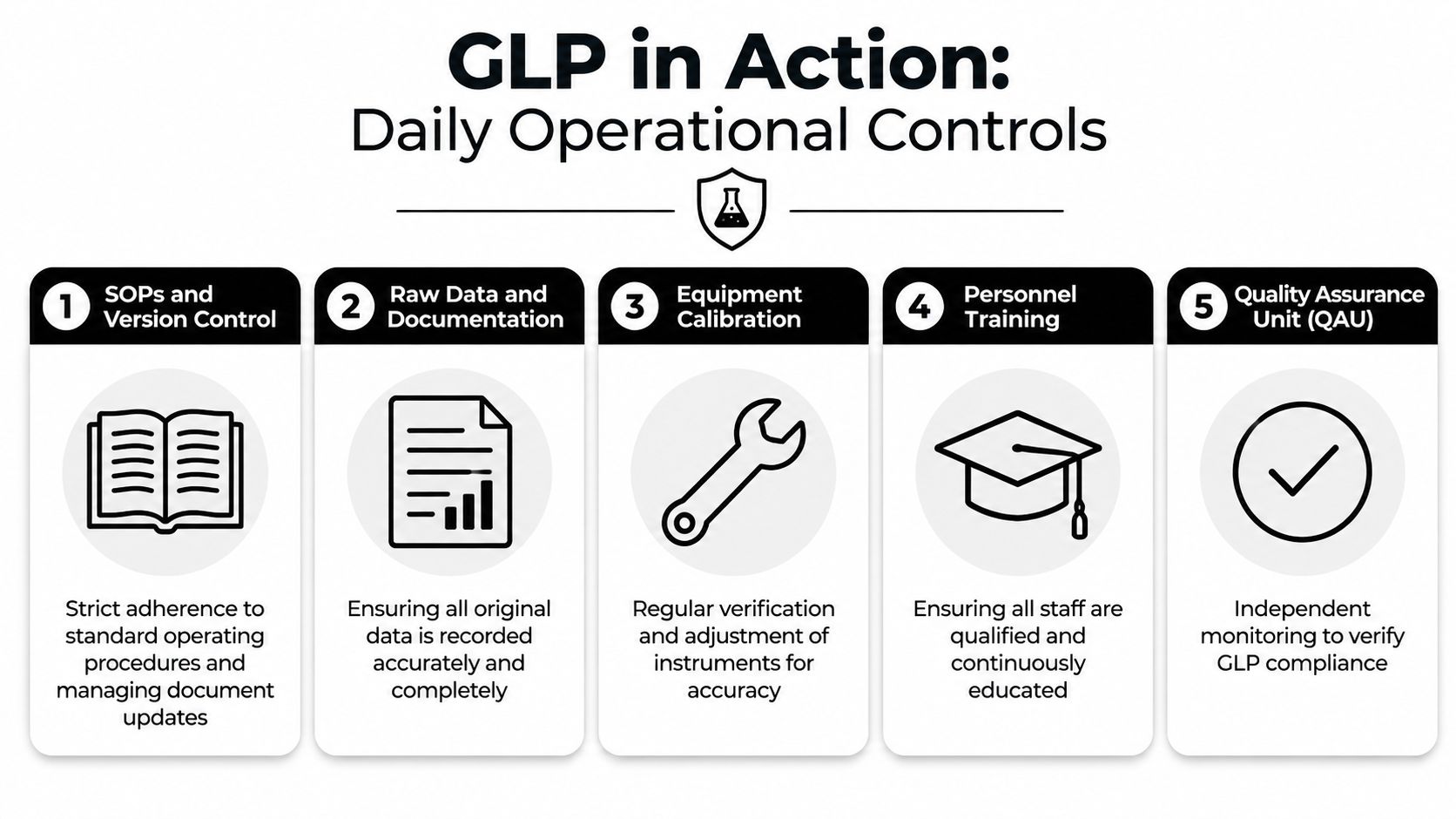
Five controls that auditors actually ask about
- SOPs and version control. The lab should be able to show the current procedure, the approval trail, and evidence that staff used the right version at the right time.
- Raw data and documentation. Original observations, instrument outputs, and manual entries need to be complete, legible, and tied to the study record.
- Equipment calibration. Instruments such as pipettes and thermometers should have traceable calibration records, not just a sticker on the side.
- Personnel training. Staff need documented competency for the tasks they're allowed to perform, especially on critical or regulated work.
- Quality Assurance Unit. Independent review is what separates a controlled study from a self-certified one.
What “audit-traceable” looks like in a small lab
A small or mid-size lab doesn't need enterprise theater, but it does need discipline. If a pipette was used on a sensitive batch, the calibration record should exist and be retrievable. If a SOP changed, the team should know which runs were done under the old version and which under the new one.
Practical rule: if a record lives only in someone's memory or inbox, it doesn't count as control.
A useful way to think about the system is that each record answers one question. SOPs answer “How was the work supposed to happen?” Raw data answers “What happened?” Calibration records answer “Was the tool fit for purpose?” Training records answer “Who was qualified?” QA records answer “Who checked the checkers?” Once those answers are available on demand, the lab becomes much easier to defend.
For teams trying to keep documentation usable instead of bloated, modern knowledge systems can help as long as they preserve the source trail. That's why some groups evaluate knowledge base tools with AI workflows when they're trying to improve retrieval without weakening control.
The Hidden GLP Risks in Reagents and Consumables
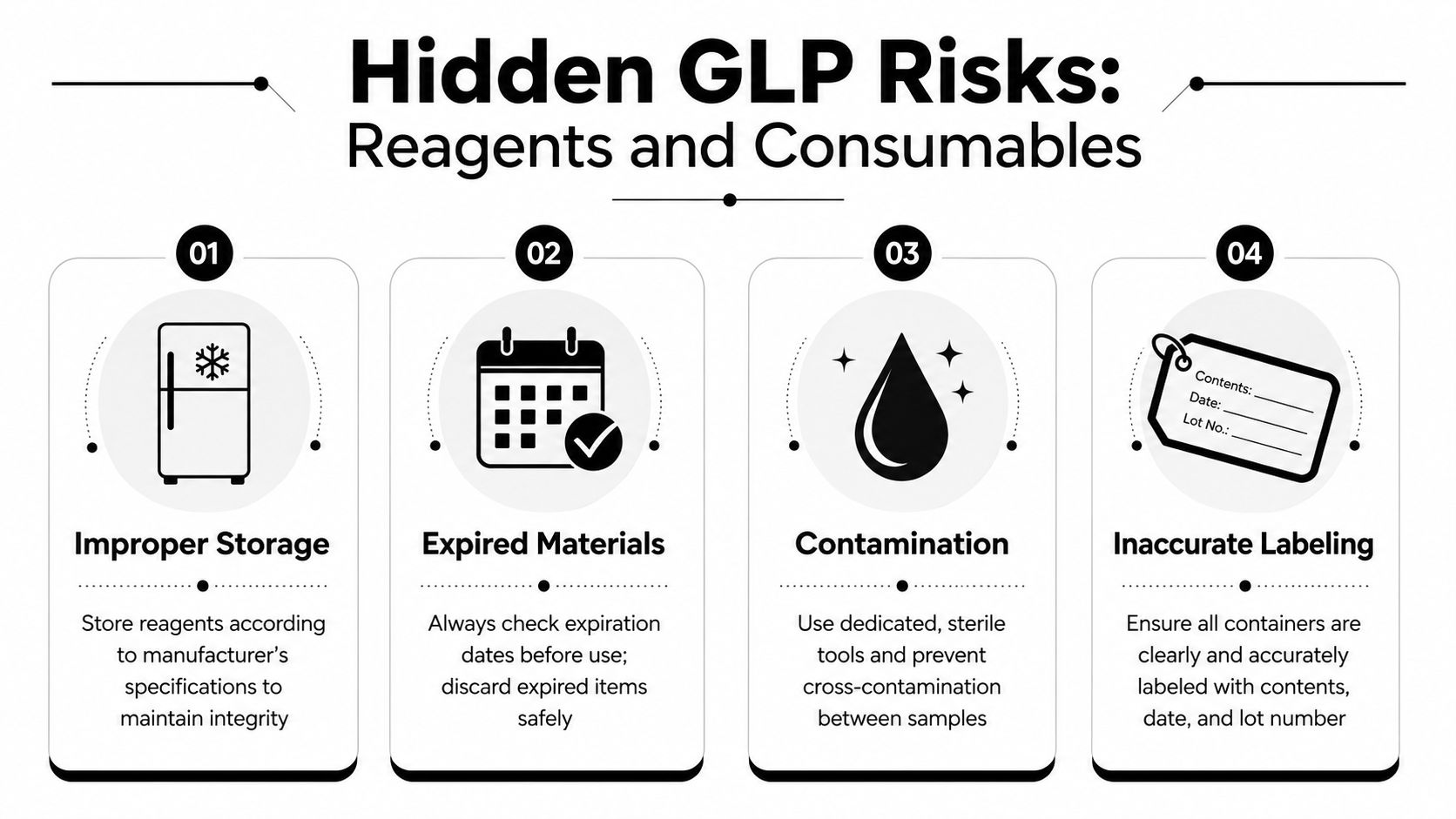
A lab can have polished SOPs and well-trained staff, yet still lose control at the bench if the reagents, consumables, and water supply are weak points. QC guidance expects each new reagent lot or batch to be documented and tested alongside the prior lot, and it expects water quality records to show the required standards, including pH and resistivity, with corrective action recorded when results fall outside specification QC reagent and water quality guidance. That level of control is often what separates a stable workflow from one that looks fine until a comparison fails or a result drifts.
Batch verification is where many teams get too casual
A reagent lot can look identical on the shelf and still behave differently in use. Parallel qualification is the practical check that catches that gap before it reaches a study run. If a new batch is accepted without comparison to the prior one, the team may end up blaming biological variation or operator technique for a problem created by the material itself.
That matters just as much for water. Many labs treat water as background support, yet QC practice treats it as a controlled input, like any other material that can affect the result. If pH or resistivity records are missing, the lab loses part of the trail that shows the work was performed under suitable conditions.
For teams that want a clearer method for verifying inputs, quality-control testing methods can help standardize what gets checked before routine use.
Storage, labeling, and retention are not minor details
Storage failures are easy to miss because they often leave no immediate sign. A tube may still look intact after temperature abuse, an expired vial may still carry a readable label, and a contaminated item may still pass through busy hands unnoticed. That is why GLP reviewers pay attention to how materials are received, stored, labeled, and retained, not only to how they are used.
Retention and sample division matter for the same reason. If a shipment, lot, or test item is questioned later, a retained sample may be the only way to sort out whether the issue started with the material, the handling, or the downstream process. When that sample is missing, the lab is left arguing from memory instead of evidence.
A simple control habit helps here: ask the same four questions every time a consumable enters the workflow.
- Was the lot checked? Compare the new batch with the prior one before routine use.
- Was storage controlled? Confirm the material stayed within the required conditions from receipt onward.
- Was the label complete? Make sure the content, date, and lot number are visible and consistent.
- Can the sample be traced later? Keep retention and division practices strong enough to support dispute resolution.
For peptide, reagent, and distribution workflows, that discipline often prevents more trouble than broad compliance reminders ever will. The hidden GLP failures usually start with ordinary inputs, then spread when no one verifies them early.
Preparing for GLP Audits and Avoiding Common Pitfalls
An audit rarely discovers a brand-new problem. It usually finds a problem the lab already knew, at some level, was there. Internal discipline around documentation, calibration, training, and archiving is what prevents the same issue from surfacing during an inspection. A practical reference on regulatory compliance documentation can help teams think in terms of records, not just policies.
What inspectors tend to look at first
Inspectors usually start with the study record, the SOP set, the equipment status, and the training trail. Then they move to the people who did the work, the way deviations were handled, and whether archived records can be retrieved. That's why unsigned SOP versions, undocumented calibrations, and unarchived raw data are such common findings, they're visible quickly and they signal a weak system behind them.
Deviation, corrective action, and root cause are not the same thing
A deviation is what happened. A corrective action is what the lab did to fix the immediate problem. A root-cause analysis asks why the problem happened in the first place so it doesn't recur. Teams often stop at the second step and call it done, but auditors look for the third.
A good prevention habit is to prepare the walkthrough before anyone arrives. The team should know where current SOPs live, how calibration records are retrieved, who can explain the study timeline, and where the raw data and archives sit. If those answers take time to assemble, the lab is already carrying avoidable risk.
Practical rule: if a document is hard to find during an internal review, it'll be harder to defend during an audit.
The best labs treat audits like a routine test of whether the system still works, not like a special event. That mindset lowers panic and raises consistency, which is exactly what regulators want to see.
What Procurement Teams Should Demand From GLP Suppliers
Procurement teams can't inspect every bench, but they can demand evidence that the supplier's quality system is real. A useful starting point is a supplier code review like suppliers code of conduct 2026 compliance, because policies only matter when they translate into documented behavior. The same logic applies to product suppliers, especially in regulated research supply chains.
The paperwork should match the product story
A Certificate of Analysis should clearly identify the batch, the tested attributes, and the material being supplied. Batch testing should be documented, retention samples should be available where appropriate, and storage and transport conditions shouldn't be treated as verbal assurances. If a supplier can't show how the material was controlled before shipment, the downstream customer inherits the risk.
That's where supplier qualification becomes a real quality decision, not a purchasing formality. A transparent Research Use Only policy, readable terms, and retrievable records all help prove that the product was handled within a defined system.
For teams comparing partners, a useful reference is the supplier qualification criteria. The right question isn't just whether the item is available quickly, it's whether the documentation will survive a customer audit or a regulator's request for evidence.
If a lab needs supplies that fit a documented quality system, Herbilabs focuses on high-purity reagents, temperature-controlled storage, clear COAs, and reliable fulfillment for research workflows across the EU, UK, and USA. For teams that need consistency they can defend downstream, visit Herbilabs and review how its RUO-focused supply model supports GLP-minded procurement and quality control.


