Private Label, White Label, Wholesale partnerships available - EU, USA and UK - Free shipping from €75

Bacteriostatic Water vs Sodium Chloride: A Research Guide
The popular advice on bacteriostatic water vs sodium chloride is usually too simple: choose water for peptides and saline for injections. That shortcut can create formulation, sterility, and patient-safety problems because the correct diluent depends on the compound, the administration route, the preservative system, and how often the container will be accessed.
Bacteriostatic water and plain sodium chloride aren't interchangeable liquids with different labels. One combines sterile water with 0.9% benzyl alcohol, while the other provides an isotonic 0.9% sodium chloride solution without bacteriostatic or antimicrobial agents. The practical decision is therefore not brand versus brand. It's a property-matching exercise.
Table of Contents
- Why the Diluent Choice Is More Than a Two-Product Question
- Defining Each Diluent and Its Core Composition
- Side-by-Side Technical Criteria That Drive the Decision
- Matching the Diluent to Reconstitution and Injection Workflows
- Sterility, Contamination Risk, and Post-Opening Stability
- Peptide and Reagent Compatibility With Benzyl Alcohol
- Choosing the Correct Diluent in Research Workflows
Why the Diluent Choice Is More Than a Two-Product Question
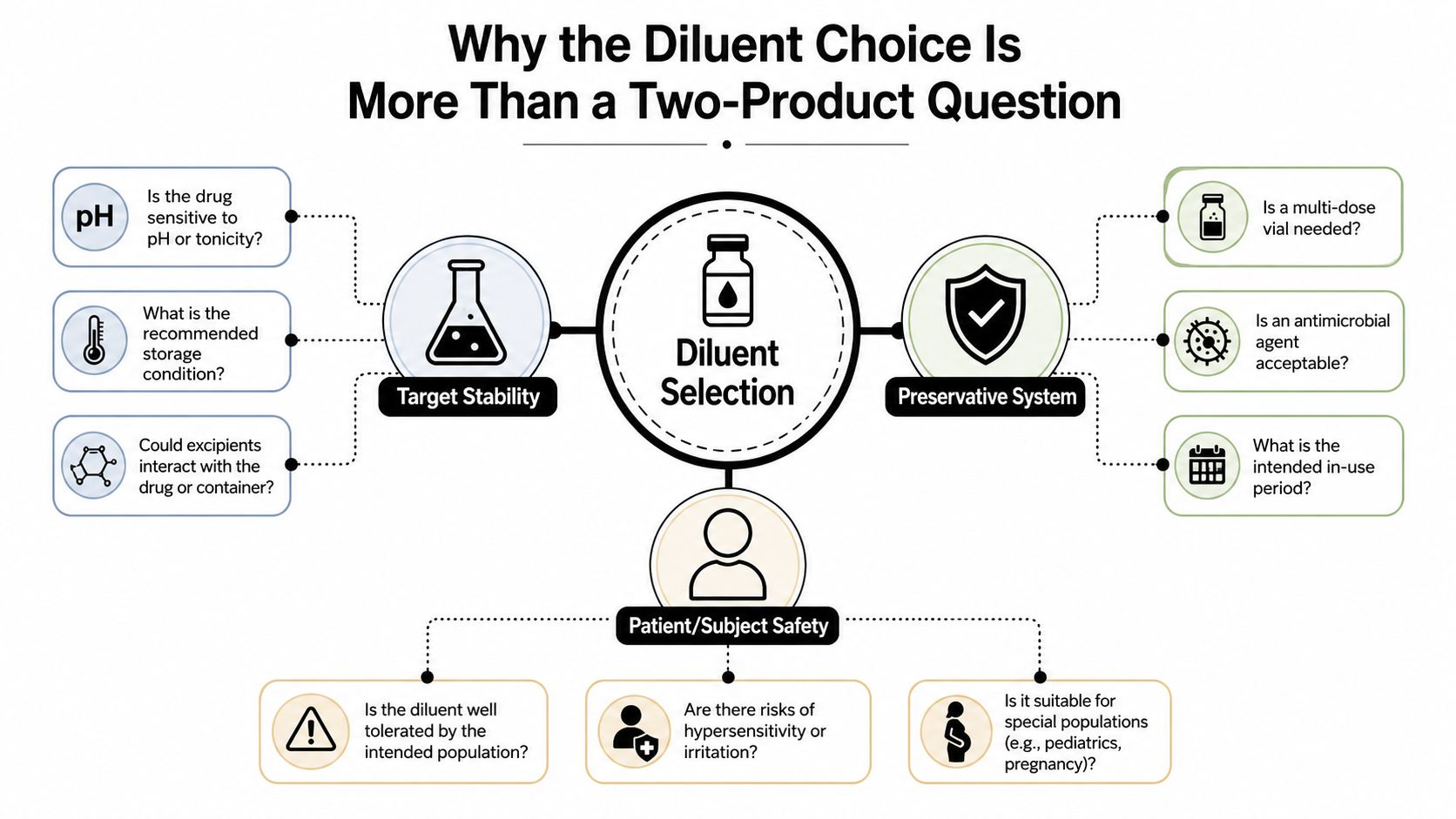
A researcher choosing a diluent should start with the target formulation, not the bottle on the shelf. Three questions usually determine the direction:
- Does the final preparation need isotonicity? Sodium chloride solutions are selected when the formulation must match a physiologic salt environment.
- Can the compound tolerate benzyl alcohol? Bacteriostatic water contains a preservative, and that preservative can be unsuitable for some compounds, assays, or sensitive populations.
- How many withdrawals will the container support? A preserved multi-dose presentation may fit a repeated-access workflow, while preservative-free saline is commonly chosen for immediate or single-session use.
U.S. labeling established a clear distinction between preservative-containing diluents and plain saline-based solutions. DailyMed identifies bacteriostatic water for injection as a sterile, nonpyrogenic preparation containing 0.9% benzyl alcohol, or 9 mg/mL, and lists multi-dose presentations such as a tray of 25 and a 30 mL plastic flip-top vial. By contrast, 0.9% sodium chloride irrigation is labeled sterile and isotonic, with no bacteriostatic or antimicrobial agents (DailyMed product labeling).
The false binary
The phrase “water versus saline” hides important differences in tonicity, ionic content, preservative exposure, route compatibility, and access pattern. Bacteriostatic sodium chloride adds another layer of confusion because it combines sodium chloride with a preservative, making it distinct from both plain bacteriostatic water and preservative-free saline.
A sound decision process asks what the reconstituted preparation needs to do. A compound intended for a single immediate administration may not benefit from a preservative. A multi-dose research workflow may value repeated access, but only if the compound and intended use tolerate the preservative system.
Practical rule: The diluent should match the formulation and workflow, not the product name alone.
Defining Each Diluent and Its Core Composition
Bacteriostatic water for injection, or BWFI, is sterile water containing 0.9% benzyl alcohol, quantified as 9 mg/mL. The benzyl alcohol acts as a bacteriostatic preservative, which supports repeated withdrawals from a properly handled multi-dose vial. Sterile water for injection is different. Its labeling describes a sterile preparation without a bacteriostat or added antimicrobial agent, intended for single-dose use after a suitable solute is added (FDA sterile water labeling).
0.9% sodium chloride contains sodium chloride in water and is isotonic rather than plain hypotonic water. Its purpose is to provide a salt concentration that can be compatible with physiologic environments and with formulations that require saline. Plain saline doesn't contain an antimicrobial preservative, so an opened container doesn't gain the same multi-dose preservation feature as bacteriostatic water.
The distinction becomes clearer in the following comparison.
| Parameter | Bacteriostatic Water, BWFI | Sodium Chloride 0.9% |
|---|---|---|
| Base | Sterile water | Sterile water containing sodium chloride |
| Preservative | 0.9% benzyl alcohol, or 9 mg/mL | None in plain preservative-free saline |
| Tonicity | Hypotonic as a water-based formulation | Isotonic |
| Ionic content | No sodium chloride added | Contains sodium and chloride ions |
| Primary selection logic | Repeated withdrawals when benzyl alcohol is compatible | Isotonic compatibility or immediate-use workflows |
| Container logic | Often supplied in multi-dose presentations | Commonly used as a preservative-free single-dose solution |
| Regulatory distinction | Preservative-containing sterile diluent | Sterile saline without bacteriostatic or antimicrobial agents |
The composition matters because adding a diluent changes the final chemical environment. Researchers comparing options can also consult this practical guide to compare peptide reconstitution solutions, while still checking the target compound's own compatibility information before selecting a product.
Side-by-Side Technical Criteria That Drive the Decision
A useful comparison starts with the preparation's intended use. Tonicity matters when the final solution will contact tissue or enter a route that requires physiologic compatibility. Preservation matters when a container will be entered repeatedly. Those benefits don't always point to the same product.
| Decision Criterion | Bacteriostatic Water | Sodium Chloride 0.9% |
|---|---|---|
| Tonicity requirement | Doesn't provide an isotonic saline environment | Provides an isotonic saline environment |
| Preservative system | Contains benzyl alcohol | Plain saline has no antimicrobial preservative |
| Repeated withdrawals | Can support a multi-dose workflow when labeling and compatibility allow | Usually selected for immediate or single-session use |
| Compound compatibility | Requires confirmation that benzyl alcohol is acceptable | Requires confirmation that sodium chloride is acceptable |
| Route considerations | Not a universal choice for clinical administration | Often preferred when isotonicity is required |
| Laboratory use | May be useful when added salt would interfere with the formulation | May introduce ions that affect downstream chemistry |
| Main trade-off | Preservation can add compatibility and safety restrictions | Lack of preservation limits repeated-access convenience |
Tonicity comes before convenience
A solution's tonicity describes how its dissolved components affect water movement across biological membranes. Plain bacteriostatic water is hypotonic because it consists of water with benzyl alcohol, while 0.9% sodium chloride is isotonic because it contains 0.9% NaCl (FDA product label).
That doesn't mean saline is automatically correct. The compound may require a different environment, and the final preparation may undergo additional concentration or buffering steps. It means that sodium chloride begins with a physiologic salt profile, while bacteriostatic water doesn't.
Preservation comes with a condition
Benzyl alcohol can reduce the consequences of some contamination pathways in a multi-dose workflow, but it doesn't make poor aseptic technique acceptable. It also doesn't prove compatibility with every peptide, protein, reagent, or patient group.
Researchers assessing saline specifications can review sodium chloride injection USP as part of a broader product and labeling check. The final choice still belongs to the validated formulation protocol.
Matching the Diluent to Reconstitution and Injection Workflows
Workflow is where the theoretical differences become operational. A multi-dose vial accessed across several sessions creates a different requirement from a preparation made immediately before one use. A laboratory reagent has different needs from a solution intended for administration.
| Workflow Scenario | Bacteriostatic Water | 0.9% Sodium Chloride | Rationale |
|---|---|---|---|
| Repeated access to a compatible research preparation | Often suitable | Less convenient in a preservative-free format | The preservative supports a repeated-withdrawal workflow when the label and formulation allow it |
| Immediate single-session preparation | May be unnecessary | Often suitable | No preservative is needed when the solution is prepared and used promptly |
| Formulation requiring isotonic saline | Usually not the default | Often preferred | Sodium chloride supplies the required salt environment |
| Compound sensitive to benzyl alcohol | Avoid unless compatibility is established | May be preferable if saline is compatible | Removing the preservative can resolve one compatibility concern |
| Laboratory reagent dissolution | Can be appropriate when salt would interfere | May be unsuitable if sodium or chloride affects the assay | The downstream chemistry determines the acceptable ionic composition |
| Cell culture or sensitive biological assay | Requires protocol-specific review | Requires protocol-specific review | Neither diluent should be selected without checking the assay conditions |
Multi-dose research preparations
Bacteriostatic water can fit a compatible lyophilized research preparation that will be accessed repeatedly. The preservative addresses one practical problem, namely the increased handling associated with repeated withdrawals. It doesn't establish that the reconstituted compound remains chemically stable, nor does it replace the need for validated storage and discard instructions.
A researcher should verify the compound's stability data, the intended container, the access frequency, and the route or assay conditions. If the compound is known to interact with benzyl alcohol, the convenience of a preserved vial may not justify the formulation risk.
Immediate-use preparations
Plain 0.9% sodium chloride is often a better fit when isotonicity matters and the preparation will be used in a single session. Its lack of antimicrobial preservative can be an advantage when the compound, patient population, or assay requires minimized preservative exposure.
The same principle applies to clinical compatibility. A route that demands physiologic tonicity should not receive a water-based diluent just because the water is sterile. Route-specific requirements and the approved product instructions take priority over general peptide-handling habits.
Sterility, Contamination Risk, and Post-Opening Stability
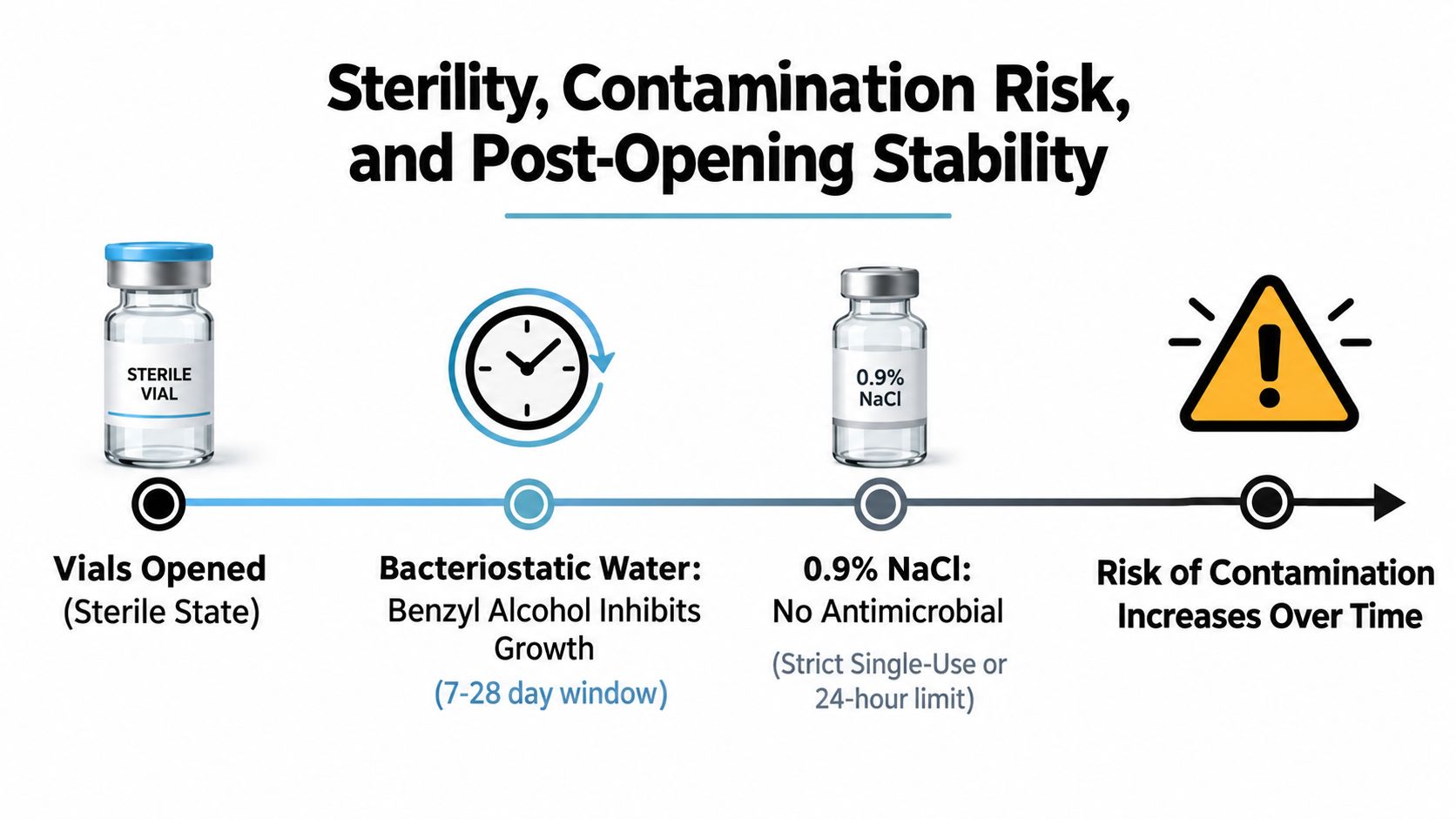
Both products can begin in a sterile state, but opening changes the contamination risk. Every puncture creates another opportunity for microorganisms or particulates to enter, especially when operators reuse needles, disinfect inconsistently, or store the container outside its labeled conditions.
Bacteriostatic water addresses part of this problem through 0.9% benzyl alcohol, which inhibits microbial growth and supports its multi-dose presentation. The preservative is a safeguard within a controlled workflow, not a guarantee of sterility after careless handling.
The opening date is part of the protocol
Recent product guidance and industry discussions commonly describe a 28-day post-opening window for bacteriostatic water or bacteriostatic saline, but the exact discard instruction must come from the product labeling and the governing institutional procedure. A 28-day window shouldn't be treated as a universal license to keep every reconstituted preparation for that period, because the added drug may have a shorter stability period.
Plain 0.9% sodium chloride has no preservative effect. It is therefore commonly handled as a single-use solution unless the specific container labeling provides different instructions. An opened saline container shouldn't be retained merely because the liquid appears clear.
The sterile water for reconstitution product category also illustrates why sterile status and bacteriostatic status must remain separate questions. Sterile water without a preservative can be appropriate for a defined single-use protocol, but it doesn't provide the same repeated-access rationale as bacteriostatic water.
What laboratories should document
A defensible multi-dose process records the facts that determine whether continued use is permitted:
- Opening date and time: Record when the container first entered active use.
- Product identity: Keep the label, lot information, and preservative details with the preparation.
- Puncture history: Track each access and investigate unusual frequency or handling.
- Storage conditions: Follow the product label rather than assuming refrigeration or room-temperature storage is interchangeable.
- Visual inspection: Check for unexpected particles, cloudiness, discoloration, or container damage before use.
- Discard decision: Apply the shorter relevant limit when the diluent or reconstituted compound has different stability instructions.
A preserved vial can reduce one contamination risk, but it can't correct a broken aseptic process or extend the chemical stability of the added compound.
Peptide and Reagent Compatibility With Benzyl Alcohol
Benzyl alcohol changes the formulation. That change may be acceptable, irrelevant, or harmful depending on the compound and the assay. A peptide that remains soluble and stable in bacteriostatic water may benefit from the multi-dose format, while another preparation may show precipitation, altered recovery, or reduced assay reliability after exposure to the preservative.
The correct approach is to look for compound-specific evidence rather than relying on a peptide category or a supplier's general recommendation. “Peptide” doesn't describe one uniform chemical behavior. Sequence, structure, concentration, buffer conditions, container materials, and temperature can all influence compatibility.
| Compound or Workflow | Compatible With Bacteriostatic Water | Compatible With 0.9% Sodium Chloride | Notes |
|---|---|---|---|
| Peptide with documented benzyl alcohol tolerance | Potentially | Potentially, if saline is also compatible | The validated formulation should determine the choice |
| Peptide with uncertain preservative compatibility | Not established | Potentially preferable if saline is validated | Preservative-free handling removes one variable |
| Preparation requiring isotonic saline | Usually not the default | Often suitable | Sodium chloride provides the salt environment |
| Sensitive protein or peptide formulation | Requires direct stability evidence | Requires direct stability evidence | Solubility and structure can change with the diluent |
| HPLC or mass spectrometry workflow | May interfere with analysis | May interfere if ions affect the method | Method validation should define acceptable residual components |
| Enzymatic assay | Requires assay-specific review | Requires assay-specific review | Preservatives and salts can both alter activity or baseline behavior |
| Neonatal or other sensitive clinical population | Requires strict safety review | Often considered when preservative-free use is required | Benzyl alcohol exposure can be inappropriate in sensitive populations |
Why benzyl alcohol can be the wrong variable
The preservative may affect solubility, protein structure, analytical recovery, or enzyme activity. In an HPLC method, a residual preservative can change the background or interfere with the mobile-phase system. In mass spectrometry, formulation components can affect ionization behavior. In an enzymatic assay, the same component may alter activity or baseline readings.
These outcomes aren't automatic, but they are enough to require a compatibility check. A useful technical discussion of how preservative concentration can affect research validity is available through this benzyl alcohol concentration guide.
Sensitive populations require separate scrutiny
Benzyl alcohol can be inappropriate for neonates and other sensitive populations because of established safety concerns. That consideration shifts many clinical workflows toward preservative-free, single-dose preparations when the formulation and route permit it.
The distinction between bacteriostatic water, bacteriostatic saline, and sterile water for injection remains important here. Bacteriostatic saline contains sodium chloride plus a preservative, while plain saline lacks the bacteriostatic component. A clinician or researcher must verify the exact product rather than infer its composition from the word “saline.”
Choosing the Correct Diluent in Research Workflows
A practical decision framework begins with the label and ends with the workflow. U.S. labeling distinguishes bacteriostatic water from sterile water and plain saline, and that distinction carries through to how laboratories assess repeated access, isotonicity, preservative exposure, and downstream compatibility.
A concise protocol check
Before selecting a diluent, the responsible researcher should confirm:
- Compound stability: Does the target remain soluble and chemically stable in water, saline, or benzyl-alcohol-containing water?
- Tonicity requirement: Does the final preparation need an isotonic salt environment?
- Route or assay: Will the preparation be administered, used in an analytical method, or added to a biological system?
- Preservative tolerance: Is benzyl alcohol acceptable for the compound, method, and subject population?
- Access pattern: Will the container be entered repeatedly, or will the preparation be used in one session?
- Storage and discard instructions: Which product label and institutional procedure govern the opened container and the reconstituted compound?
A working decision rule
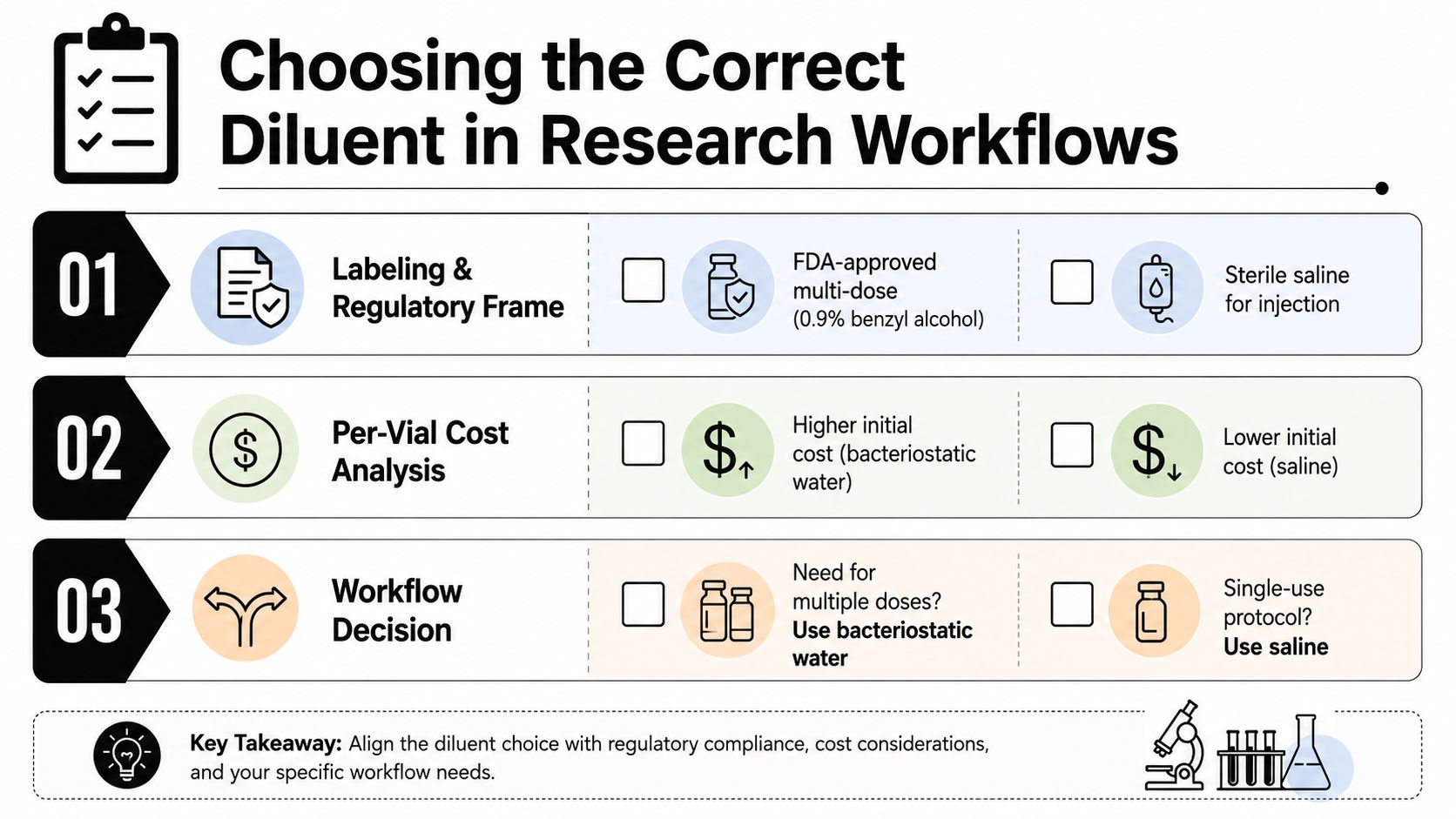
Bacteriostatic water is a reasonable candidate when a compatible preparation requires repeated withdrawals and the protocol accepts benzyl alcohol. Plain 0.9% sodium chloride is a reasonable candidate when isotonicity matters, preservative exposure should be avoided, or the workflow is immediate and single-session. Sterile water for injection belongs in protocols that require preservative-free water and include a separate plan for final tonicity adjustment.
The cost calculation also needs a workflow perspective. A multi-dose container may reduce unused liquid in a repeated-access process, while single-dose saline can reduce the complexity of managing an opened preserved vial when repeated access isn't needed. The correct choice depends on actual use, not the apparent convenience of a larger container.
Herbilabs offers research-use-only bacteriostatic water and reconstitution solutions in multiple vial formats, giving laboratories and distribution partners an option to evaluate alongside other products using the same label, compatibility, and documentation criteria.
Researchers and distributors comparing sterile diluents can review the Herbilabs range of bacteriostatic water and reconstitution solutions, then match vial format and preservative profile to the intended workflow. The team can also help buyers identify the product documentation needed for compliant research-use-only procurement.


