Private Label, White Label, Wholesale partnerships available - EU, USA and UK - Free shipping from €75
Bac Water for Injection: A Guide for Labs & Resellers
A lab has a peptide vial on the bench, a syringe ready, and a protocol that looks straightforward. Then the results drift. One batch dissolves cleanly, another foams, a third loses performance after a few withdrawals. People often blame the assay, the compound, or the operator. Just as often, the hidden problem sits in the diluent choice and handling.
That's why Bac Water for Injection deserves more attention than it usually gets. In sterile workflows, a “basic” liquid can become a major control point for reproducibility, contamination risk, inventory planning, and downstream safety. Labs and distributors that treat it like a commodity usually end up troubleshooting the same avoidable problems twice.
Material quality starts long before the sample reaches the instrument, which is why material purity in experimental integrity matters so much in real laboratory work.
Table of Contents
- The Hidden Variable in Your Research
- What Is Bac Water for Injection
- Bac Water vs Sterile Water vs Saline
- Common Research Applications and Vial Handling
- Critical Safety and Compatibility Considerations
- Storage Shelf Life and Procurement Best Practices
The Hidden Variable in Your Research
A common failure sequence looks ordinary at first. A lyophilized compound is reconstituted, aliquots are drawn over several days, and the first preparation appears fine. Later withdrawals behave differently. Solubility changes, clarity changes, or assay consistency drops enough that the team starts questioning the compound itself.
In many labs, that triggers a long and expensive detour. Staff review storage logs, calibration records, and formulation notes. But the actual issue may be much simpler. The wrong diluent was selected for the use pattern, or the correct diluent was handled as if its preservative could compensate for weak aseptic technique.
Why this basic vial matters more than people expect
Bac Water for Injection sits near the start of the workflow, so small mistakes there spread outward. A compromised diluent affects reconstitution, repeat withdrawals, vial life, training, and customer complaints if the material moves through a reseller channel.
Practical rule: When a result varies after preparation, the diluent and the handling method should be checked before anyone assumes the active material failed.
This matters especially for labs and wholesalers supporting multiple users. One vial may pass through receiving, storage, picking, packing, shipment, and bench use before anyone notices a preventable mismatch between formulation and application.
Reproducibility starts before the first withdrawal
Teams usually focus on the active ingredient. They should. But the diluent controls part of the environment that active ingredient sees first. If the preparation step is inconsistent, the experimental readout often reflects that inconsistency rather than the compound's real behavior.
That's why experienced operators don't treat bac water for injection as a generic add-on. They treat it as part of the formulation decision. The preservative, the intended route, the withdrawal pattern, and the compound's own instructions all matter at the same time.
What Is Bac Water for Injection
A simple definition that actually helps
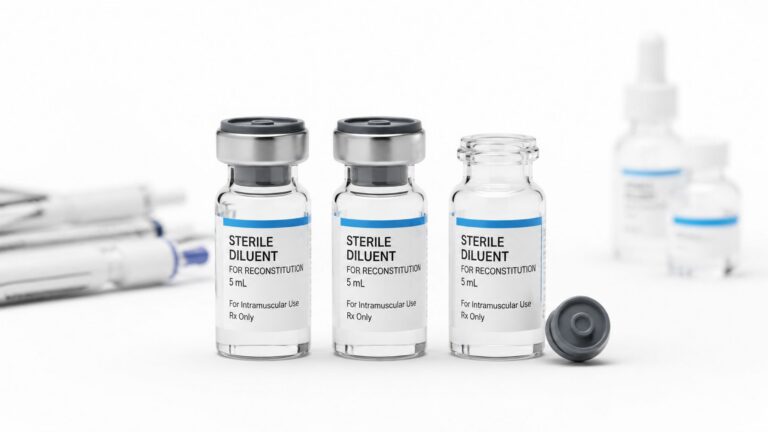
Bac Water for Injection is a multi-dose sterile diluent. In major labeling and pharmacopeial-style references, it is defined as water for injection containing 0.9% (9 mg/mL) benzyl alcohol as a preservative, and the U.S. DailyMed label states a pH of 5.7 within an allowable USP range of 4.5 to 7.0 under testing conditions. That same reference also notes the product is supplied in a multiple-dose container for repeated withdrawals and describes its very low ionic contribution to formulations because it is primarily water plus preservative, not a buffered salt system, as outlined in the DailyMed labeling for Bacteriostatic Water for Injection.

The phrase bacteriostatic causes confusion. It doesn't mean the vial is immune to contamination. It means the preservative helps inhibit bacterial growth after puncture. A useful mental model is a security guard at the door, not a cleanup crew already inside.
That distinction matters in real handling. If a vial is accessed repeatedly with poor technique, the preservative doesn't turn bad practice into safe practice. It only shifts the risk profile compared with preservative-free sterile water.
Why the chemistry matters in practice
The composition looks simple, but each part has a job.
- Sterile water base: It provides the liquid phase needed to dissolve or dilute an injectable preparation without contributing salts or meaningful buffering.
- Benzyl alcohol preservative: It supports multi-dose use by slowing microbial proliferation after stopper puncture.
- Low ionic strength: It helps when a formulation should not receive extra ions from the diluent.
- Minimal buffering capacity: It means pH behavior can become important during manufacturing, quality review, or compound-specific compatibility checks.
Bac water for injection is a diluent, not a standalone injectable solution for general use.
That last point is easy to miss. Product registration and labeling place it in the role of parenteral diluent, meaning it is intended for diluting or dissolving drugs according to those drugs' own instructions. It isn't a free-form substitute for every sterile liquid in the lab.
For a new research partner or distributor, the takeaway is straightforward. This is not “just water in a vial.” It is a sterile preparation engineered to support repeated withdrawals while introducing a preservative that can help operationally and complicate compatibility at the same time.
Bac Water vs Sterile Water vs Saline
The decision point most teams get wrong
Most selection errors happen because staff ask only one question: “Is it sterile?” That's too narrow. The better question is, “What kind of sterile liquid fits this formulation and this use pattern?”
For repeated withdrawals, Bac Water for Injection is distinct from Sterile Water for Injection because it contains a preservative. U.K. product information specifies 9.45 mg/mL benzyl alcohol (about 0.945% w/v), consistent with the common preservative level used to suppress microbial growth after puncture, while Sterile Water for Injection contains no preservative, as described in the U.K. Summary of Product Characteristics for Bacteriostatic Water for Injection.
For teams reviewing foundational sterile media options, water for injection in laboratory supply workflows gives useful background on where plain WFI fits versus preserved multi-dose diluents.
Diluent comparison
| Feature | Bacteriostatic Water | Sterile Water for Injection | Normal Saline (0.9% NaCl) |
|---|---|---|---|
| Preservative | Yes, benzyl alcohol | No | Not discussed here as a preservative system |
| Typical use pattern | Multi-dose withdrawal | Single-use or immediate-use workflows | Used when an isotonic saline vehicle is required |
| Added ions | Very low ionic contribution | Very low ionic contribution | Contains sodium chloride |
| Buffering effect | Minimal | Minimal | Different from plain water because salt is present |
| Best fit | Repeat vial access when compatible with the compound | Preservative-free dilution when required | Applications needing saline rather than plain water |
A few practical rules help remove ambiguity:
- Choose Bac Water for Injection when the product instructions allow a preserved diluent and the vial will be entered more than once.
- Choose Sterile Water for Injection when the formulation must stay preservative-free or when repeated access is not needed.
- Choose saline when the preparation specifically requires a sodium chloride vehicle rather than water alone.
The preservative is the main dividing line between the first two. Saline is a different category problem. It is not merely “another sterile water.” It changes the ionic environment.
A preservative answers one question. It does not answer all formulation questions.
That's why substitution errors are so costly. A lab may correctly want a sterile liquid but still pick the wrong one because the decision ignored ionic content, preservative sensitivity, or the intended number of withdrawals.
Common Research Applications and Vial Handling
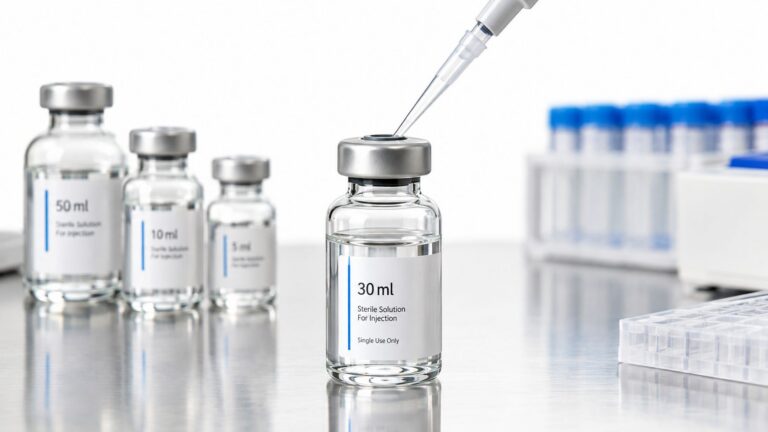
A frequent use case is reconstituting lyophilized materials intended for repeated withdrawal in a controlled research setting. The preparation itself isn't complicated, but small handling errors can create concentration drift, foaming, contamination risk, or physical stress on the compound.

A practical reconstitution workflow
A clean workflow starts before the needle touches the stopper.
- Confirm the compound instructions first. The correct diluent is defined by the compound, not by habit.
- Check the vial condition. The seal, stopper, and liquid appearance should all be acceptable before use.
- Prepare a clean work area. The preservative helps, but it doesn't replace disciplined setup.
- Disinfect both stoppers. The bac water vial and the compound vial both need the same attention.
- Withdraw the planned volume carefully. Volume planning should be done before puncture, not during a rushed mix.
- Introduce the diluent slowly. Directing liquid against the vial wall often reduces agitation.
- Swirl gently if needed. Rough shaking can stress delicate materials.
The “slowly” part matters more than many new operators realize. When liquid is forced directly onto a dry cake or powder mass, local concentration spikes and foaming can occur. With some materials, that creates a preparation that looks dissolved but behaves inconsistently later.
Handling habits that protect the vial
A multi-dose vial stays useful only if each withdrawal protects the next one.
- Use a fresh sterile needle and syringe each time. Re-entry with previously used equipment raises contamination risk.
- Track first puncture clearly. A vial without a visible puncture date is hard to manage reliably.
- Limit unnecessary entries. Poor planning increases puncture count and handling exposure.
- Store according to label and compound instructions. The vial and the reconstituted product are not always governed by the same storage logic.
A short visual demonstration often helps newer staff standardize technique:
The operational point is simple. Bac water for injection supports repeated access, but every puncture is still a contamination event waiting to happen if the handler treats the preservative as a substitute for clean technique.
Critical Safety and Compatibility Considerations
Where Bac Water for Injection is the wrong choice
The preservative that makes repeated withdrawal practical also creates hard boundaries. Canadian registration and related labeling position bacteriostatic water as a parenteral diluent, not a free-standing injectable, and associated product information warns that benzyl alcohol can be linked to hypersensitivity concerns and is not for use in newborns in some formulations, as reflected in the Canadian product registration details for Bacteriostatic Water for Injection USP.

That means safety review has to go beyond “sterile or not sterile.” The correct question is whether the target product, population, and route all permit a benzyl alcohol preserved diluent.
Three common mistakes show up repeatedly:
- Using it by default for every reconstitution. Some compounds require preservative-free dilution.
- Ignoring population-specific restrictions. Neonatal and highly sensitive use cases demand stricter screening.
- Treating compatibility as obvious. It often isn't.
If the compound instructions are silent or restrictive about preservatives, staff should stop and verify before mixing.
Questions distributors and labs should ask before release
Most online explanations stop at the definition. The harder operational question is compatibility. Which products should not be mixed with bac water for injection, and why?
The most useful answer is procedural rather than universal. Benzyl alcohol may be inappropriate because of population safety, route restrictions, or formulation chemistry. Some products tolerate it. Others may not. Existing practical guidance highlights that users need better decision support on incompatibilities and on when sterile water is the better choice, as discussed in this practical overview of what bacteriostatic water is used for.
A distributor or lab manager should ask:
- Does the product labeling specify the diluent?
- Does the formulation require preservative-free preparation?
- Is the target use group restricted because of benzyl alcohol?
- Could added preservative affect solubility or stability?
- Is the final route compatible with this diluent choice?
That checklist prevents a lot of avoidable errors. Compatibility is not a generic property of the vial. It is a property of the vial plus the compound plus the intended use.
Storage Shelf Life and Procurement Best Practices
Shelf life is an operational issue, not just a label issue
For wholesalers and laboratories, shelf life problems usually show up as process failures, not theory problems. A vial is received without clear batch traceability. First puncture dates aren't recorded. Stock rotates poorly. A customer asks whether the same handling rule applies across brands, climates, and repeated puncture patterns, and the documentation on hand is too thin to answer confidently.
That's why storage needs to be managed as a system.
- Keep receipt records tied to lot information. If a question appears later, traceability has to be immediate.
- Separate unopened from in-use stock. Mixed storage creates confusion fast.
- Document puncture dates on active vials. Without that, discard decisions become guesswork.
- Train pick-pack staff on packaging integrity checks. Procurement quality can be lost in fulfillment, not just manufacturing.
There is also a larger commercial reason to get this right. A recent market assessment projected the global bacteriostatic water for injection market at US$1.22 billion in 2024, with North America holding 41.7% share, highlighting how important supply reliability and QC discipline have become in this category, according to market coverage of the bacteriostatic water for injection sector.
What to verify before buying or distributing
Procurement teams shouldn't stop at the product name. They should verify whether the documentation and packaging support the intended workflow.
A practical review usually includes:
- Label clarity: The preservative content, intended use, and any restrictions should be easy to identify.
- Container format: Multi-dose handling only works if the packaging supports repeated access without confusion.
- Batch documentation: COA and release records should match the shipped lot.
- Storage instructions: Warehouse staff and end users need consistent handling guidance.
- Market designation: Teams should understand whether a product is supplied for clinical use, compounding contexts, or Research Use Only workflows.
For organizations working in non-clinical channels, Research Use Only definition and labeling practice is an important part of procurement review, especially when sales cross the EU, UK, USA, and LATAM markets.
One market-facing option in this space is Herbilabs, which supplies bac water and related reconstitution solutions in RUO formats for laboratory and distribution workflows. The relevant question isn't branding. It is whether the supplier provides clear batch documentation, appropriate labeling, and stable fulfillment practices that match the buyer's channel.
Good procurement reduces bench risk before the carton is ever opened.
For bac water for injection, that is the essential operational lesson. Shelf life, compatibility, and logistics are not side issues. They are part of the product's usefulness.
Labs and distributors that need sterile diluents, batch documentation, and RUO-aligned supply options can review Herbilabs for bacteriostatic water and related laboratory materials. The value is in clear product information, traceable handling, and supply practices that fit real research workflows.