Private Label, White Label, Wholesale partnerships available - EU, USA and UK - Free shipping from €75

3cc Syringe with Needle: A Wholesaler’s Sourcing Guide
A procurement manager usually notices the 3cc syringe with needle only when something goes wrong. A client rejects a lot because the graduations aren't clear enough for small transfers. A researcher asks why a syringe specified for injection doesn't hold securely during repeated vial access. A warehouse team discovers that the product mix is built around vaccination inventory, while the actual orders are coming from labs, outpatient clinics, and resellers who need conventional configurations for preparation, aspiration, and controlled low-volume work.
That's why this item can't be treated as a commodity line with a generic SKU description. The 3cc syringe with needle sits at the intersection of measurement accuracy, sterile handling, workflow fit, and market-specific compliance. For wholesalers and distribution partners, poor selection creates avoidable returns, stock imbalance, and regulatory exposure. Good selection supports cleaner fulfillment, fewer technical complaints, and better alignment between what the catalog says and what the end user needs.
Table of Contents
- The Essential Role of the 3cc Syringe in Modern Science
- Anatomy of a High-Performance 3cc Syringe
- Decoding Needle Gauge and Length for Application Success
- Critical Use Cases in Laboratory and Clinical Settings
- Navigating Quality Assurance and Regulatory Compliance
- A Strategic Procurement Guide for Wholesalers
- Optimizing Your Supply Chain From Storage to Fulfillment
The Essential Role of the 3cc Syringe in Modern Science
The 3cc syringe with needle remains one of the most frequently specified formats because it balances usable capacity with control. In healthcare practice, it's widely used because the size is versatile enough for both vaccine injections and intramuscular injections, and the common 23-gauge needle configuration is suitable for intramuscular and subcutaneous use, which makes it highly adaptable in sterile product handling and medication administration, as noted in this overview of selecting the right 3cc syringe for medical use.
For distributors, that versatility is both an advantage and a trap. It allows one product family to serve multiple buyer groups, but it also encourages lazy specification. A syringe that works well for vaccine administration won't automatically be the best fit for reagent transfer, fluid aspiration, or repeated vial access in a laboratory workflow. Capacity alone doesn't decide suitability. Needle attachment, graduation clarity, dead space, and packaging format all matter.
Why buyers keep returning to this format
A 3 mL capacity is large enough for many common low-volume tasks, but still small enough to support controlled handling. That matters in environments where operators need to draw, check, and deliver a measured amount without moving to a larger barrel that reduces fine control.
Wholesalers usually see demand cluster around a few practical advantages:
- Cross-workflow usability: The same basic format can support outpatient, research, and sterile preparation needs.
- Simpler inventory planning: One core line can anchor a broader syringe portfolio when variants are specified correctly.
- Lower complaint risk when matched properly: Buyers usually object to poor fit, not to the 3cc category itself.
Practical rule: The 3cc platform works best when procurement treats it as a configurable instrument, not a default filler SKU.
What procurement teams should evaluate first
Before approving any wholesale line, teams should map the device to the actual task. The critical questions are straightforward. Is the user injecting, aspirating, transferring, or preparing? Is the solution thin or more resistant to flow? Does the user need a secure connection under repeated handling? Are they measuring close to the lower end of the scale?
Those questions determine whether the product supports the workflow or merely resembles the right product on paper. In regulated supply, that difference is expensive.
Anatomy of a High-Performance 3cc Syringe
A high-performing syringe isn't defined by barrel volume alone. Performance comes from how the parts work together under real handling conditions. That includes visible graduations, plunger movement, residual volume, and the interface between barrel and needle.

Why the barrel and graduations matter
The barrel must do two jobs at once. It has to contain fluid securely, and it has to allow the operator to read the intended volume without ambiguity. In wholesale review, teams often focus on sterility and neglect legibility. That's a mistake. A syringe can be sterile and still perform poorly if the graduations are hard to distinguish under bench lighting or in a busy clinical room.
Accuracy also has a lower operating boundary. Under ISO 7886-1, users should measure no less than 20% of the indicated syringe volume, which means the minimum measurable volume for a 3cc syringe is 0.6 mL. The same guidance ties this threshold to maintaining 99%+ purity benchmarks and preventing dosage errors in laboratory and medical workflows, as discussed in this published analysis of syringe accuracy standards.
That single point has direct procurement consequences. If a customer routinely needs volumes below that threshold, a 3cc format is the wrong primary recommendation. The correct response isn't better operator training. It's a smaller syringe or a validated dilution approach.
Plunger design and tip selection
The plunger determines how smoothly fluid is drawn and expelled. It also affects how much material remains behind after delivery. A low-dead-space plunger design can reduce retained fluid at the hub and barrel interface to less than 0.05 mL, which improves dose delivery and reduces waste in clinical workflows, according to this product specification for a 3cc low-dead-space Luer Lock syringe with 23G x 1.5 needle.
For buyers handling expensive sterile solutions, residual volume matters. It affects both cost control and consistency across repeated administrations or transfers.
Tip style is the next procurement breakpoint:
- Luer Lock: Better when the user needs a more secure attachment, repeated manipulation, or greater confidence against accidental disengagement.
- Luer Slip: Better for rapid changes and simpler workflows where speed matters more than connection security.
A tip decision should follow workflow risk, not habit. Labs doing repeated vial access, reconstitution, or controlled transfers usually benefit from a more secure connection. High-turnover settings that prioritize quick swaps may prefer slip-fit convenience if the task permits it.
A syringe that measures clearly but disconnects at the wrong moment still fails the workflow.
Decoding Needle Gauge and Length for Application Success
Most product complaints that get blamed on the syringe originate with the needle specification. Gauge and length determine penetration depth, flow behavior, handling comfort, and suitability for the intended route or transfer task. If distributors don't guide buyers correctly here, the rest of the product specification won't rescue the order.
Gauge selection starts with fluid and task
Gauge numbers move in the opposite direction from diameter. A lower gauge means a wider needle. A higher gauge means a thinner one. Procurement teams should keep the explanation simple because many end buyers mix up gauge with length or assume that a “finer” needle is always better.
A thinner needle can be useful when the operator wants a more delicate puncture or is working with low-viscosity material. A wider needle is often more practical for aspiration, faster draw, or more resistant fluids. The right selection depends on what the user is doing with the device, not on a blanket preference for one gauge family.
The 3cc format is often paired with a 23-gauge needle in a 1.5-inch configuration for intramuscular or subcutaneous use in common setups. Buyers who need additional options should review a broader catalog of injection needle sourcing options for laboratory and medical supply planning.
A practical configuration table
The table below is best used as a procurement conversation tool. It maps common market requests to likely applications without pretending that every task has a single universal answer.
| Gauge (G) | Length (Inches) | Primary Application | Example Use Case |
|---|---|---|---|
| 23G | 1.5 | Intramuscular injection | Standard 3cc syringe with needle setup for IM administration |
| 23G | 1 | Subcutaneous or mixed outpatient use | General-purpose administration where a shorter reach is preferred |
| 25G | 5/8 | Subcutaneous injection | Small-volume subcutaneous delivery |
| 22G | 1 to 1.5 | Fluid aspiration or thicker solution handling | Drawing from vials where easier flow is needed |
| 27G | 1/2 to 5/8 | Low-viscosity transfer or fine injection work | Delicate handling where slower flow is acceptable |
A few practical checks prevent most mismatches:
- Match gauge to flow behavior: Thicker or harder-to-draw material usually calls for a wider lumen.
- Match length to route: Injection depth and access requirements should determine shaft length.
- Separate transfer from administration: A needle that's comfortable for injection may be inefficient for aspiration or preparation.
Distributors that build needle options around actual use cases get fewer technical support requests and cleaner reorder behavior.
Critical Use Cases in Laboratory and Clinical Settings
The value of a 3cc syringe with needle appears in the workflows where control matters more than raw capacity. It tends to perform best in procedures that require measured transfer, stable hand feel, and compatibility with sterile vial-based work.

Where the 3cc format works best
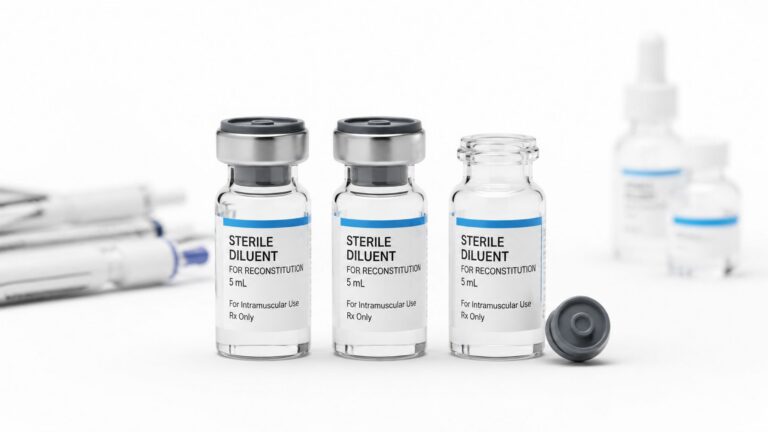
In peptide handling and similar laboratory routines, this syringe size is commonly selected for controlled transfer of sterile diluents into a vial. The operator can draw a measured volume of bacteriostatic water, pierce the stopper, and introduce the liquid with more restraint than a larger barrel typically allows. That reduces the chance of overshooting the intended addition during reconstitution.
The same logic applies to small-volume injections and routine sample handling. A 3cc barrel gives enough working range for common outpatient and research tasks without becoming awkward in the hand. For aspiration, it can work well when the fluid load is modest and the needle gauge is chosen for flow rather than default stock convenience.
Common functional settings include:
- Peptide reconstitution: Controlled movement of sterile diluent into lyophilized material.
- Sample draw and transfer: Small-volume movement between vial, tube, or reaction vessel.
- Minor-volume administration: Intramuscular or subcutaneous delivery when the chosen needle matches route and formulation.
- Bench preparation tasks: Reagent handling where a sterile, single-use transfer device is preferred.
Buyers often ask for “a 3cc syringe” when they actually need a complete transfer setup. Procurement should clarify barrel size, tip type, attached needle specification, and packaging before quoting.
Distribution realities outside controlled clinical settings
Not every downstream use occurs in a tightly managed laboratory or clinical environment. That matters for distributors serving public health, community programs, and mixed regional markets. Ethnographic analysis has shown that for some People Who Inject Drugs, conventional 3cc syringes with needle are often the only accessible tool. The same analysis highlights that standard safe-injection guidance may not apply cleanly because of complex psychosocial realities in the field, as described in this ethnographic study on injection practices and access conditions.
That doesn't turn a wholesale guide into a harm-reduction manual. It does mean supply decisions can't rely on an idealized end-user profile. Some distributors serve both clinical and non-clinical channels. Those businesses need tighter product labeling, clearer customer segmentation, and internal rules on which configurations are offered into which programs.
A practical response includes:
- Separate catalog logic by use environment. Don't merge clinic stock, research stock, and community-distribution stock into a single vague listing.
- Document intended use carefully. Sales descriptions should avoid implying that one configuration is optimal for every setting.
- Train account teams on sensitive markets. They need to recognize when procedural assumptions from hospital supply don't hold.
The 3cc syringe with needle is simple hardware. The distribution context around it isn't.
Navigating Quality Assurance and Regulatory Compliance
A syringe line should never enter inventory on the strength of a price sheet alone. For wholesalers, quality assurance has to be documented, reviewable, and tied to release criteria. If the supplier can't support that process cleanly, the product will create problems later in audits, client complaints, or border clearance.

What quality teams should verify before purchase
Sterility claims have to be more than marketing language. Procurement and QA teams should inspect packaging integrity, lot identification, labeling consistency, and the supplier's supporting quality file. If an individual sterile pack arrives with weak seals, unclear print, or incomplete lot traceability, the issue isn't cosmetic. It undermines confidence in the full handling chain.
A serious review usually includes the following:
- Packaging integrity: Each unit or pack should arrive intact, legible, and traceable to a lot.
- Device consistency: Needle attachment, plunger travel, and graduation print should be uniform across samples.
- Documentation set: Certificate of Analysis, sterility documentation where applicable, and technical specifications should be available on request.
- Change control visibility: The supplier should disclose material or manufacturing changes that affect the commercial SKU.
A strong documentation workflow reduces friction later. Teams managing cross-border distribution often centralize these records in a dedicated regulatory compliance documentation process so that commercial, warehouse, and QA staff aren't working from conflicting files.
Audit note: If a supplier can provide certificates only after repeated chasing, that delay is part of the product risk profile.
Compliance has to match the destination market
EU, UK, and USA distribution doesn't run on one interchangeable regulatory assumption. A syringe approved or documented for one market may still require different labeling, declarations, or supporting records for another. Wholesalers that bundle all destinations into one procurement stream often discover the problem only after a shipment is blocked or a customer asks for market-specific evidence.
The operational principle is simple. Verify the conformity pathway before purchase, not after arrival. Teams should confirm that the manufacturer's documentation aligns with the target market and with the intended product classification and claim language used in sales materials.
That review should cover:
| Compliance area | What the wholesaler needs to confirm |
|---|---|
| EU market | MDR-aligned documentation and applicable conformity records |
| UK market | UK-specific marking and supporting documentation where required |
| USA market | FDA-relevant classification, registration pathway, and import documentation as applicable |
| Internal release | Lot traceability, technical file access, and document retention rules |
Quality assurance is expensive when done poorly. When done well, it protects margin, customer trust, and operational continuity.
A Strategic Procurement Guide for Wholesalers
Good procurement starts before the request for quotation goes out. The most reliable buyers define the application, documentation standard, and acceptable configuration range first. Only then do they compare suppliers. That sequence matters because it prevents the common failure of choosing the cheapest line and trying to validate it afterward.

Questions that expose weak suppliers quickly
A wholesaler evaluating a 3cc syringe with needle should test whether the supplier understands the product as an instrument, not just a sales line. The most useful questions are operational.
Ask for the intended applications supported by the configuration. Ask whether the product is offered in Luer Lock and Luer Slip variants. Ask what needle gauges and lengths are consistently available, not just theoretically manufacturable. Ask how the lot record, sterility documentation, and technical file are delivered with each shipment. Ask whether samples come from routine production or from a special qualification batch.
A formal supplier qualification criteria framework for laboratory and medical product sourcing helps keep that review consistent across buyers and regions.
The strongest procurement files usually include these checkpoints:
- Application fit: Which client workflows is the exact SKU intended to support?
- Configuration stability: Are barrel, plunger, tip, and needle specifications stable from lot to lot?
- Packaging format: Is the product supplied in a form that matches warehouse handling and customer expectation?
- Documentation readiness: Can QA records be supplied before purchase approval?
- Escalation path: Who resolves nonconformance, and how quickly is replacement stock issued?
Conventional versus safety-engineered supply decisions
One of the most persistent sourcing errors is assuming that safety-engineered needle systems should replace conventional 3cc syringes with needle across every workflow. That's not a universal rule. The CDC has noted that many facilities mistakenly use safety-engineered needles exclusively even when conventional needles are more appropriate for non-vaccine procedures such as medication preparation. That mismatch creates inefficiency and cost burdens, as explained in CDC guidance on purchasing needles for vaccinations.
For wholesalers, the practical lesson is narrower and more useful than “buy both.” Inventory should reflect task separation.
Use conventional configurations when the client's work centers on preparation, aspiration, transfer, or other non-vaccine procedures where the conventional device is the better operational fit. Use safety-engineered options where the workflow or customer requirement calls for that protection profile.
A workable purchasing framework looks like this:
| Decision point | Conventional 3cc syringe with needle | Safety-engineered option |
|---|---|---|
| Medication preparation | Often appropriate | May add unnecessary complexity |
| Vaccine administration | Depends on facility policy and applicable requirements | Often preferred where mandated |
| Specimen collection or aspiration | Often appropriate when matched to task | Not automatically superior |
| Mixed-inventory facilities | Useful as part of a segmented portfolio | Useful where safety requirement is explicit |
Procurement gets cleaner when teams stop asking which format is “best” and start asking which format is correct for the workflow.
The buyer's job isn't to maximize safety language in the catalog. It's to place the right device in the right channel with the right documentation.
Optimizing Your Supply Chain From Storage to Fulfillment
A strong syringe program can still fail after purchase if storage and fulfillment controls are weak. Sterile product integrity depends on what happens in the warehouse as much as on what happens at manufacture. Cartons should be stored in stable, clean conditions, protected from packaging damage, and rotated so older compliant stock ships first. If outer packaging deforms, labels detach, or sterile pouches are abraded during handling, the commercial value of the inventory drops immediately.
Label architecture also matters. Warehouse teams should be able to distinguish conventional from safety-engineered stock, Luer Lock from Luer Slip, and one needle configuration from another without opening cases or relying on memory. That reduces picking errors and keeps customer complaints from becoming recurring operational noise.
Fulfillment works best when product data, QA release status, and market restrictions sit in the same system. A distributor that separates technical records from picking logic usually ships the wrong substitute at the worst possible time. The 3cc syringe with needle is a small product, but it demands disciplined handling from sourcing through last-mile delivery. That discipline is what clients remember when they decide who gets the next purchase order.
Herbilabs supports researchers, resellers, and distribution partners with sterile laboratory supplies, high-purity diluents, clear documentation, and dependable fulfillment across the EU, UK, and USA. Teams that need a reliable partner for compliant sourcing and wholesale support can review the company's laboratory supply offering at Herbilabs.