Private Label, White Label, Wholesale partnerships available - EU, USA and UK - Free shipping from €75
100 Unit Insulin Syringe Guide for Accurate Lab Dosing
A technician has a vial on the bench, a calculator open, and a 100 unit insulin syringe in hand. The label gives a quantity in milligrams, while the barrel shows units. The temptation is to treat those markings as if they describe the same thing. They don't. The syringe scale describes volume, and the solution concentration determines how much active material occupies that volume.
That distinction prevents the most common mistake in this workflow. A U-100 scale means 1 unit equals 0.01 mL, while 100 units equals 1 mL, as outlined in the U-100 syringe unit conversion guide. The number on the barrel is like a ruler marking distance. It tells the technician how much liquid is being drawn, not how many milligrams or micrograms the liquid contains.
Table of Contents
- Introduction to the 100 Unit Insulin Syringe
- How Capacity and Calibration Work
- Technical Specs That Affect Accuracy
- Choosing the Right Syringe for Peptide and Lab Workflows
- Safety Sterility and Responsible Disposal Practices
- Procurement Packaging and Compliance for Distributors
- Final Takeaways for Confident Syringe Selection
Introduction to the 100 Unit Insulin Syringe
A technician preparing a small-volume draw may reach for a 100 unit insulin syringe because its scale is familiar. That choice should start with the intended volume, not the syringe's name. The barrel measures calibrated liquid volume. It does not identify the concentration or the amount of active material in the solution.
A ruler provides a useful comparison. It records distance, while the material being measured remains a separate question. In the same way, a syringe marking describes liquid volume, while the vial's concentration determines how much insulin, peptide, or other compound that volume contains.
The correct opening questions are: “What volume does this marking represent?” and “What concentration is in the vial?” Keeping those answers separate makes the workflow easier to check and helps prevent a unit marking from being mistaken for milligrams or micrograms.
Practical rule: Units on a U-100 syringe are volume marks, not a universal measure of active drug.
The format developed because insulin manufacturers and healthcare systems needed a common concentration paired with a matching measuring device. In the United States, U-100 insulin was scheduled for introduction on August 1, 1980, with older strengths phased out over four months, according to this PubMed-indexed report on insulin standardization. In the United Kingdom, the British Diabetic Association recommended in 1983 replacing commonly used 40 units/mL and 80 units/mL strengths with a single 100 units/mL strength. Those changes helped establish the modern U-100 format in major markets.
The same type of volume scale now appears in insulin handling, peptide reconstitution, and laboratory workflows involving small liquid quantities. That broader use calls for closer label control. A syringe marked for U-100 insulin is not automatically a general-purpose dose tool. The solution concentration, intended application, syringe capacity, and graduation detail all need review.
For a technician or distributor, the selection logic is practical:
- Read the scale correctly. The barrel reports volume through U-100 calibration.
- Match capacity to the draw. A 0.3 mL or 0.5 mL barrel can make a small target easier to see than a 1 mL barrel.
- Check accuracy-related details. Graduations, needle design, and dead space affect how closely the drawn volume matches the intended volume.
- Separate equipment choice from treatment decisions. A syringe measures a volume. It does not determine what anyone should inject.
The 100 unit insulin syringe is therefore a volume-measurement option, not a default. For very small draws, a shorter barrel may offer clearer graduation resolution and reduce reading uncertainty. Distributors can use dose ranges to stock suitable 0.3 mL, 0.5 mL, and 1 mL options rather than treating the largest familiar scale as the universal choice.
How Capacity and Calibration Work
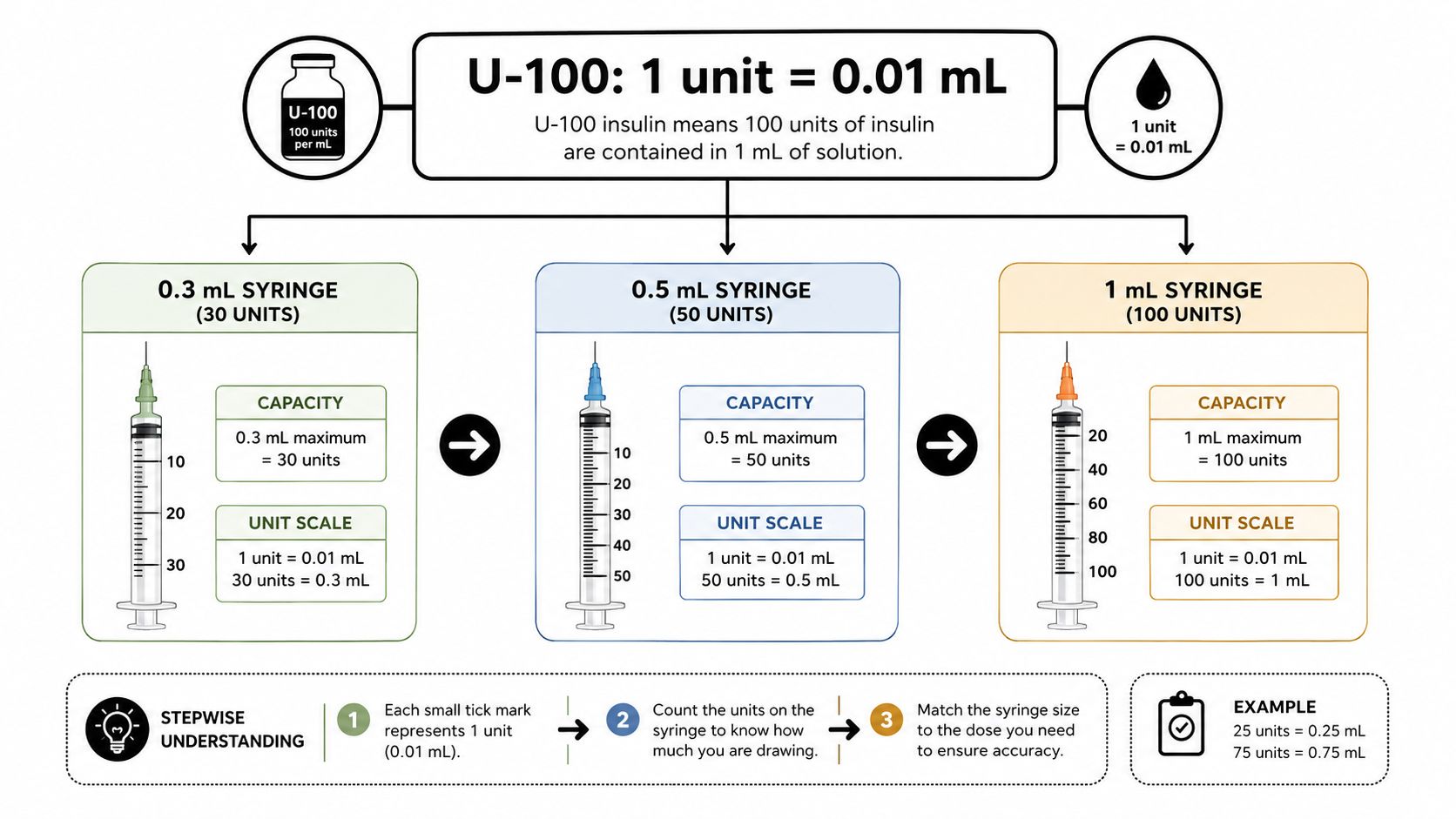
A 100-unit syringe is a measurement format, not an automatic choice. Under U-100 calibration, 1 unit equals 0.01 mL, so 100 units equals 1 mL. The same relationship works in reverse: multiply the unit marking by 0.01 to find milliliters, or divide milliliters by 0.01 to find the U-100 reading.
The scale works like a ruler with equal intervals. Each unit marks one hundredth of a milliliter, while the barrel's total length reflects its capacity. Changing the barrel from 1 mL to 0.5 mL or 0.3 mL changes the maximum volume and scale range, not the U-100 conversion.
Capacity follows the barrel
Common U-100 capacities are 0.3 mL, 0.5 mL, and 1 mL. Their matching maximum scales are 30 units, 50 units, and 100 units, respectively, as described in ISO-linked syringe documentation.
| Syringe capacity | Maximum U-100 scale | Practical meaning |
|---|---|---|
| 0.3 mL | 30 units | Shorter range for small-volume draws |
| 0.5 mL | 50 units | Middle capacity for moderate draws |
| 1 mL | 100 units | Largest common format, often called the 100-unit syringe |
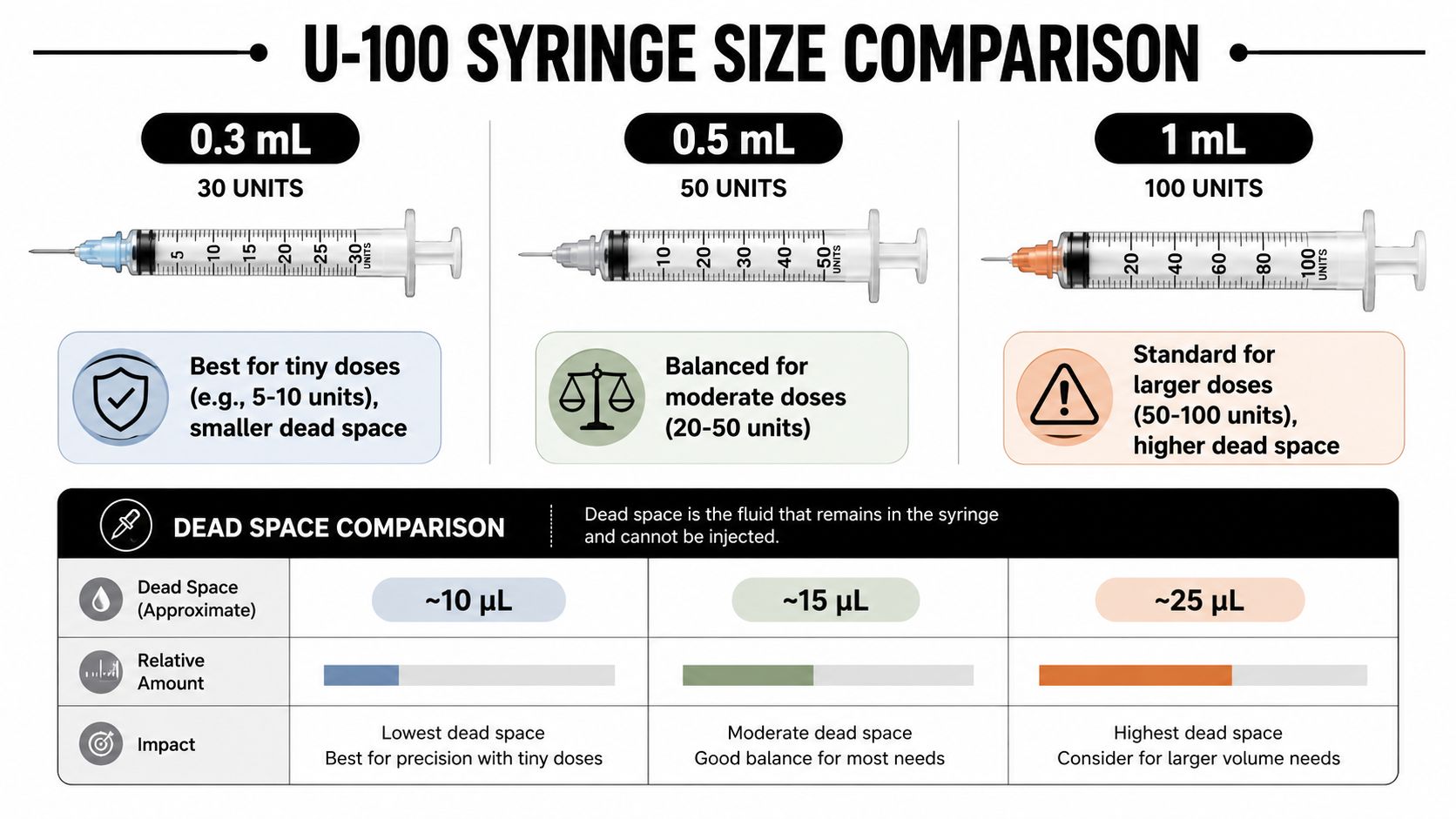
A smaller barrel does not concentrate the liquid. It reaches its capacity sooner and can make a small target occupy more of the visible scale. A 1 mL barrel provides more range, which suits larger draws but may leave a micro-dose closer to the first part of a longer scale. That is why distributors should stock by expected dose range rather than treat the 100 unit insulin syringe as the default.
Reading the graduations
Models may use 1 or 2 units as their smallest graduation. With U-100 calibration, one unit represents 0.01 mL and two units represent 0.02 mL. Finer marks offer more resolution for small draws, although narrow spacing demands careful viewing.
Align the specified plunger edge with the target mark, hold the barrel at eye level, and remove bubbles before confirming the reading. Teams should use the same reading method each time. Capacity alone is not enough for a comparison sheet. Include graduation detail so buyers can judge whether the scale suits their workflow.
For broader educational context, readers may browse men's health articles. That material should supplement, not replace, product labeling and professional guidance, especially when instructions must keep units and milliliters clearly separate.
Technical Specs That Affect Accuracy
A 100 unit insulin syringe is a volume-measurement choice, not an automatic default. Accuracy depends on how the barrel scale, needle, connection, materials, and internal dead space work together. For a micro-dose, one small reading difference can matter more than the syringe's maximum capacity.
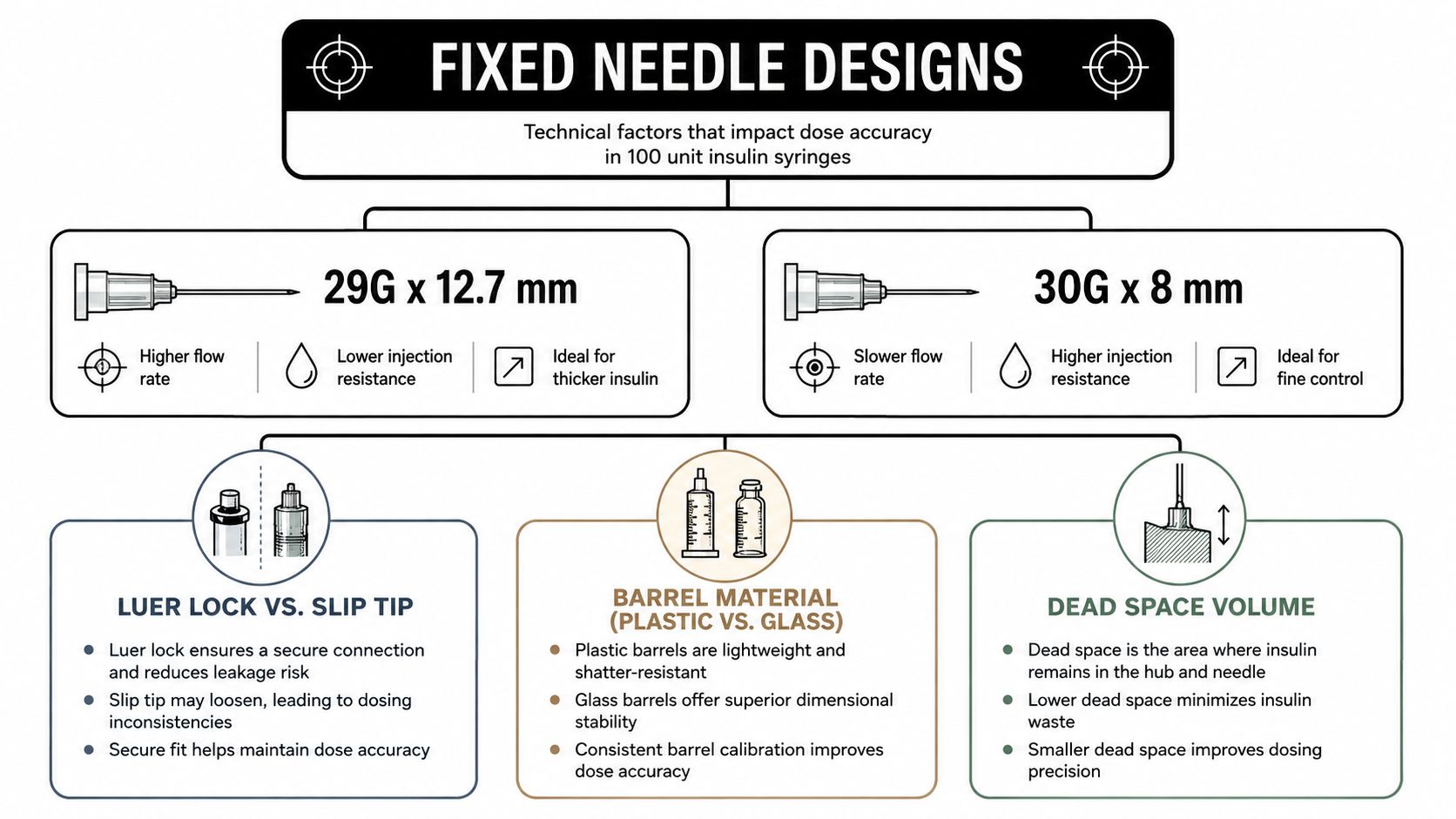
The needle specification describes two separate features. Gauge indicates thickness, while length indicates how far the needle extends. Product listings may show 29G x 12.7 mm or 30G x 8 mm on 1 mL U-100 models, but those dimensions represent different physical profiles and should not be treated as interchangeable.
Needle gauge and length
A finer needle can change draw and delivery behavior, particularly with more viscous liquids. Length also affects how the syringe fits the intended application because it determines the available penetration distance. Buyers should read the product datasheet for gauge and length instead of estimating dimensions from a photograph.
A fixed needle removes a connection step and can reduce variation caused by attaching components. It does not make every fixed-needle model suitable for every workflow. The liquid, access method, intended use, and required scale resolution still need to match.
Dead space and residual volume
Dead space is the internal volume left in the syringe and needle after the plunger reaches its delivery position. It works like liquid trapped in the bend of a narrow tube. With a very small draw, that residual amount can represent a meaningful share of the intended volume.
Lower dead space can reduce residual fluid loss and support more consistent delivery, especially for small draws. Buyers should request dead-space information for the exact model. Two syringes with the same capacity can still differ in internal design and residual volume.
A practical specification review
Review a listing in a fixed order:
- Calibration: Confirm U-100 marking when U-100 calibration is required.
- Graduation: Record whether the scale uses 1-unit or 2-unit divisions, because finer marks provide more reading resolution.
- Needle: Check gauge, length, and whether it is fixed.
- Dead space: Look for a stated value or an applicable technical benchmark.
- Connection and materials: Verify construction and connection style against the workflow.
The scale should match the draw range. A 0.3 mL or 0.5 mL barrel may make a micro-dose easier to read than a 1 mL barrel, while the larger format offers more room for a larger draw. This is a measurement decision, similar to choosing a ruler with markings suited to the object being measured.
Teams receiving stock can record these checks with their quality control testing requirements. A clear specification record helps prevent substitution of a visually similar syringe with a different graduation pattern, needle profile, or internal dead-space design.
Choosing the Right Syringe for Peptide and Lab Workflows
A technician preparing a very small draw may reach for a 1 mL syringe because it is familiar, then discover that the plunger movement is difficult to read near the lower end of the barrel. A 0.3 mL or 0.5 mL syringe can place the same small volume across a more useful portion of its scale. Selection should therefore begin with dose range, visual resolution, and measurement risk, not with the largest available capacity.
The U-100 conversion established earlier remains 1 unit equals 0.01 mL and 100 units equals 1 mL. In peptide or laboratory work, the workflow may first convert a target quantity in milligrams into solution volume, then convert that volume into syringe units. Write down the concentration, intermediate volume, and final unit reading. Each step can otherwise introduce a wrong concentration, mismatched unit, or barrel-reading error.
Match the barrel to the draw
A 0.3 mL syringe reaches 30 units under U-100 calibration. It suits a workflow in which the intended volume stays within that capacity and close reading is a priority. A 0.5 mL syringe reaches 50 units, offering a middle option when 0.3 mL is too restrictive but 1 mL provides more unused scale than the draw requires.
The 1 mL syringe reaches 100 units and remains appropriate for larger draws or workflows that require that capacity. For a small draw, however, much of the barrel can remain empty, making a short plunger movement harder to distinguish. Capacity works like the length of a ruler. A longer ruler is not automatically more precise for a small object.
| Selection question | More suitable direction |
|---|---|
| Is the required volume very small? | Assess a 0.3 mL barrel for readability |
| Does the draw fall in a moderate range? | Compare 0.5 mL and 1 mL options |
| Does the workflow require the larger capacity? | Use a 1 mL U-100 model |
| Is the solution concentration changing? | Recalculate volume before selecting the marking |
Never select by assuming that a “full syringe” represents a standard amount of active material. The barrel describes capacity only. Peptide and research solutions may have different concentrations after reconstitution, so the required volume must be calculated for the specific preparation.
Reconstitution workflow discipline
Before opening a multi-access vial, the technician should record the material identity, solvent, concentration, syringe calibration, and intended draw volume. If the calculation moves from milligrams to milliliters and then to units, retain each intermediate value in the worksheet or batch record. This creates a visible check instead of relying on memory.
For veterinary purchasing teams reviewing products for another insulin concentration, buy Prozinc insulin syringes illustrates why concentration-specific selection matters. A U-100 syringe should not replace a syringe intended for another concentration because both barrels use unit markings.
Distributors can stock 0.3 mL, 0.5 mL, and 1 mL U-100 capacities, then organize the catalog by likely draw range. Each listing should distinguish maximum volume, graduation resolution, needle configuration, and intended workflow. That arrangement helps buyers choose a measuring tool suited to the dose instead of treating the 1 mL model as the default.
Safety Sterility and Responsible Disposal Practices
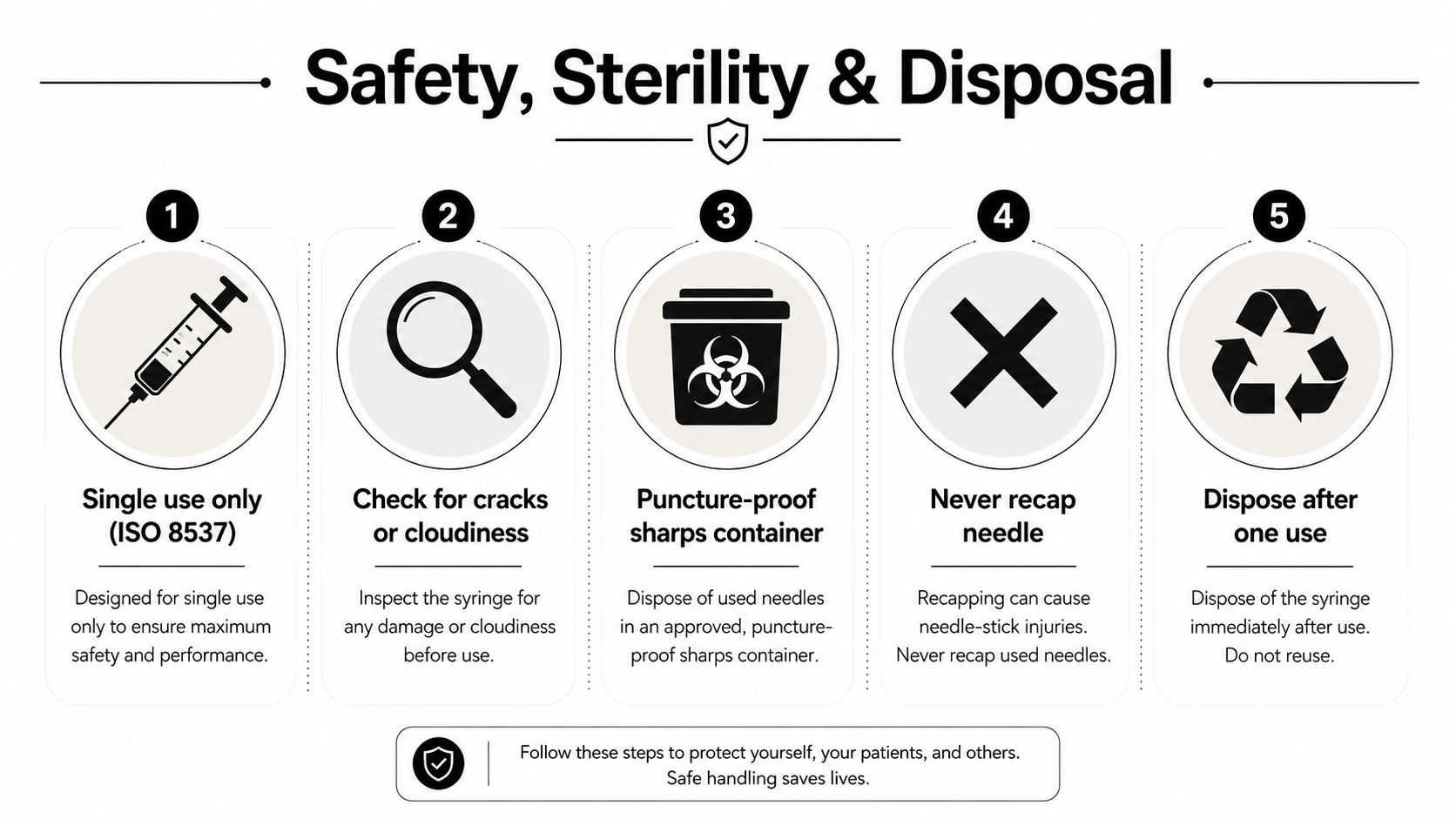
A U-100 syringe is a sterile, single-use plastic syringe intended solely for insulin injection under ISO 8537. The standard also requires visual differentiation for syringes designed for a specific concentration, such as U-100, so barrel markings and cap color coding can help users distinguish products when several concentrations are present. The ISO 8537 standard overview provides the applicable standard context.
Sterility starts before the syringe leaves its package. The operator should inspect the sterile barrier, confirm the label, prepare a clean work area, and keep the needle tip away from gloves, benches, vial edges, and other non-sterile surfaces. If the tip touches a non-sterile object, replacing the syringe is safer than trying to continue.
A repeatable handling routine
A team can standardize the following sequence:
- Verify the label: Confirm U-100 calibration, capacity, needle details, and expiry information before opening the package.
- Inspect the device: Reject packaging with damage or a syringe showing cracks, particles, cloudiness, or other visible defects.
- Prepare the vial: Disinfect the stopper according to the laboratory's approved aseptic procedure and allow the surface to dry.
- Draw without contamination: Keep the needle sterile, avoid unnecessary contact, and check the barrel at eye level.
- Dispose immediately: Place the used syringe into an approved puncture-resistant sharps container.
Reusable habits protect both the sample and the operator. A new syringe should be used for every access, and a needle shouldn't be recapped after use because recapping creates an additional handling opportunity for a needlestick. A vial intended for repeated access also requires a validated workflow and suitable sterile diluent. The syringe itself doesn't preserve a preparation or make repeated access safe.
Teams documenting these behaviors can use an aseptic technique guide as a training reference for surface preparation, sterile handling, and contamination control. Written procedures should identify who performs each step and where the sharps container is positioned.
Concentration matching is non-negotiable
A U-100 insulin syringe should be paired with U-100 insulin when it is being used for insulin dosing. Mixing a U-100 syringe with another insulin concentration can produce a dangerous conversion error because the barrel marking assumes a particular concentration.
The same caution applies when a syringe scale is repurposed for volume measurement in a research workflow. The operator must identify the solution concentration independently and ensure that the labeling doesn't imply that a syringe unit equals a fixed quantity of active compound.
Procurement Packaging and Compliance for Distributors
A distributor deciding whether to stock a 100 unit insulin syringe is making a measurement decision, not selecting a universal default. The United Kingdom moved toward a single 100 units/mL insulin strength after the British Diabetic Association's 1983 recommendation to move away from 40 units/mL and 80 units/mL strengths. The United States began introducing U100 insulin on August 1, 1980, as described in the historical account of insulin concentration standardization. Standardized concentration made dedicated syringe calibration easier to interpret.
A procurement file should preserve that clarity. It should identify the calibration, sterile status, single-use designation, capacity, graduations, needle dimensions, packaging format, and applicable standard. “Insulin syringe” by itself leaves too many questions for buyers comparing products across the EU, UK, and USA.
What a distributor should verify
A purchasing review should cover:
- Regulatory and labeling fit: State whether the product is intended for clinical use, laboratory use, or Research Use Only distribution.
- Batch documentation: Request certificates of analysis or other batch records when the supplier provides them.
- Sterile packaging: Confirm whether each unit is individually sterile packaged and whether that format suits the customer's workflow.
- Continuity: Check lead times, replenishment options, and regional shipping conditions.
- Specification consistency: Compare incoming batches with the approved gauge, length, capacity, graduation, and dead-space requirements.
Packaging remains part of product control after delivery. Buyers assessing protective films and pouch materials can review Crayex's Foodpharma packaging films when barrier performance and presentation affect handling or sale.
Build the catalog around use
List the 0.3 mL, 0.5 mL, and 1 mL formats as distinct stock keeping units. A smaller barrel can make a micro-dose easier to read, while a 1 mL barrel provides greater capacity. Graduation spacing and dead space also affect the volume that remains in the device, so product pages should explain the intended dose range rather than present capacity as the only selection criterion.
Each listing should show maximum U-100 capacity in both milliliters and units, followed by graduation details, needle gauge and length, sterile status, and packaging information. That layout helps a buyer match the barrel to the workflow before placing an order.
Storage and fulfillment require the same discipline. Temperature-controlled storage, clear lot tracking, and reliable dispatch reduce the chance of an unlabeled substitute or a product outside the approved specification. Internal teams can record packaging requirements before accepting a supplier or changing a catalog item. Herbilabs supplies laboratory reagents and sterile diluents, which may form part of a customer's documented laboratory workflow.
Final Takeaways for Confident Syringe Selection
A reliable selection decision can be reduced to four checks:
- Confirm the scale. U-100 units describe volume, with 1 unit equal to 0.01 mL and 100 units equal to 1 mL.
- Choose the capacity. A 0.3 mL or 0.5 mL barrel may make a small draw easier to read, while a 1 mL model provides the largest common U-100 capacity.
- Review the engineering. Graduation spacing, needle gauge and length, fixed-needle construction, and dead space influence practical measurement quality.
- Match the concentration and workflow. A U-100 syringe belongs with a compatible U-100 application, and research workflows require separate concentration and sterility checks.
For end users, the biggest mistake is treating a full syringe as a standard active dose. For laboratory managers, the bigger risk is allowing staff to convert between milligrams, milliliters, and units without recording the intermediate concentration. For distributors, the avoidable error is stocking by capacity alone without showing graduations, needle details, sterile status, and intended use.
A dependable catalog therefore treats the 100 unit insulin syringe as a volume-measurement option, not a universal default. The right product is the one that gives the operator sufficient capacity, clear markings, suitable dead space, compatible concentration labeling, and a documented sterile workflow.
Herbilabs supplies laboratory reagents and sterile diluents, including bacteriostatic water and reconstitution solutions in premium glass vials, with batch documentation and Research Use Only policies for applicable products. Visit Herbilabs to review sourcing options for peptide and laboratory workflows, including individual vials, multi-pack formats, and wholesale or distribution partnerships.


