Private Label, White Label, Wholesale partnerships available - EU, USA and UK - Free shipping from €75

1 Cc Syringe Luer Lock: Specs, Use Cases, and Buying Guide
A researcher reaches for a syringe during peptide reconstitution, notices the barrel is larger than expected, and then sees the needle connection shift while pressure is applied. Nothing dramatic has happened yet, but the workflow has already become harder to control. At small volumes, a poor graduation scale, excess dead space, or an unsuitable connector can affect how much liquid reaches the vial and how confidently the operator can withdraw it.
The 1 cc syringe luer lock is designed for this kind of controlled, small-volume work. It combines a 1 mL capacity, fine graduations, and a threaded connector that retains a compatible needle or accessory. It appears in clinical, laboratory, compounding, and research supply chains because it sits at the intersection of precision, compatibility, and repeatable handling. The lock, however, isn't a guarantee against every failure. Correct threading, compatible components, sterile packaging, lot traceability, and a workflow with as few unnecessary connections as possible still matter.
Table of Contents
- Why the 1 cc Luer Lock Syringe Earned Its Place at the Bench
- Anatomy of a 1 cc Luer Lock Syringe
- Technical Specifications That Matter
- Luer Lock vs Luer Slip in Real Workflows
- Reconstitution Workflows and Best-Practice Handling
- Needle and Accessory Compatibility
- Quality Assurance, Sterility, and Regulatory Basics
- Buying and Sourcing Tips for Wholesalers and Resellers
Why the 1 cc Luer Lock Syringe Earned Its Place at the Bench
A 1 cc syringe holds the same nominal volume as a 1 mL syringe. The smaller barrel gives the operator a clearer view of the liquid column than a larger disposable syringe, which helps when a task involves a small transfer rather than a large-volume draw. In peptide reconstitution, that difference is practical. The operator can see the meniscus, align it with the graduation, and control the plunger with less movement.
The connector is equally important. The familiar Luer geometry sits on a long standardization path. ISO 594-1, published in 1986, and ISO 594-2, published in 1998, defined the 6% Luer taper and lock fittings for syringes, needles, and related medical equipment, as documented in the ISO 80369-7 standard sample. Those earlier standards were later withdrawn and replaced by the ISO 80369 family, with ISO 80369-7 governing hypodermic and intravascular applications.
That history changes how the product should be viewed. A 1 cc luer lock syringe isn't merely a small plastic consumable. It's a component in a globally harmonized connector system intended to improve compatibility and reduce dangerous misconnections by making connectors more application-specific.
Why distributors keep it in the core range
A distributor can place this syringe in several workflow categories without treating it as a universal solution:
- Small-volume dosing: The compact barrel supports close visual control during low-volume transfers.
- Needle retention: The threaded collar helps resist accidental separation when the assembly is handled or manipulated.
- Insulin-related measurement: Common U-100 1 mL syringes are marked to hold up to 100 units, usually in 10-unit increments, as described in the ISO 80369-7 catalogue entry.
- Connector familiarity: Staff across hospitals, laboratories, and home-care settings often recognize the Luer format.
The historical record also includes a 1995 International Organization for Standardization recommendation for worldwide standard use of the Luer-tipped syringe, noted in the same catalogue material. That combination of small-volume control and connector uniformity explains why the 1 cc format remains a flagship SKU for many medical and laboratory suppliers.
Anatomy of a 1 cc Luer Lock Syringe
A useful way to assess a syringe is to inspect it as an assembly rather than as a single product. Each part affects handling, visibility, or connection integrity.
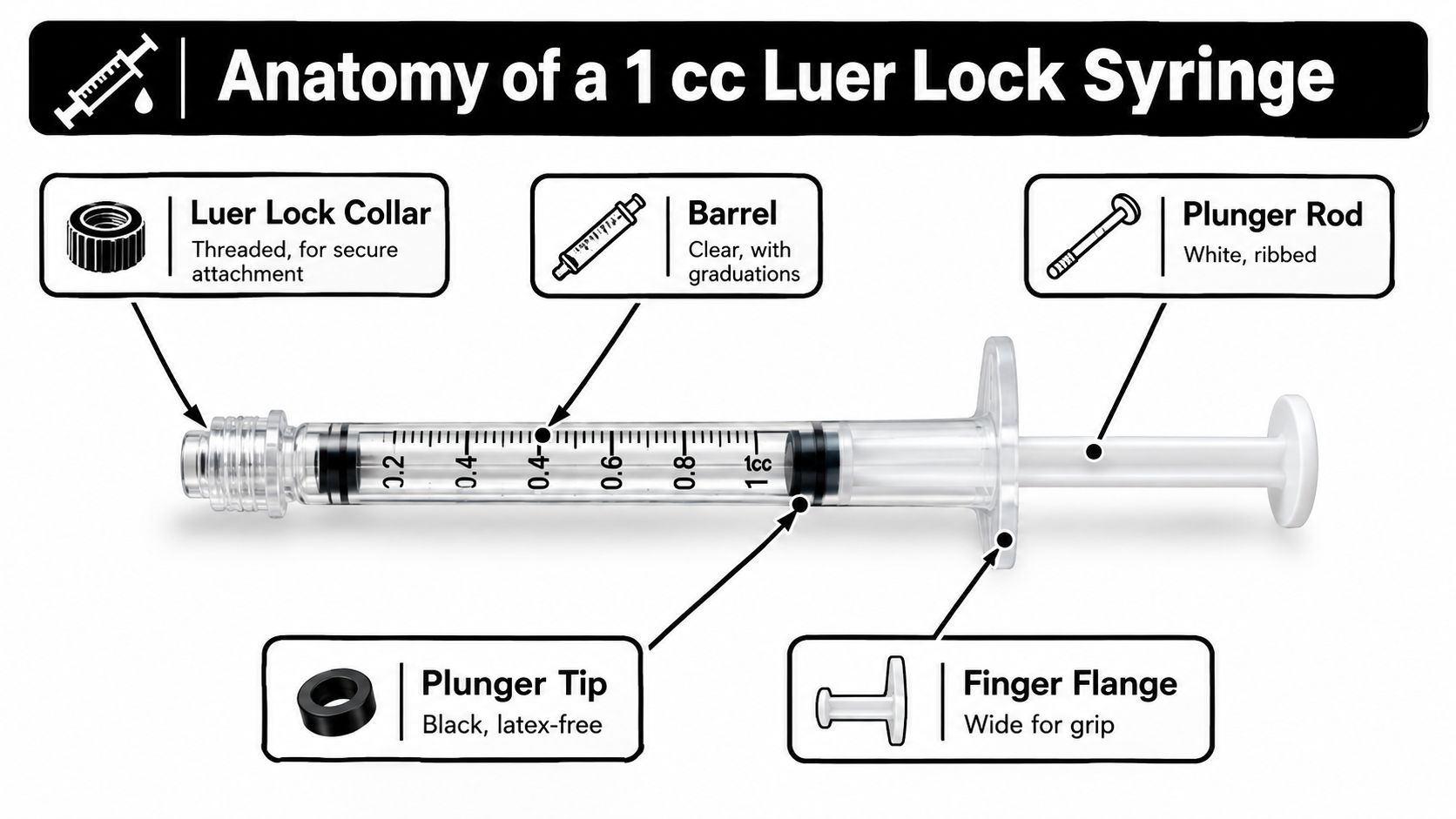
The barrel and graduation scale
The clear barrel contains the liquid and provides the visual reference for measurement. Its graduations need to be legible, evenly printed, and aligned with the plunger tip. A clear barrel is valuable only when the markings remain visible under the lighting and handling conditions of the bench.
The finger flange gives the operator a stable contact point while the plunger rod transfers force to the stopper. A flange that feels too narrow or flexible can make slow aspiration uncomfortable, particularly when a viscous liquid creates resistance.
The plunger tip and seal
The plunger tip, often specified as latex-free, forms the moving seal inside the barrel. It needs to travel smoothly without excessive drag, while still limiting leakage and air movement around the stopper. Material declarations matter when a researcher has a latex sensitivity or when an assay could be affected by extractables from unsuitable elastomers.
The tip also affects reading accuracy. Operators should read the liquid level consistently at the correct reference point and avoid treating the visible edge of the stopper as interchangeable with its leading measurement edge.
The Luer lock connection
The 6% Luer taper works like a cone that self-centres the sealing surfaces. The taper creates the fluid seal, while the threaded collar acts like a handshake with a mechanical grip. As described in the EN 1707 connector information, the threaded lock adds positive mechanical retention between the syringe and a compatible needle or accessory.
That distinction is central. The taper seals; the thread resists separation. A lock can still be cross-threaded, damaged, or loosened through poor handling, so the operator should engage the threads straight and tighten by hand only.
Technical Specifications That Matter
A supplier datasheet earns attention when each specification connects to a bench consequence. Capacity alone does not show whether the syringe will support a low-volume transfer, recover an expensive solution, or fit the intended needle assembly.
One published 1 mL BD Luer-Lok syringe specification lists 0.01 mL graduations, volumetric accuracy of ±5% for 1 mL or smaller, and waste space of 0.07 mL, according to the BD Luer-Lok product specification. These are product-specific examples, not universal values for every manufacturer.
A practical specification reference
| Specification | Typical value | Practical meaning |
|---|---|---|
| Nominal capacity | 1 mL, or 1 cc | Suits small-volume transfers and measurements |
| Graduation increment | 0.01 mL on the cited BD specification | Provides a fine visual scale for controlled dispensing |
| Volumetric accuracy | ±5% for 1 mL or smaller on the cited BD specification | Defines how closely the printed scale represents actual volume |
| Waste space, or dead space | 0.07 mL on the cited BD specification | Liquid retained in the syringe and connector can matter during low-volume recovery |
| Connector | 6% Luer taper with threaded lock | Combines a taper seal with mechanical retention |
| Plunger tip | Confirm the supplier's material declaration | Helps assess latex sensitivity and assay compatibility |
The dead-space figure deserves close review. In a workflow that repeatedly transfers a small amount of high-value liquid, residue in the barrel tip, connector, and needle can reduce recovery. A fine graduation scale does not remove that retained volume.
Procurement rule: Review the graduation, accuracy statement, and dead-space figure as separate specifications. A fine scale cannot compensate for an unsuitable dead-space profile or an accuracy tolerance that exceeds the task's needs.
For wholesalers and resellers, these details also support product standardization. A consistent 6% taper and documented connector format reduce compatibility surprises across needle and accessory lines, while clear accuracy and dead-space data make it easier to match a syringe to peptide reconstitution and other low-volume workflows.
Material and sterility details belong on the same review sheet. Verify the barrel polymer, stopper composition, lubricant or coating information where relevant, and the supplier's sterility documentation. Sterility also depends on packaging that preserves the stated condition until use, not merely a claim on a product page.
Luer Lock vs Luer Slip in Real Workflows
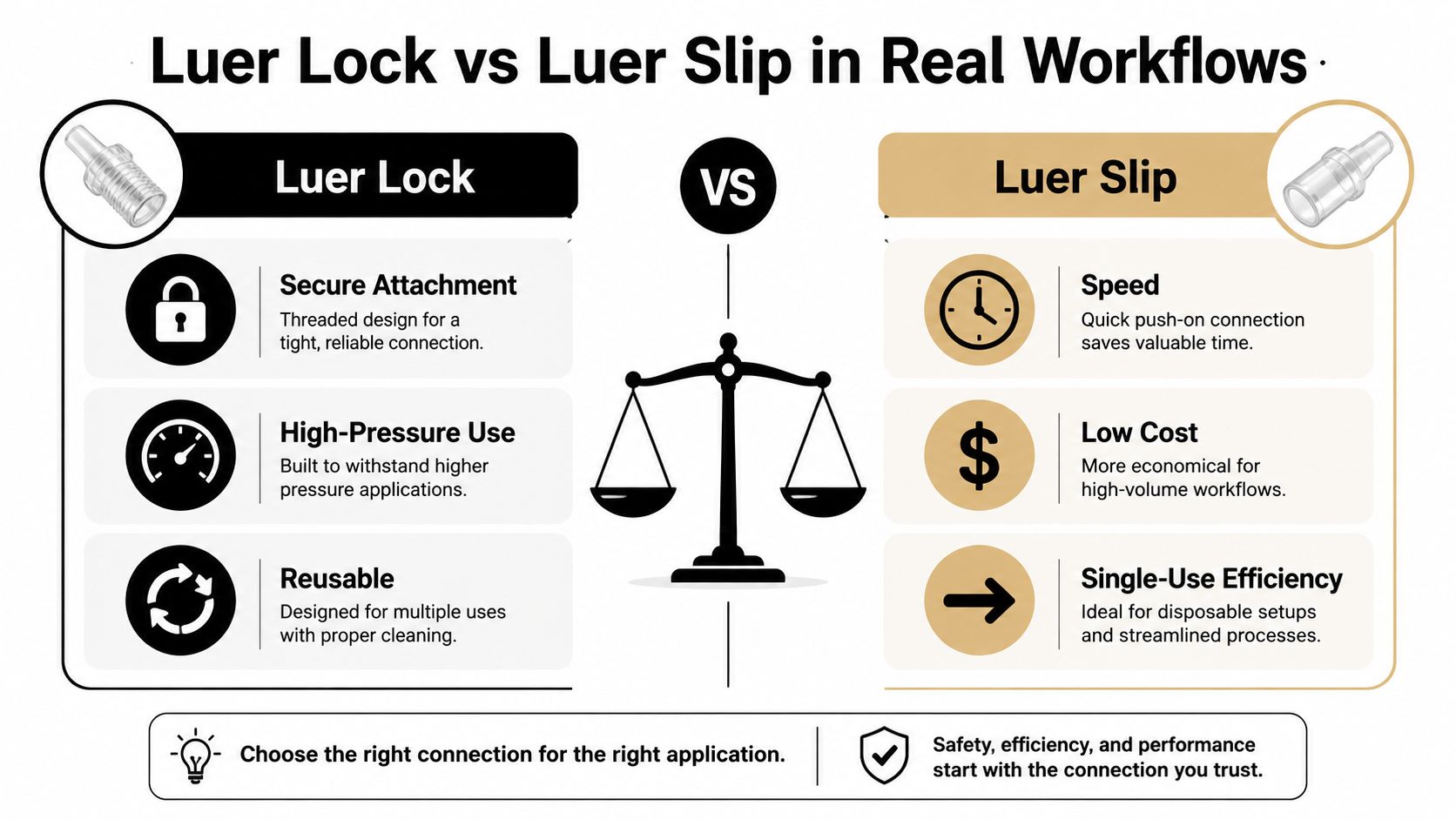
Luer lock isn't automatically the better choice. It provides a threaded connection, but the extra retention comes with more assembly time, more opportunity for cross-threading, and possible cost differences. Luer slip connects quickly by pushing the hub onto the taper, which can suit a simple, low-pressure, single-attachment transfer.
Where luer slip can work well
Luer slip is useful when speed and uncomplicated assembly dominate the workflow. A technician attaching a needle for a brief, low-pressure transfer may value a push-fit connection that requires no collar rotation. High-throughput operations can also prefer fewer assembly movements when the connection remains stable and the procedure doesn't involve repeated manipulation.
The drawback is reduced mechanical retention. A push-fit hub can be more vulnerable to movement or separation when the assembly is tugged, rotated, or exposed to high handling force. That doesn't make every luer slip connection unsafe, but it makes the workflow design more important.
Where luer lock earns its place
The threaded format is more defensible when the needle will be manipulated repeatedly, when resistance may increase during aspiration or injection, or when accidental separation could contaminate a valuable sample. Peptide reconstitution often contains several of those conditions. The syringe may be connected while drawing diluent, used to inject a vial, and then handled again during withdrawal.
A lock also supports a broader accessory strategy. Filter needles, vented spikes, caps, and other compatible components can be specified around the same connector family, provided the mating parts are verified rather than assumed to fit.
The right question isn't “Which connector is best?” It's “How many times will this connection be handled, and what happens if it separates?”
For a single, quick transfer with low mechanical stress, luer slip may be efficient. For repeated vial access, higher resistance, field handling, or a sample that cannot be casually replaced, luer lock usually offers the stronger workflow margin. Neither design removes the need for sterile technique or correct compatibility checks.
Reconstitution Workflows and Best-Practice Handling
A threaded connector helps, but technique still controls the outcome. A new operator should be trained to treat the syringe, needle, vial, diluent, and storage container as one system.
Begin by checking the vial identity, seal, label, and condition. Clean the stopper according to the applicable procedure and allow the surface to dry. Select only the diluent specified for the material and intended research protocol. The syringe and needle should remain in their sterile packaging until assembly.
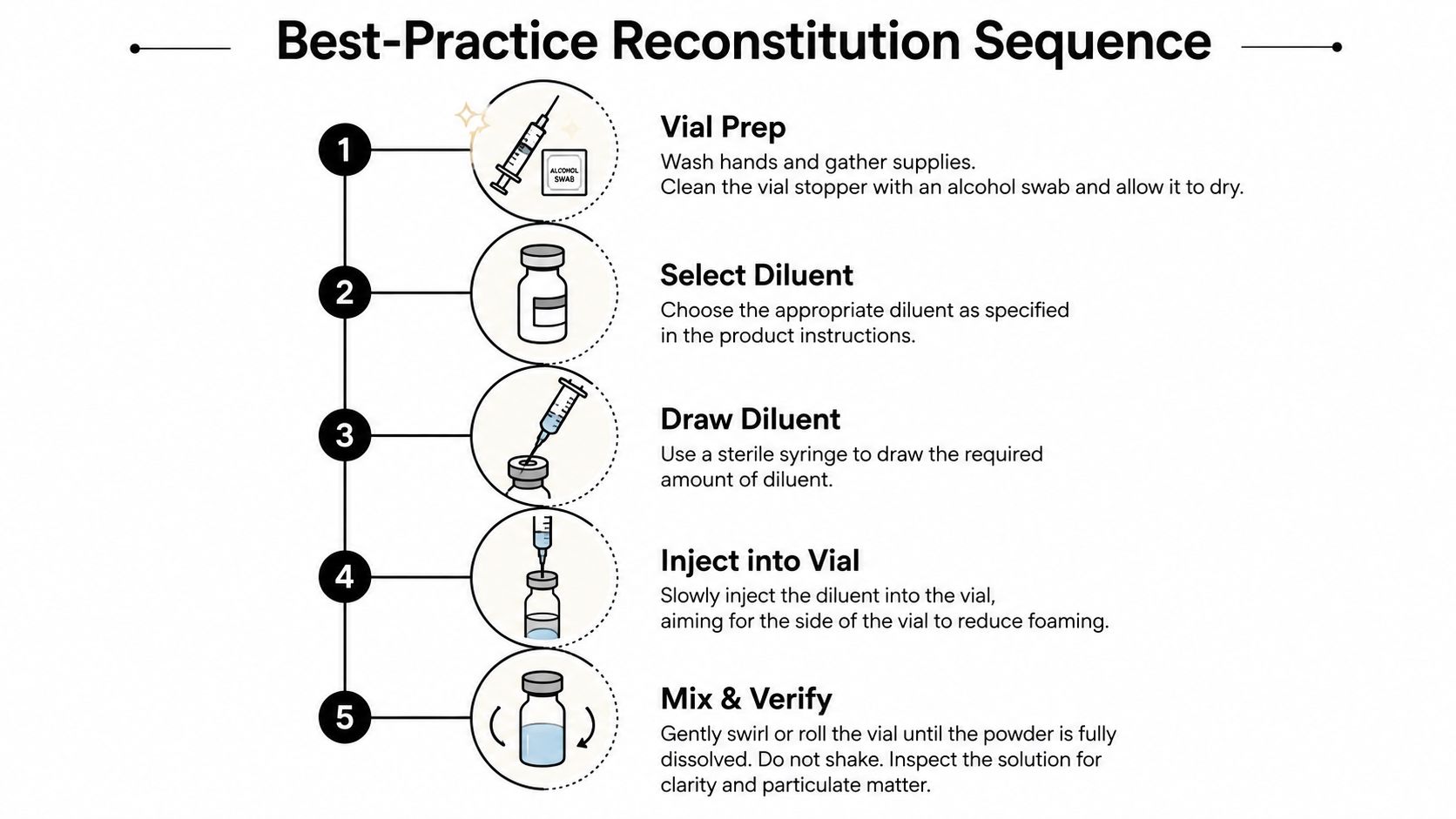
A controlled sequence
- Prepare the vial. Confirm the vial and diluent, inspect the closures, and disinfect the access surface using the approved procedure.
- Draw the diluent. Attach the needle by engaging the threads straight. Tighten by hand only, then draw slowly while keeping the graduations visible.
- Inject into the vial. Insert the needle through the stopper using the protocol's specified technique. A retained threaded connection reduces the chance of needle pop-off during injection, but it doesn't correct excessive force or a damaged component.
- Dissolve gently. Direct the liquid appropriately and allow the powder to wet gradually. Gentle swirling is generally preferred to aggressive agitation, and the material's protocol should control whether any mixing action is acceptable.
- Withdraw and inspect. Check the solution for unexpected particles, discoloration, or incomplete dissolution before transferring it. Use a new sterile single-use assembly whenever the procedure requires another withdrawal or access event.
The practical guide to reconstitution for experimental success can serve as additional training material for teams documenting their own handling procedures.
A short demonstration can help new staff understand the sequence, especially the relationship between vial pressure, needle position, and slow plunger movement.
Cross-threading is a common preventable problem. If the collar doesn't turn smoothly, stop and realign it rather than forcing it. Luer-lock fittings should be tightened by hand, and patient-safety guidance notes that they can still separate if accidentally unscrewed. Unused ports should remain capped with compatible sterile closures, and a syringe labelled single-use should never be washed or reused.
Needle and Accessory Compatibility
Choosing a 1 cc luer lock syringe is only the first compatibility decision. The needle gauge, shaft length, hub design, filter requirements, and any cap or adapter must match the actual task.
For peptide-related bench work, buyers often evaluate 29 to 31 gauge needles with a half-inch length, but those dimensions should be treated as workflow options rather than universal instructions. A shorter needle can reduce the internal path between barrel and target, which may help limit retained liquid, while a larger gauge may be appropriate for drawing a more viscous diluent. Drawing and delivery may require different needle choices.
A compatibility checklist
- Gauge: Smaller gauge numbers indicate a larger needle bore. A drawing needle may need a wider bore than a delivery needle, depending on viscosity and protocol.
- Length: Select enough length for the intended vial access or delivery method without adding unnecessary internal volume.
- Hub: Confirm that the needle hub is a compatible female Luer lock design, not merely described as “standard” without documentation.
- Filter option: Use a Luer-lock filter needle when the protocol requires particulate filtration. A filter needle isn't a substitute for inspecting the source liquid or following validated filtration practice.
- Vented access: A vented spike may suit a container or workflow that requires pressure equalization, but it must be compatible with the vessel and procedure.
- Unused ports: Keep open connections capped with compatible closures. An uncapped port creates an avoidable contamination and air-ingress risk.
ISO 80369-7 narrows the relevant connector family for hypodermic and intravascular applications to reduce misconnections. That doesn't mean every component from every supplier should be accepted without review. Thread dimensions, taper condition, hub tolerances, packaging, and intended application still need verification against the supplier's technical documentation.
Teams specifying needles for customers can use the guide to buying injection needles as a practical reference, then confirm the final combination against the actual manufacturer's datasheets. A compatibility chart should list syringe SKU, needle SKU, gauge, length, hub type, filter status, sterile packaging, and intended use.
Quality Assurance, Sterility, and Regulatory Basics
A professional buyer should ask for documents tied to the actual product and lot, not broad statements about factory quality. The first review should identify the intended market, application, and regulatory status. A product suitable for research use may not carry the same authorization or labeling as a device intended for clinical administration.
Documents that deserve review
- Connector conformity: Ask how the product addresses the applicable ISO 80369-7 requirements and request supporting technical documentation.
- Market marking: For EU distribution, confirm the applicable CE documentation. For the United States, determine whether an FDA 510(k) clearance applies to the exact device and intended use.
- Material declarations: Request latex-free and DEHP-free statements where the customer or assay requires them.
- Sterility evidence: Check the sterilization method, such as EO or gamma where applicable, plus the associated validation and packaging information.
- Lot traceability: The lot number should connect the shipped units to manufacturing, inspection, packaging, and release records.
A Certificate of Analysis can include sterility results, endotoxin information, dimensional inspection, and visual inspection. Each item answers a different question. Sterility evidence addresses the validated release process, endotoxin data addresses a separate contamination concern, dimensional inspection supports connector and barrel consistency, and visual inspection can identify obvious defects that automated checks may miss.
The overview of sterility assurance levels can help teams distinguish sterilization terminology from the broader question of package integrity and release documentation. A sterile claim is only useful if the packaging remains sealed, the expiry information is clear, and the lot can be traced after shipment.
Red flag: A supplier that can't identify the lot, packaging configuration, sterilization method, and applicable compliance documents shouldn't be the first choice for a critical workflow.
Buying and Sourcing Tips for Wholesalers and Resellers
Wholesalers and resellers shouldn't evaluate a 1 cc luer lock syringe on unit price alone. A low purchase price can become expensive if packaging arrives damaged, documents are incomplete, lead times vary, or customers receive mixed lots that are difficult to trace.
Start with the commercial structure. Confirm the minimum order quantity, case configuration, inner packaging, shelf life, storage conditions, and replenishment lead time. Ask whether quality testing is performed per lot or only at a broader batch level. A reseller needs to know which certificate accompanies a shipment and whether the supplier can provide a retained sample or investigation record after a complaint.
A practical supplier review
- Documentation first: Request a product datasheet, current COA, sterility confirmation, material declarations, and traceability format before placing a large order.
- Packaging second: Decide whether customers need individually sealed units, retail-ready cartons, or bulk cases. The best configuration depends on the sales channel and handling environment.
- Freight and storage: Review carton dimensions, shipping protection, temperature expectations, and damage-claim procedures. Sterile devices still need careful logistics even when they don't require refrigerated transport.
- SKU discipline: Keep syringe capacity, connector type, needle compatibility, and regulatory status clear in the product title and catalogue data.
- Compliance language: If the product is for research use only, preserve that status in listings, invoices, packaging, and customer communications. Don't blur a research supply into a clinical claim.
Market direction also supports a more nuanced assortment. A 2026 industry estimate places the luer lock connector market at USD 1.89 billion in 2026 and USD 2.61 billion by 2036, according to Fact.MR's tamper-evident syringe caps market analysis. The same source projects luer-lock-cap formats at 36.0% share in 2026, reflecting demand for secure threaded closure compatibility in higher-value injectable use cases. Another estimate in the supplied market background places the luer plug market at USD 0.93 billion in 2026, with luer slip leading at 54.1% share, so a lock-only catalogue may overlook customers who prioritize speed or lower acquisition cost.
For teams expanding a catalogue across marketplaces, a resource on scaling inventory through smart sourcing can complement the technical review. The commercial lesson is simple: stock the connector that fits the workflow, then document why it fits.
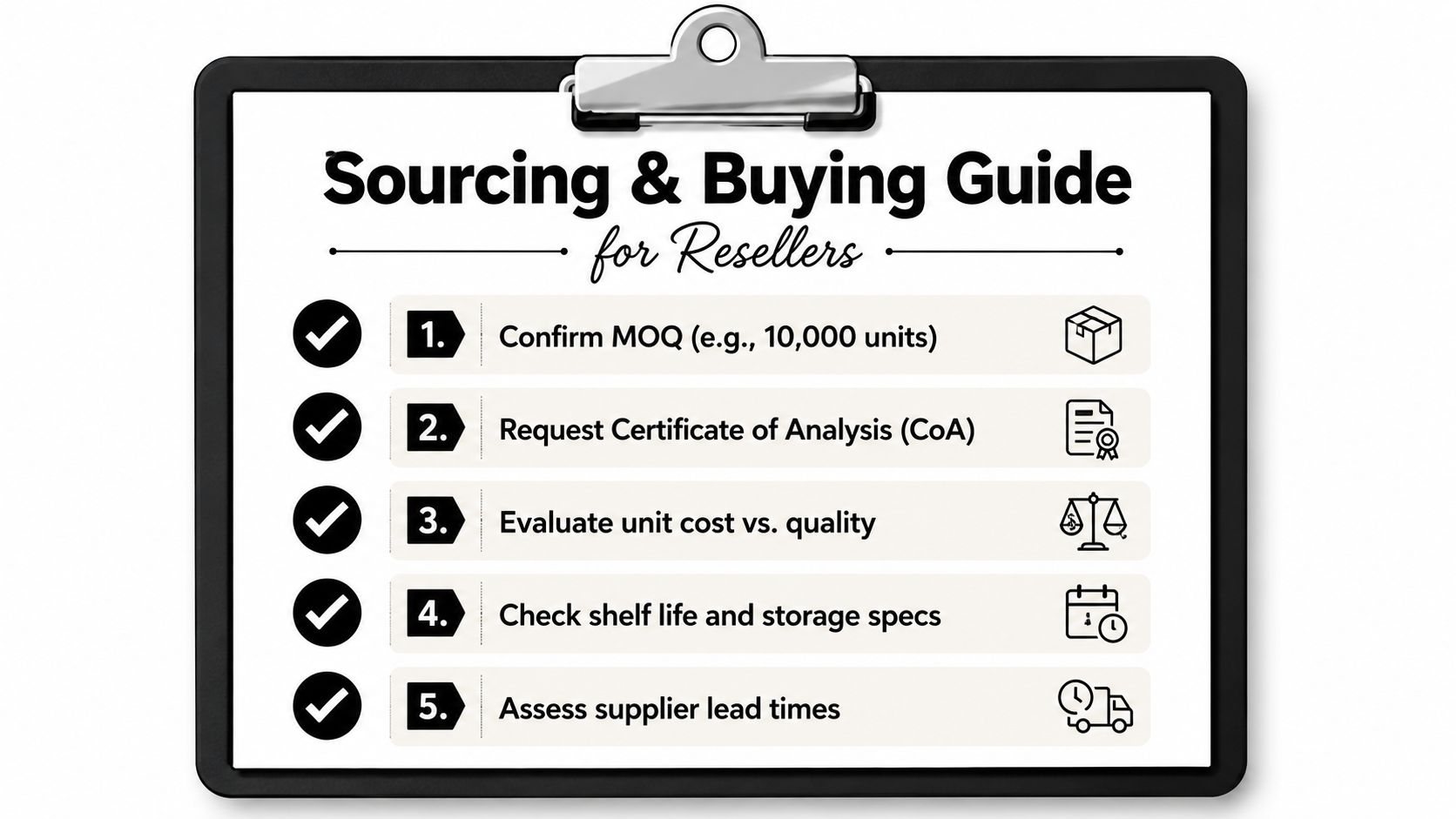
A supplier call should end with written answers to five questions: What is the exact MOQ? Which lot documents ship with the order? How is sterility maintained through packaging and freight? Which needles and accessories are confirmed compatible? What happens if a customer reports a defective connection? Those answers are more valuable than a generic “medical grade” claim.
Herbilabs supplies sterile diluents, reconstitution solutions, premium glass vials, clear COAs, and wholesale options for research-use workflows. Visit Herbilabs to review compatible laboratory supplies and discuss sourcing requirements for EU, UK, USA, and international distribution.