Private Label, White Label, Wholesale partnerships available - EU, USA and UK - Free shipping from €75
Lot Number Traceability: A Practical Guide for Labs
A cloudy vial arrives on the bench, the complaint lands in the inbox, and the first question is simple: which customers got this batch, and can the distributor prove it without digging through three folders and an old spreadsheet? That is the test of lot number traceability. It is not the label on the box alone, it is the ability to connect that label to the receiving record, the production record, and every shipment that moved downstream.
In peptide and reagent distribution, that distinction matters fast. A lot can be split into single vials, bundled into kits, repacked for a local customer, then shipped across the EU, UK, or USA. If the record chain breaks at any one of those steps, the complaint turns into a broader hold, and the QA team loses the ability to isolate the issue cleanly.
Table of Contents
- What Lot Number Traceability Really Means
- Why Lot Number Traceability Matters for Safety and Compliance
- The Technical Stack Behind a Traceable Lot
- Lot Traceability Versus Serial Level Tracking
- Running an Audit, Recall, and Reporting Workflow
- Common Pitfalls and How to Fix Them
- Putting Lot Number Traceability Into Practice
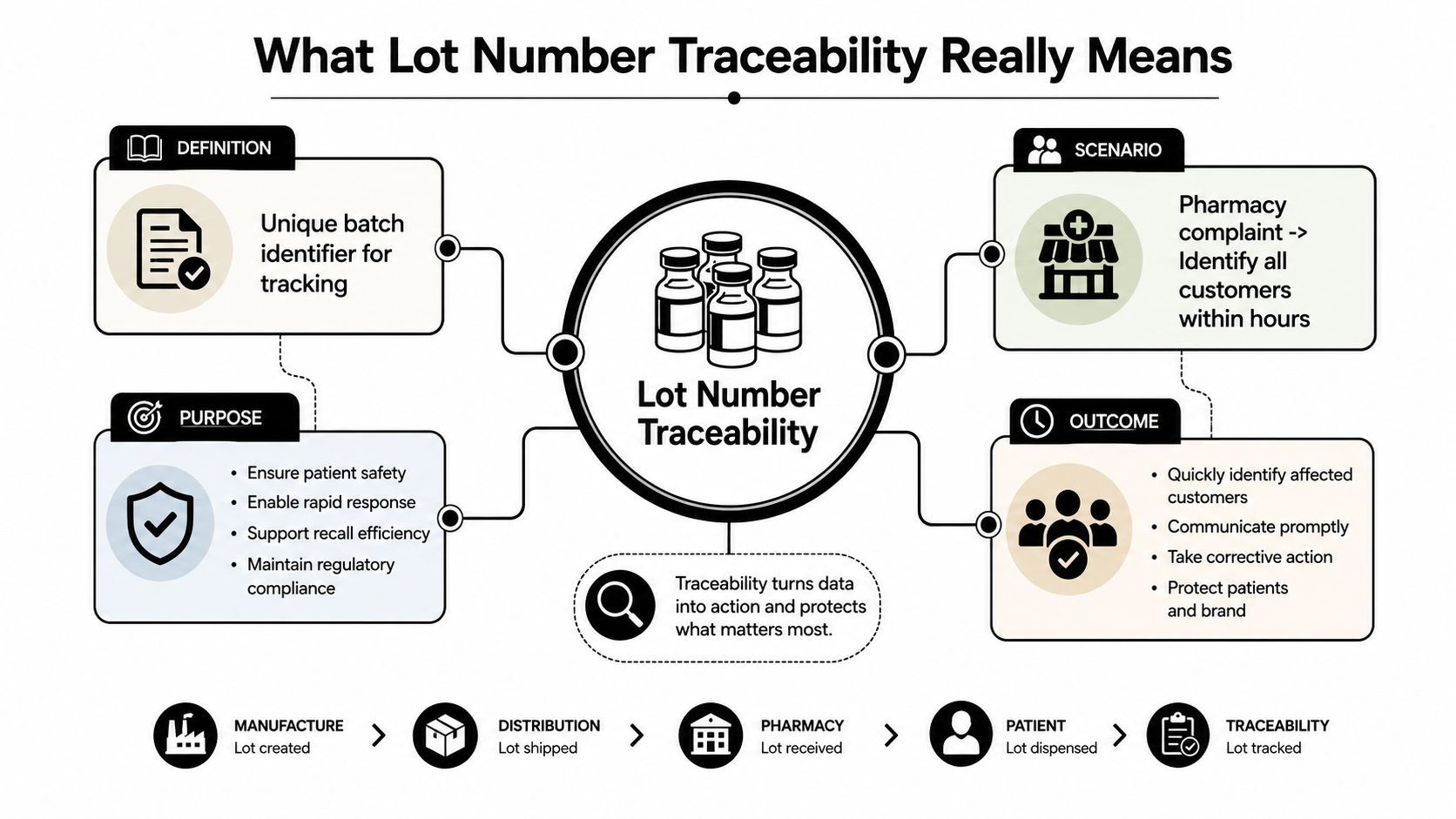
What Lot Number Traceability Really Means
A peptide distributor gets a message that a vial looks cloudy. The warehouse team finds the shelf location, but that only answers where the vial sits right now. QA needs a different answer, one that reaches backward to the input lot and forward to every customer who received material from that same batch.
Lot number traceability is that backward and forward link. A lot number groups units made or handled under the same conditions, while traceability connects that group to its inputs, process history, and destinations. That is why lot traceability is more than a label, it is a chain of evidence.
The FDA's FSMA traceability-lot-code rule formalized that idea for covered food categories by requiring firms to assign a traceability lot code when they first pack a raw agricultural commodity, first land-receive food from a fishing vessel, or transform food, and by telling firms not to create a new code for routine shipping activity (FDA FSMA traceability-lot-code rule). In plain language, the code is supposed to survive normal movement through the supply chain instead of getting replaced at every handoff.
Lot Traceability and Serial Traceability at a Glance
| Dimension | Lot Traceability | Serial Traceability |
|---|---|---|
| Unit of control | Batch or production lot | Smallest saleable item |
| Main purpose | Targeted recall and genealogy | Item-level visibility and anti-counterfeit control |
| Typical use | Reagents, raw materials, many lab consumables | High-value or tightly regulated products |
| Data shape | One lot can cover many units | Each item carries its own identity |
In practice, the distributor is trying to preserve chain of custody across a batch, not just assign a stock code. A useful companion reference on that topic is the complete 2026 chain of custody guide, because lot traceability works best when custody, location, and batch identity stay aligned.
One more point helps new teams avoid confusion. Lot traceability is often broad enough for inventory control and COA matching, while serial tracking goes deeper and tags each item separately. For teams reading a certificate of analysis, the basics of identity and batch mapping are easier to see in how to read a certificate of analysis.
Why Lot Number Traceability Matters for Safety and Compliance
A distributor often sees the problem first at the dock. A pallet arrives with one supplier lot on the outer carton, a different internal code on the repacked cases, and a customer asking which COA applies to the kit that just shipped. Traceability matters because regulators treat batch identity as a control point, not a convenience. In food categories, the FDA's FSMA framework makes that expectation explicit, and the same logic carries into life sciences, where records have to show what was received, what was made, and where it went.
That regulatory frame changes the job description for distributors. A lot number is not just a warehouse shorthand. It becomes part of the documented evidence that supports release decisions, complaint handling, and recall scope.
Why lab distributors feel the same pressure
For peptide and reagent sellers, the product may be marked RUO, but the operating standard is still strict. Customers want the COA tied to the exact batch they received, and QA teams need to know whether a repack, kit build, or cross-border shipment changed the record chain. If the chain stays intact, a complaint can stay narrow. If it breaks, confidence drops across every adjacent unit, because nobody can separate the affected lot from the rest with any certainty.
The EU MDR uses a similar discipline in medical device work, where the lot number links a model-level identifier to a uniquely traceable physical batch and connects back through QMS and ERP records to components, operators, and customers (EU MDR lot numbering practice). That same logic fits lab supply operations. The system has to preserve genealogy, not just stock count.
Practical rule: if QA cannot tie the batch to its inputs and recipients from a single record set, traceability is only partial.
Documentation carries the same weight as movement. The regulatory compliance documentation record set should support receiving, production, and shipment without forcing staff to rebuild history by hand.
A repacked vial, a custom kit, or a shipment split across borders can still stay traceable if the record links are kept clean. For distributors handling those handoffs, a practical roadmap for manufacturers is useful as a process reference, because the same discipline applies when a lot moves from intake to transformation to outbound fulfillment.
The basic compliance principle
A lot number is only useful if downstream partners preserve it. The traceability code has to remain searchable through receiving, packing, transformation, and shipment records, with records ready to support an investigation when needed. That same logic fits lab distribution. If a batch is repacked into smaller units, the original identity still has to be visible in the new packaging record, even after the outer presentation changes.
In practice, that means traceability has to survive the steps that distributors touch every day. Receiving captures the supplier lot and COA. Repacking carries the original lot into the new container record. Kitting ties component lots to the finished kit. Shipping attaches those records to each outbound line so the genealogy can be reconstructed without guesswork.
The Technical Stack Behind a Traceable Lot
A traceable lot depends on a stack, not a single tool. The label matters, the scan matters, the database matters, and the SOP that forces staff to use them matters too. When any one of those pieces is weak, the trace chain gets fuzzy.
Label, code, and system of record
Downstream partners often expect a Traceability Lot Code built from a case GTIN and a lot code, because that combination stays readable across the supply chain and gives each traceability lot a unique identity inside the assigning firm's records (PTI FSMA 204 TLC guidance). For a distributor, the label is the visible layer, but the authority lives in the ERP or LIMS. That system has to store the supplier lot, internal lot, quantity, date, and certificate reference as structured fields, not as free text buried in notes.
A sensible setup also keeps receiving, production, and shipping records separate enough to stay clear, but linked enough to reconstruct the genealogy. The receiving step captures the supplier lot and COA. The production or kitting step creates the internal lot. The shipping step attaches that lot to every outbound line.
Barcodes, QR codes, and SOPs
Barcodes and QR codes solve the human problem of bad typing. They also help the warehouse team avoid duplicate lot creation when a container is repacked or a kit is assembled. The SOPs do the rest, because staff need a clear rule for when to scan, what to capture, and which record wins if two systems disagree.
Operational standard: the label should point to the record, and the record should point to the original source document.
A practical roadmap for turning that into a working operation is laid out in practical roadmap for manufacturers, especially for teams that are replacing fragmented spreadsheets with connected workflows.
The record flow distributors should protect
| Stage | What gets captured | Why it matters |
|---|---|---|
| Receiving | Supplier lot, COA, date, quantity | Creates the starting point |
| Transformation | Internal lot, child lots, kit content | Preserves genealogy through repack or kitting |
| Shipping | Lot on each shipment line | Shows which customer got which batch |
That flow is also why supply chain visibility is more than a dashboard. It is a record discipline.
Lot Traceability Versus Serial Level Tracking
Batch-level control is enough when the product behaves like a batch. That is often the case for research reagents, peptide solvents, and many lab consumables where the key question is which lot moved where, not which individual vial went to which person. Serial-level tracking becomes more useful when the smallest saleable unit carries its own risk, value, or compliance burden.
When lot level is the right fit
Lot traceability works well when a single formulation is made, tested, and distributed as a group. It supports COA matching, targeted recalls, and warehouse control without forcing the distributor to tag each vial separately. That keeps the system lighter and usually easier for teams to run correctly.
When serial level adds value
Serial tracking makes sense when item-level visibility is needed for anti-counterfeit controls, regulated devices, or fulfillment models where one lot gets split across many channels and the business still needs to know the fate of each individual unit. It is also the stronger option when the same product passes through many hands and the distributor needs a record for each unit, not just the batch.
The hidden trap is thinking lot traceability alone guarantees customer-level visibility. It does not, unless the upstream lot data, production data, and outbound shipment records are joined in one system. Without that join, a team may know the batch existed, but not exactly which customers received each transformed unit.
Decision rule: use lot traceability for batch integrity and recall control, then add serial tracking only when the product, risk profile, or channel complexity justifies the extra detail.
That matters for distributors who repack, kit, and direct-ship in the same operation. A stable reagent might stay at lot level from receipt to customer delivery. A mixed kit may need child lot records so the parent lot still points back to the original components. A serialized workflow is only worth the overhead if the business needs item-level proof, not just batch-level proof.
Running an Audit, Recall, and Reporting Workflow
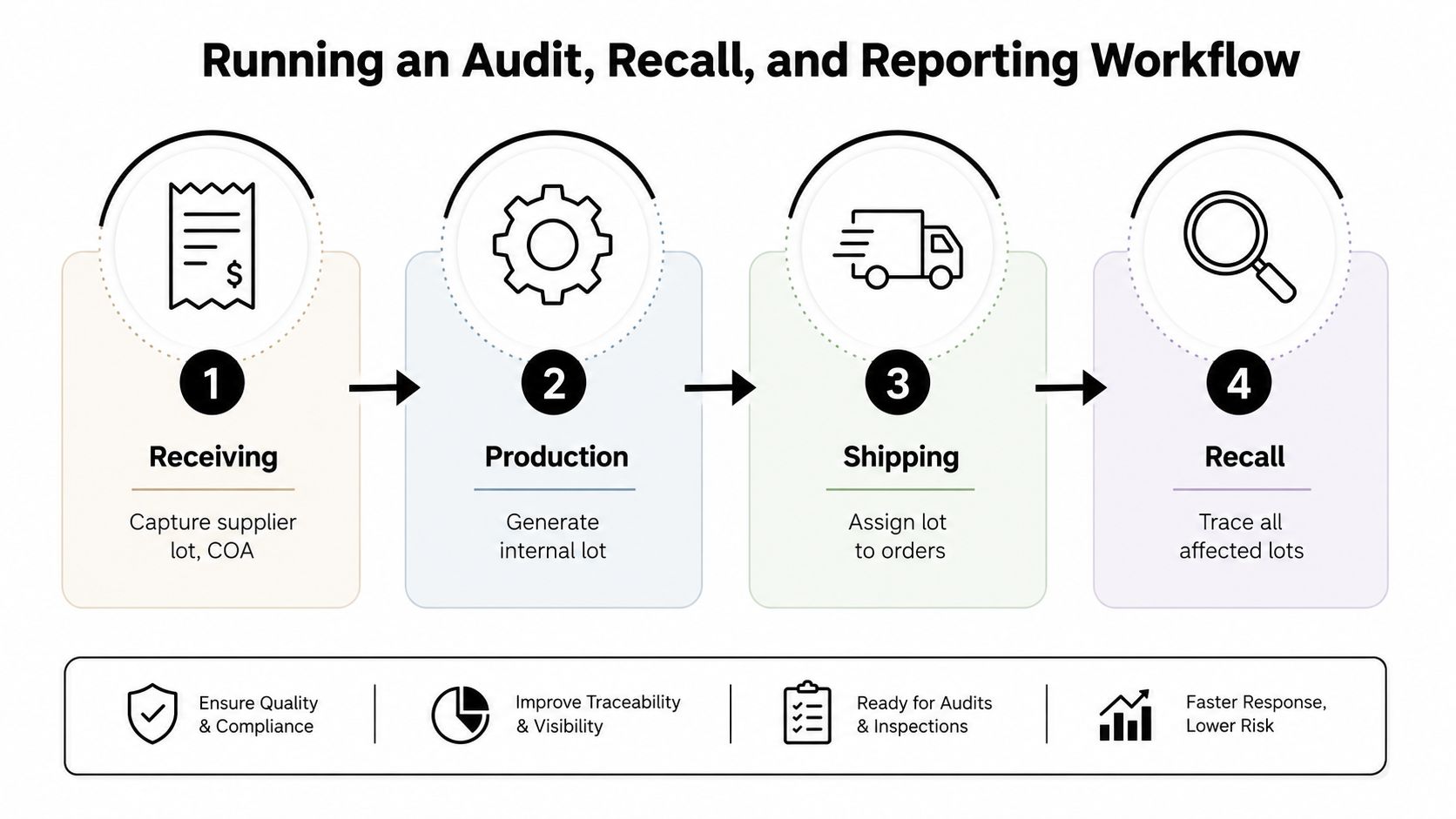
A traceability system proves itself when something goes wrong. The receiving team captures the supplier lot and COA, the production team assigns the internal lot, shipping attaches the lot to outbound orders, and QA can pull the whole chain fast enough to keep the issue narrow. That flow should be routine, not heroic.
A workable recall sequence
- Receiving captures the supplier lot, COA, receipt date, and quantity.
- Production or kitting creates the internal lot and preserves the child lot links.
- Shipping attaches the lot to each order line and shipment record.
- Recall or audit pulls every affected lot, customer, and supporting document.
That is the sequence QA should test during a mock recall. Industry guidance recommends checking whether every job and customer affected by a lot can be identified in minutes rather than hours (Datacor lot tracking and traceability guide). The timing matters because a slow search often means the records are fragmented, not just incomplete.
Records that should be ready on demand
A distributor should be able to produce the supplier lot record, the internal lot record, the COA, the receiving log, the production or kitting log, the shipment log, and the customer list tied to that batch. If the product changed form, the team should also show the transformation record that links the parent lot to the child lots. Those records should come out of the system as clean reports, not screenshots or email chains.
The audit readiness checklist for businesses is a useful companion when QA wants to compare current records against inspection expectations. The same discipline also helps when the business serves wholesale partners who ask for batch proof before they release stock.
Inspection standard: if a reviewer asks for one lot, the team should not need to rebuild that story from five different places.
The best test is simple. Pull one lot, trace it backward to the input, and forward to every customer, then check whether the chain closes without manual reconstruction.
Common Pitfalls and How to Fix Them
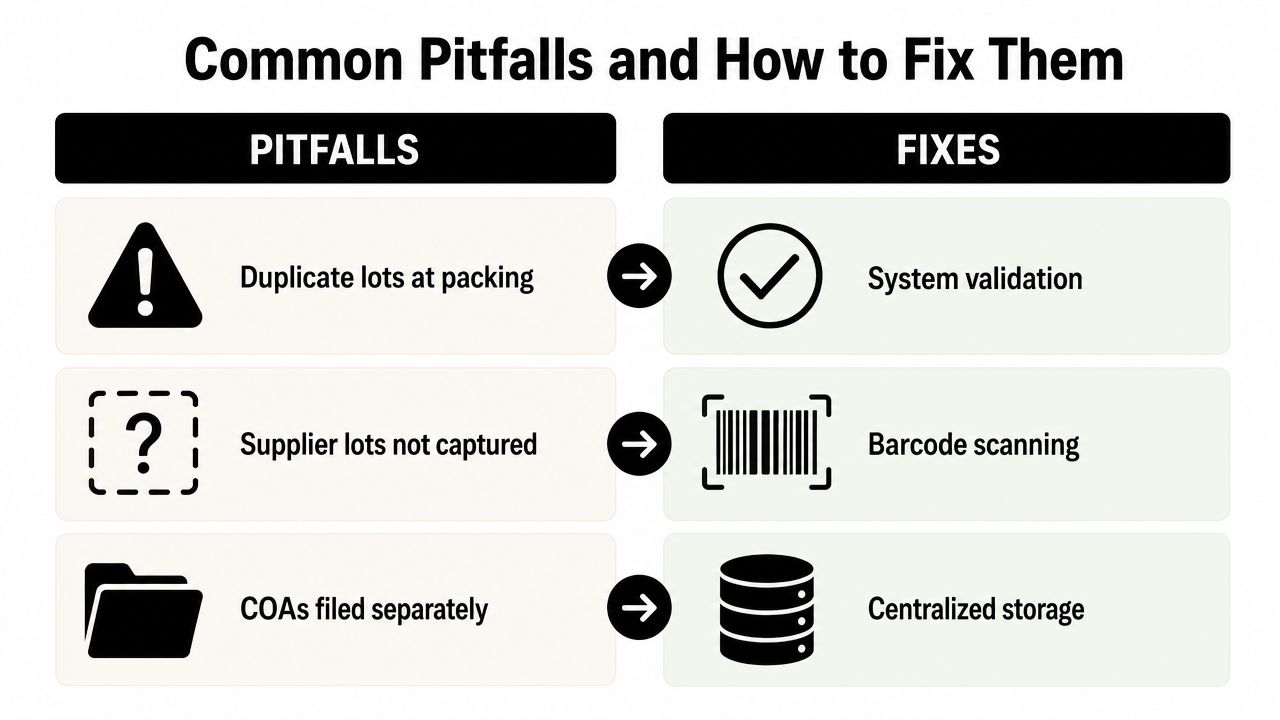
Most traceability failures do not start with a big system outage. They start with one small habit that spreads. A lot gets typed twice, a supplier lot gets skipped at receiving, or a COA gets stored in a different folder from the production record, and the chain gets weaker each time.
Receiving mistakes
A common symptom is that the warehouse can see stock, but QA cannot prove where it came from. The root cause is usually manual entry or a receiving screen that lets staff complete the transaction without capturing the supplier lot. The fix is straightforward, make the lot field mandatory and require barcode scanning at receiving.
Another frequent issue is that COAs sit in a shared drive while the lot record sits in the ERP. That split slows every investigation. The fix is centralized storage, with the COA linked to the lot record instead of stored separately.
Production and kitting mistakes
Duplication at packing is one of the easiest errors to miss. A packer may generate a new lot when the process should have preserved the original batch identity, which breaks genealogy and confuses downstream partners. The fix is system validation that blocks duplicate lot creation unless the SOP explicitly calls for a new internal lot.
Kits create a different problem, because the final kit may hide the child lots that went into it. If those child links are lost, the distributor cannot trace a defect back to the exact source material. The fix is to record the component lots at the moment of assembly, not after the kit leaves the bench.
Distribution and ERP mistakes
ERP overrides can overwrite trace data, especially when staff use shortcuts to speed up order entry. The symptom shows up later, when a shipment report no longer matches the lot that was picked. The fix is role-based access, change logs, and a weekly spot check on outbound lot integrity.
If the ERP lets staff "clean up" history without a trace, the history was never controlled.
The lot and serial number traceability overview is useful for teams comparing batch control with item-level control, especially when the same operation handles both.
The maturity pattern is clear. Better teams do not just create lot numbers, they protect them through every handoff. Weaker teams treat traceability as a filing task, then discover too late that the file and the product no longer match.
Putting Lot Number Traceability Into Practice
The cloudy vial complaint at the start of the story is not just a quality event, it is a test of discipline. If the receiving record captured the supplier lot, if the kitting step preserved the child lots, and if shipping attached the lot to every order line, QA can isolate the affected batch and notify the right customers quickly. If any one of those links is missing, the problem spreads into a documentation problem.
The clean implementation pattern is simple. Capture at receiving, preserve through every transformation, and prove the chain with a regular mock recall. That sequence works for a lab supplier, a peptide distributor, and a wholesale partner because it respects how real batches move, split, and ship across borders.
Herbilabs works in this same operating space, with RUO reagents, clear COAs, and batch-focused fulfillment that depends on traceable records. For teams building stronger lot control across EU, UK, and USA channels, Herbilabs is a practical place to review how lot identity, documentation, and distribution can stay aligned in day-to-day lab supply work.


