Private Label, White Label, Wholesale partnerships available - EU, USA and UK - Free shipping from €75
Laboratory Information Systems for Modern Research Labs
The popular advice is to choose a laboratory information system by comparing feature lists, then let the vendor manage the transition. That approach fails in multi-site research environments. A system can have impressive dashboards, instrument interfaces, and automation features yet still create operational risk if staff can't use it easily, historical data can't be trusted, or each country requires a different exchange and compliance pathway.
Modern laboratory information systems sit at the intersection of sample custody, clinical reporting, research data, instruments, procurement, and regulated workflows. The difficult work begins after procurement. Teams must preserve active operations, reconcile legacy records, validate interfaces, train staff without removing critical coverage, and connect sites that don't share the same legal or technical environment. The following framework focuses on those decisions, not on sales demonstrations.
Table of Contents
- Why Cloud Migration Is an Operational Decision Not a Technical One
- Understanding the Difference Between LIS and LIMS
- Core Modules and Workflows Inside a Modern LIS
- Interoperability Standards and Cross-Border Integration Challenges
- Implementation Checklist for a Safe LIS Migration
- Selection Criteria That Actually Predict Long-Term Success
- Common Pitfalls and How to Avoid Them During Deployment
Why Cloud Migration Is an Operational Decision Not a Technical One
Cloud migration is often presented as an architecture choice between hosted infrastructure and an on-premise server. Laboratory managers experience it differently. The core question is whether the organization can change its operating model without weakening continuity, validation, staffing coverage, or data control.
Recent coverage of U.S. laboratories describes continued movement from legacy on-premise LIS platforms toward hybrid and cloud models, alongside broader process digitization and greater use of analytics. That shift is happening while laboratories manage staffing and cost pressures, so migration becomes an operational resilience decision, not an IT project. The relevant question is not “Should the lab modernize?” It is “Can the lab modernize safely with the people, budget, and recovery procedures available?”
A cloud deployment may reduce the burden of maintaining local infrastructure, but it doesn't remove responsibility. The laboratory still owns workflow design, access control, validation evidence, downtime procedures, vendor oversight, and the quality of migrated records. A hybrid model can offer more control over sensitive integrations or local devices, yet it adds another boundary to monitor and troubleshoot.
Start with the work, not the hosting model
Before selecting an architecture, managers should map the work that must continue during a service interruption:
- Specimen intake: Identify how samples are accessioned, labeled, prioritized, and located when the LIS is unavailable.
- Instrument operations: Document which analyzers can buffer results, which depend on middleware, and which require manual recovery.
- Review and release: Define who can validate results, how urgent findings are communicated, and how records are reconciled afterward.
- Site coordination: Record the dependencies between central laboratories, research sites, couriers, EHRs, procurement systems, and public reporting channels.
A migration plan that begins with a hosting diagram usually misses these dependencies. A plan that begins with failure modes can determine which workloads belong in the cloud, which require local resilience, and what recovery evidence must be retained.
A practical comprehensive cloud migration guide can help structure infrastructure planning, but laboratory leaders still need a separate operational plan. That plan should assign decision rights, define escalation routes, rehearse downtime, and protect time for validation. The technology is only one part of the changeover.
Design for constrained staffing
The strongest migration teams protect subject-matter expertise. If the technologist who understands a complex molecular workflow is also responsible for daily batches, removing that person for full-time project work creates a new production risk. Better sequencing uses short, scheduled validation sessions, recorded decisions, and cross-training so knowledge doesn't remain with one individual.
Cloud adoption works when it makes recovery, monitoring, and support more dependable. It doesn't work when the laboratory treats the platform as a replacement for process ownership.
Understanding the Difference Between LIS and LIMS
LIS and LIMS overlap, but they organize laboratory work around different primary objects. An LIS is generally patient-centric. It manages clinical orders, specimen identification, result review, and reporting to clinicians or connected healthcare systems. A LIMS is generally sample-centric, supporting research, manufacturing, quality control, environmental testing, batch relationships, and flexible testing workflows.
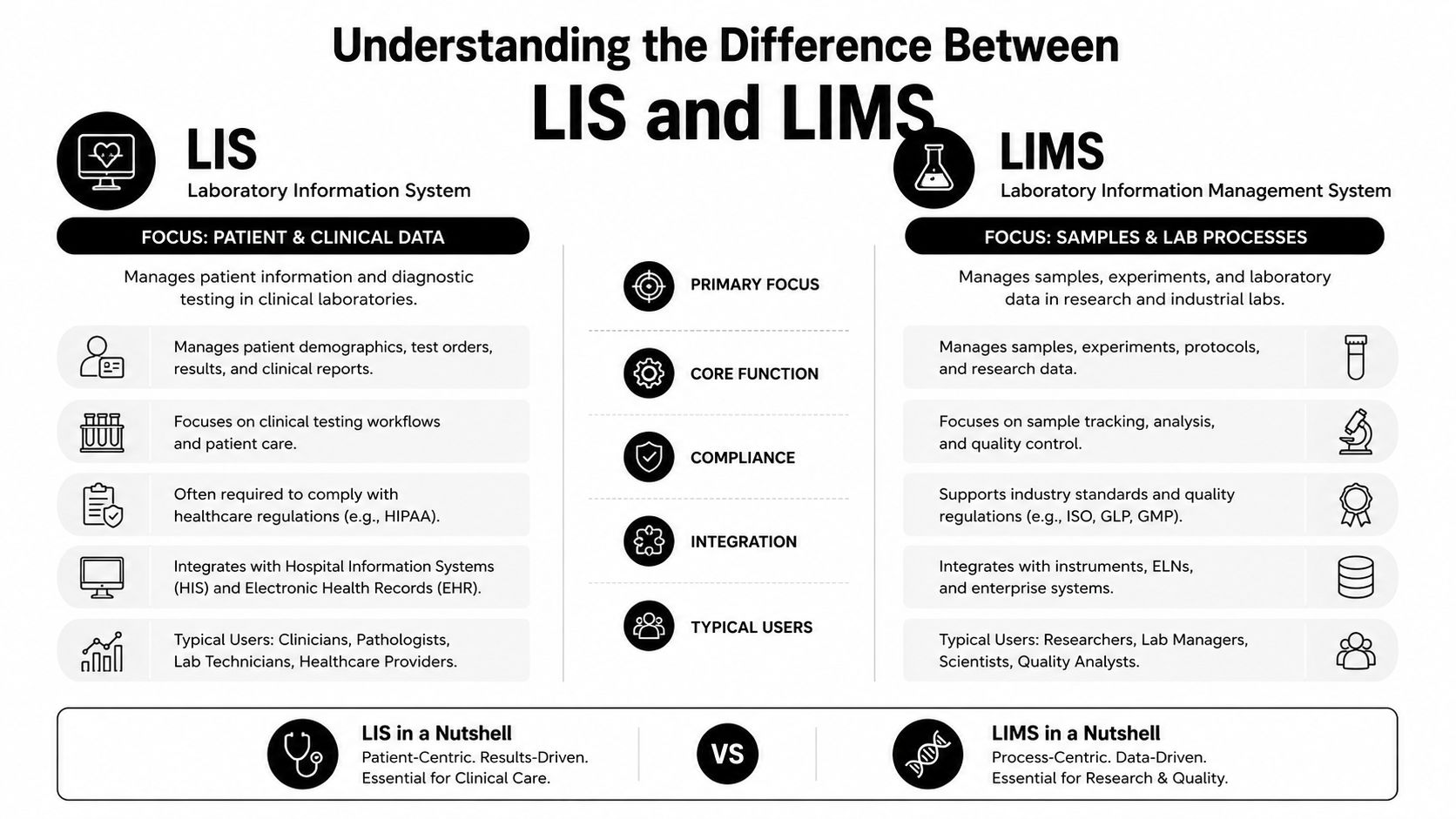
In a hospital hematology laboratory, a clinician orders a blood panel, the request enters from the EHR, and staff accession the specimen against a patient record. Analyzer results are reviewed before the final report returns to the clinical care pathway. The LIS must protect patient identity, show clinical result status, apply reference information and reporting rules, and connect reliably with healthcare records across sites.
A peptide research facility follows a different chain of custody. A sample may belong to a study, compound, formulation, reagent batch, or experimental protocol. Staff may need to track aliquots, replicate testing, instrument outputs, storage locations, preparation steps, and research metadata. Results do not all become diagnostic reports, so the workflow points toward a LIMS or a laboratory platform with strong sample-centric capabilities.
Choose by workflow and accountability
| Operating model | Primary record | Typical recipients | Stronger system fit |
|---|---|---|---|
| Clinical diagnostics | Patient and order | Clinicians, patients, healthcare systems | LIS |
| Research and development | Sample, study, method, and experiment | Researchers, sponsors, quality teams | LIMS |
| Manufacturing quality control | Batch, lot, sample, and specification | Quality assurance and regulatory teams | LIMS |
| Mixed clinical and research network | Patient records plus samples and studies | Clinical, research, and external systems | Coordinated LIS and LIMS environment |
The wrong choice creates configuration and integration pressure. A patient-focused LIS may struggle with complex sample lineage, repeated testing, or non-diagnostic entities. A research-oriented LIMS may need substantial configuration before it can support clinical reporting, EHR integration, and patient-safety controls.
Hybrid environments are common in large, multi-site organizations. A clinical LIS can own diagnostic workflows while a LIMS manages research, manufacturing, or environmental operations. Define which system owns each record, then specify how identifiers, statuses, results, and audit events move between platforms. This ownership model also determines how suppliers, instruments, couriers, and external laboratories connect to the workflow. Product labels matter less than the data model and the regulatory obligations attached to each operation.
Core Modules and Workflows Inside a Modern LIS
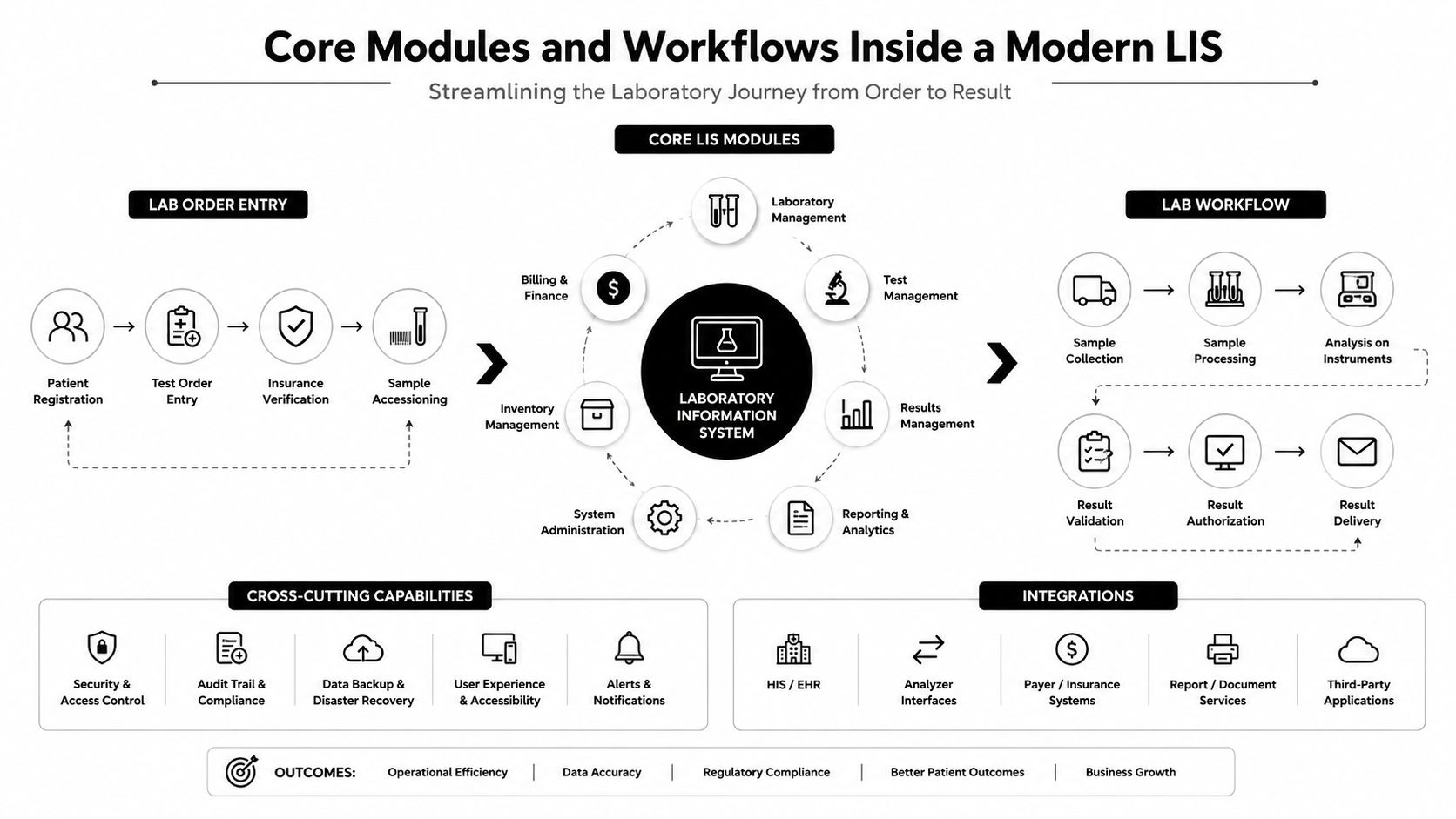
A modern LIS is best understood as an orchestration layer for the testing lifecycle. It doesn't merely store results. It connects an order to a specimen, a specimen to a method and instrument, an instrument output to a review process, and an approved result to the appropriate recipient.
Follow one result through the system
The workflow begins when an order arrives from an EHR, ordering portal, study system, or another source. The LIS creates or receives the relevant identifiers, confirms the requested test, and applies rules for collection, priority, location, and specimen type. At accessioning, staff verify the label, capture receipt information, and assign the specimen to a route, bench, storage location, or analytical process.
From there, several modules work together:
- Order and accessioning controls connect the request to the correct patient, study, or sample record.
- Specimen tracking records collection, receipt, transfers, aliquots, storage, and disposition.
- Worklists and routing rules direct work to the appropriate section, method, analyzer, or technologist.
- Instrument and middleware interfaces receive analytical output and associate it with the correct order and specimen.
- Quality and validation rules flag exceptions, compare results with configured conditions, and route findings for human review.
- Reporting services format the approved result and send it to the EHR, clinician, researcher, sponsor, public health network, or other authorized recipient.
- Billing and operational interfaces pass appropriate information to financial or administrative systems without making billing logic the source of truth for clinical results.
Automation reduces transcription and repetitive routing, but it doesn't eliminate professional judgment. A technologist still needs to resolve questionable flags, investigate mismatched identifiers, review quality-control conditions, and decide when a result requires escalation. The system should make those decisions visible, not bury them behind an automated status.
Operational rule: Every automated handoff needs an exception path that a named person can understand and manage.
Protect the data at every handoff
The most dangerous gaps occur between modules. An analyzer may transmit a value successfully while a unit, reference interval, specimen status, or comment fails to map correctly. A report may reach the EHR while a correction workflow doesn't preserve the required history. These are not cosmetic defects. They can affect interpretation, accountability, and reconciliation.
Configuration should therefore be tested with normal, abnormal, corrected, rejected, delayed, and duplicate scenarios. Teams managing regulated research workflows may also compare LIS functions with specialized compliance tracking software where the system of record needs additional oversight around obligations and documentation.
The following video can provide a visual introduction to the relationship between LIS modules and laboratory operations.
A sound design keeps ownership clear. The LIS should coordinate testing and reporting, middleware should manage appropriate instrument communication, and downstream systems should consume controlled outputs rather than rewriting them without notice.
Interoperability Standards and Cross-Border Integration Challenges
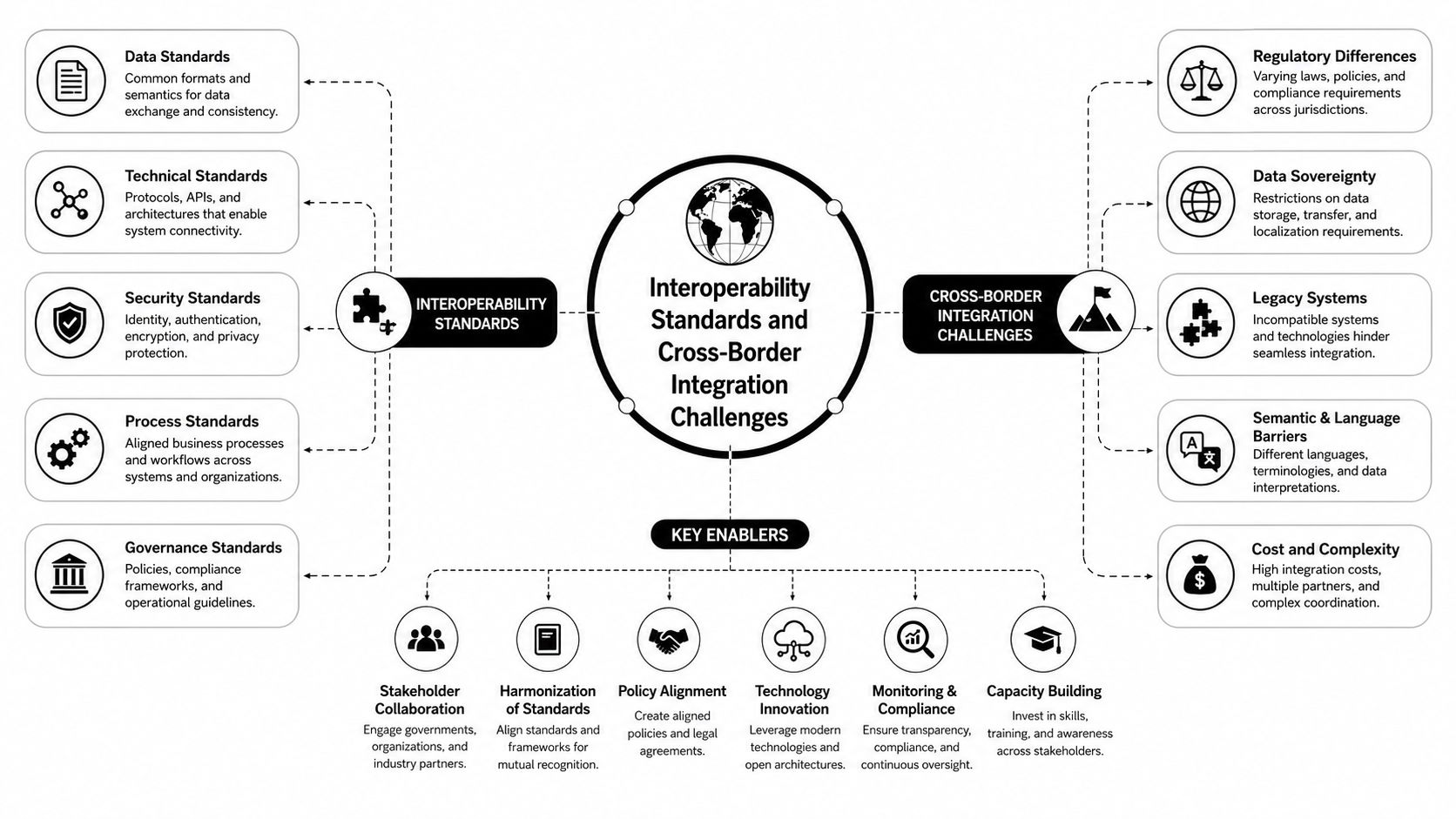
Interoperability becomes difficult when a laboratory stops operating as one isolated site. A multi-site research network may need to exchange data with EHRs, instruments, ERP platforms, cloud services, public health networks, sponsors, and national exchange frameworks. Each connection can carry different identifiers, security expectations, terminology, retention rules, and approval processes.
FHIR is useful for flexible, API-based exchange, particularly in SaaS-oriented architectures. LOINC supports consistent identification of laboratory tests and observations. Older HL7 messaging remains relevant in many operational environments, so replacement isn't always practical or justified. A comparative study found that a hybrid model using FHIR for exchange and LOINC for terminology management was the most effective approach for smooth laboratory-system integration. The study is available through this comparative interoperability analysis.
Standards don't resolve governance by themselves
A message can be technically valid and still be operationally unusable. One site may define a test name differently, another may use a local specimen code, and a third may require a national identifier. If the network hasn't agreed on ownership, mapping, correction rules, and retention, a standards-based interface moves ambiguity faster.
Multinational laboratories must make several decisions before building interfaces:
- Terminology ownership: Decide who approves local-to-standard mappings and how changes are communicated.
- Jurisdictional control: Establish where personal or sensitive data may be stored, processed, and accessed.
- Auditability: Preserve the relationship between the original result, transformed message, receiving system, and later correction.
- Vendor boundaries: Identify which interfaces, mappings, and certificates remain portable if a supplier changes.
- Public network obligations: Separate clinical exchange requirements from public health reporting and research data sharing.
Market reporting identifies interoperability as a central buying criterion and describes pressure from HL7 FHIR deadlines, TEFCA-style exchange backbones, and modernization needs in Europe and the United Kingdom. It also highlights regional fragmentation and the growing importance of cloud deployment in some market estimates. The broader lesson is that one integration strategy won't fit the EU, UK, USA, and LATAM without local governance and compliance review. A practical discussion of integrating software systems is useful for framing those dependencies, but laboratory teams must translate the principles into controlled mappings and validation evidence.
Build a translation layer deliberately
A shared integration layer can isolate local systems from the core LIS and hold approved mappings, routing rules, validation checks, and monitoring. That approach costs more design effort at the beginning, but it can reduce the need to customize the core platform for every jurisdiction.
Order and sample workflows also benefit from explicit status models. Teams should define what “received,” “in process,” “rejected,” “verified,” “corrected,” and “reported” mean across systems. Where order visibility is a priority, order tracking systems can complement laboratory workflows, provided ownership and data synchronization are unambiguous.
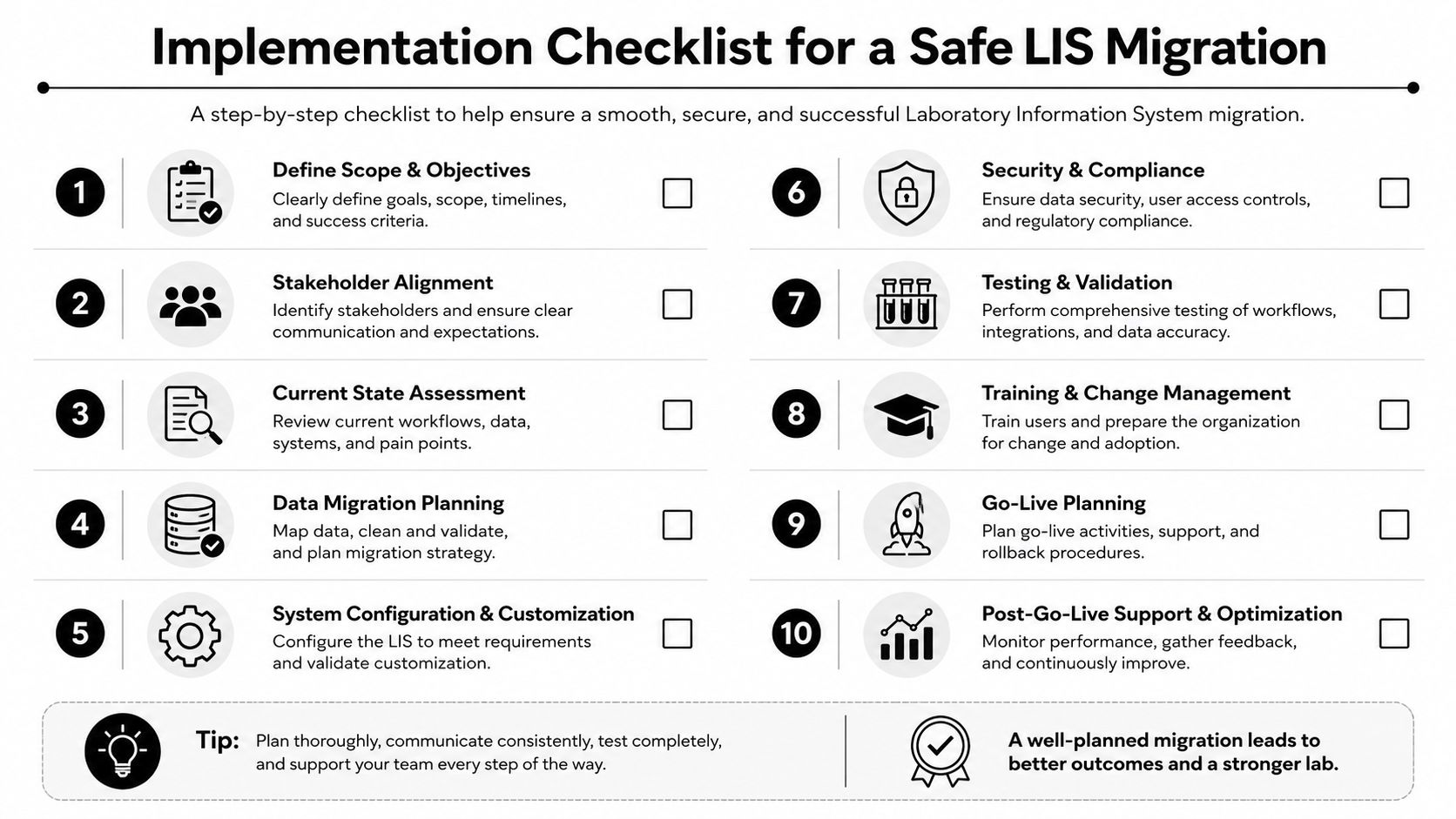
Implementation Checklist for a Safe LIS Migration
A safe migration is a controlled change to laboratory operations, not a database copy followed by a launch party. The project needs deliverables, decision gates, and enough staffing capacity to test the new system without neglecting current work.
Phase one, audit and design
Start by inventorying active workflows, interfaces, instruments, reports, users, roles, historical fields, and external recipients. Data owners should classify records that must migrate, records that can remain archived, and records that require transformation or manual review. The team should produce a signed mapping document for identifiers, statuses, units, comments, reference information, and correction history.
Next, define the cutover boundary. Decide which specimens, orders, studies, and results remain in the old system and which move into the new one. Without a precise boundary, staff can create duplicate accessions or release results against incomplete records.
Phase two, validate with realistic work
Instrument interfaces need more than a successful connectivity test. Re-validation should cover representative methods, abnormal values, repeat testing, cancellations, flags, units, comments, instrument downtime, and middleware exceptions. Report testing should confirm formatting, recipient routing, corrections, access permissions, and audit events.
Parallel running can reduce uncertainty, but it consumes staff time. The laboratory should choose a limited, representative workload, define who compares outputs, and set acceptance criteria before the comparison begins. A parallel run without a decision gate becomes an expensive habit rather than evidence for go-live.
Phase three, train around coverage
Training schedules must reflect the roster, not the vendor's preferred calendar. If a senior technologist runs daily batches, training can use staggered sessions, protected handover periods, and trained super-users who remain available on the bench. Role-based practice is more effective than a single generic demonstration because accessioning staff, reviewers, supervisors, and administrators face different failure modes.
The project should also maintain a downtime pack with paper forms, contact routes, recovery instructions, reconciliation logs, and authority for urgent decisions. Data integrity guidance, including the use of validated ELN or LIMS templates for research capture, can supplement the migration controls in a data integrity in research resource.
Phase four, cut over and monitor
At go-live, assign owners for interface monitoring, queue review, incident triage, user support, and reconciliation. Daily review should examine rejected messages, unverified work, duplicate records, missing results, report corrections, and turnaround problems. The project should keep a rollback or containment decision available until evidence shows stable operation.
A migration is complete only when the laboratory can demonstrate that normal work, exceptions, downtime recovery, and audit review all function under real staffing conditions.
Selection Criteria That Actually Predict Long-Term Success
Vendor demonstrations reward polished screens. Daily laboratory work rewards fewer ambiguous clicks, clear queues, fast exception handling, and interfaces that behave predictably under pressure. Feature count is a weak proxy for operational fit.
Usability deserves a formal place in procurement. One peer-reviewed evaluation of LIS and LIMS usability reported an overall mean System Usability Scale score of 59.7, significantly below the standard benchmark of 68, with p < 0.001 in the published evaluation (peer-reviewed usability evaluation). The practical implication is not that every platform will perform identically. It is that a functionally complete system can still impose cognitive load, training overhead, and data-entry friction.
Test the work users actually perform
A serious evaluation puts real staff in front of configured workflows. Ask an accessioning operator to correct a mislabeled specimen, a technologist to resolve an analyzer exception, and a supervisor to investigate a corrected result. Observe how many screens they need, whether the next action is obvious, and whether the audit trail explains what happened.
The evaluation should include:
- Usability under pressure: Can staff distinguish urgent, blocked, rejected, and completed work?
- Integration depth: Does the platform support controlled exchange with EHR, instruments, middleware, ERP, ELN, and supply-chain systems?
- Configuration control: Can authorized laboratory personnel change workflows without uncontrolled vendor intervention?
- Data lineage: Can users trace a result from source output through transformation, review, correction, and report?
- Commercial durability: Are implementation, interfaces, validation, support, upgrades, storage, and exit costs visible?
Use a weighted scoring model
| Criterion | Weight | Why It Matters |
|---|---|---|
| Operator usability | High | Reduces avoidable friction and supports reliable adoption |
| Interoperability maturity | High | Determines whether the platform can exchange controlled data across sites |
| Validation and auditability | High | Supports regulated workflows, investigations, and accountability |
| Migration capability | High | Protects historical context and reduces cutover risk |
| Workflow configurability | Medium | Allows the laboratory to adapt without excessive custom code |
| Instrument and middleware support | Medium | Connects analytical work to review and reporting |
| Total cost of ownership | High | Exposes recurring support, interface, upgrade, and exit obligations |
| Supply-chain integration | Medium | Links materials, lots, inventory, and testing context where needed |
The weights should reflect the laboratory's risk profile rather than a generic RFP template. Research networks should also test how the platform handles reagent lots, consumables, sample transfers, and partner data. A supply-chain process can undermine a carefully validated LIS if staff can't reconcile incoming materials with the work they support.
Herbilabs offers research-use-only reagents and sterile diluents with product documentation and fulfillment processes that can be considered alongside broader laboratory supply-chain controls. That doesn't replace a LIMS inventory module, but it illustrates why supplier records, certificates, lot information, and receiving workflows belong in the operational design.
Common Pitfalls and How to Avoid Them During Deployment
An implementation can fail through a series of small omissions. A middleware interface may pass ordinary analyzer results but mishandle a flagged value. The team sees green connectivity status and assumes the work is safe, until a result arrives with the wrong unit or missing comment. Preventive testing must include exceptions, not just successful transmissions.
Legacy data creates a similar trap. A migration team may map patient or sample identifiers while overlooking local status codes, historical comments, aliquot relationships, or corrected results. The new record then appears complete but loses the context needed for review. A field-level inventory, sample reconciliation, and approved transformation log can expose those gaps before cutover.
Report formatting deserves its own gate. A result can be analytically correct yet operationally dangerous if the recipient sees an unclear flag, a truncated comment, or an incorrect routing destination. Users from each receiving role should approve representative reports, including amended and rejected-result scenarios.
Audit trails also fail. If an interface overwrites a value without preserving the source, actor, time, and reason, the laboratory may struggle to reconstruct an event during an investigation. The project risk register should therefore include audit-event testing, access reviews, correction workflows, and downtime reconciliation.
After deployment, governance must continue. Test menus change, instruments are replaced, sites join the network, suppliers change, and regulations evolve. A standing change-control group should review proposed modifications, require impact assessment, schedule validation, and confirm that support documentation matches the live configuration.
Herbilabs helps research teams and supply-chain partners source research-use-only reagents and sterile diluents while maintaining access to product documentation and dependable fulfillment. Visit Herbilabs to review available laboratory supplies and consider how supplier records, lot information, and data integrity fit into the wider laboratory information system workflow.


