Private Label, White Label, Wholesale partnerships available - EU, USA and UK - Free shipping from €75
Data Integrity in Research: A Practical Lab Guide
You're handed a dataset that looks tidy, the plots line up, the notebook pages are signed, and the team is ready to move on. Then an auditor asks for the raw chromatograms, the original file is gone, and the whole record loses trust in a single moment. That's the part many labs miss, data integrity in research isn't about making data look neat, it's about making every record defensible from the first measurement to long-term archive.
That matters even more when the work depends on reagents moving through the bench in a controlled state. A vial that arrived with a complete certificate, stayed in the right cold chain, and carried a traceable lot number gives downstream records something solid to stand on. A practical way to see the bigger picture is to treat integrity as a continuous system, not a file cabinet, and to compare it with the way structured trial programs handle records in trial data management with OMOPHub.
Table of Contents
- Why Data Integrity in Research Deserves Daily Attention
- The Regulatory Frame Around Research Data
- The ALCOA+ Principles Made Concrete
- Where Integrity Breaks in Real Labs
- End-to-End Practices That Protect Every Record
- How Reliable Reagent Sourcing Underpins Integrity
- A Practical Integrity Checklist for Working Labs
- Treating Integrity as One Connected System
Why Data Integrity in Research Deserves Daily Attention
A peptide synthesis run can look perfect on paper. The yield chart is clean, the review sign-off is done, and nobody spots a problem until an external audit asks for the raw chromatograms and finds that they were overwritten during a routine export. At that point, the issue isn't the chemistry, it's the trustworthiness of the record.
Integrity is not the same as quality
In plain terms, data quality asks whether the data are fit for use, while data integrity asks whether the record can be trusted. The distinction matters because a dataset can be statistically tidy and still be unusable if the provenance is broken, the original files are missing, or the changes can't be reconstructed. The National Academies' 2002 report, later reflected in NIH and NCBI guidance, placed the responsibility on researchers to ensure integrity, and emphasized that complete documentation of collection conditions, equipment, and transformations is part of that duty NCBI guidance on research data integrity.
That is why auditors and quality reviewers focus on how a result was produced, not just on whether it looks reasonable. A record without a clear chain from raw data to reported value can't support a decision, even if the final table appears polished.
Practical rule: if a result can't be traced back to the original observation, the record isn't complete enough to defend.
Why this belongs on the daily bench, not just in the audit room
Modern guidance treats integrity as a lifecycle issue, not a final review step. A 2024 Nature Scientific Data paper defines integrity through accuracy, completeness, reproducibility, understandability, interpretability, and transferability, and it recommends preserving raw data in multiple locations even when only processed data are used Guidelines for Research Data Integrity. That pushes integrity upstream, into the way a lab collects, names, stores, backs up, and reuses data.
The useful mental shift for a new lab manager is simple. A clean worksheet does not prove integrity. A system that preserves the full story does.
The Regulatory Frame Around Research Data
A batch record can look complete on the bench and still fail a review later. A sealed tube, a signed worksheet, and a tidy spreadsheet do not matter if no one can show who made each entry, when a value changed, or whether the final number still matches the original event. The regulatory frame exists to keep that chain visible, which is why audit trails, validation, and controlled signatures are part of the record itself.
What the main frameworks are protecting
21 CFR Part 11 governs electronic records and electronic signatures so they cannot be altered without detection or attributed incorrectly. In practice, the signature must stay linked to the record it approves, and the system must preserve a reviewable change history. EU Annex 11 points in the same direction for computerized systems, with the same underlying concern, records must remain attributable and reviewable over time.
GLP protects non-clinical study records by requiring work to be planned, documented, and reconstructable. GCP does the same for clinical research, where subject safety and credible evidence depend on accurate source data and controlled handling. EMA Annex 15 adds the validation and change-control mindset, because a system that changes without review can undermine everything recorded in it.
A working scientist's one-sentence version of each rule
- 21 CFR Part 11: use validated systems that keep electronic signatures and audit trails bound to the record.
- EU Annex 11: treat computerized systems as controlled systems, not just convenient software.
- GLP: document the study so another qualified person could follow the same chain of events.
- GCP: preserve source data and oversight so patient-related records stay credible.
- EMA Annex 15: validate changes before they can affect records or reporting.
For a broader checklist of documentation discipline, the internal guide on regulatory compliance documentation is useful because it frames records as controlled evidence, not paperwork for its own sake.
A separate operational layer matters too. Log review turns system controls into active oversight, and practical guidance on log management for regulatory compliance helps explain why reviewable logs matter when changes, access, or errors need to be reconstructed later.
Regulations ask for records that remain intelligible and reconstructable after the fact, not additional paperwork for its own sake.
The ALCOA+ Principles Made Concrete
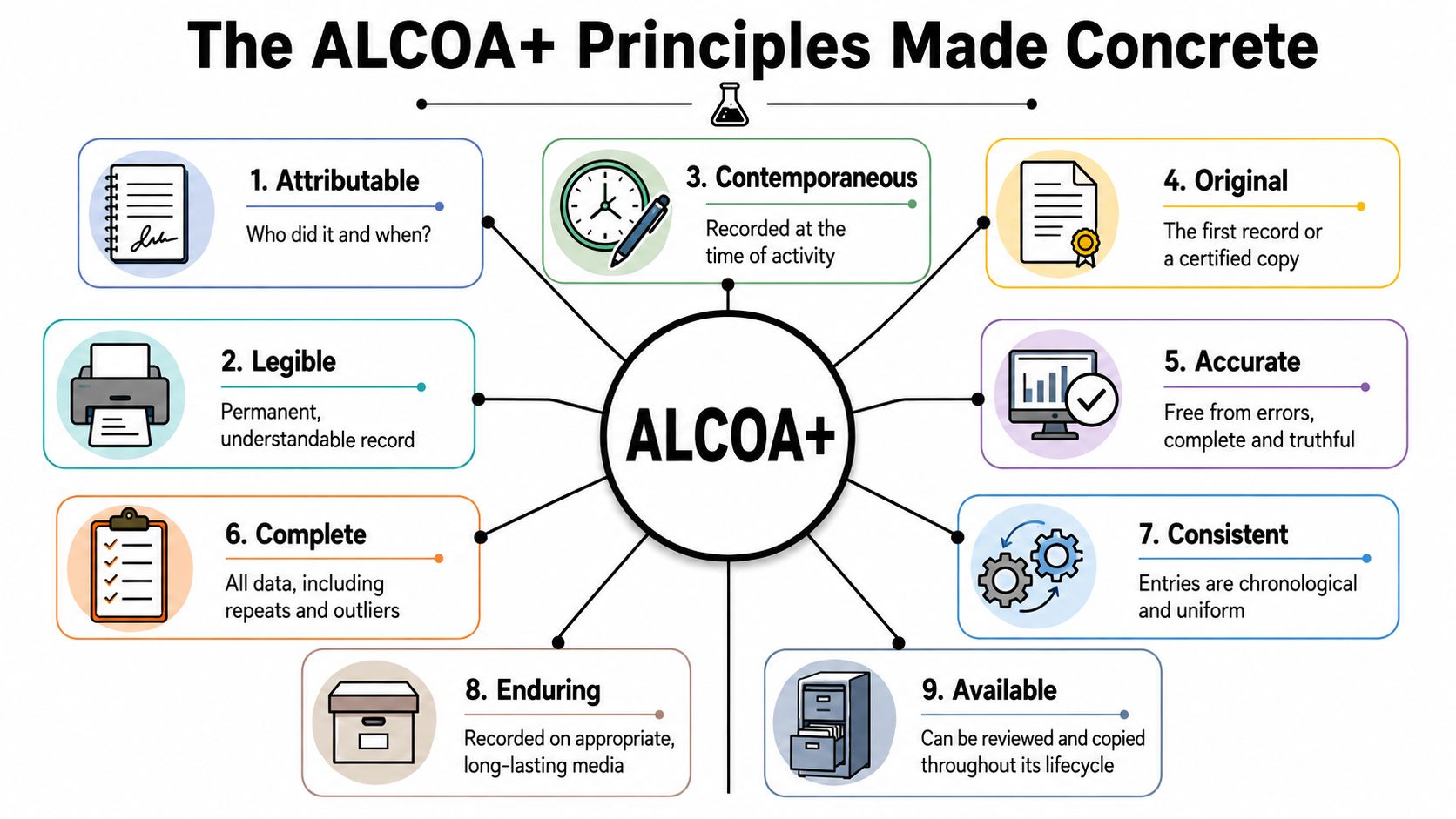
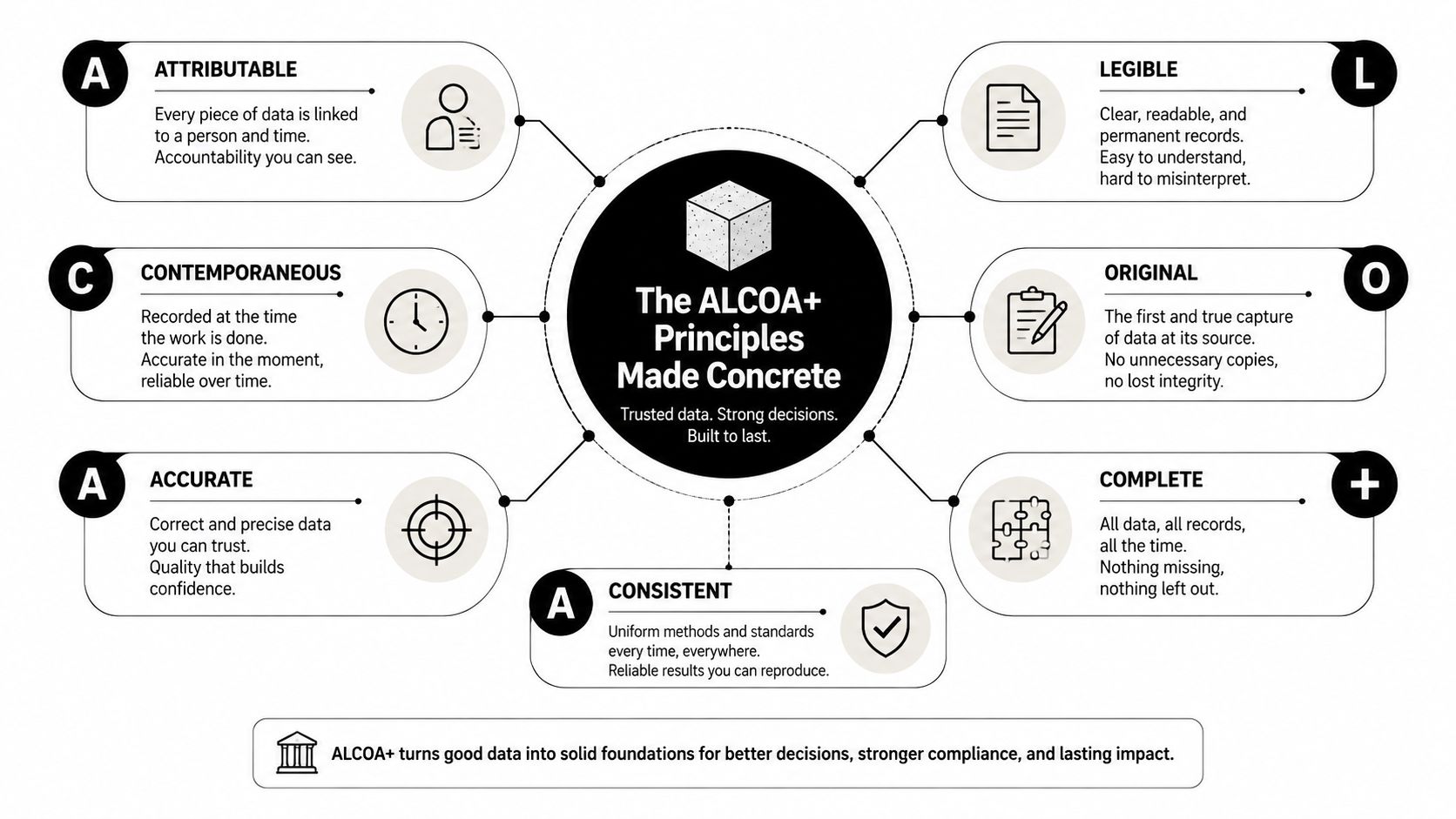
A bench notebook is only useful if someone else can follow it later. ALCOA+ becomes practical when each attribute is treated as a pass, fail test for every record that leaves the bench. A record that fails one test may still exist, but a later reviewer may not be able to trust it.
The first five attributes, one bench example each
Attributable means the record shows who did the work and, where relevant, which instrument or system captured it. A vial log that names the analyst, the balance, and the timestamp does this cleanly.
Legible means the record can still be read and understood later. A scanned page that's crisp and searchable is better than a blurred photo of a notebook corner.
Contemporaneous means the entry happens when the activity happens, not later from memory. A weight written down at the same minute the balance reading appears is defensible, a value copied into the LIMS hours later is weaker.
Original means the first capture is retained, or a certified copy is created under controlled conditions. Raw instrument files and event logs matter here because summaries alone rarely preserve enough context.
Accurate means the record reflects what really happened, without hidden edits or loose transcription. That includes using calibrated devices and keeping corrections visible instead of wiping away the first entry.
Practical rule: if the first record disappears, the later report inherits a trust problem.
The additional four attributes many labs underweight
Complete means nothing material is missing, including repeats, exceptions, and metadata. A tidy file that omits outliers may look cleaner, but it doesn't reconstruct the event.
Consistent means the story matches across documents, timestamps, and units. If the notebook, LIMS, and report disagree, the reviewer has to ask which one is true.
Enduring means the record survives the retention period in a usable form. Backed-up PDFs are safer than fragile files that depend on one local machine or one software version.
Available means the record can still be found and opened when needed. A perfect archive that nobody can retrieve is not much use during review or inspection.
Upstream material quality fits into the same chain. A certificate of analysis, cold-chain control, and batch testing are not separate from ALCOA+, they shape whether the record stays credible once the assay begins. If a reagent arrives without traceable qualification, the downstream notebook may be neat, but the study still carries a gap in its evidence trail.
The phrase data integrity in research becomes much more concrete when each attribute is tied to a real record. The phrase data integrity in research becomes a practical checklist for whether a record can survive scrutiny.
Where Integrity Breaks in Real Labs
Most integrity failures don't start with fraud. They start with shortcuts, understaffed handoffs, and assumptions that a “good enough” control will hold forever. That's why the practical question isn't whether people are honest, it's whether the process still preserves the record when work gets busy.
A reagent switch that looked harmless
A lab changes suppliers to reduce cost. The new diluent arrives with a short-spec sheet, but the team accepts it without a full certificate of analysis, batch review, or inbound verification. Months later, the assay refuses to reproduce, and the root cause turns out to be a trace contaminant in the new material.
The missing control here is upstream qualification. Without batch-level documentation and lot traceability, the downstream data may still be real, but the study can't prove what material was used.
A weight written on scrap paper
An analyst weighs a sample, scribbles the number on scrap paper, and enters it into the LIMS after a break. The value may be correct, but the contemporaneous link is gone, and nobody can tell whether the transcription was exact or reconstructed from memory.
The missing control here is the primary record at the moment of activity. A later entry creates a gap that no amount of neat formatting can fully repair.
An instrument moved, but not re-qualified
A balance is moved between rooms, then put back into service without re-verifying calibration status. The drift is small enough to escape casual review, but it affects the whole study.
The missing control here is change control tied to equipment qualification. Location changes, servicing, and recalibration need to be part of the same integrity story, because the record is only as sound as the device that generated it.
The useful correction is simple. Integrity failures are usually procedural, not malicious. That's why a lab manager has to look first at handoffs, approval paths, and verification habits before assuming the problem is bad intent.
End-to-End Practices That Protect Every Record
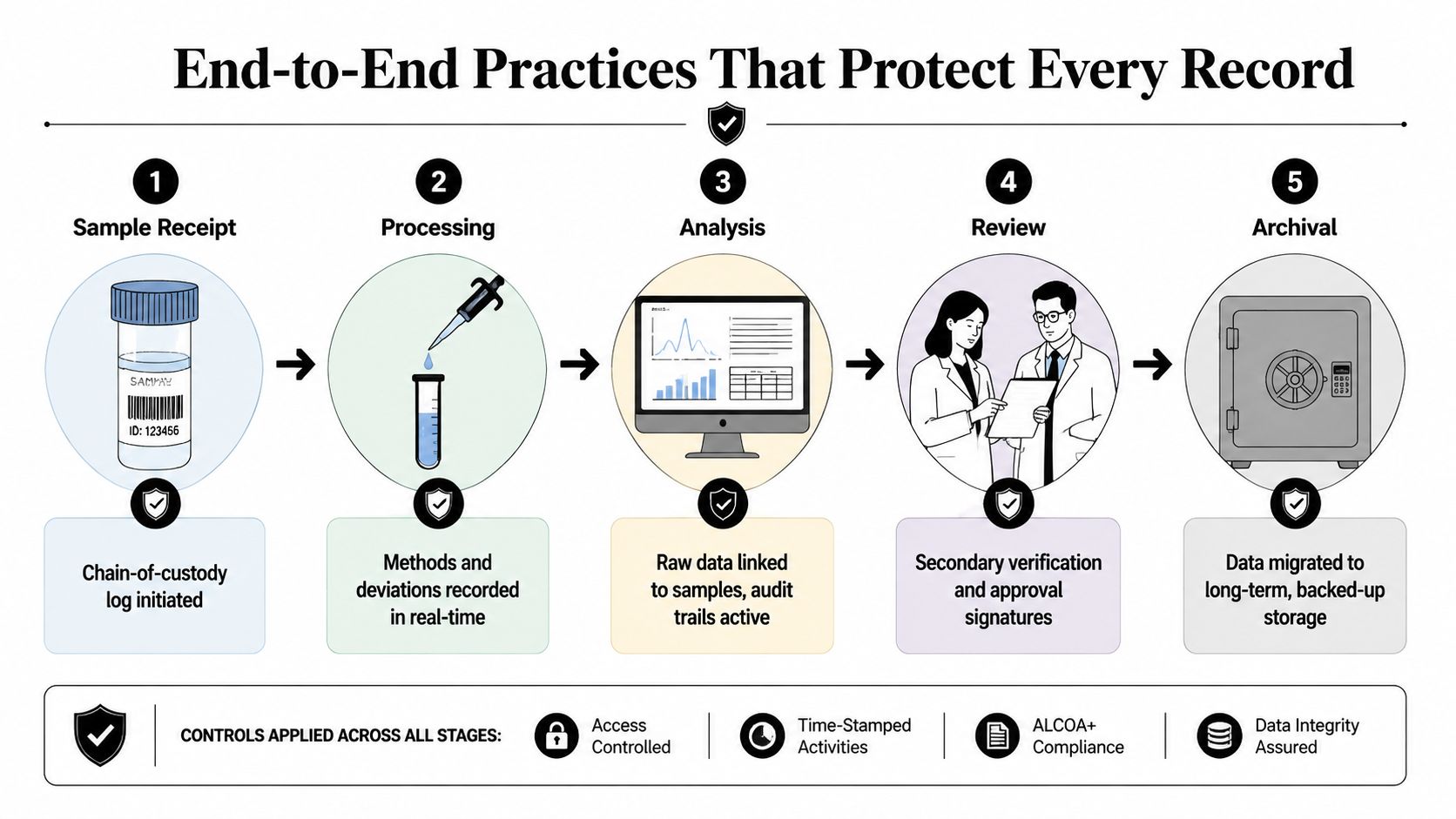
A strong integrity system is built at every handoff. Sample receipt, reagent use, instrument status, data capture, processing, review, and archive all need a control that matches the risk at that point. If one step is weak, the later steps can't fully rescue the record.
Controls that belong at each hand-off
- Sample receipt: use a chain-of-custody log that captures who received the material, when it arrived, and whether the condition matched expectations.
- Reagent handling: tie every lot to its certificate of analysis and storage condition, because later attribution depends on knowing exactly what was used.
- Instrument use: gate work by calibration records and qualification status, so data aren't generated on a system that's out of state.
- Data capture: use validated ELN or LIMS templates that force the right metadata fields instead of relying on memory.
- Data processing: keep versioned scripts and preserve raw data alongside processed outputs, so the calculation path can be rebuilt.
- Backups: keep offsite copies and test restores, because a backup that can't be restored is only an assumption.
- Audit trails: review who changed what and when, not just whether a file exists.
- Training and SOPs: make sure people know which control protects which record, so the system doesn't depend on one person remembering everything.
Practical rule: every handoff should answer one question, “what proves this record still means what it said when it was created?”
How a manager can check the system weekly
A weekly review doesn't need to be grand. It just needs to catch drift before drift becomes practice. Spot-check audit trails for unexplained edits, confirm one backup can be opened, review freezer and cold-storage logs, and clear open deviations before they pile up.
The goal is not to chase perfection. It's to keep the chain of evidence intact while the work is still fresh enough to fix.
How Reliable Reagent Sourcing Underpins Integrity
Integrity starts before the first pipette tip is picked up. If the input material is undocumented, mishandled, or impossible to trace, downstream controls are trying to defend a weak foundation. A lab can do everything right at the bench and still lose the integrity argument if the reagent story is incomplete.
Four sourcing questions that matter
| Integrity Dimension | What It Protects | Evidence to Request | Example From a Qualified Supplier |
|---|---|---|---|
| COA transparency | Batch identity and specification matching | Batch-specific certificate of analysis, lot number, release details | A complete certificate shipped with the vial and matched to the label |
| Cold chain integrity | Material state during storage and transit | Temperature-controlled storage logs, shipping conditions, dispatch timing | Controlled storage and same-day dispatch reduce avoidable temperature exposure |
| Batch testing | Confidence that material meets stated specs | Identity, purity, and contaminant testing information | Batch testing against purity benchmarks before release |
| Traceability | The ability to reconstruct where the vial came from | Lot number linkage, production record, supplier documentation | A lot number that connects the vial to manufacturing records |
A practical supplier review should start with those four questions, not with marketing copy. If the answers are vague, the later data trail will carry that weakness forward.
What a supplier should be able to show
Herbilabs is one example of how those controls can be presented in practice, with a dedicated production facility since 2018, batch testing against 99%+ purity benchmarks, clear COAs with shipments, and temperature-controlled storage with same-day dispatch. The internal guide on how to read a certificate of analysis is useful here because it trains staff to look past the label and into the batch-specific evidence.
That doesn't make supplier choice a branding exercise. It makes it a risk decision. A reagent with full documentation, intact storage conditions, and traceable lot records gives the downstream record something reliable to stand on, while a vague source pushes uncertainty into every later result.
A Practical Integrity Checklist for Working Labs
A checklist only helps if it becomes a habit. Used once, it creates a false sense of control. Used on a schedule, it becomes the small discipline that stops bigger problems from hiding in plain sight.
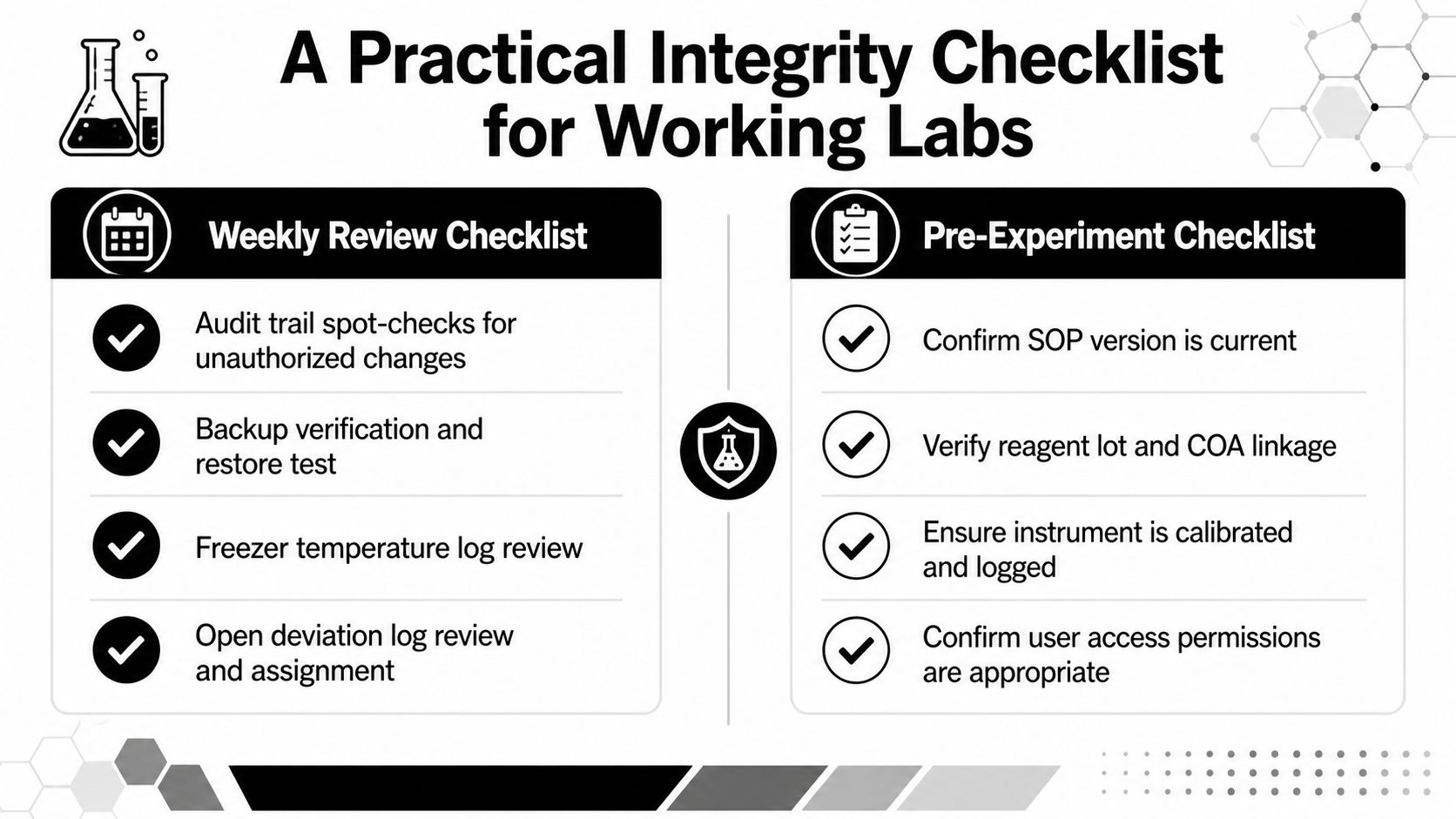
Weekly review checklist
- Audit trail spot-checks: look for edits that don't match the workflow, because unexplained changes weaken attribution and consistency.
- Backup verification: confirm a restore test works, since enduring records have to survive recovery, not just storage.
- Freezer temperature log review: check for unexplained excursions, because sample condition affects the record downstream.
- Open deviation log review: assign owners and due dates, so exceptions don't vanish into routine.
Monthly system checklist
- SOP version control: confirm every active procedure is current, because inconsistent instructions produce inconsistent records.
- Training currency: verify the team is signed off on the systems they use, because a control nobody understands gets bypassed.
- Instrument calibration status: confirm critical equipment is in date, since accurate records depend on fit-for-purpose tools.
- Reagent COA audit: spot-check batch documentation and lot linkage, because receipt controls matter long before analysis.
A good manager pins this list near the team board and uses it in the meeting, not as a one-time cleanup tool. The routine matters more than the format.
Treating Integrity as One Connected System
The cleanest way to think about integrity is as one chain from supplier to archive. A missing COA at receipt weakens later attribution, an unsigned ELN page weakens later review, and an uncalibrated instrument weakens the raw data before anyone sees the chart. The weak link doesn't stay local, it spreads.
The most useful first move is usually narrow. Pick one recurring handoff, such as reagent receipt, and apply every ALCOA+ attribute to it, then expand to the next handoff once that process is stable. The internal traceability guide on lot number traceability fits that mindset because it makes upstream documentation part of the same system as downstream review.
A lab that treats integrity this way stops chasing separate problems and starts building one reliable workflow. That is the standard.
If your lab needs reagents, batch documentation, and temperature-controlled fulfillment that fit into a serious integrity program, visit Herbilabs and review the product and documentation standards before your next order. Their supplies are built for teams that need traceability to continue after the shipment arrives, not stop at the bench.


