Private Label, White Label, Wholesale partnerships available - EU, USA and UK - Free shipping from €75
Achieve ISO Certification Compliance for Lab Suppliers
The audit notice landed on a Friday afternoon, right when the lab-supply team was trying to clear backorders, check batch records, and answer a customer complaint about a certificate of analysis. That's the moment ISO certification compliance stops feeling abstract and starts looking like a production issue, a documentation issue, and a commercial issue all at once. For suppliers and distributors serving regulated buyers, the primary pressure isn't the certificate on the wall, it's proving that the system behind it still works when orders are moving, staff are busy, and an auditor starts asking for evidence.
Independent market research estimates the global ISO certification market was worth US$16.14 billion in 2024 and is projected to reach US$66.25 billion by 2034, which signals how significantly compliance has moved into normal business operations Fact.MR market forecast. For lab teams, that growth isn't just an industry headline, it reflects how often buyers now expect documented quality controls, traceable records, and audit-ready processes before they'll approve a supplier.
A useful starting point is to treat compliance like a controlled release process. Every document, approval, and corrective action needs to be in the right place before the shipment, not after the complaint.
Table of Contents
- Introduction to ISO Certification Compliance
- Understanding Key ISO Standards for Lab Suppliers
- Core Elements of Effective ISO Certification Compliance
- Preparing for ISO Audits Checklist
- Addressing Sector Specific Challenges for RUO Reagent Producers and Wholesalers
- Common Nonconformities and How to Resolve Them
- Maintaining Continuous Compliance and Selecting Certification Bodies
- Conclusion Best Practices and Next Steps
Introduction to ISO Certification Compliance
A reagent producer can run a smooth week, then receive notice of an external audit and find that every folder, label, calibration record, and supplier file suddenly matters. That is the practical side of ISO certification compliance, a system that shows whether a company can keep quality consistent while normal work continues. It is a disciplined way to prove that the business knows what it does, documents what it does, and can repeat it reliably.
For lab-supply teams, the first question is often simple. Which certification body is being used, and is it properly accredited for the standard being claimed? A procurement checklist should verify that point before a contract is signed, just as a buyer would confirm a distributor's cold-chain packaging before accepting temperature-sensitive material. Teams also need the evidence trail behind that decision, which is why many keep their records aligned with regulatory compliance documentation guidance.
That shift matters because ISO adoption is not niche. In the ISO Survey analysis of 2024, ISO 9001:2015 certificates rose from 837,052 in 2023 to 1,474,118 in 2024, and ISO 14001:2015 certificates increased from 300,410 to 676,232 over the same period ISO Survey 2024 analysis. Those figures show how widely quality and controlled processes are embedded across global supply chains.
For lab-supply teams, the value is practical. Customers want confidence that a lot was handled correctly, documents match the shipment, and issues are corrected instead of repeated. The same discipline also helps with traceability when records must support multilingual markets, which is why some teams keep a reference point for best practices for certified translation services.
Understanding Key ISO Standards for Lab Suppliers
A lab-supply team preparing for audit often finds the same problem at the counter and in the filing cabinet, the standards sound similar, but they answer different questions. ISO 9001 covers the quality-management system, ISO 17025 covers the technical competence of testing and calibration laboratories, and ISO 14001 covers environmental management, which becomes relevant when a supplier handles waste, chemicals, packaging, or storage conditions.
ISO 9001 and ISO 17025 serve different jobs
ISO 9001 is often the first standard a distributor meets because it defines how the business controls its work from order to shipment. For lab-supply teams, that means documented purchasing, receiving, handling, storage, shipping, complaints, and corrective action. The broader adoption of the standard also explains why it shows up so often in supply-chain conversations, as noted earlier in the ISO Survey 2024 analysis.
ISO 17025 serves a different purpose. It applies when a business performs testing, calibration, or analytical work and must show that the method itself is technically sound. A wholesaler that sends out third-party COAs may not need 17025 for the whole operation, but an in-house lab that verifies purity, identity, or instrument performance may need it for the testing function.
A simple rule helps here. If a company is proving how it runs, ISO 9001 usually anchors the system. If it is proving how a lab test is technically performed, ISO 17025 becomes the standard to examine.
| Standard | Scope | Key Focus | Applicability |
|---|---|---|---|
| ISO 9001 | Quality-management system | Consistent processes, customer requirements, corrective action | Manufacturers, distributors, wholesalers, and service operations |
| ISO 17025 | Testing and calibration competence | Technical validity, method control, measurement reliability | Laboratories, in-house testing units, calibration functions |
A procurement checklist should also verify the certification body behind the certificate. A certificate is only as useful as the body that issued it, so lab-supply teams should confirm accreditation before signing a contract, the same way they would confirm a shipping temperature range before accepting sensitive material. The best practices for certified translation services are also useful here, because multilingual certificates, manuals, and procedures can create confusion if the wording is not checked carefully.
Where ISO 14001 fits into the picture
ISO 14001 does not replace quality requirements, but it matters when storage, disposal, packaging, and transport create environmental obligations. The 2024 survey also showed stronger use of ISO 14001 in many sectors, which reinforces that environmental controls are part of ordinary business control, not a side project ISO Survey 2024 analysis.
For lab suppliers, the practical test is simple. If a process creates waste, spill risk, packaging pressure, or storage concerns, the environmental system should cover it the same way the quality system covers order accuracy. A certificate may open the conversation, but the procedures behind it decide whether the system holds up under review.
Practical rule: choose the standard based on the process being judged, not on the certificate that looks most impressive in a sales deck.
Core Elements of Effective ISO Certification Compliance
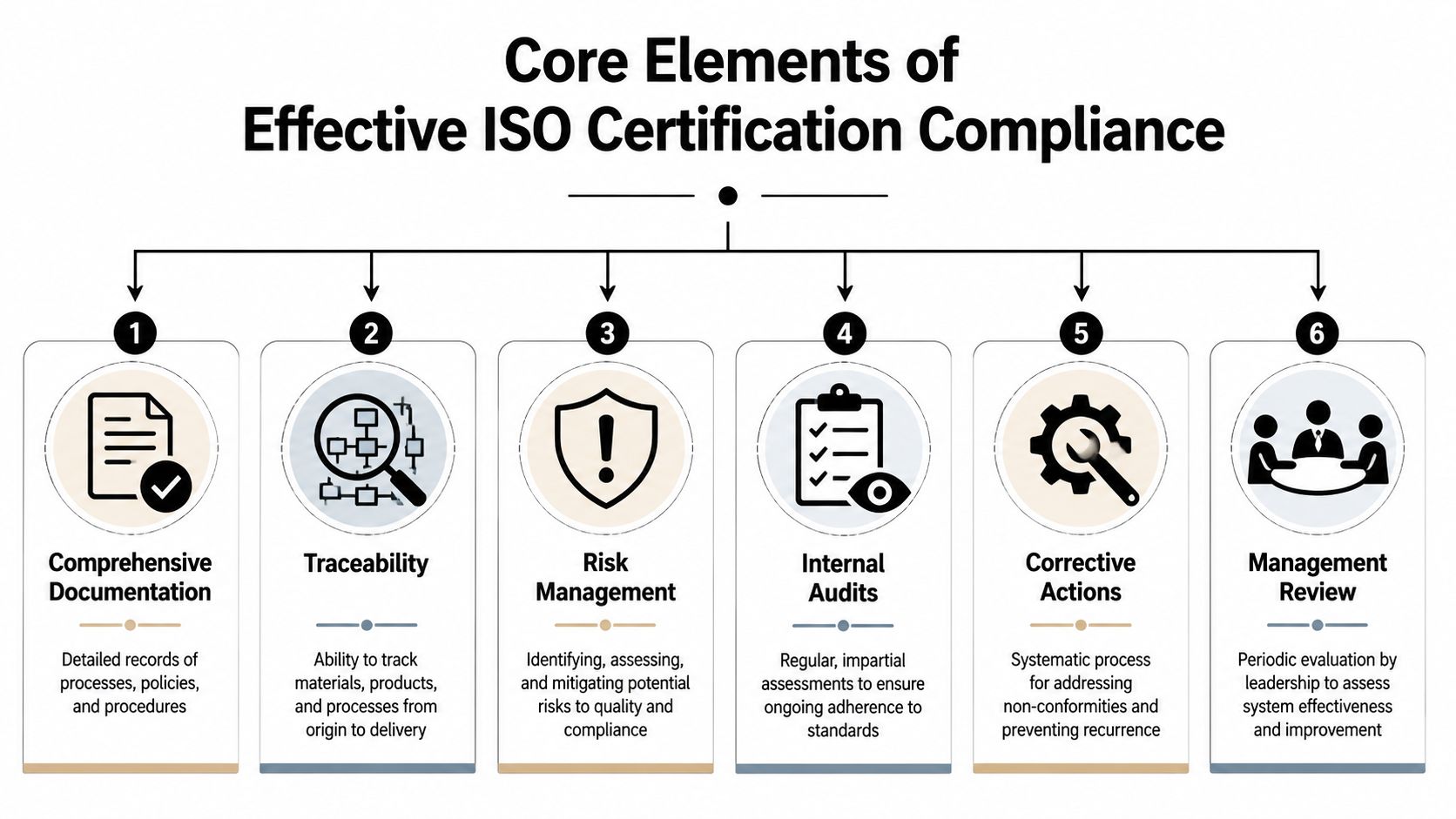
A compliant system isn't built from templates alone. Auditors look for a management system that's operating, with documents in use, records that connect to real transactions, and managers who review problems instead of just filing them away. That is why ISO certification compliance has six core building blocks for lab-supply businesses, and each one needs to be visible in day-to-day work.
Documentation and traceability make the system auditable
Documentation is more than a shared drive full of PDFs. It means procedures, forms, instructions, and records are controlled, current, and used by the people doing the work. For a reagent distributor, that can include receiving procedures, storage requirements, lot records, COAs, and dispatch checks.
Traceability connects the paperwork to the actual product journey. If a customer questions a vial, the team should be able to trace the batch from receipt or production through storage, handling, and shipment without stitching together guesses from email threads. That's where well-structured records prevent panic, because the evidence already exists.
The same principle applies to supplier oversight and raw materials. If a supplier certificate is missing, or a batch has an unresolved deviation, the system should show that the item was held, reviewed, and released or rejected through a controlled decision. A clean trace chain makes it easier to defend a result and easier to fix a problem.
CAPA, internal audits, and management review keep the system alive
Corrective action is not just “fix the file.” It means the team finds the root cause, addresses the defect, and checks whether the fix worked. In a lab-supply setting, that might mean changing a packaging step, retraining staff on label verification, or tightening supplier approval criteria after a nonconformance.
Internal audits are the company's rehearsal for the certification audit. They work best when the auditor is independent from the process being checked and asks hard questions about evidence, not intentions. Management review then closes the loop, because leaders have to see recurring issues, resource needs, audit outcomes, and improvement priorities in one place.
A strong audit trail is built before the auditor arrives. If the evidence only exists after a request, the process is already weak.
For a practical testing and verification example that supports this kind of control mindset, teams often align these routines with quality control testing guidance. ISO certification compliance requires an implemented management system, internal audits, management review, corrective actions for nonconformities, and an external audit by an accredited certification body, with annual surveillance audits and typically a three-year recertification cycle to preserve validity Scrut ISO 27001 guide.
Preparing for ISO Audits Checklist
An audit usually goes smoother when the team treats it like a staged release, not a surprise inspection. The common failure mode is simple, certification projects collide with peak production or launches, and corrective actions stay incomplete because no one protected the schedule Insight Assurance on ISO challenges.
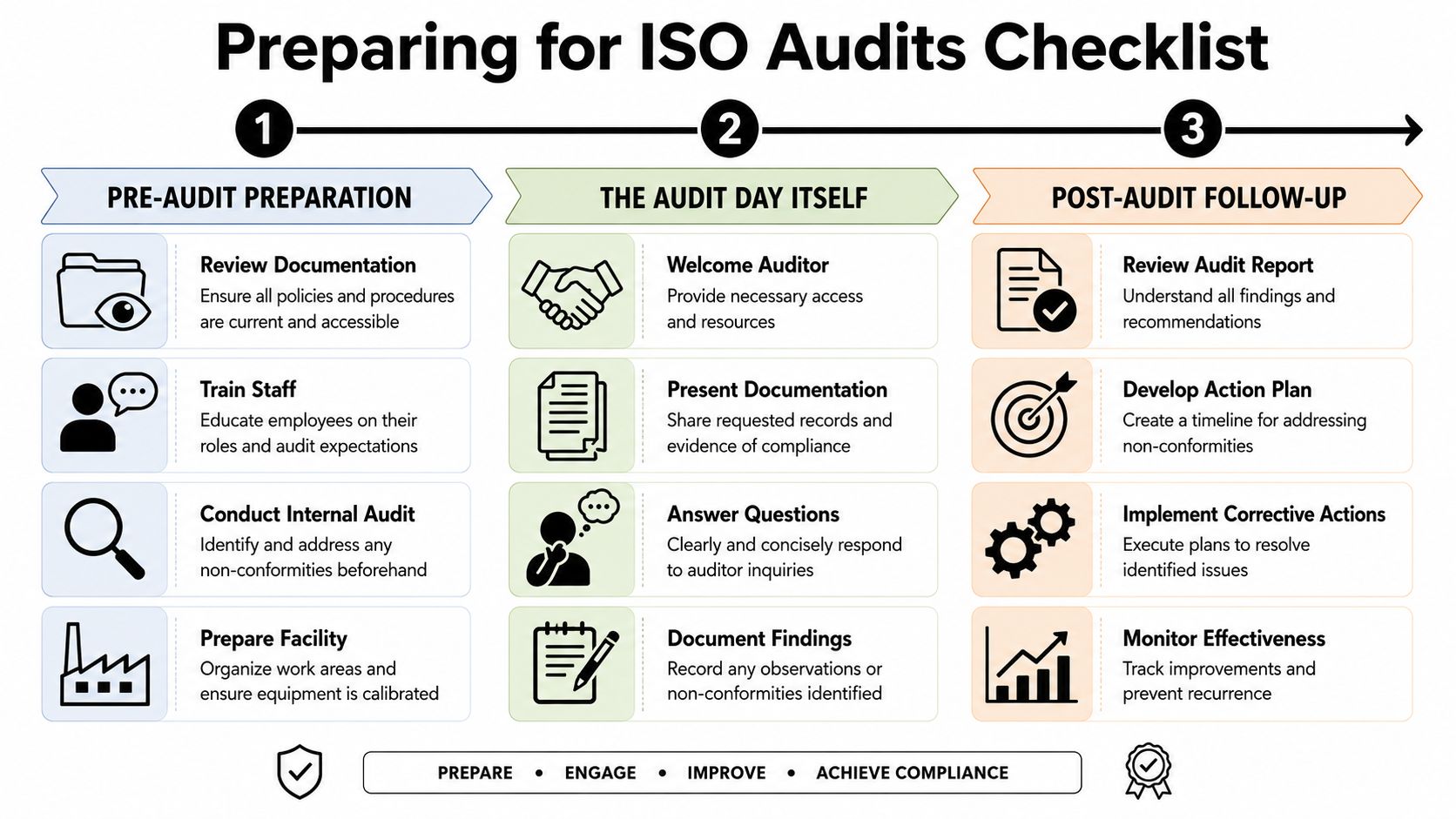
Pre-audit preparation
Before the auditor arrives, the business needs current procedures, complete records, and people who know where evidence lives. A gap review should look for missing approvals, outdated forms, training gaps, and unresolved nonconformities. Internal mock audits help here because they expose weak spots while there's still time to fix them.
A practical pre-audit list looks like this:
- Review documentation: confirm procedures, work instructions, and forms are current and approved.
- Train staff: make sure people can explain their tasks, the forms they use, and what to do when something goes wrong.
- Conduct an internal audit: test the system like an outsider would, then log findings clearly.
- Prepare the facility: check equipment status, labels, storage areas, and access to records.
Audit day and follow-up
On audit day, the team should welcome the auditor, present requested records quickly, and answer questions with facts instead of guessing. If a record is missing, the right response is to say so and explain the control that should have prevented the gap, not to improvise an answer. That kind of honesty often does more for credibility than a rushed explanation.
The follow-up matters just as much. Findings should be reviewed, action owners assigned, deadlines set, and effectiveness checked after correction. If the same issue appears again, the original fix wasn't strong enough, which means the team needs root-cause discipline rather than another document patch.
The checklist image below can sit beside the team's audit prep board, because visual cues help people track what's done and what still needs work.
A short training walk-through also helps teams remember the sequence.
Addressing Sector Specific Challenges for RUO Reagent Producers and Wholesalers
RUO reagent work adds pressure because the product, the label, and the paperwork all have to stay aligned. A bottle can be technically correct but still create trouble if the disclaimer is vague, the batch record is incomplete, or the temperature log doesn't cover the whole storage path. That's why RUO compliance needs to sit inside the broader ISO system instead of being handled as a separate afterthought.
Batch records and labels need to tell the same story
For RUO producers, every lot should have a clear identity, a defined specification, and a COA that matches the product shipped. If the label says one thing and the COA says another, customers lose trust quickly, and auditors start asking whether the process control is weak or whether the release step is poorly defined. The safest approach is to link batch testing, packaging, and labeling under one controlled review before release.
The Research Use Only definition and compliance context is especially useful for teams that sell across borders or through distribution partners. RUO wording has to remain clear enough that downstream users understand the intended use, but consistent enough that sales, operations, and quality teams aren't improvising their own versions.
Temperature control and supplier qualification matter more than many teams expect
Cold chain records are part of traceability, not a side log. If a product requires controlled storage, the business needs evidence that conditions stayed within the defined range during receipt, storage, picking, and shipment. When a distributor outsources warehousing or uses third-party logistics, supplier qualification becomes part of product quality, not just procurement housekeeping.
A useful internal question is this, can the team prove that the product stayed fit for use from receipt to dispatch without relying on memory? If the answer is shaky, the system isn't ready for the kinds of questions that arrive during audits or customer reviews.
Operational shortcut to avoid: don't separate “quality files” from “shipping files.” For RUO products, they should connect, because the shipment is part of the quality story.
Common Nonconformities and How to Resolve Them
Audit findings in lab-supply environments usually look small on paper, then turn out to point at bigger process issues. A missing signature might really be a training gap, a late COA might reflect a release bottleneck, and a weak supplier file may show that procurement and quality never agreed on the approval rule. The trick is to treat each finding as evidence of a system weakness, not as an isolated annoyance.
Outdated procedures and weak records
Outdated procedures often appear when teams grow fast or change software, but the document control process doesn't keep up. The fix starts with one owner for each controlled document, a review date, and a clear rule for removing obsolete versions from use. If the process is simple enough that staff can't accidentally pick the wrong version, audit risk drops immediately.
Poor traceability records usually point to habits, not bad intent. Operators may be doing the right thing but skipping a field, or a system may allow critical data to be entered later from memory. The remedy is to tighten the workflow so the record is created at the point of work, not reconstructed afterward.
Supplier control and CAPA closure
Supplier lapses are common when purchasing focuses on price or speed without tying approval to documented quality criteria. A stronger approach is to define what evidence a supplier must provide, how often it gets reviewed, and what happens when a certificate, COA, or performance issue appears. That keeps the approval decision repeatable instead of personality-driven.
CAPA problems often come from closing the ticket too early. A correction is not the same thing as a corrective action, and auditors usually know the difference fast. An effective fix includes root cause, implementation, verification of effectiveness, and a follow-up check after the change has had time to prove itself.
If a team wants a simple test, ask whether the same issue would recur if the original person went on leave tomorrow. If the answer is yes, the action plan needs more substance.
Maintaining Continuous Compliance and Selecting Certification Bodies
Compliance only stays valid when the business treats it like an ongoing cycle. Internal audits need a calendar, management review needs a regular cadence, and changes in products, sites, storage, or outsourcing need to pass through formal control before they hit the floor. That is especially important when a lab-supply business grows from one site to several, because the same procedure can behave differently once inventory, people, and equipment are spread out.
Keep the system live between audits
The best-run systems don't wait for surveillance visits to discover gaps. They keep small, repeatable checks running, so nonconformities are visible while they're still easy to fix. The team should also keep change control tight, because a new warehouse, a new packaging line, or a new distributor relationship can change the scope of the certification without anyone noticing.
Training helps here, especially when responsibilities shift or new staff join quickly. A good place to reinforce that habit is VideoLearningAI's compliance training best practices, because strong training programs make it easier for operations, quality, and sales to work from the same rules.
Verify the certification body before signing anything
Choosing the wrong certification body can create expensive confusion. Accredited ISO certification requires an independent certification body recognized by an accreditation body, and verifying through IAF member lists helps confirm that the certificate is valid and scoped correctly Advisera on accredited ISO certification.
A practical procurement checklist should include:
- Check accreditation status: confirm the certification body is recognized by an accreditation body, not just listed as “ISO friendly.”
- Match the scope carefully: make sure the certificate covers the actual site, activity, and product family being sold.
- Verify the certificate holder: confirm the legal entity name matches the company receiving the audit.
- Review site coverage: ensure the certificate includes the locations that handle the relevant work.
- Confirm validity in the IAF chain: use the member list path so the certificate can be checked independently.
That approach helps buyers, distributors, and procurement teams avoid weak claims and unscoped certificates, which can look fine in a sales proposal but fail during due diligence.
Conclusion Best Practices and Next Steps
ISO compliance gives lab-supply teams more than an external certificate. It creates a working discipline around documents, traceability, supplier controls, audits, and corrective action, and those habits are what customers trust when orders are urgent and product integrity matters. The companies that do this well usually don't treat compliance as a separate department, they treat it as part of how the business runs every day.
The next steps are practical. Select an accredited certification body, schedule a gap analysis, assign audit owners, and lock in a review rhythm before the first external audit date gets close. After that, keep the system alive with internal audits, change control, and leadership review, because that's what makes the certificate believable long after the first issue closes.
For teams building a stronger compliance roadmap, useful support still comes from templates, accreditation registries, and peer forums. The goal is simple, make the process clear enough that the organization can prove control without scrambling when someone asks for evidence.
A CTA for Herbilabs is to review your current compliance files, map your audit gaps, and align your certification path with a supplier model built for traceable, audit-ready operations.


