Private Label, White Label, Wholesale partnerships available - EU, USA and UK - Free shipping from €75

Customer Service Responsiveness for Lab-Supply Wholesalers
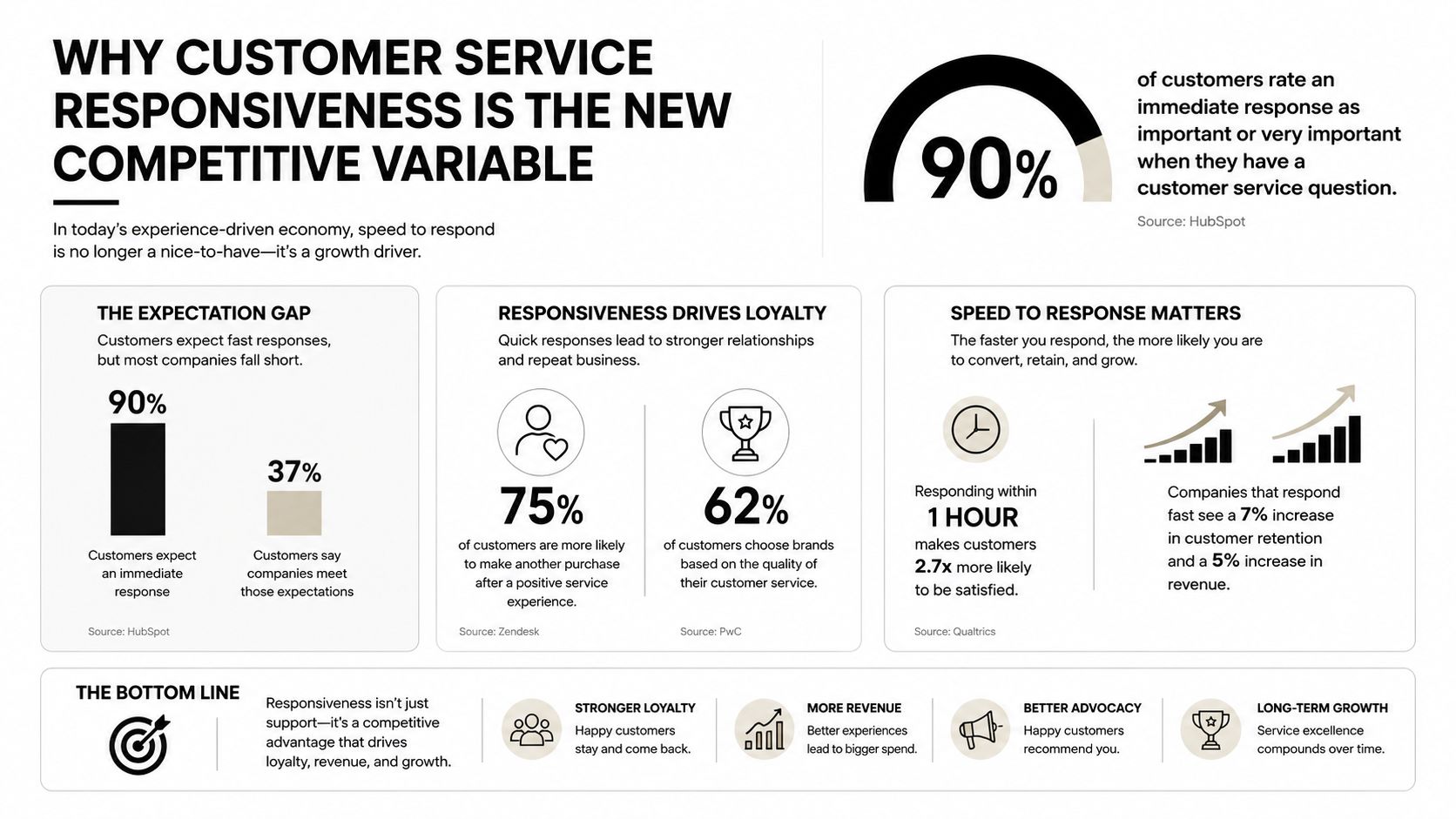
A 12-hour average first response time is colliding with customer expectations measured in minutes. A widely cited 2026 benchmark reports that only 37% of companies meet expectations for response speed, while 89% of customers expect a reply within one hour and another benchmark records 82% expecting a sales response within 10 minutes. (2026 customer response-time benchmark)
For a lab-supply wholesaler, responsiveness isn't just the time before an agent sends a greeting. It determines whether a delayed cold-chain shipment is contained, whether a Certificate of Analysis reaches procurement before an internal deadline, and whether a distributor receives a credible answer before switching suppliers. The right operating model treats speed, accuracy, ownership, and escalation as one service discipline.
Table of Contents
- Why Customer Service Responsiveness Is the New Competitive Variable
- Defining Customer Service Responsiveness for Lab-Supply Operations
- Channel-by-Channel Response Expectations and Constraints
- KPIs That Actually Measure Responsiveness in Distribution
- Setting Tiered SLAs for Wholesale and Distribution Partners
- Practical Scenarios From the Herbilabs Partner Network
- Measuring and Reporting Responsiveness Over Time
- Best Practices and a 90-Day Responsiveness Rollout Plan
Why Customer Service Responsiveness Is the New Competitive Variable
Responsiveness has become a competitive variable because research-use orders can fail in ways a blended support average hides. A delayed shipment, inaccurate COA, or compromised cold-chain package creates operational risk before a customer-service dashboard shows a problem. The right response model measures how quickly the correct team acknowledges the issue, takes ownership, provides a credible update, and confirms closure.
A single target for every channel is poor operations. Phone calls, live chat, procurement email, WhatsApp distributor requests, and public social-media questions carry different urgency, context, and risk. Customer service responsiveness is a channel-by-channel design problem. Each channel needs its own SLA, escalation path, and reporting cadence.
The cost of a slow acknowledgment
Research-use buyers judge a wholesaler after an exception appears. A shipment may miss its expected timing, a COA may contain an inconsistency, or a temperature-controlled package may require immediate review. A quick but vague reply leaves the buyer exposed. A technically correct answer that arrives after the buyer has made another arrangement may still lose the order.
Responsiveness has three operating dimensions:
- Acknowledgment: The customer knows the request reached the right team.
- Progress: The customer receives a named owner, next action, and update time.
- Closure: The customer receives the verified answer, remedy, or documented reason for delay.
Published research links responsiveness positively and significantly with customer retention. (Research on responsiveness and retention) For distributors, the consequence is practical. Slow acknowledgments create uncertainty, repeat contacts, account-manager intervention, and avoidable pressure on renewals.
Operational rule: A first reply should reduce uncertainty, not merely prove that a ticket exists.
A Herbilabs-style B2B partner should publish channel-specific SLAs, assign P1 escalation rules for cold-chain and quality-document exceptions, and review performance weekly. The dashboard should separate shipment timing, COA accuracy, and cold-chain cases instead of hiding them inside one monthly average. That reporting makes it clear whether the right customer received the right response quickly enough.
Defining Customer Service Responsiveness for Lab-Supply Operations
A useful definition must describe the complete service event, not just the first timestamp. Customer service responsiveness is the time and quality gap between a partner raising an order, documentation, compliance, or shipping question and the wholesaler acknowledging it, advancing it, resolving it, and confirming closure through the appropriate channel.
That definition separates responsiveness from related measurements. CSAT indicates how the customer felt about an interaction. Ticket volume shows demand. Average handle time shows agent workload. None of those metrics proves that an urgent COA request was acknowledged promptly or that a shipment exception had a named owner.
Three clocks need separate reporting
The first clock is first-response time, measured from receipt to the first meaningful acknowledgment. An automated receipt can stop the silence, but it shouldn't be counted as a completed service response unless it provides useful status, ownership, or a clear next step.
The second clock is full-resolution time, measured until the customer receives the verified answer or agreed remedy. A COA request may need QA confirmation. A cold-chain concern may need logistics, warehouse, and quality review. Those cases shouldn't be marked resolved because an agent sent a holding message.
The third clock is the update interval. When resolution takes longer, the team must tell the customer what changed and when the next update will arrive. Proactive notices about temperature excursions, backorders, or revised ETAs often prevent repeat contacts more effectively than a faster generic reply.
Definition for a partner handbook
A distribution manager can use this wording:
Customer service responsiveness means acknowledging every partner request within the published channel SLA, assigning an accountable owner, communicating the next action and update time, resolving the request with verified information, and confirming closure. Urgent shipment, quality, compliance, and product-integrity concerns receive priority based on operational risk, regardless of the channel used.
That language establishes the vocabulary before teams negotiate targets. It also prevents a common failure, rewarding an operation for sending fast acknowledgments while customers remain uncertain about ownership and completion.
Channel-by-Channel Response Expectations and Constraints
Each channel creates a different operational bottleneck. Lab-supply wholesalers should set targets around risk, ownership, and available records, not copy generic response benchmarks. A shipment delay, COA discrepancy, or cold-chain concern needs a defined route to logistics or QA, even when the request arrives through a low-priority channel.
Channel-by-channel response targets for lab-supply wholesalers
| Channel | Recommended Service Target | Primary Operational Constraint |
|---|---|---|
| Published business-window target, with urgent cases prioritized | Backlog aging, ticket prioritization, and QA availability | |
| Phone | Immediate queue handling with rapid escalation for urgent cases | Staffing and product-document knowledge |
| Live chat | Fast handling for routine requests, visible human handoff for complex cases | Bot-to-human routing for regulated or complex SKUs |
| Published business-window target | Audit trail, ownership, and distributor time zones | |
| Social media | Prompt initial routing, followed by private service handling | Approved public replies and private escalation |
Email requires prioritization rules before additional staffing. A cold-chain exception should bypass a routine catalog question. A non-urgent university COA request can enter a documented QA queue, provided the owner and expected next action are recorded.
Phone coverage depends on staffing, but headcount alone will not fix weak service. First-line agents need access to product records, COA procedures, safety documentation, and transfer rules for questions requiring QA, warehouse, or logistics review. Supervisors should review missed calls and transfers by channel and issue type.
Live chat handles simple order-status questions efficiently when current order data is available. The handoff must remain visible when a customer raises product-integrity, compliance, or shipment-risk concerns. An AI chatbot for Facebook and Instagram response can support initial routing, but public replies must not expose sensitive order or documentation details.
WhatsApp suits LATAM distributors when every conversation enters the formal service record. Convenience should not create an untracked parallel inbox. A connected supply-chain visibility workflow gives support staff current shipment information, reducing repeated requests for tracking details and making escalation easier to audit.
Social media needs a strict boundary between public acknowledgment and private resolution. Route order, COA, and temperature questions into the owned service queue, then report response and escalation performance by channel. Herbilabs-style B2B operations should publish these rules internally, assign an owner for every exception, and review queue performance on a fixed cadence.
KPIs That Actually Measure Responsiveness in Distribution
A useful responsiveness dashboard shows where partners wait, what they need, and which operational dependency is blocking progress. It must not reward fast closure of easy tickets while COA questions, shipment exceptions, and quality concerns age in the background. For lab-supply distribution, the dashboard should connect queue performance to documentation accuracy, shipment timing, and cold-chain risk.
Five measures belong in the operating review.
The five measures that matter
First-response time by channel shows whether each queue meets its assigned promise. Set targets by intent, not by one blended average. A routine university procurement email can follow a broader business-window target. An active cold-chain concern needs rapid acknowledgment, a named owner, and a recorded next action.
Full-resolution time measures completion rather than reassurance. A quick reply has limited value if the team still has not confirmed a replacement, verified a lot document, or completed a carrier investigation. Report this KPI by issue type and dependency so warehouse, QA, and logistics delays remain visible.
Backlog aging should separate tickets unresolved past 24, 48, and 72 hours. Age often matters more than total volume because one old, high-risk exception can threaten an account while the wider queue appears controlled. Review the oldest cases by risk, partner, and required function, then assign an escalation owner.
Abandonment rate belongs in phone and chat reporting. A low answer time does not prove access if customers leave before reaching someone who can handle shipment-integrity or documentation questions. Pair abandonment data with issue type and time window to identify staffing or routing failures.
CSAT by channel gives a clearer operational signal than one blended score. Email customers may judge completeness and clarity. Phone customers may judge access and confidence. Segment results by channel and partner type, then review negative feedback at account level.
Responsiveness KPI targets for lab-supply wholesalers
| KPI | Standard Tier | Priority Tier | Why It Matters in Distribution |
|---|---|---|---|
| First-response time | Meet the published channel SLA | Acknowledge promptly with a named owner | Shows whether urgency is recognized |
| Full-resolution time | Set by issue type and dependency | Set a firm next-update interval | Separates progress from a holding reply |
| Backlog aging | Review past 24, 48, and 72 hours | Escalate quality and cold-chain cases first | Surfaces work that can threaten renewal |
| Abandonment rate | Track phone and chat separately | Investigate repeated abandonment patterns | Exposes access problems hidden by average speed |
| CSAT | Segment by channel and partner type | Review negative feedback at account level | Connects service experience to relationship risk |
Demote two vanity metrics. Average handle time without context can produce rushed replies and unnecessary transfers. Overall ticket volume without backlog age can make a busy, controlled queue look worse than a smaller queue holding critical exceptions.
Teams setting alert logic and routing rules can consult automation tips for SLAs. Use automation to surface aging, ownership gaps, and missed updates. Keep the decision to close a quality exception with the accountable human owner.
Setting Tiered SLAs for Wholesale and Distribution Partners
A single 24-hour promise is easy to publish and difficult to trust. It treats a university buyer, an independent investigator, a peptide reseller with an active shipment, and a LATAM distributor coordinating multiple orders as if they have the same operational exposure.
The SLA should classify partner type, channel, issue intent, and consequence. A routine COA request and a possible cold-chain failure may arrive through the same inbox, but they don't belong in the same queue.
Tiered SLA matrix by partner type and channel
| Partner Type | Phone | Social | ||
|---|---|---|---|---|
| University procurement | Acknowledge within 12 business hours for non-urgent documentation | Answer within the published phone queue target | Same business-window standard as email | Acknowledge publicly, then move details private |
| Peptide reseller | Under 1 hour for active shipment or product-integrity issues | Sub-30-minute response for an active cold-chain shipment | Under 1 hour during the agreed operating window | Rapid acknowledgment with private escalation |
| Independent investigator | Same-day acknowledgment for routine product questions | Prompt answer during published hours | Same-day response with written record | Move technical or order details to a private channel |
| LATAM distributor | Business-window target aligned to time zone and order urgency | Priority callback for shipment exceptions | Under 4 hours for active distribution issues | Public acknowledgment followed by account-manager ownership |
These are operating examples, not universal promises. The exact SLA should account for business hours, time zones, carrier dependencies, and whether the team can verify the answer without QA or warehouse support.
A published SLA should include five fields:
- First-response window, measured in business or calendar time.
- Full-resolution target, or the next-update commitment when resolution depends on another team.
- Escalation contact, including the role that owns the handoff.
- Customer remedy, such as replacement review, documented investigation, or account-credit assessment where contract terms permit.
- Exclusions and evidence requirements, including information needed to investigate a shipment or lot.
An active cold-chain shipment deserves a tighter phone response than a non-urgent university COA request. Conversely, an SLA shouldn't promise instant final resolution when a carrier or QA team must verify facts. Partners value a credible update more than an impossible guarantee.
For urgent orders, the account handbook can point partners to expedited shipping options, while support retains responsibility for explaining availability and escalation rather than sending customers to search for answers.
Practical Scenarios From the Herbilabs Partner Network
A responsiveness policy proves its value during exceptions. Two cases expose weak support designs quickly: a shipment with possible cold-chain damage and a late request for a verified COA.
Scenario one, a delayed cold-chain shipment
A peptide reseller reports a delayed shipment on Wednesday morning. The carrier record shows the package stuck in transit for 14 hours. Support must treat this as a product-integrity risk, not a routine order-status question.
The triage sequence should be explicit:
- Within 20 minutes: Acknowledge the report, confirm shipment and product details, and assign a logistics owner.
- Immediately after triage: Open the courier claim and record the last verified scan.
- Warehouse decision: Assess whether a replacement can leave the nearest suitable facility.
- Quality record: Document the chain-of-custody gap and preserve carrier evidence.
- Customer update: State what has been completed, what remains unknown, and when the next decision will arrive.
An AI acknowledgment can confirm receipt and collect tracking information. It cannot decide whether the product remains acceptable, authorize a replacement, or communicate a quality conclusion without human review.
Escalation rule: A possible temperature or chain-of-custody failure is P1, regardless of whether the report arrives by email, phone, chat, or WhatsApp.
The account manager should remain visible until logistics and quality close the case. A fast first reply has little value if ownership disappears afterward.
Scenario two, a Friday COA request
A university procurement officer emails at 4:45 p.m. on Friday for a COA covering a lot that has already shipped. The request arrives after the QA team's cutoff, so support must not promise a document before verification.
The system should acknowledge receipt, state the QA handoff time, and identify the Monday owner. The account manager should see the request before the next business window begins, while QA retains responsibility for document accuracy. If the buyer has a deadline, record it in the ticket and escalation path, not only in the email subject line.
The ticket should also preserve the lot identifier, requested document, shipment reference, and any stated deadline. Those fields give QA enough context to investigate without another avoidable exchange.
A bot can reduce uncertainty by confirming intake and routing the request. It cannot replace the person accountable for checking the lot record, correcting a document mismatch, or explaining why release requires review. These scenarios show why responsiveness needs separate rules for shipment timing, cold-chain integrity, and COA accuracy rather than one average response target.
Measuring and Reporting Responsiveness Over Time
Responsiveness deteriorates when teams review it only after a complaint. A weekly dashboard should show first-response time, full-resolution time, backlog aging, channel-level CSAT, and SLA hit rate by partner type and issue category.
The support lead owns ticket-level performance. The account manager owns partner-level patterns, including repeated exceptions, declining channel feedback, and cases that require intervention more than once. Quality, logistics, and warehouse leaders should receive the cases that depend on their decisions, rather than letting support absorb the delay without comment.
The reporting cadence
| Report | Owner | Frequency | Key Metrics |
|---|---|---|---|
| Queue Health Report | Support lead | Weekly | First response, backlog aging, abandonment, SLA hit rate |
| Partner Exception Report | Account manager | Weekly | Repeat shipment, COA, and fulfillment issues |
| Service Review Pack | Account manager with operations | Monthly | CSAT by channel, resolution time, SLA misses, order exceptions |
| SLA Calibration Review | Operations lead | Quarterly | Rolling 90-day medians, breach causes, target changes |
The monthly partner review should pair support data with order volume, COA requests, shipment exceptions, reships, and chargebacks. The purpose isn't to claim that faster replies caused every downstream result. The purpose is to identify whether delays cluster around specific products, warehouses, carriers, or partner types.
Quarterly recalibration should use rolling 90-day medians, not averages. A median shows the typical experience without allowing one extraordinary week to distort the contract. Targets should change only when the underlying workflow, staffing model, or partner requirement has changed.
A named report such as “Cold-Chain P1 Aging” is more actionable than “Support Performance.” A report titled “COA Requests Awaiting QA” tells the responsible manager what to do next. Order-status automation can support this model when connected to accurate records, and order-tracking systems can reduce avoidable status questions without removing human escalation from high-risk cases.
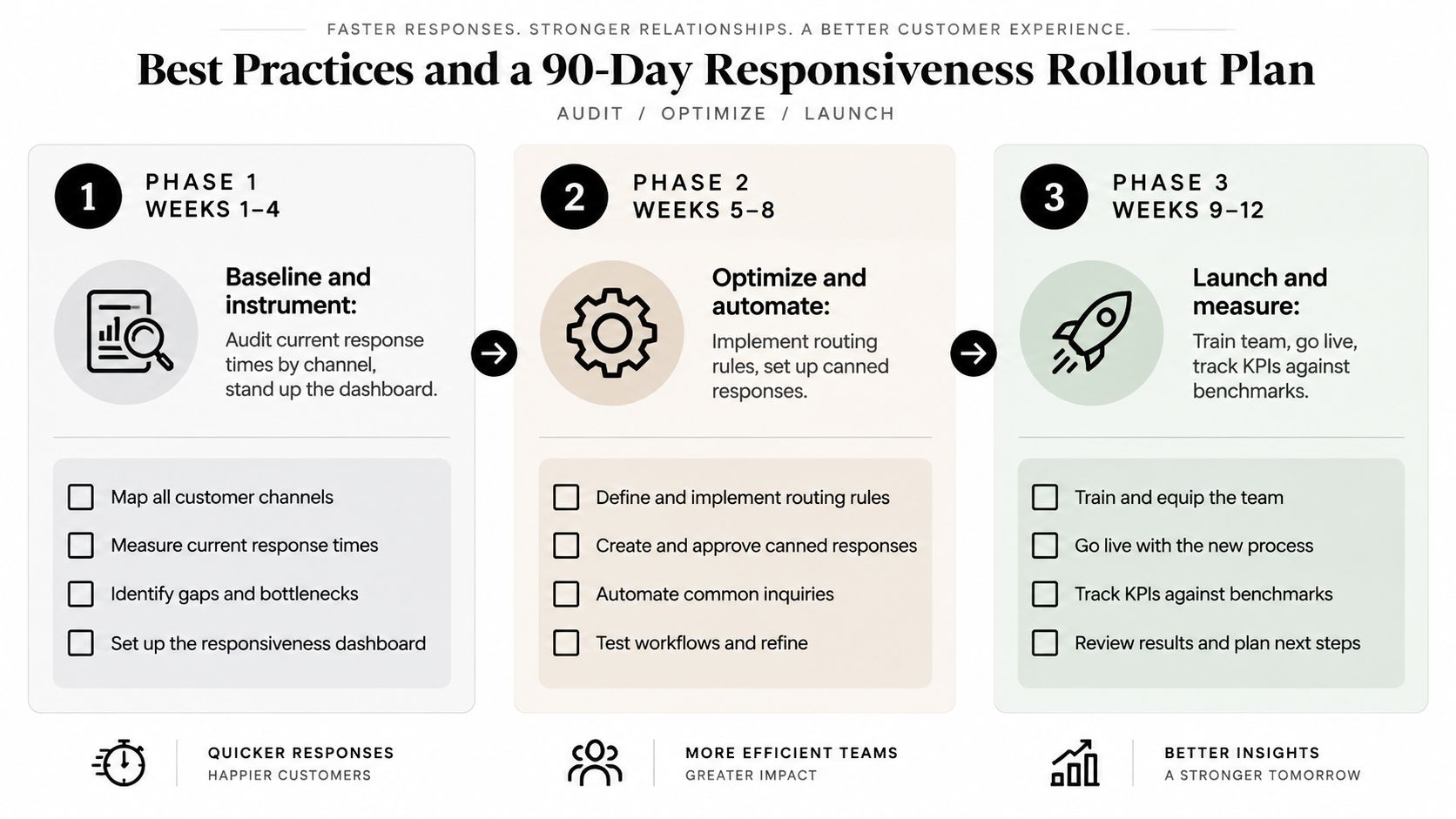
Best Practices and a 90-Day Responsiveness Rollout Plan
Reliable responsiveness comes from operational habits, not a banner promising “fast support.” Four habits separate a dependable wholesaler from a team that merely reports a good average:
- Instrument before promising: Capture timestamps, channel, partner type, issue intent, owner, and closure status before publishing new SLAs.
- Design per channel: Staff and route email, phone, chat, WhatsApp, and social according to their actual constraints.
- Treat risk as the priority signal: COA discrepancies, cold-chain concerns, and product-integrity exceptions outrank routine requests regardless of where they enter.
- Report soft numbers: Partners should see misses, causes, remedies, and corrective actions, not only successful cases.
A cautious automation program can support acknowledgment, categorization, order-status retrieval, and routing. Current coverage also emphasizes that customers may accept AI for initial contact but still want quick human access for complex, high-risk, or emotional issues. One 2026 industry summary reports that AI chatbots resolve 41% of queries without human escalation, up from 18% in 2023, while median first-response time has fallen 47% over three years. The same summary reports that 29% of customers wait 30 minutes or more and only 13% connected with an agent in the past year, showing why faster digital entry points don't guarantee responsive end-to-end service. (AI and human escalation in customer service)
A 90-day rollout
Weeks 1 to 4, baseline and instrument. Audit current response and resolution times by channel. Add backlog-aging views, document every COA and cold-chain escalation path, and identify where tickets lose ownership.
Weeks 5 to 8, publish and pilot. Publish tiered SLAs for a small group of wholesale partners. Configure routing rules, autoresponders, escalation alerts, and approved templates. Test the workflow with two or three partners, then review every breach rather than hiding it in an aggregate.
Weeks 9 to 12, launch and measure. Train support, QA, logistics, and account managers on the new rules. Roll out the dashboard broadly, compare performance with channel benchmarks, and place responsiveness on the standard partner business-review agenda.
A practical checklist should include:
- Queue map: Every channel has an owner, backup owner, and escalation route.
- Priority rules: Shipment integrity, COA, and compliance concerns receive explicit severity levels.
- Customer language: Each SLA states acknowledgment, update, resolution, and remedy expectations.
- Automation boundaries: AI can acknowledge and route, but humans own quality, compliance, and sensitive outcomes.
- Review cadence: Weekly operations review, monthly partner review, and quarterly target recalibration.
Further guidance on customer service best practices for 2026 can supplement the rollout, but the operating standard should come from the wholesaler's own queue data and partner commitments.
Herbilabs offers laboratory supplies, COAs, fulfillment support, and customer assistance through phone, email, social media, and WhatsApp, with wholesale and distribution options for research-use workflows. Visit Herbilabs to review the available supply and partner services, then align the account's response rules with the shipment, documentation, and product-integrity needs that matter most.


