Private Label, White Label, Wholesale partnerships available - EU, USA and UK - Free shipping from €75

Core Supplies for Maintaining Aseptic Research Conditions
This guide covers the critical tools and techniques for upholding sterility and achieving reliable outcomes in a research setting.
The Foundation of Reliable Research Data
Since the pioneering work of Louis Pasteur demonstrated the existence of microorganisms, the fight against contamination has been central to scientific discovery. In modern research, this battle is won or lost based on the integrity of the laboratory environment. An aseptic workspace is not merely clean. It is a meticulously controlled state, free from the microbial and chemical contaminants that can invalidate an entire study.
When these controls fail, the consequences are direct and cascading. A single contaminated culture can produce inaccurate data, leading to flawed conclusions and false positives that derail research pathways. We have all felt the sting of losing irreplaceable cell lines or patient samples, a setback that represents more than just a failed experiment. It translates into wasted grant funding, significant project delays, and a loss of momentum that can be difficult to regain.
Effective lab contamination control is therefore not just a procedural detail but a fundamental component of research integrity. Adherence to aseptic protocols is a cornerstone of Good Laboratory Practice (GLP) and a prerequisite for producing credible, publishable results. Upholding these standards is how the scientific community maintains trust and ensures that every conclusion is built upon a foundation of verifiable, untainted data.
Essential Consumables for Aseptic Workflows
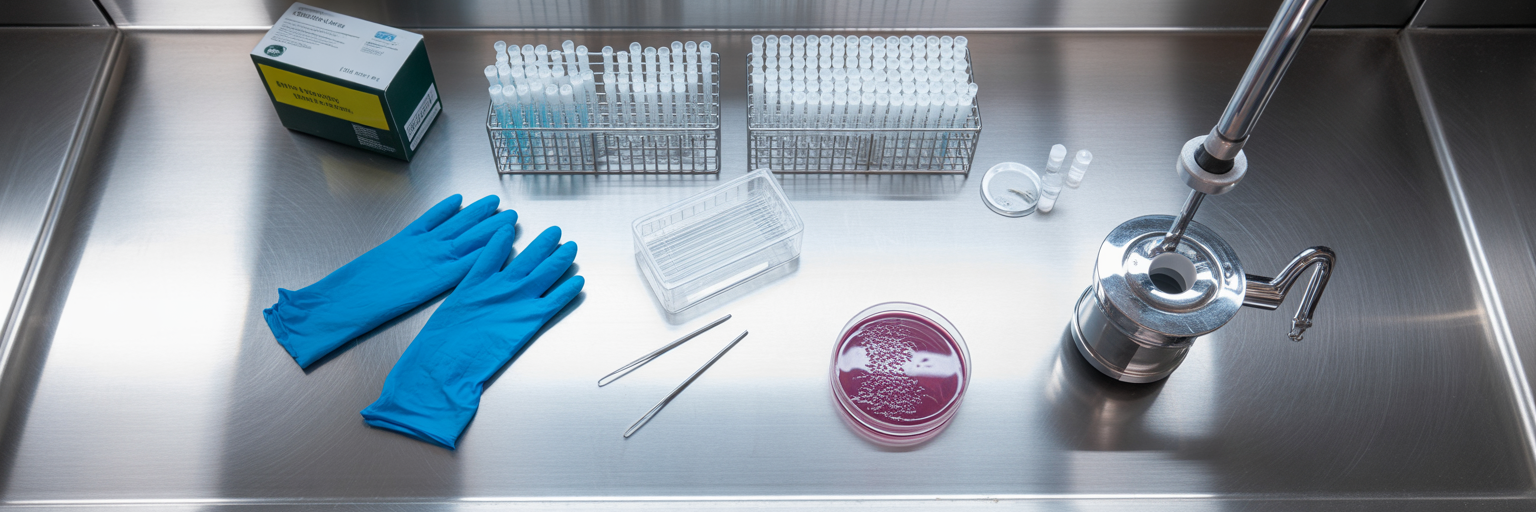
With the principles of sterility established, the focus shifts to the practical tools required to maintain it. A successful aseptic workflow depends on a carefully selected inventory of high-quality consumables. These are not just supplies. They are the physical barriers and vessels that protect your experiments from the outside world.
Barrier Protection: Gloves, Pipettes, and Tips
Your first line of defence is personal barrier protection. While nitrile and latex gloves both provide a barrier, nitrile offers superior chemical resistance and eliminates the risk of latex allergies, making it the standard in most labs. Beyond gloves, preventing cross-contamination during liquid handling is critical. Filtered pipette tips are indispensable for sensitive applications like PCR and qPCR. The small filter inside each tip acts as a barrier against aerosols, preventing sample-to-sample or pipette-to-sample contamination that can compromise results.
Sterile Vessels and Filtration Systems
The containers that hold your samples are just as important. For adherent cell lines, flasks and plates with tissue culture-treated surfaces are necessary to ensure proper cell attachment and growth. When preparing buffers or media, syringe filters are essential for sterilisation. A 0.22 µm pore size is the standard for removing bacteria, while a larger 0.45 µm filter may be used for clarification to remove particulates before final sterilisation. Choosing the correct filter prevents contamination without altering your solution’s composition.
Understanding Material Certifications
The certifications on your sterile lab supplies are a guarantee of purity. DNase-free and RNase-free certifications are non-negotiable for genomics and transcriptomics, as stray enzymes can degrade your precious DNA or RNA samples. Pyrogen-free (or endotoxin-free) is critical for cell-based assays and any work involving live subjects, as pyrogens can trigger inflammatory responses and skew data. A well-stocked laboratory will have a comprehensive inventory of these items, and you can explore a full range of certified sterile products in our shop. For any new lab, the essential list includes:
- Nitrile gloves
- Filtered pipette tips
- Sterile, certified microcentrifuge tubes and conical tubes
- Tissue culture-treated flasks, dishes, and plates
- Sterile syringe filters (0.22 µm)
- Individually wrapped serological pipettes
The Critical Role of High-Purity Diluents
While solid consumables form the physical barriers of an aseptic environment, liquid reagents like diluents are an integral part of the experiment itself. Their purity is paramount. Diluents are used to reconstitute lyophilised (freeze-dried) peptides and compounds, prepare stock solutions, and create buffers. The quality of your diluent directly impacts the stability and reliability of your final solution.
A primary example is bacteriostatic water for research. This is not simply sterile water. It is a sterile, non-pyrogenic water solution containing 0.9% benzyl alcohol, which acts as a bacteriostatic preservative. The sterile diluent benefits are significant, particularly for compounds that will be used over time. The preservative allows for multiple withdrawals from the same vial while inhibiting microbial growth, reducing waste and minimising the risk of contamination introduced by repeated needle punctures. This improves workflow efficiency, especially when working with expensive or sensitive reagents. For researchers requiring a reliable source for their experiments, a 30ml vial of our reconstitution solution offers ample volume for multiple applications.
However, choosing the right diluent requires careful consideration of your experimental needs. The baseline for these diluents is often Water for Injection (WFI), which must meet stringent purity standards for endotoxins and total organic carbon as defined in USP General Chapter <1231>. Proper storage is also crucial to maintain its efficacy. Best practices include storage at controlled room temperatures between 20°C and 25°C, a recommendation supported by guidelines outlined by institutions like USC.
| Diluent | Composition | Primary Use Case | Key Advantage | Key Limitation |
|---|---|---|---|---|
| Bacteriostatic Water | Sterile Water + 0.9% Benzyl Alcohol | Reconstituting lyophilised compounds for multi-use | Preservative allows for multiple withdrawals, reducing contamination risk | Benzyl alcohol can be incompatible with certain cells or assays |
| Sterile Water for Injection (WFI) | Highly purified sterile water | Single-use applications; preparing solutions where a preservative is undesirable | Highest purity, no additives | No preservative; must be discarded after opening to prevent contamination |
| Sterile Saline (0.9% NaCl) | Sterile Water + 0.9% Sodium Chloride | Isotonic dilutions for cell work, injections | Isotonic, preventing osmotic stress on cells | Not suitable for all chemical solutions; single-use vials are common |
| Phosphate-Buffered Saline (PBS) | Sterile Water + Phosphate Salts + NaCl | Washing cells, diluting reagents for biological assays | Maintains a constant pH (physiologic range) | Phosphate can interfere with certain enzymatic reactions |
Selecting and Verifying High-Purity Products

Procuring the right supplies is a critical responsibility for lab managers and principal investigators. The quality of your research is directly linked to the quality of your materials, so due diligence in sourcing high-purity lab products is not just about finding the best price. It is about ensuring reproducibility and reliability.
Supplier Vetting and Certification
When evaluating suppliers, look beyond the price tag. A credible supplier will be transparent about their quality control processes. When vetting suppliers, confirming they operate under a certified Quality Management System, such as the one detailed by the International Organization for Standardization in ISO 9001:2015, provides assurance of their commitment to consistent quality. This demonstrates a dedication to processes that ensure product reliability from batch to batch.
Decoding the Certificate of Analysis (CoA)
For any high-purity product, the Certificate of Analysis (CoA) is a non-negotiable document. It is the supplier’s proof that a specific lot meets required specifications. When you review a CoA for a product like bacteriostatic water, you should find clear results for sterility testing, endotoxin levels measured in EU/mL, and confirmation of the benzyl alcohol concentration. This document is your assurance of lot-to-lot consistency, which is essential for long-term experimental reproducibility. Reputable suppliers provide easy access to this documentation; for example, you should be able to retrieve a CoA for any specific lot number you purchase.
Red Flags in Procurement
Protect your research by being vigilant for warning signs during procurement. Be cautious of suppliers who exhibit the following red flags:
- Unusually low prices that seem too good to be true
- Inability or unwillingness to provide a CoA for a specific lot
- Vague or incomplete product documentation and specifications
- Poor customer support or lack of technical expertise
Investing in quality supplies from a vetted supplier is an upfront investment that prevents costly experimental failures and data artifacts down the line.
Best Practices for Handling and Storing Sterile Supplies
Purchasing high-quality sterile supplies is only half the battle. Maintaining their sterility until the moment of use depends entirely on proper handling and storage. This is where aseptic laboratory techniques become paramount, transforming good supplies into reliable results. These handling procedures are aligned with universal biosafety guidelines, such as those detailed in the CDC’s ‘Biosafety in Microbiological and Biomedical Laboratories’ (BMBL), which serves as a standard for safe laboratory practices.
Adherence to a strict protocol is key. Follow these fundamental steps every time:
- Always perform critical tasks within a certified laminar flow hood or biological safety cabinet to work in a sterile field.
- Thoroughly disinfect the outer packaging of all supplies with 70% ethanol before introducing them into the sterile workspace.
- Open sterile packaging using a technique that avoids touching any critical surfaces, such as the tip of a pipette or the mouth of a vial.
- Never place sterile items like vial caps or pipette tips on a non-sterile surface. The benchtop is never sterile.
Proper storage is equally important. Bacteriostatic water, for instance, should be stored at a controlled room temperature (20°C to 25°C) and protected from light to prevent the degradation of its preservative. For inventory management, implement a First-In, First-Out (FIFO) system to ensure older stock is used first. When you open a multi-use vial, immediately write the date of opening on the label. Finally, ensure all lab members are trained on proper disposal methods, segregating waste into biohazard containers, sharps containers, and general lab waste as appropriate. Staying updated on handling protocols is key, and you can often find more in-depth guides and tips on our blog.
Integrating Sterility into Your Lab’s Culture
Ultimately, maintaining an aseptic environment is not a series of isolated tasks but a continuous, collective process. It is a culture built on three interconnected pillars: sourcing high-quality supplies, executing rigorous handling techniques, and maintaining a controlled workspace. When every member of the lab understands and commits to these principles, sterility becomes a shared responsibility that safeguards the integrity of everyone’s work.
The upfront investment in high-purity supplies and stringent protocols may seem demanding. However, it pales in comparison to the costs they prevent: invalidated experiments, retracted papers, and the erosion of scientific credibility. A deep-seated commitment to sterility is a strategic investment in efficient, reliable, and impactful science. Building a culture of sterility starts with reliable partners, and at Herbilabs, we are committed to providing the foundational supplies for your research success.