Private Label, White Label, Wholesale partnerships available - EU, USA and UK - Free shipping from €75
Bacteriostatic Water Near Me: 2026 Buying Guide
A search for Bacteriostatic Water near me usually starts the same way. A lab bench is set, lyophilized material is waiting, and the missing piece is a sterile diluent that can handle repeated vial access without turning into a contamination risk. Then the search results arrive: retail pharmacies with vague listings, marketplace sellers with no documentation, and supplier pages that don't say enough about what is present in the vial.
That confusion matters because this isn't a casual consumable. Demand for Bacteriostatic Water for Injection is rising, with the global market projected to grow from USD 1.22 billion in 2024 to USD 2.61 billion by 2034, a projected 7.9% CAGR according to Market.us reporting on the BWFI market. Buyers who need a dependable local path can start with a practical supplier map such as Herbilabs location coverage, but location alone doesn't answer the harder questions about legality, product quality, or packaging standards.
Table of Contents
- The Search for Bacteriostatic Water
- Understanding Bacteriostatic Water
- Intended Use Safety and Regulations
- The Dilemma of Sourcing Locally
- How to Vet Any Bacteriostatic Water Supplier
- The Herbilabs Standard A Reliable Solution
- Frequently Asked Sourcing and Handling Questions
The Search for Bacteriostatic Water
Typing Bacteriostatic Water near me into a search bar sounds like a simple procurement step. In practice, it often produces noise instead of answers. Buyers usually see retail pharmacy pages, research supply listings with limited stock visibility, and online vendors that show a vial photo but almost nothing about preservative content, sterility controls, or intended use classification.
That's the sourcing problem. The vial has to be right before the first puncture, not after a failed batch, a rejected receiving check, or a contamination concern.
Why the search gets messy
Local availability depends on more than distance. Pharmacy systems may not index the product clearly. Staff may know it only when bundled with a medication workflow. University or institutional supply rooms often aren't open to public purchase. General lab distributors may stock sterile water, saline, or non-comparable solvents under similar search terms.
Practical rule: If the supplier can't tell a buyer exactly what preservative is in the vial, what the intended use designation is, and what packaging format is used, that listing isn't ready for serious work.
Buyers searching locally also tend to assume that a nearby source is automatically safer. It isn't. A regulated specialist that documents every batch is usually more dependable than a nearby seller with vague labeling and no supporting paperwork.
What works better than a blind local search
A useful buying process starts with three filters:
- Confirm the exact product type: It has to be bacteriostatic water, not plain sterile water and not saline.
- Check whether the supplier serves the intended use: Research procurement, lab use, or another compliant pathway.
- Require documentation up front: A seller should be able to answer technical questions before payment, not after delivery.
The difference between a smooth purchase and a wasted week usually comes down to this. Buyers who define the product correctly and vet the seller early avoid most of the confusion built into the “near me” search.
Understanding Bacteriostatic Water
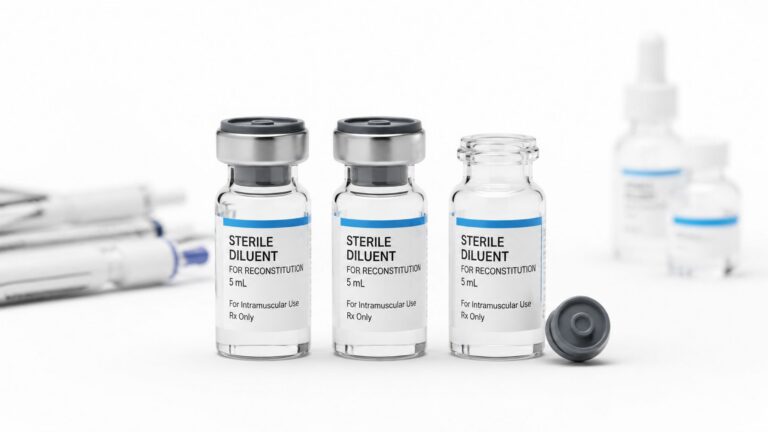
Bacteriostatic water is not “extra clean water.” It is a sterile solution designed for repeated access in a multi-dose format because it contains a preservative that inhibits microbial proliferation after the vial has been punctured.
To make that distinction visual, this comparison helps:
What it is and what it does
The key formulation point is specific. Bacteriostatic Water for Injection is a sterile solution containing 0.9% benzyl alcohol, or 9 mg/mL, and that preservative disrupts the bacterial cell membrane and inhibits protein synthesis, allowing a multi-dose vial to remain usable for up to 28 days after first use according to PrescriberPoint's BWFI therapy reference.
That wording matters because bacteriostatic doesn't mean bactericidal. It inhibits bacterial growth. It doesn't mean the liquid can be handled casually, and it doesn't rescue poor aseptic technique.
A practical application guide for peptide work is available in Herbilabs guidance on mixing peptides with bacteriostatic water. That kind of use case is where the product earns its place in a lab workflow: repeated withdrawals, stable handling, and less waste than a single-use approach.
A short walkthrough is often helpful before procurement or use:
How it differs from similar liquids
Confusion usually comes from three lookalike categories. They are not interchangeable.
| Product | Preservative | Multi-dose suitability | Main practical note |
|---|---|---|---|
| Bacteriostatic water | Benzyl alcohol present | Yes, when handled correctly | Designed for repeated access |
| Sterile water for injection | No preservative | Not the same use case | Better treated as single-use once opened |
| Normal saline | Different formulation | Use depends on protocol | Not a direct substitute for every reconstitution job |
The most common purchasing mistake is simple. A buyer asks for “sterile water,” receives sterile water, and only notices the mismatch once a protocol calls for repeated vial access.
Bacteriostatic water solves a very specific problem. Repeated access to the same vial without relying on plain water that has no preservative support.
That's why terminology matters at the point of sale. If the label, listing, or counter conversation drifts into generic “water for injection” language, the buyer should slow the order down and verify exactly what is being supplied.
Intended Use Safety and Regulations
A buyer walks up to the counter asking for bacteriostatic water and hears, "We have sterile water." That answer sounds close enough until the vial is used for repeated withdrawals and the preservative question surfaces too late. Safety starts with intended use, label accuracy, and whether the product is being handled inside a regulated clinical channel or sold into a research or gray-market channel with weaker controls.

Why the preservative matters
Benzyl alcohol is the reason bacteriostatic water can support repeated vial access. It is also the reason the product carries specific restrictions. Solutions containing benzyl alcohol are contraindicated for neonates, so any purchaser who cannot identify the end use should stop the order and clarify it before the vial changes hands.
Formulation errors are a practical sourcing risk, not a theoretical one. Analysts cited in Strategic Market Research's bacteriostatic water market report summarized gray-market findings that included products with no benzyl alcohol, excess benzyl alcohol, and detectable endotoxins.
Each failure mode points to a different problem:
- No benzyl alcohol: the vial does not match the intended bacteriostatic function.
- Too much benzyl alcohol: the formulation is out of specification and should not be accepted.
- Detectable endotoxins: the product has already failed a basic safety screen.
pH control matters for the same reason. A vial sold for injection-related reconstitution should match established specification ranges and remain consistent from lot to lot. If a seller cannot produce a specification sheet, lot information, or any documentation showing what standard the product is made to, treat the vial as an unknown.
That distinction matters even more in the over-the-counter gray zone. A product may be sold without a prescription in one setting, refused in another, and listed online with research language that changes its legal and practical use case. Labs and distributors should understand the difference between clinical supply and research use only labeling requirements before buying locally or online.
Where gray market products fail
Poor listings tend to fail in the same places. The product title is imprecise. The label image is incomplete or unreadable. The seller avoids stating preservative content, packaging standard, or intended use. There is no certificate trail, no lot traceability, and no clear manufacturer identity.
A vial that cannot prove what it contains should be treated as an unknown.
In practice, source quality and formulation quality are the same issue. A seller willing to obscure one usually obscures the other.
The Dilemma of Sourcing Locally
Local sourcing looks efficient on paper. Someone needs a vial quickly, so the search shifts to chain pharmacies, compounding-adjacent counters, and nearby lab suppliers. The problem is that local access often depends less on the product itself and more on store policy, staff familiarity, and what system the item sits inside.
Why pharmacy counters give mixed answers
The most practical summary is also the most frustrating one. Bacteriostatic water sits in a gray zone at the retail level. Verified data indicates that it is considered a non-prescription diluent by federal rules when sold alone, but individual store policies and state-level variation leave buyers uncertain about whether they can purchase it over the counter, as discussed in Arpovo Health's review of prescription requirements for bacteriostatic water.
That explains why one buyer may get a straightforward yes while another gets a refusal from a different branch of the same chain. Counter staff often recognize it only in connection with a patient-specific injectable medication workflow. When the same item is requested as a standalone supply, the answer may depend on who is working, what the local policy says, and whether the store stocks it at all.
What local options usually get wrong
Retail pharmacies aren't the only local channel, and they're not always the most practical one.
- University supply channels: Often restricted to internal departments, approved investigators, or institutional accounts.
- General chemical distributors: May carry high-purity water products that aren't packaged or documented for this exact use case.
- Marketplace pickup sellers: Usually offer speed, but often skip the paperwork that procurement teams need.
A local search also tends to compress unlike products into one result page. Sterile water, saline, empty vials, and bacteriostatic water can appear side by side as if they are equivalent. They aren't.
Local is convenient only when the seller can answer technical questions without hesitation.
For urgent procurement, the better question usually isn't “Who has something nearby?” It's “Who can prove the vial is the right one, in the right packaging, under the right intended-use designation?” When local sellers can do that, local works well. When they can't, specialty sourcing is usually faster in real terms because it avoids returns, replacements, and avoidable delays.
How to Vet Any Bacteriostatic Water Supplier
A supplier should survive a technical review before they ever get your payment details. That standard applies whether the vial is coming from a local medical outlet, a research supplier, or an online seller operating in the prescription gray zone.

Documentation before price
Start with the documents, not the listing photos and not the price.
If a seller cannot produce a specification sheet, batch information, or a clear statement of intended use, the conversation is already limited. In practice, that usually separates regulated research suppliers from gray-market resellers. The better suppliers answer direct questions quickly. The weaker ones rely on vague product copy and hope the buyer does not ask for details.
Check these points first:
- Product classification: The label and product page should clearly state what the vial is sold for. If it is not approved for clinical human use, that boundary should be stated plainly, such as Research Use Only where applicable.
- Specification detail: The supplier should be able to confirm the formulation and core release criteria, including the expected pH range noted earlier in this article.
- Batch traceability: Ask whether the vial can be tied to a lot or batch record. If the answer is unclear, accountability is unclear too.
- Container material: Glass vials are usually the safer choice for storage, handling, and compatibility review.
I reject suppliers fastest on one point. They use terms like “medical grade,” “lab quality,” or “premium sterile,” but cannot show the paperwork behind those words.
Packaging handling and fit for purpose
The vial itself gives you useful information if you know what to inspect. Good packaging does not prove a product is acceptable on its own, but poor packaging often exposes a weak supply chain.
A practical receiving checklist looks like this:
| Checkpoint | What to look for | Why it matters |
|---|---|---|
| Label clarity | Exact product name and intended use | Reduces confusion with sterile water, saline, or empty supply items |
| Vial material | Glass vial | Supports stable storage and cleaner handling review |
| Seal condition | Intact stopper, clean crimp, no visible damage | Helps identify tampering, rough transit, or poor storage |
| Lot information | Batch or lot reference on vial or outer packaging | Supports traceability if a question comes up later |
| Technical support | Direct answers to formulation and handling questions | Shows the seller actually knows the product |
Ask one simple question if you want a fast read on supplier quality: “Can you send the current spec sheet and explain how this product is classified?” Serious suppliers answer directly. Gray-market sellers often dodge the classification question, especially when they are trying to sell into both research and consumer demand without saying so clearly.
If the seller cannot explain the vial, the buyer should not trust the vial.
Storage and transit standards matter too. A properly labeled product can still become a problem if it arrives with a damaged closure, unclear lot identification, or packaging that suggests careless handling. For local pickup, inspect before you leave. For shipped orders, document the condition on arrival and keep the packaging until the batch is accepted into inventory.
The Herbilabs Standard A Reliable Solution
Specialist sourcing exists because the local market is inconsistent. Buyers in the EU, UK, and USA often need a supplier that can remove ambiguity around packaging, documentation, intended use, and fulfillment speed in one transaction instead of several.

What serious buyers usually need
The core requirements are straightforward. They need consistent stock, premium glass vial packaging, batch documentation, and a supplier that treats Research Use Only status as an actual compliance boundary instead of a small disclaimer.
Herbilabs is structured around that procurement reality. The company operates its own production facility, maintains 99%+ purity benchmarks, provides batch-specific COAs, and sells these products strictly for Research Use Only. Temperature-controlled storage and shipping reduce uncertainty during transit, and same-day dispatch matters when a delayed consumable can stall an entire workstream.
Why procurement teams keep returning to specialist suppliers
Reliability usually wins over proximity. A nearby seller may save a day on paper but create a week of back-and-forth if the vial arrives with unclear labeling or no documentation. A specialist supplier earns repeat orders by removing those friction points before the order is placed.
Herbilabs also serves a broad customer base across research and distribution channels. The company has been active since 2018, supports buyers across the EU, UK, and USA, and is trusted by over 100,000 clients, including universities, research organizations, and independent investigators. For wholesalers and distribution partners, that matters because continuity of supply and documentation quality tend to outweigh novelty, especially for a basic reagent that should never become a bottleneck.
In practical terms, the standard is simple. The product has to arrive documented, stable, properly packaged, and ready to fit into a compliant research workflow. That's what specialist procurement is supposed to solve.
Frequently Asked Sourcing and Handling Questions
A good purchase still needs disciplined handling. Most downstream problems come from storage shortcuts, repeated sloppy access, or continuing to use a vial after it should've been retired.
Should opened vials be refrigerated
Opened vials are commonly kept refrigerated in research settings because cooler storage supports stability expectations after first puncture. The key point is consistency. The vial should stay clean, sealed between uses, and protected from unnecessary handling.
Before every access, the stopper should be treated as a contamination control point. A fresh sterile needle should be used each time, and any vial with visible particles, cloudiness, or container damage should be set aside and not used.
When should a vial be discarded
Verified data states that bacteriostatic water in multi-dose use can remain suitable for up to 28 days after the initial puncture when handled correctly, based on the preservative-backed multi-dose use described earlier. Past that point, repeated access has introduced too many opportunities for contamination to justify keeping the vial in circulation.
A short discard guide helps:
- After the use window ends: Retire the vial even if liquid remains.
- If appearance changes: Cloudiness, particles, or discoloration are enough reason to discard it.
- If the closure is compromised: A damaged stopper or seal makes the vial unreliable.
- If provenance becomes unclear: Unlabeled or mixed-lot bench stock should not stay in active use.
Disposal should follow the site's sharps and laboratory waste procedures. The vial and any associated needles should never be handled like routine household trash inside a professional workflow.
Herbilabs gives researchers and procurement teams a cleaner alternative to the usual Bacteriostatic Water near me confusion. Buyers who need premium glass vials, batch-specific COAs, strict Research Use Only handling, and dependable fulfillment across the EU, UK, and USA can review current options directly at Herbilabs.