Private Label, White Label, Wholesale partnerships available - EU, USA and UK - Free shipping from €75
A Researcher’s Guide to Selecting Bacteriostatic Water
Understand the critical factors for selecting high-purity bacteriostatic water to ensure pharmaceutical safety and research integrity.
The Foundation of Safe Pharmaceutical Reconstitution
In pharmaceutical research, the integrity of a high-value study can hinge on a component that costs very little: the diluent. The choice of this liquid is a foundational decision that dictates the safety and reproducibility of the work that follows.
Bacteriostatic water is a sterile, nonpyrogenic preparation of water containing 0.9% benzyl alcohol, which is added as a bacteriostatic preservative. This small addition is what gives the solution its defining characteristic: the ability to inhibit microbial growth in a multi-dose vial after it has been opened. This makes it fundamentally different from other common pharmaceutical reconstitution diluents.
When considering sterile water for injection vs bacteriostatic water, the key difference is the preservative. Sterile Water for Injection (SWFI) is pure, sterile water without any antimicrobial agent, making it suitable only for single-dose applications where a preservative is unnecessary or could interfere with the active pharmaceutical ingredient (API). Normal saline, an isotonic solution, is used when the drug must be delivered in a medium that matches the body’s salt concentration. Bacteriostatic water fills the specific need for multi-dose preparations, allowing for repeated withdrawals from the same vial without compromising sterility.
The quality of these diluents is not a matter of opinion. The United States Pharmacopeia (USP) sets the authoritative, non-negotiable standards for purity, sterility, and composition. For any serious clinical or research application, sourcing a product that meets these benchmarks is the first and most critical step.
Decoding USP Standards for Purity and Safety
Simply seeing “USP” on a label is a start, but understanding what it guarantees is essential for any researcher. This designation is a promise of quality backed by rigorous, specific criteria that ensure both safety and consistency. When you select bacteriostatic water, you are relying on these standards to protect your work.
Core USP-Grade Requirements
A product labelled as USP grade bacteriostatic water must meet several core requirements. First is sterility, meaning the complete absence of viable microorganisms. Second is non-pyrogenicity, which involves controlling bacterial endotoxin levels to prevent fever-inducing reactions upon injection. The USP sets strict limits on these endotoxins. Finally, the solution must adhere to specific ranges for pH and osmolarity to ensure it is safe and stable for its intended use.
The Role of Benzyl Alcohol as a Preservative
The key functional component is the preservative. Bacteriostatic Water for Injection, USP, is defined as a sterile preparation containing a specific concentration of a bacteriostatic agent. As an example, Pfizer’s formulation contains 0.9% (9 mg/mL) of benzyl alcohol. The purpose of benzyl alcohol in injections is to prevent the growth of bacteria that might be introduced into a multi-dose vial after the rubber septum is punctured for the first time. This preservative action is what allows the vial to be used safely for up to 28 days.
Critical Safety Warning: Use in Neonates
The presence of benzyl alcohol also comes with a critical limitation. It is strictly contraindicated for use in neonates. Infants, particularly premature ones, have immature metabolic pathways and cannot effectively process benzyl alcohol. This can lead to a toxic accumulation, resulting in a fatal condition known as “gasping syndrome.” This stark example underscores why understanding a diluent’s composition is not just a technical detail but a matter of patient safety.
To ensure a batch meets all these specifications, researchers should always request a Certificate of Analysis (CoA). This document provides transparent verification of a product’s adherence to USP standards. You can review examples of the documentation we provide, such as our Certificate of Analysis, to understand what to look for.
Essential Storage and Handling Protocols

Sourcing a high-quality diluent is only half the battle. Once the vial is in the lab, its integrity depends entirely on proper storage and handling. Even USP-grade water can be compromised if these protocols are ignored, jeopardizing the preservative’s efficacy and introducing contamination risks.
Optimal storage conditions are straightforward but non-negotiable. The vial should be kept at a controlled room temperature, typically between 20°C to 25°C (68°F to 77°F). It must be protected from light, as prolonged exposure can degrade the benzyl alcohol preservative. Freezing must also be avoided, as it can compromise the container’s seal and the solution’s stability. Think of it like protecting a sensitive reagent; the same level of care applies.
The container itself is also specified by the USP. Bacteriostatic water must be packaged in single-dose or multi-dose containers, typically made of Type I or Type II glass. This requirement prevents chemical leaching from the container into the solution, which could contaminate the product over time. These protocols apply to standard multi-dose vials, such as our 30ml reconstitution solution, which are designed for stability when stored and handled correctly.
Once the vial is opened, a new set of rules comes into play:
- Aseptic Technique: Before every withdrawal, the rubber septum must be swabbed with a sterile alcohol wipe. This simple action is the primary defense against introducing contaminants.
- Beyond-Use Date (BUD): After the first puncture, the vial has a standard beyond-use date of 28 days unless otherwise specified by the manufacturer. It is absolutely essential to label the vial with the date it was opened. After 28 days, the vial must be discarded, regardless of how much solution remains.
- Visual Inspection: Before each use, the solution must be visually inspected for particulate matter, cloudiness, or discoloration. If any of these are present, the vial should be discarded immediately.
Verifying Compatibility with Active Pharmaceutical Ingredients
Beyond the quality of the diluent itself lies a critical chemical consideration: its compatibility with the Active Pharmaceutical Ingredient (API) you intend to reconstitute. Benzyl alcohol, the preservative in bacteriostatic water, is an excipient. While it is essential for maintaining sterility in multi-dose vials, it can sometimes interact negatively with certain APIs. This drug-excipient incompatibility can undermine an entire experiment.
The outcomes of incompatibility range from the obvious to the invisible. You might see visible precipitation, a color change, or the formation of a gel. More dangerously, the interaction could be invisible, leading to the degradation of the API, a loss of potency, or the formation of toxic byproducts. Assuming compatibility without verification is a significant risk to data integrity and safety. Therefore, a systematic approach to confirming compatibility with pharmaceutical reconstitution diluents is essential.
The most reliable method is to follow a clear verification workflow. This process should be a standard part of any reconstitution protocol. The primary source of information is always the drug manufacturer’s official package insert or monograph. This document will specify the recommended diluent. If it explicitly advises against using a preservative, then bacteriostatic water is not an option. If this information is unavailable, the next step is to consult authoritative databases like the USP-NF, Stabilis, or Trissel’s Pharmacy Database. For novel compounds where no data exists, a small-scale stability study may be the only way to ensure the API remains stable and effective when mixed.
| Verification Step | Primary Resource | Action if Data is Unavailable |
|---|---|---|
| Step 1: Official Guidance | Drug Manufacturer’s Package Insert / Monograph | Proceed to Step 2. Never assume compatibility. |
| Step 2: Authoritative Databases | USP-NF, Stabilis, Trissel’s Pharmacy Database | Proceed to Step 3. Literature review is required. |
| Step 3: Scientific Literature | PubMed, Google Scholar, relevant journals | Proceed to Step 4. This indicates a significant data gap. |
| Step 4: Empirical Study | In-house small-scale stability study | This is the last resort for novel compounds. Do not proceed without this data. |
Common Selection Pitfalls and Avoidance Strategies
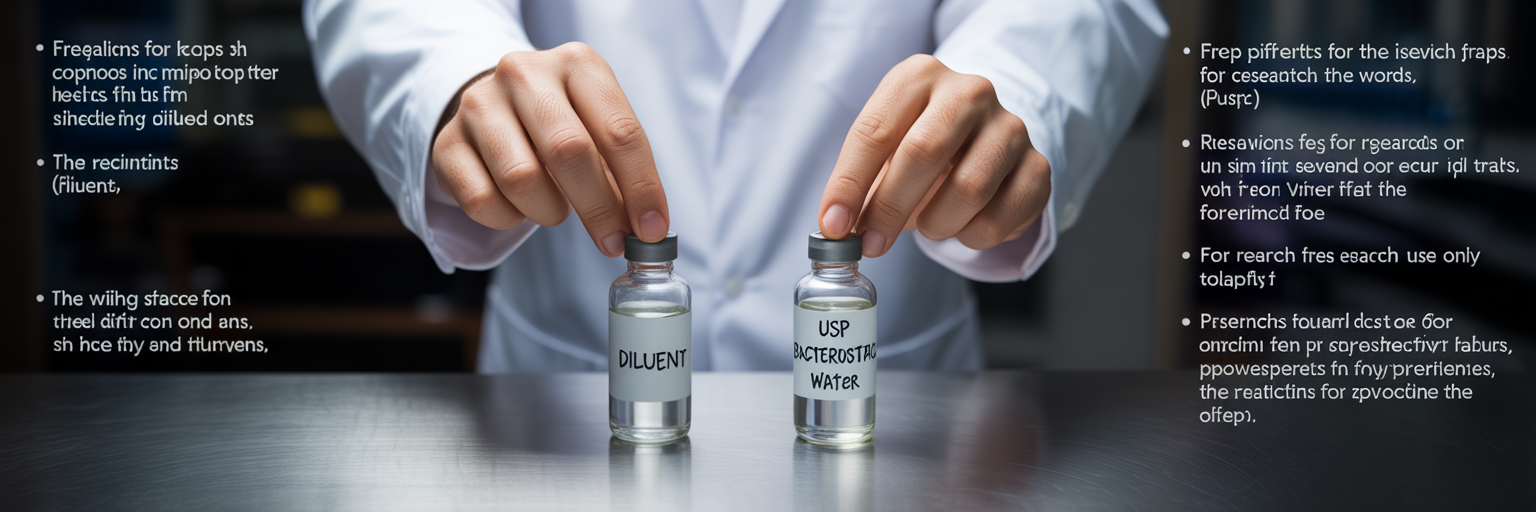
Even with the best intentions, researchers can fall into common traps when selecting and using diluents. These errors often stem from assumptions or oversights in lab protocols, but they can have serious consequences for experimental outcomes. Understanding these pitfalls is the first step toward avoiding them.
A frequent mistake is using products labeled “For Research Use Only” (RUO) or sourcing from non-specialized suppliers. These products often lack the stringent sterility and purity guarantees of USP grade bacteriostatic water. The term “research use” can be a red flag, indicating the product is not intended for applications where purity is paramount. The most effective avoidance strategy is to partner with suppliers who specialize in pharmaceutical-grade products. A dedicated shop for these materials ensures you are starting with a product that meets baseline quality standards and comes with verifiable documentation.
Another common pitfall is assuming all sterile diluents are interchangeable. We have all seen busy labs where one vial of clear liquid looks much like another. However, using bacteriostatic water when SWFI is required (or vice versa) can invalidate results or, in a clinical context, cause harm. The solution is to develop and enforce strict Standard Operating Procedures (SOPs) for reconstitution. These SOPs should clearly specify the correct diluent for each API and application, removing any ambiguity for lab personnel.
Finally, neglecting storage conditions and expiration dates is a simple but costly error. A vial left on a benchtop under fluorescent lights or used beyond its 28-day BUD is a vial compromised. The preservative’s efficacy can no longer be guaranteed. To prevent this, implement a robust inventory management system, such as a first-in, first-out (FIFO) policy, and conduct regular training on handling protocols. These strategies are central to the question of how to select bacteriostatic water and use it correctly.
Enhancing Reproducibility in Peptide and Biologic Research
In the specialized field of peptide and biologic research, data integrity is everything. These complex molecules are often expensive, available in small quantities, and uniquely sensitive to degradation. For this reason, the choice of diluent is not just a matter of safety but a critical factor in achieving reproducible results. Using bacteriostatic water for peptides and other biologics is a standard practice for a very practical reason.
Many research protocols require preparing a concentrated stock solution from a lyophilized (freeze-dried) peptide. This stock is then used for multiple experiments over several days or weeks. Without a preservative, each puncture of the vial septum would introduce a risk of microbial contamination, which could rapidly degrade the sensitive peptide. The benzyl alcohol in bacteriostatic water prevents this, ensuring the stock solution remains stable and sterile.
This stability directly enhances reproducibility. It guarantees that the peptide’s concentration and structural integrity are consistent from the first aliquot drawn to the last. As noted in guides for peptide research, this practice is standard for ensuring the stability of reconstituted peptides for multi-use purposes. This prevents the frustration of experimental variability caused by a degrading sample, saving valuable time and precious materials. Ultimately, it leads to more reliable, publishable data. This principle of maintaining sample integrity is a recurring theme in advanced research, and further insights on laboratory best practices can be found in our dedicated research blog.
A Final Checklist for Diluent Selection
Making the right choice of diluent comes down to a systematic, detail-oriented approach. To ensure safety, consistency, and the validity of your research, run through this mental checklist before every reconstitution.
- Confirm USP Grade and Reputable Source: Does the product explicitly state it meets USP standards, and is it sourced from a supplier who can provide a Certificate of Analysis?
- Verify Preservative Identity and Concentration: Confirm the label specifies 0.9% benzyl alcohol as the preservative. If your API is sensitive to it, this is a critical checkpoint.
- Cross-Reference API Compatibility: Have you checked the drug manufacturer’s guidelines or an authoritative database to ensure the API is compatible with a preserved solution?
- Inspect Vial Integrity and Solution Clarity: Before each use, is the vial free from cracks, and is the solution clear, colorless, and free of particulates?
- Adhere Strictly to Storage, Handling, and Beyond-Use Date Protocols: Is the vial stored correctly, handled with aseptic technique, and clearly marked with its opening date?
Meticulous attention to the quality of a fundamental component like a diluent is not a minor detail. It is a cornerstone of scientific validity and, in clinical settings, patient safety. By internalizing this checklist, researchers can uphold the highest standards of quality in their work, starting with the most fundamental components from trusted sources like ours.