Private Label, White Label, Wholesale partnerships available - EU, USA and UK - Free shipping from €75
Validating Bacteriostatic Water for Sensitive Research Protocols
Discover how to confirm the integrity of bacteriostatic water through physical, chemical, and microbiological testing to ensure reliable research outcomes.
The Critical Role of Purity in Research Outcomes
The conversation around scientific reproducibility often points to complex experimental designs, but the truth is frequently much simpler. A significant portion of irreproducible results stems from overlooked variables, with reagent purity being a primary culprit. For something as fundamental as water, assuming its quality without verification is a gamble that can cost weeks of work and significant funding.
The connection between trace contaminants and compromised data is direct and unforgiving. Imagine spending a month on a cell culture study, only to discover that trace endotoxins in your water triggered an unintended immune response, rendering all your data invalid. In molecular biology, a few stray metallic ions can inhibit critical enzymatic reactions, stopping your PCR or cloning experiment in its tracks. We have all seen those confusing chromatograms; often, ghost peaks in HPLC are not a mystery but the result of organic residues from the solvent, leading to complete misinterpretation of results.
These failures are more than just frustrating setbacks. They represent a direct financial drain on a laboratory’s resources and a significant loss of valuable time. This is why proactive research water quality control is not an extra step but a foundational one. It transforms reagent management from a passive task into an active strategy for safeguarding experimental integrity.
Ultimately, verifying the purity of every component, especially one as ubiquitous as bacteriostatic water, is a pillar of credible science. It protects your data, your budget, and your lab’s reputation. For those looking to deepen their understanding of laboratory best practices, we regularly share insights on our blog that cover a range of essential topics.
Identifying Common Contaminants in Bacteriostatic Water
Understanding the ‘why’ of purity verification naturally leads to the ‘what’. What exactly are we looking for? Bacteriostatic water is designed to be a stable, multi-use solvent, but it is not immune to contamination. These impurities fall into several distinct categories, each posing a unique threat to sensitive assays. Acknowledging these common contaminants in lab water is the first step toward effective mitigation.
Microbial and Endotoxin Contamination
The benzyl alcohol in bacteriostatic water is effective at preventing new bacterial growth, but it is not a sterilising agent. It does not kill resilient bacterial spores or fungi. More importantly, it does not neutralise endotoxins, also known as pyrogens. These lipopolysaccharide fragments from the cell walls of Gram-negative bacteria are notoriously heat-stable and can provoke strong inflammatory responses in cell cultures and animal models, even if the bacteria themselves are no longer viable.
Chemical and Ionic Impurities
Contaminants can also be chemical in nature. Over time, compounds can leach from storage containers, whether they are plasticisers from flexible vials or silicates and ions from certain types of glass. The source water used in manufacturing can also introduce trace metals or other inorganic chemicals if not properly purified. As highlighted by Atlas Scientific, key indicators of water quality often involve screening for metals, hydrocarbons, and other chemical residues.
Particulate Matter
Particulates are solid impurities that can range from visible fibres and dust to sub-visible particles. These can originate from the manufacturing environment, packaging materials, or even precipitate out of the solution itself. In practice, they are notorious for clogging the delicate fluidics of HPLC systems, flow cytometers, and other sensitive analytical equipment, causing downtime and requiring costly repairs.
Degradation Byproducts
Bacteriostatic water is not infinitely stable. With exposure to oxygen or improper storage conditions, the benzyl alcohol preservative can slowly oxidise. This chemical breakdown produces benzaldehyde and benzoic acid. These byproducts are not inert; they lower the solution’s pH, which can alter drug solubility, protein stability, and the kinetics of chemical reactions in unpredictable ways.
| Contaminant Category | Examples | Potential Source | Experimental Interference |
|---|---|---|---|
| Microbial | Bacteria, Fungi, Spores | Compromised seal, aseptic technique failure | False results in cultures, sample degradation |
| Endotoxins (Pyrogens) | Lipopolysaccharides from Gram-negative bacteria | Bacterial contamination (even if cells are non-viable) | Induces inflammatory responses in cell/animal models |
| Inorganic Chemicals | Heavy metals (Pb, Fe), Silicates | Leaching from containers, source water | Enzyme inhibition, altered pH/conductivity |
| Organic Chemicals | Plasticisers, Volatile Organic Compounds (VOCs) | Leaching from plastic vials, environmental exposure | Ghost peaks in chromatography, cytotoxicity |
| Particulates | Dust, fibres, glass fragments, precipitates | Environment, packaging, chemical reactions | Clogged fluidics, light scattering in spectroscopy |
| Degradation Products | Benzaldehyde, Benzoic Acid | Oxidation of benzyl alcohol over time | Lowered pH, unpredictable chemical interactions |
Essential Physical and Visual Inspection Protocols
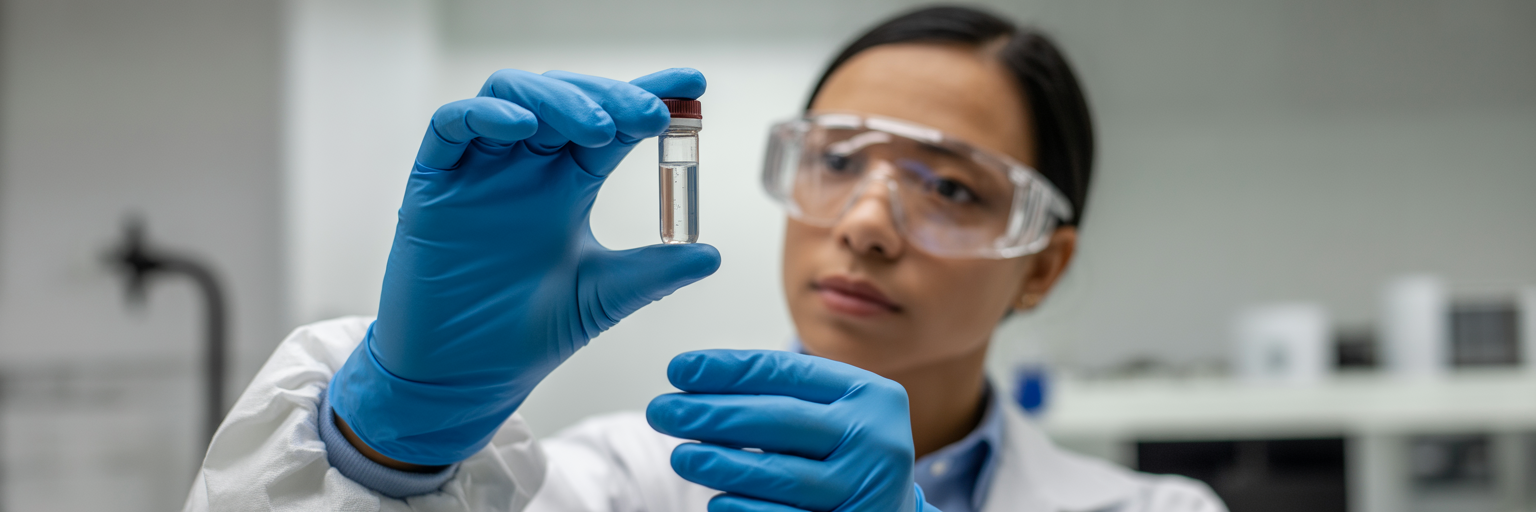
Before any advanced instrumentation is involved, your first line of defence is a thorough physical and visual inspection. This simple, no-cost procedure can immediately flag obvious quality issues and prevent a compromised vial from ever entering your experimental workflow. It should become an automatic reflex for any researcher upon receiving a new batch of reagents.
When your lab receives a new supply, such as one of our 30ml reconstitution solutions, the first step is always a methodical visual check. Follow these simple steps:
- Check the Seal Integrity: Examine the vial’s cap and rubber septum. Is the cap securely crimped? Is there any visible damage to the stopper? A loose cap or a compromised seal is an open invitation for microbial and environmental contamination.
- Assess Clarity and Colour: Hold the vial against a clean white background to check for any discolouration or haze. Then, hold it against a black background to look for turbidity. The solution should be perfectly clear and colourless. Any yellowing or cloudiness is an immediate red flag.
- Inspect for Particulates: Gently swirl the vial, do not shake it, and observe the liquid under a bright light. Look for any suspended matter, such as fibres, dust, or tiny crystals. These particles can interfere with analytical measurements and damage sensitive equipment.
While this inspection is a critical screening tool, it is important to recognise its limitations. Visual checks cannot detect dissolved impurities, endotoxins, low-level microbial contamination, or incorrect pH. A vial can appear perfectly clear and still contain contaminants that will ruin your experiment. This is why visual inspection is only the beginning of a comprehensive quality assessment, creating a necessary bridge to more definitive analytical testing.
Core Analytical Testing for Chemical Purity
Once a vial passes visual inspection, the next step is to confirm its chemical purity with quantitative methods. This is where we move from observation to measurement, answering the fundamental question of how to test bacteriostatic water with precision. These core analytical tests provide objective data on the solution’s composition and safety, ensuring it meets the stringent requirements for sensitive research.
Baseline Purity Metrics: pH, Conductivity, and TDS
A few rapid tests can provide an excellent snapshot of overall purity. Measuring pH is crucial; it should fall within a specific range, typically 5.0 to 7.0. As industry resources from sources like Sensorex explain, a deviation from this range can indicate degradation of the benzyl alcohol or the presence of acidic or alkaline contaminants. Conductivity and Total Dissolved Solids (TDS) are quick screens for ionic impurities. A high reading suggests the presence of dissolved salts or minerals that have no place in a high-purity solvent.
Advanced Organic Analysis with HPLC
High-Performance Liquid Chromatography (HPLC) is the gold standard for analysing organic components. This technique serves two primary functions. First, it precisely quantifies the concentration of the benzyl alcohol preservative, confirming it is at the correct 0.9% level. Second, and just as importantly, it can detect and quantify organic impurities, including the benzaldehyde and benzoic acid that result from degradation. An HPLC chromatogram provides a clear fingerprint of the solution’s organic profile.
Critical Endotoxin Screening: The LAL Assay
For any research involving cell cultures, tissues, or animal models, this test is non-negotiable. The Limulus Amebocyte Lysate (LAL) assay is an extremely sensitive method for detecting endotoxins. The LAL test for endotoxins can identify these pyrogenic substances at picogram-per-millilitre levels, far below what could cause a visible effect but more than enough to trigger a significant biological response. A negative LAL result is a prerequisite for using bacteriostatic water in any biological application.
Reputable suppliers will always provide a Certificate of Analysis (CoA) detailing the results for these critical tests for each batch. This document is your assurance that the product met specifications before it left the facility, and it provides a baseline for any in-house verification you perform.
Microbiological Screening and Sterility Verification
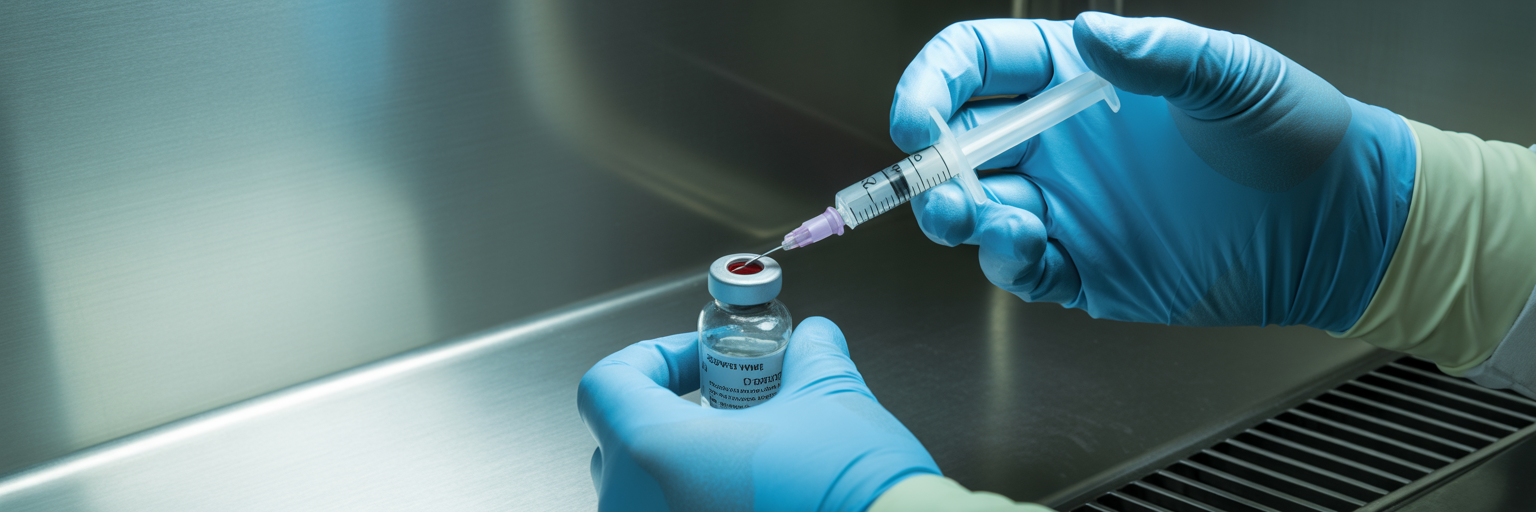
Beyond chemical purity, ensuring the microbiological integrity of bacteriostatic water is essential, especially given its multi-dose nature. This requires understanding a key distinction that is often a source of confusion in the lab: the difference between ‘bacteriostatic’ and ‘sterile’. A bacteriostatic solution inhibits the growth of microorganisms, while a sterile solution is completely free of all viable life forms. Bacteriostatic water is manufactured to be sterile, but its integrity relies on proper handling after the first use.
Official sterility testing is performed according to strict pharmacopeial standards. As outlined in resources like the Clinical Microbiology Procedures Handbook, a common method is membrane filtration (as per USP <71>). In this test, the water is passed through a 0.22 or 0.45-micron filter, which is then placed on growth media and incubated to see if any colonies form. This confirms the initial sterility of an unopened vial.
Once a vial is opened, the clock starts. The commonly accepted 28-day expiry date after the first puncture is not arbitrary. It is based on the preservative’s effectiveness and the increasing risk of contamination with each use. To maintain sterility throughout its use, a strict aseptic technique for vials is mandatory. This is not just good practice; it is a critical procedure to prevent the introduction of contaminants.
Every researcher should adhere to these steps without exception:
- Always swab the septum with a sterile 70% isopropyl alcohol wipe before each puncture.
- Allow the alcohol to dry completely. This is when the disinfecting action occurs. Do not rush this step.
- Use a new, sterile needle and syringe for every single entry into the vial. Reusing needles is a primary cause of cross-contamination.
- Never touch the needle to any non-sterile surface before puncturing the septum.
Establishing a Compliant Quality Assurance Framework
A successful research outcome depends on a system, not just a single test. Synthesising all these verification steps into a compliant quality assurance framework ensures that every vial of bacteriostatic water used in your lab is safe, pure, and reliable. This framework begins long before the water arrives at your bench and continues until the vial is discarded.
The first and most critical element is sourcing. Partnering with a supplier that adheres to Good Manufacturing Practices (GMP) and provides a comprehensive Certificate of Analysis (CoA) for every lot is fundamental. This external validation provides a strong foundation of trust. From there, your lab should implement a clear Standard Operating Procedure (SOP) for reagent verification. This SOP should mandate incoming visual checks for all batches and define triggers for more advanced testing based on the sensitivity of the intended experiment.
Documentation is the backbone of any quality system. Your records must provide full traceability for troubleshooting and audits. This means logging lot numbers, attaching CoA data, recording the results of any in-house tests, and clearly marking each vial with its first-use and disposal dates. If an experiment yields unexpected results, this logbook is often the first place you will look to rule out reagent issues.
Finally, these procedures are only effective if they are followed. Formal training for all personnel on everything from proper aseptic technique for vials to documentation ensures that your lab’s bacteriostatic water purity standards are consistently met. Partnering with a supplier that provides transparent documentation and adheres to high manufacturing standards is the first step in any quality framework, so it is wise to browse their full range of solutions to find a trusted source for your critical reagents.