Private Label, White Label, Wholesale partnerships available - EU, USA and UK - Free shipping from €75
How to Buy Bacteriostatic Water Online Safely
In 2026, bacteriostatic water is still available online, but it isn't equally easy to source for every buyer or in every geography. Marketplace enforcement has shifted search and purchasing channels more than it has eliminated supply, while hospital and pharmacy availability has faced documented constraints.
A researcher may discover that a familiar marketplace listing has disappeared, while a distributor finds several smaller suppliers still advertising stock. A hospital buyer may face a completely different situation from a laboratory purchaser in another country. That difference is the starting point for a safe decision.
Bacteriostatic water isn't ordinary sterile water, and a product page alone can't establish whether a vial is suitable for a research workflow, clinical application, or distribution program. The practical answer is to verify the formulation, lot documentation, intended use, storage process, and supplier accountability before placing an order.
Table of Contents
- Why Buying Bacteriostatic Water Online Requires Care
- What Bacteriostatic Water Actually Is
- How to Verify Quality Through COA and Batch Testing
- RUO Versus Clinical Grade, and What That Means for Your Purchase
- Safe Ordering Steps for Quantity, Storage, and Fulfillment
- Current Sourcing Landscape and Shortage Realities
- Red Flags, Compliance Risks, and Distribution Partnerships
Why Buying Bacteriostatic Water Online Requires Care
A laboratory buyer searching for bacteriostatic water online usually expects a routine procurement task. The search produces multiple listings, different vial sizes, and claims about sterility or purity. The difficult part begins when the buyer tries to determine which listing represents a controlled injectable product and which one is a loosely described liquid sold through an unfamiliar channel.
The FDA labeling defines bacteriostatic water for injection as a sterile, nonpyrogenic preparation containing 0.9% benzyl alcohol, supplied in a multiple-dose container for repeated withdrawals. That formulation is materially different from plain sterile water, so a listing that says only “sterile water” doesn't establish equivalence. FDA DailyMed labeling identifies the formulation and documents commercial formats such as a multiple-dose 30 mL vial.

Why sterility evidence matters
A recall involving lot W20308 of 30 mL multiple-dose vials shows why online convenience cannot replace supplier verification. Sterilization could not be confirmed, and the FDA warning described serious potential outcomes, including invasive bacterial infection, bacterial meningitis, septicemia, fever, chills, malaise, and cutaneous abscess. The FDA recall notice for bacteriostatic water also identifies the 0.9% benzyl alcohol formulation.
Marketplace removals create another layer of confusion. Recent coverage describes Amazon removing bacteriostatic water listings across 2024 through 2026, with enforcement connected to prescription-product restrictions and FDA concerns about peptide reconstitution use. Independent reporting also describes out-of-specification pH and benzyl alcohol findings in many tested marketplace products, which makes an anonymous listing a poor substitute for lot-level documentation.
Practical rule: A lower price or visible “in stock” badge doesn't compensate for missing sterility records, unclear labeling, or an untraceable lot.
The buyer's first questions should therefore be practical:
- What is the exact formulation? The label should identify bacteriostatic water for injection and the preservative concentration.
- Who manufactured and released the lot? A reseller should be able to identify the source and provide matching documentation.
- What use is permitted? Research-use-only material isn't a clinical product.
- How was the vial stored and shipped? Preservative content doesn't repair poor handling or confirmed sterilization failures.
What Bacteriostatic Water Actually Is
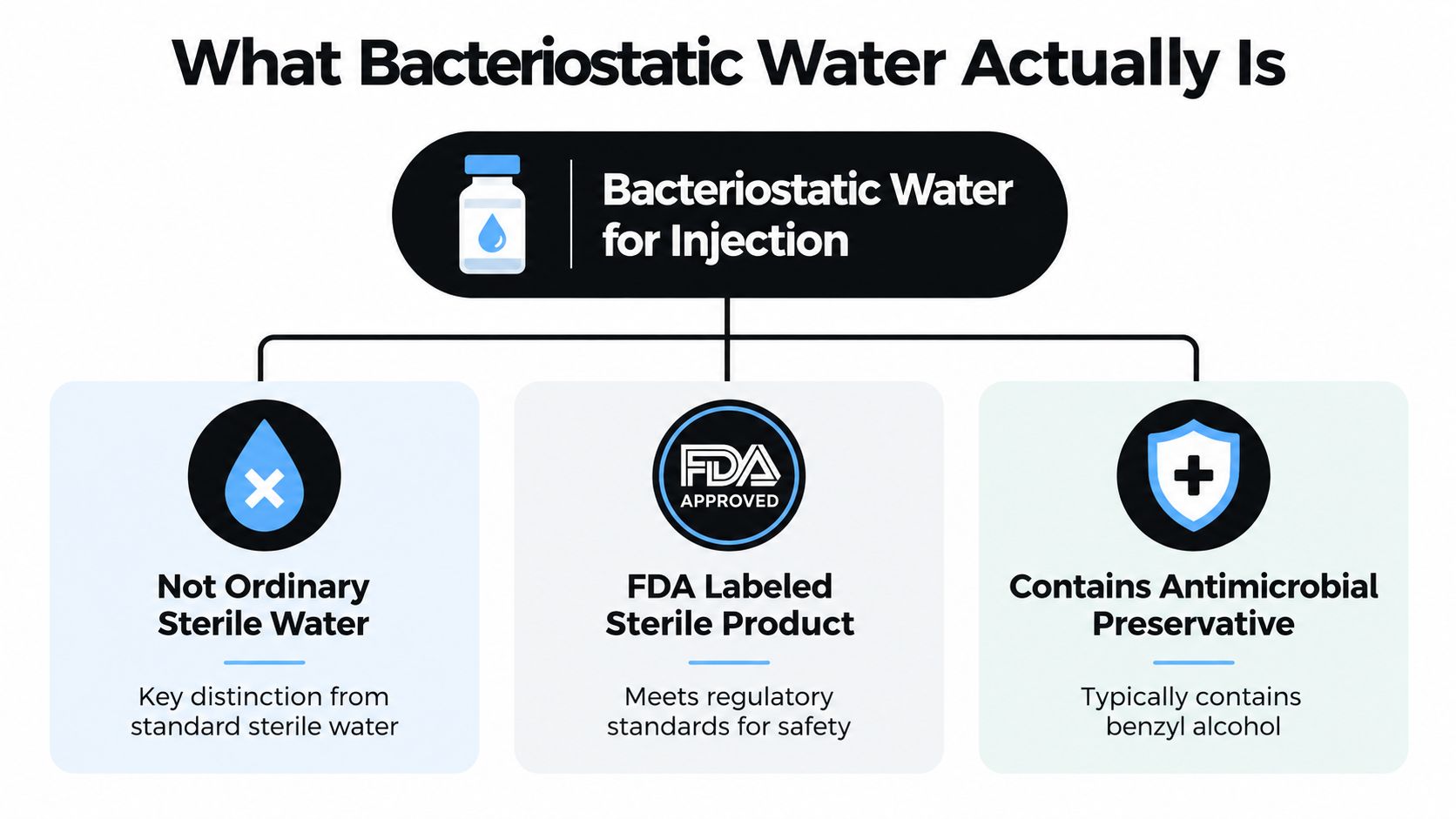
Bacteriostatic Water for Injection is a defined sterile diluent, not a generic name for purified water. FDA labeling describes a sterile, nonpyrogenic preparation with 0.9% benzyl alcohol, or 9 mg/mL, as a bacteriostatic preservative in a multiple-dose container. The DailyMed product label is the appropriate reference when a supplier's product page is vague.
Benzyl alcohol is the differentiating ingredient. It inhibits microbial growth after puncture, but it isn't a guarantee that contamination won't occur, and it doesn't turn an improperly handled vial into a sterile one. That distinction matters in any workflow involving repeated access, where aseptic technique, container integrity, and storage remain essential.
Bacteriostatic water compared with sterile water
Plain sterile water for injection doesn't contain the bacteriostatic preservative described above. It may be appropriate where a product's instructions require preservative-free water and single-use handling, but it shouldn't be treated as interchangeable with bacteriostatic water for repeated withdrawals. Compatibility must always be determined by the instructions for the substance being reconstituted and by the relevant professional or institutional protocol.
| Purchase question | Bacteriostatic water | Plain sterile water |
|---|---|---|
| Preservative | Contains benzyl alcohol under the labeled formulation | No bacteriostatic preservative |
| Container purpose | Multiple-dose format | Often selected for single-use workflows |
| Verification focus | Preservative strength, sterility, lot traceability, container closure | Sterility, formulation, single-use labeling |
| Substitution decision | Requires compatibility review | Must not be assumed equivalent |
The 0.9% specification is the anchor a wholesaler should look for on the label and certificate of analysis. Some labels also note a 1.1% benzyl alcohol formulation, so the buyer should verify the exact monograph and strength rather than accepting “bac water” as sufficient identification.
For readers comparing injectable diluents with other saline products, understanding 0.9% saline for virus care can help clarify why concentration and intended use matter. Different diluents may look similar online while serving different technical purposes.
How to Verify Quality Through COA and Batch Testing
A certificate of analysis is useful only when it belongs to the product and lot being purchased. Generic laboratory paperwork, an undated PDF, or a certificate that names a different vial size doesn't provide meaningful batch accountability. A buyer evaluating an online supplier should request the COA before payment, not after a problem appears.
A practical COA review
The review can follow a fixed sequence:
- Match the identity. The product name, formulation, preservative concentration, container type, manufacturer, lot number, and expiry information should align with the listing and the vial label.
- Confirm sterility testing. The document should identify the lot tested and describe the relevant sterility result. “Sterile” without batch identification is weak evidence.
- Look for endotoxin or pyrogen controls. A sterile diluent also needs controls addressing pyrogen risk. The COA should show what was tested and the applicable acceptance status.
- Check benzyl alcohol. The certificate should confirm the stated concentration rather than merely listing “preservative present.”
- Review container closure information. A good manufacturing and release process includes evidence that the vial and closure protect the contents through handling and shipment.
- Compare dates and signatures. Release information should be coherent, traceable, and attributable to a responsible quality function.
A practical guide to how to read a certificate of analysis is useful for staff who need a repeatable document-review process rather than a visual check of a supplier's branding.
Storage and first-puncture controls
The commonly cited label framework supports repeated withdrawals with aseptic technique, while secondary expert summaries describe a 28-day refrigerated use window at 2–8°C after first puncture. The technical summary on bacteriostatic water handling should be treated as supplementary guidance, with the product's own approved labeling and institutional procedures taking priority.
The important operational point is that benzyl alcohol is bacteriostatic, not bactericidal. It inhibits reproduction rather than killing every organism, so repeated needle entries, poor stopper disinfection, warm storage, or damaged closures can still compromise the vial.
Documentation standard: If the supplier can't provide a matching lot number, sterility result, preservative result, and storage instruction, the order hasn't passed quality review.
A COA also shouldn't be viewed in isolation. The supplier should explain how it manages incoming inventory, lot rotation, temperature exposure, complaints, and recall communication. A polished certificate paired with vague fulfillment answers remains an incomplete qualification package.
RUO Versus Clinical Grade, and What That Means for Your Purchase
The intended-use statement determines what a buyer can responsibly do with a product. Research Use Only, or RUO, bacteriostatic water is positioned for laboratory and research workflows, not for injection into humans or animals. A clinical-grade product follows a different regulatory and labeling pathway, and a seller shouldn't blur those categories with language such as “medical quality” or “suitable for everyone.”
| Decision point | RUO product | Clinical-grade product |
|---|---|---|
| Intended customer | Laboratory, university, research organization, or investigator | Clinical, pharmacy, or healthcare setting |
| Permitted use | Research workflows under institutional controls | Use governed by applicable clinical labeling and professional requirements |
| Label review | Must clearly state research-only limitations | Must identify the approved clinical context |
| Buyer responsibility | Prevent clinical repurposing and control distribution | Confirm authorization, storage, and applicable dispensing rules |
Choosing by buyer type
A university laboratory normally needs a documented RUO product, a stable supply plan, and records that support internal quality procedures. An independent investigator needs the same clarity about intended use, but may also need help confirming whether the material can enter the institution's receiving and safety system.
Distributors face a broader obligation. They need to preserve the original labeling, maintain lot traceability through resale, and prevent marketing language from turning an RUO diluent into an implied clinical product. This matters across the EU, UK, USA, and LATAM, where product classification, import rules, advertising restrictions, and distribution expectations can differ.
The research use only definition gives procurement teams a useful starting point for reviewing claims. It doesn't replace local legal advice or the product's governing label, but it helps staff identify when a listing's marketing language exceeds the documented use.
Neonatal use requires particular caution because benzyl alcohol can be contraindicated in neonates. A distributor serving multiple markets should therefore use clear product-usage controls rather than presenting bacteriostatic water as universal injectable water.
Safe Ordering Steps for Quantity, Storage, and Fulfillment
A successful order begins before the checkout page. The buyer should define the workflow, expected consumption, destination, storage capacity, and receiving procedure first. That prevents a common procurement error, ordering a large quantity because the unit price looks attractive, then exposing excess inventory to avoidable storage or expiry problems.
Build the order around the workflow
A single vial may suit a short research run with controlled access. A multi-pack can simplify continuity for a laboratory with predictable demand, provided the receiving team can inspect and rotate every unit. Bulk purchasing makes sense only when the supplier can support lot documentation, reliable replenishment, and storage conditions that match the product requirements.
The order record should include:
- Exact vial format: Confirm the volume, closure, label, lot, and expiry before dispatch.
- Quantity justification: Tie the quantity to current workflow needs rather than speculative demand.
- Receiving inspection: Check seals, labels, visible damage, leakage, and temperature exposure on arrival.
- Inventory rotation: Use first-in, first-out handling and isolate questionable stock.
- Shipping plan: Confirm tracking, dispatch timing, packaging, and whether temperature-controlled fulfillment is available.
Protect the product after checkout
Cold-chain handling should continue through warehousing and transport where the supplier's instructions require it. The preservative doesn't compensate for poor storage, repeated temperature excursions, or careless access. Staff should record receipt and storage events in the same inventory system used for other controlled laboratory supplies.
Packaging also deserves a direct conversation with the supplier. Vials should arrive sealed and protected from breakage, with labels that remain readable and documentation that matches the shipment. A fulfillment partner that can't explain its dispatch process, temperature controls, or damaged-goods procedure creates an avoidable quality risk.
For international buyers, shipping restrictions and fulfillment requirements should be reviewed before payment. Customs delays, carrier limitations, and destination-country rules can affect whether a shipment arrives in usable condition, even when the supplier's inventory is well controlled.
Receiving rule: Don't place questionable stock into active laboratory inventory. Quarantine it, photograph the package, record the lot, and contact the supplier while the shipment details are still available.
A disciplined buyer also defines reorder triggers qualitatively. The trigger should account for lead-time variability, current stock, planned experiments, and the time needed to qualify a replacement supplier. That approach is more resilient than waiting until the last vial is nearly gone.
Current Sourcing Landscape and Shortage Realities
The phrase “shortage” describes more than one problem. A hospital or pharmacy buyer may be dealing with a formal supply constraint, while an online researcher may be unable to find a listing on a major platform. Treating those situations as identical leads buyers either to panic-buy from weak vendors or to assume that every remaining listing is legitimate.
Independent shortage tracking recorded a U.S. shortage of bacteriostatic water for injection on the hospital and pharmacy side in 2025, with Pfizer listed as the sole supplier and availability described as limited. ASHP's shortage detail provides the relevant shortage-tracking context. Canadian records also moved through resolved and active shortage entries during 2025, showing that geography and supply channel affect the answer.
At the same time, market-monitoring coverage reported multiple online vendors stocking accessory bacteriostatic water in 2026. That combination points to market tightening and channel fragmentation, not proof that every online source has disappeared. A platform delisting changes discoverability and purchasing behavior, but it doesn't by itself establish a manufacturing shortage.
The channel changes the sourcing answer
| Buyer profile | Main question | Sensible response |
|---|---|---|
| Hospital or pharmacy procurement | Is the clinically recognized product available through authorized channels? | Check formal shortage information, manufacturer status, and approved supply routes. |
| Research laboratory | Does the available RUO product meet the laboratory's documented requirements? | Review formulation, COA, intended use, lot traceability, and fulfillment controls. |
| Distributor or reseller | Can the supplier support repeat orders and compliant downstream sales? | Qualify documentation, labeling, storage, regional restrictions, and recall support. |
| Individual online searcher | Is the listing authentic and appropriate for the intended use? | Avoid relying on marketplace presence alone and seek professional guidance where clinical use is involved. |
Marketplace enforcement across 2025 and 2026 pushed some buyers toward smaller vendors, where documentation quality varies widely. The practical response isn't to search harder for the cheapest listing. It is to compare suppliers using the same verification workflow, then separate availability from suitability.
A buyer should record the date of the availability check, the destination country, the buyer category, and the evidence supporting the order. That simple record helps distinguish a temporary listing problem from a persistent supply issue and gives procurement staff a basis for qualifying alternative channels.
Red Flags, Compliance Risks, and Distribution Partnerships
A vendor can look professional and still fail basic qualification. Product photographs, responsive chat, and a low price don't confirm sterility, preservative concentration, or lawful distribution. The strongest supplier review combines the product document, the batch record, the intended-use statement, and the fulfillment process.
Four warning signs
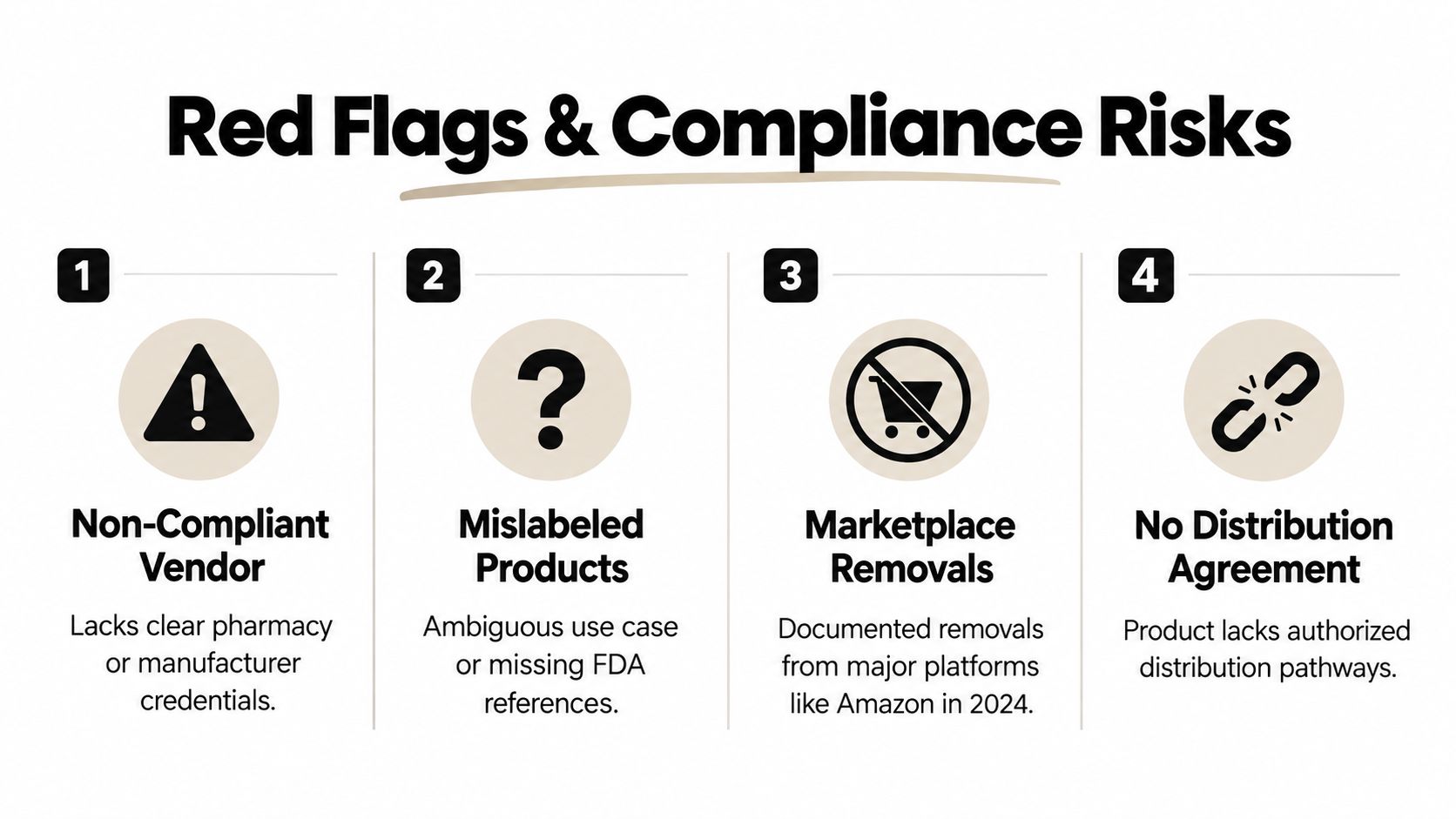
- No lot-specific COA: A generic certificate doesn't establish that the shipped vial passed sterility, endotoxin, preservative, or closure checks.
- Ambiguous product identity: “Bac water,” “sterile diluent,” or “medical water” without a precise formulation leaves the buyer to guess what is inside.
- Unclear intended use: A listing that markets RUO material for human or animal injection creates a compliance and safety concern.
- Unaccountable fulfillment: Missing manufacturer details, unclear storage, no recall process, and weak shipment records make corrective action difficult.
Recent reporting on marketplace products describes quality failures involving out-of-specification pH and benzyl alcohol levels. Those findings reinforce a basic procurement principle: the absence of a complaint isn't evidence of conformity, and marketplace reviews aren't a substitute for batch testing.
Distribution requires stronger controls
A reseller serving the EU, UK, USA, or LATAM should preserve the supplier's original documentation and avoid rewriting the product's use statement. Regional rules can differ, so a distribution agreement should define who handles labeling, import documentation, storage, customer qualification, complaints, and recalls.
A credible partnership discussion should cover:
| Qualification area | Evidence to request |
|---|---|
| Product quality | Lot-specific COA, sterility information, endotoxin or pyrogen controls, preservative result |
| Manufacturing accountability | Manufacturer identity, release responsibility, traceable lot records |
| Fulfillment | Storage conditions, dispatch process, packaging controls, tracking |
| Commercial continuity | Reorder process, available vial formats, wholesale terms, shortage communication |
| Compliance | RUO wording, regional sales restrictions, downstream marketing rules |
Herbilabs is one example of a supplier positioned around RUO bacteriostatic water and reconstitution solutions, with vial formats including 3 mL, 10 mL, 20 mL, and 30 mL, plus COAs and wholesale or private-label arrangements for distributors. Buyers should still apply the same qualification process to that supplier as to any other source, especially when the order crosses borders or enters a resale channel.
Partnership standard: A supplier should make it easier to trace, store, and explain the product. If the supplier makes those tasks harder, the apparent price advantage isn't a reliable saving.
The safest way to buy bacteriostatic water online is to treat the purchase as a controlled supply decision. Verify the formulation, match the lot documentation, confirm RUO or clinical status, plan storage, inspect fulfillment, and document the supplier review before committing to repeat orders.
For laboratories, resellers, and distribution partners, Herbilabs offers RUO bacteriostatic water and reconstitution solutions in multiple vial formats, with batch documentation and wholesale or private-label supply options. Visit Herbilabs to review the product information and discuss a sourcing arrangement that fits the destination market, storage process, and verification requirements.


