Private Label, White Label, Wholesale partnerships available - EU, USA and UK - Free shipping from €75

Bac Water Reconstitution How to Mix Peptides Safely
A rushed reconstitution usually fails in ordinary ways. The peptide cake gets hit directly with a hard jet of diluent, foam climbs the glass, the vial is shaken to “help it along,” and the final solution looks slightly off but still gets used. Later, assay behavior drifts, repeatability drops, and nobody can tell whether the issue came from the reagent, the handling, or the math.
That's why bac water reconstitution deserves more attention than it usually gets. In research-use workflows, the diluent choice, the injection angle, the final concentration, and the storage routine all affect whether a vial becomes a clean working stock or an avoidable source of variability. For wholesalers, resellers, and labs managing repeated access, the problem gets bigger when bac water is delayed and teams start asking whether sterile water is “close enough.”
Table of Contents
- Why Bac Water Reconstitution Matters for Research Integrity
- Understanding Bacteriostatic Water and When to Use It
- Preparing for Aseptic Reconstitution Without Contamination
- How to Reconstitute Peptides With Bac Water Step by Step
- Calculating Concentration and Choosing the Right Volume
- Storing Handling and Troubleshooting After Reconstitution
Why Bac Water Reconstitution Matters for Research Integrity
A lyophilized peptide vial looks stable and forgiving. It isn't. The moment liquid enters the vial, the workflow becomes less about possession and more about control. Control of contamination, control of concentration, and control of mechanical stress during dissolution.
Many handling failures start before anyone notices a visible problem. A vial can dissolve and still be poorly prepared. If the operator guessed the volume, skipped stopper disinfection, or forced diluent directly onto the cake, the resulting stock may still look usable while carrying inconsistent concentration or unnecessary degradation risk. In a research setting, that's how small prep errors become large interpretive errors.
Where the damage usually starts
Three mistakes show up repeatedly in real peptide handling:
- Volume chosen for convenience: The operator picks a round number of milliliters without first deciding what working concentration is needed.
- Fast injection into the cake: A hard stream can disturb the lyophilized mass and promote foaming or visible particulate.
- Shaking instead of dissolving patiently: Vigorous agitation is often treated as harmless. It isn't a good habit for fragile materials.
A cleaner workflow starts with treating reconstitution as part of the experiment, not as a quick setup task. That means choosing the correct diluent, planning the target concentration in advance, and using a repeatable physical technique every time.
Practical rule: If the reconstitution step isn't documented, the concentration isn't fully trustworthy.
For teams that sell or support research supplies, this matters beyond bench technique. A buyer who gets poor results after reconstitution may blame the peptide, the bac water, or the supplier interchangeably. Better guidance prevents that confusion. It also protects inventory decisions, support burden, and compliance conversations with downstream customers.
One useful framing is to treat bac water reconstitution as an integrity step, not a convenience step. That's the same mindset behind experimental integrity with bacteriostatic water. When the reconstitution process is controlled, the resulting stock is easier to trace, easier to label, and far less likely to become a hidden variable.
What correct handling actually achieves
Done properly, bac water reconstitution gives the lab four things:
- A defined concentration that can be calculated and recorded.
- A cleaner dissolution process with less foam and less visible stress on the vial contents.
- A more practical multi-use workflow when repeated puncture is expected.
- Better traceability when lots, dates, and concentrations need to be audited later.
That's the difference between “the powder dissolved” and “the stock was prepared correctly.”
Understanding Bacteriostatic Water and When to Use It
A common inventory problem looks small at first. A reseller has peptide stock ready to move, bacteriostatic water is delayed, and someone asks whether sterile water can cover the gap. That decision should not be made at the packing table.
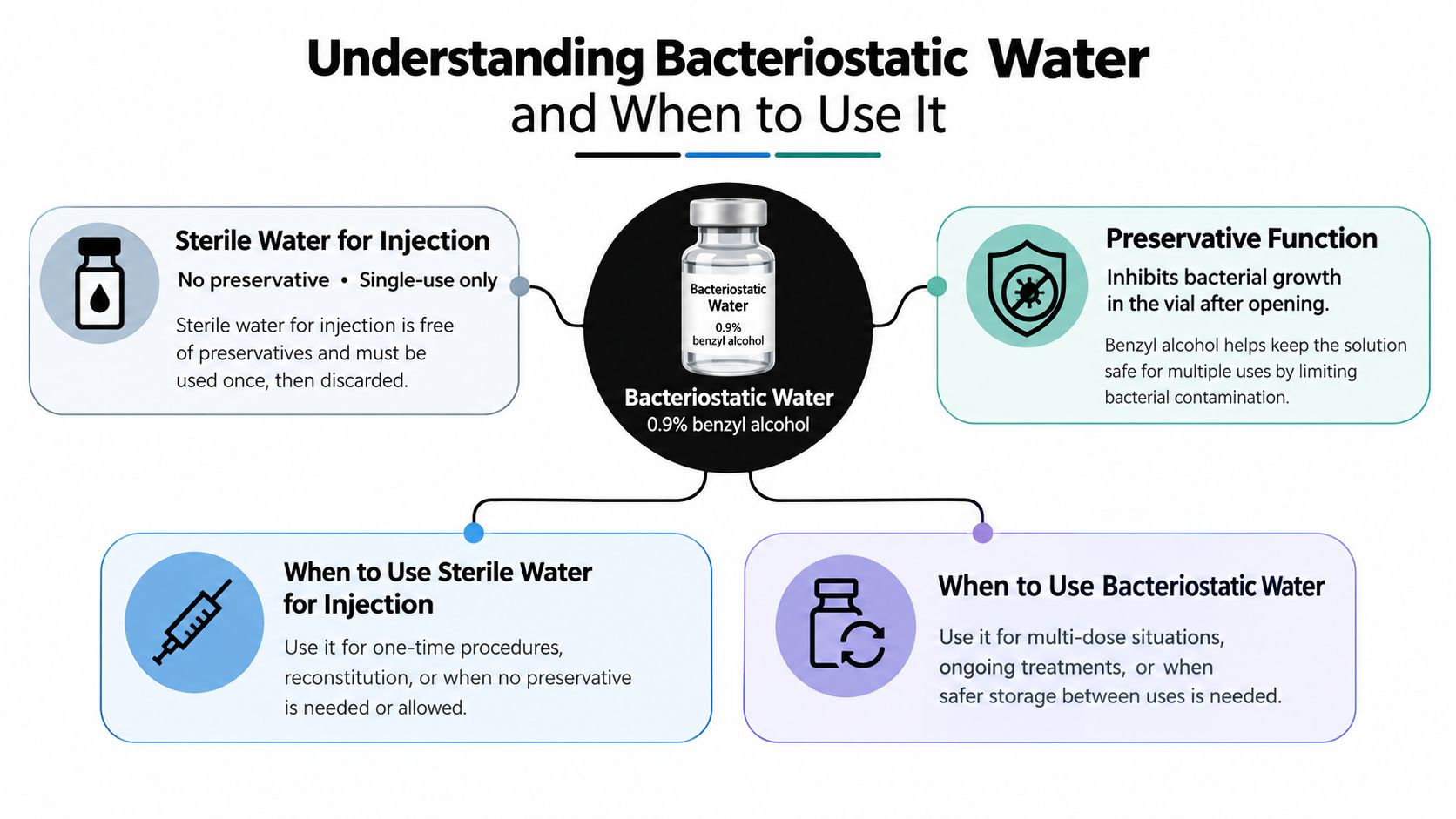
Bacteriostatic water is a specific diluent category, not a generic name for any sterile water product. Its practical role in reconstitution is tied to a preservative system intended for multi-dose handling patterns, which is why teams using it for research workflows need to distinguish it clearly from sterile water for injection and from plain water-based diluents sold under loose shorthand.
What changes when a preservative is present
The handling difference matters more than the label aesthetics. In a research setting where a vial may be entered more than once, a preservative-containing diluent supports that workflow differently than sterile water without a preservative. It does not excuse poor aseptic technique, and it does not make products interchangeable.
That is the mistake I see most often in real bench and fulfillment discussions. Teams focus on whether the powder will dissolve, but the better question is whether the final stock can be used, labeled, stored, and re-entered in a way that matches the product instructions and the lab's documentation standard.
Use this as the working rule:
- Bacteriostatic water is chosen when the product or workflow calls for a preservative-containing aqueous diluent and repeated vial access is expected.
- Sterile water for injection is a separate diluent category and should not be substituted casually because it is on hand.
- The labeled or specified reconstitution method decides the diluent, the volume, and the resulting concentration.
That last point affects concentration math directly. If a vial is intended to be reconstituted to a specific mg/mL or mcg/mL target, the wrong diluent choice often shows up alongside another avoidable error. Someone adds a convenient volume instead of the planned volume, then records an assumed concentration that does not match what is in the vial.
Use case first, convenience second
For RUO wholesalers and resellers, this is also a procurement and compliance issue. If bac water supply slips for a week, the pressure to ship with a substitute goes up. The correct response is to hold the line on documentation and product matching, not to improvise a swap that creates support problems later.
A delayed bac water shipment can ripple through inventory planning in three ways:
- Prepared kits stall because the intended diluent is missing.
- Customer support load increases when buyers ask whether another water product is "close enough."
- Traceability gets weaker if teams start making case-by-case substitutions that are not reflected in standard handling instructions.
For buyers who need a plain-language reference on the category itself, what bac water is gives a clean baseline before the volume and concentration decisions start.
When bac water is the right choice
Choose bac water when the product instructions or the research-use workflow call for that preservative-containing diluent and the reconstituted vial is expected to be accessed more than once under controlled handling. Do not choose it by habit, and do not reject it just because another clear diluent is easier to source that week.
In practice, the choice affects more than shelf picking. It sets up the math for the target concentration, influences how the operator introduces fluid into the vial wall during reconstitution, and determines whether the finished stock matches the workflow it was prepared for. That is why experienced teams treat bac water selection as part of the method, not as a last-minute accessory.
Preparing for Aseptic Reconstitution Without Contamination
A common failure point looks harmless at first. The bac water finally arrives after a shipping delay, a team is trying to clear backlogged RUO orders, and someone starts reconstitution before the target concentration, syringe size, and labels are set out. Nothing spills, but the vial gets punctured twice, the volume is adjusted on the fly, and the lot record is now harder to defend.
That kind of mistake starts before mixing.
Setup before the needle enters anything
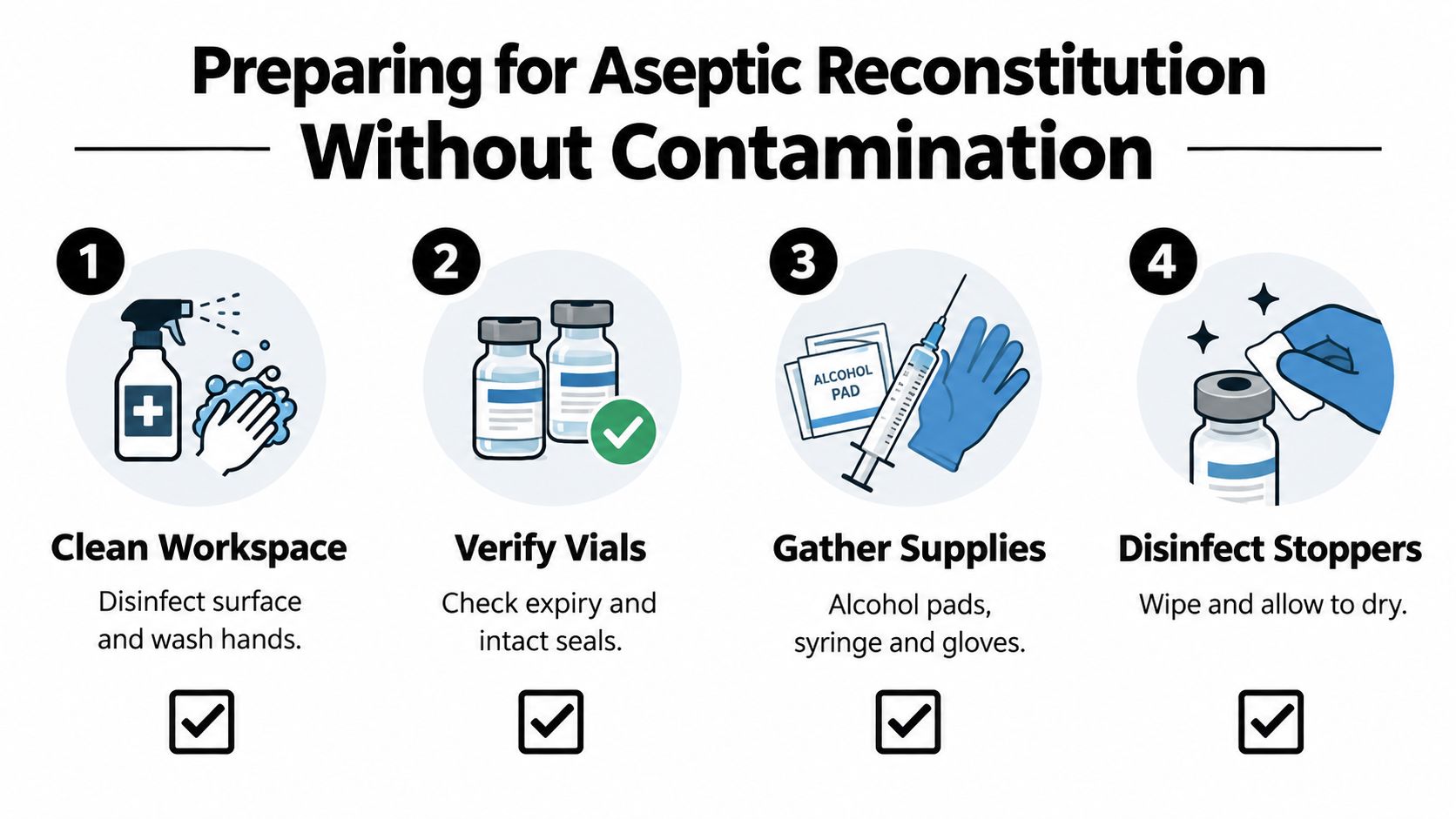
A clean reconstitution setup should answer three questions in advance: what volume is going in, what final concentration that creates, and what sterile tools will control that volume accurately. For RUO wholesalers and resellers, this matters at bench level and inventory level. If bac water procurement has been uneven, the pressure to substitute, stretch stock, or rush prep tends to show up here first.
Before puncturing either vial, set the bench so the operator does not have to improvise:
- Let both vials reach room temperature: Cold vials are more likely to collect condensation and can make dissolution less predictable.
- Disinfect both stoppers with 70% isopropyl alcohol: Wipe thoroughly and let the alcohol dry before needle entry.
- Write down the planned volume first: Do the concentration math before drawing anything up, not after the stopper has been pierced.
- Match the syringe to the task: A large syringe makes small-volume control worse. If the target is 1 mL, use a syringe that lets you read 1 mL cleanly.
- Stage the post-mix label in advance: Lot, date, diluent, and resulting concentration should already have a place on the vial or accompanying record.
The physical setup and the math are tied together. A team that has not settled on the final concentration will usually handle the vial more than necessary, redraw fluid, or change labels mid-process.
Why preparation errors create contamination risk
Contamination is not only about a dirty needle or an unclean stopper. It also comes from excess handling. Every extra puncture, every syringe swap, and every pause to recalculate volume creates another chance to touch the wrong surface or lose control of the workflow.
I see the same pattern repeatedly in rushed research prep. The operator remembers the mass in the vial but not the planned concentration, reaches for whatever syringe is nearest, then decides halfway through that the stock should have been more concentrated for downstream aliquoting. At that point, sterility and documentation are both under pressure.
A stronger routine usually includes:
- Confirm the vial identity and lot first.
- Clear the workspace down to only the required materials.
- Keep the target reconstitution volume visible beside the vial.
- Prepare the final label before mixing starts.
Teams training new staff or writing handling SOPs can treat aseptic technique in research handling as part of reconstitution control, not as a separate lesson.
What disciplined prep looks like in practice
The distinction is practical:
| Handling point | Controlled practice | Common failure |
|---|---|---|
| Vial condition | Inspect seal, stopper, label, and cake before use | Noticing defects after the vial is already punctured |
| Temperature | Allow vials to equilibrate to room temperature | Working straight from cold storage |
| Stopper prep | Alcohol wipe, then full drying time | Puncturing through a wet stopper |
| Volume planning | Calculate and note the exact mL in advance | Adjusting volume after draw-up |
| Tool choice | Use a sterile syringe sized for the intended volume | Using an oversized syringe with poor fine control |
| Documentation | Label and lot record prepared before reconstitution | Filling in concentration details from memory afterward |
Preparation rarely gets credit because the vial still looks untouched. In practice, research integrity is protected, especially for RUO sellers who need each prepared unit, instruction set, and lot record to match the method that was used.
How to Reconstitute Peptides With Bac Water Step by Step
A reseller has ten peptide vials ready to go, but the bac water shipment landed late and the team is trying to catch up fast. That is when handling errors show up. The vial gets hit with a hard stream, foam forms, the cake sticks in clumps, and the operator adds "just a bit more" to make it dissolve. At that point, the stock may still look usable, but the concentration and handling record are already drifting.
The actual mixing sequence
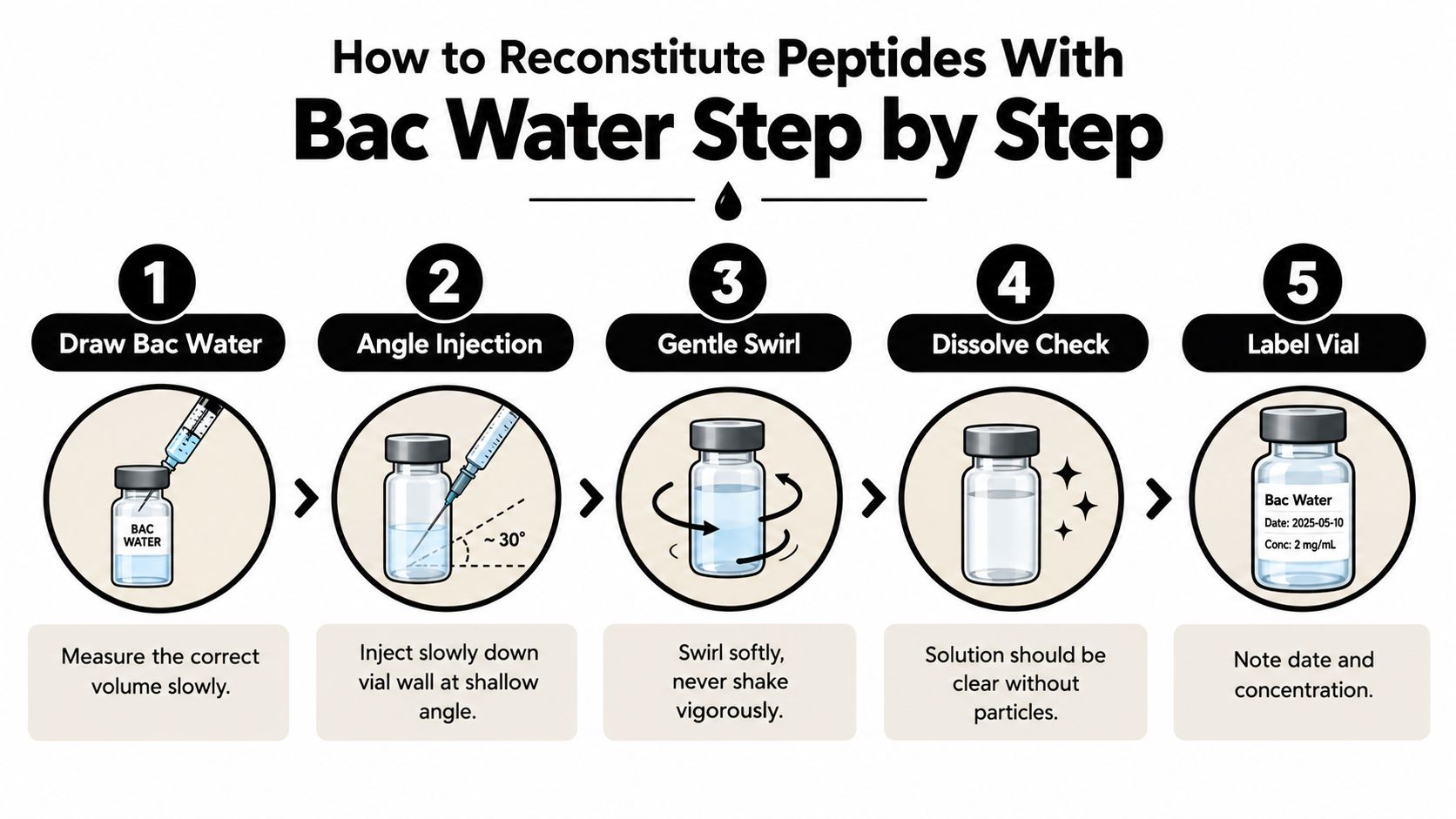
Reconstitution should be deliberate and repeatable. The goal is to add the exact planned volume, wet the cake gently, and reach a clear solution without introducing extra stress or extra punctures.
- Draw the pre-calculated volume of bacteriostatic water into a sterile syringe sized for that amount.
- Enter the vial cleanly and aim at the inner glass wall, not the center of the lyophilized cake.
- Depress the plunger slowly so the liquid runs down the wall in a thin stream.
- Pause after the addition and let the powder hydrate before moving the vial.
- Roll or swirl gently until the solution clears.
- Inspect the vial under good light and reject any result with persistent cloudiness, flakes, or visible particulate.
The wall-directed technique solves two common problems at once. It limits direct impact on the peptide cake, and it gives better control over flow rate. In routine lab work, that usually means less foaming, less material stuck high on the glass, and a cleaner dissolve.
Why wall-directed injection matters
Operators who are rushing often inject straight onto the cake because it feels faster. In practice, it creates more rework. A forceful stream can break up the cake unevenly, trap bubbles, and make the vial look underdissolved even when the chemistry is fine.
The glass wall acts as a buffer. The diluent spreads first, then contacts the powder gradually. That matters even more for RUO wholesalers and resellers who need the same handling pattern across batches, staff, and customer prep instructions. If one technician uses a gentle wall run and another blasts the center, the resulting stock may not behave the same during withdrawal.
For visual learners, this short demonstration shows the physical handling pattern clearly:
What to watch while the peptide dissolves
A calm vial is usually a good sign.
Use these cues during dissolution:
- Good: the liquid stays mostly clear and the cake shrinks evenly from the point of contact
- Normal delay: a small amount of material remains briefly, then clears with time and gentle rolling
- Problem: persistent foam, floating flakes, or haze that does not improve after the vial rests
Aggressive shaking creates avoidable handling noise. It can also make staff think they have a solubility problem when the issue is injection speed or poor wetting. If the vial is not clearing, let it sit for a short interval and inspect it again before doing anything else.
Practical mistakes that affect stock quality
Two mistakes cause repeated trouble in research-use workflows. The first is adding water before confirming the target concentration. The second is re-puncturing the vial to "correct" a guessed volume after the fact. Both create preventable recordkeeping problems for sellers managing lot consistency.
If bac water procurement is delayed, teams sometimes substitute workflow shortcuts to keep orders moving. That is a business pressure, not a technical justification. If the correct diluent or planned volume is not available, hold the prep and document the delay. A late shipment is easier to explain than a mislabeled concentration or an inconsistent stock across units.
For supply partners, tools matter. Some buyers need only single vials. Others need a repeatable stock-prep system with sterile diluents in consistent packaging. In that context, Herbilabs offers bacteriostatic water and reconstitution solutions in RUO glass vials, which fits procurement workflows where standardized supply matters more than ad hoc sourcing.
Calculating Concentration and Choosing the Right Volume
A reseller receives two vials from the same lot, and both dissolve cleanly. One was reconstituted to a stock that supports precise withdrawals. The other was mixed to a guessed volume because bac water arrived late and the team wanted inventory ready for shipment. On paper, both vials look finished. In practice, one is usable and one creates avoidable concentration risk.
The math is simple. The handling consequences are not.
Amount of compound divided by total mL added equals concentration in mg/mL. For a 10 mg vial, 1 mL gives 10 mg/mL. 2 mL gives 5 mg/mL. 4 mL gives 2.5 mg/mL. That decision should be made before the stopper is punctured, because changing course after partial reconstitution creates labeling errors, lot inconsistency, and extra contamination opportunities.
Choose volume based on how the stock will actually be used
The right volume is the one that makes later withdrawals practical and repeatable.
A very concentrated stock reduces the amount of bac water added, but it can force tiny pull volumes that are harder to measure cleanly. A very dilute stock makes pipetting or syringe measurement easier, but it increases total withdrawal volume and can lead to more vial access over time. For RUO wholesalers and resellers, that trade-off affects both bench accuracy and customer confidence, especially when multiple units from the same SKU need to match.
Use these questions before setting the volume:
- What final concentration is needed for the research workflow?
- What withdrawal volume can staff measure reliably with the tools on hand?
- How many times will the vial likely be accessed?
- Will this stock be prepared for near-term use or held as labeled inventory for later release?
One mistake shows up often in inventory settings. Teams choose a familiar number like 1 mL or 2 mL because it is easy to remember, not because it fits the target concentration. That shortcut is how a clean prep becomes a bad stock.
Concentration planning should account for injection technique
Volume selection is tied to how the bac water enters the vial. If the plan calls for a small volume, injection control matters more because the added liquid has less room to disperse error. Direct the stream against the vial wall and let it run down the glass rather than driving it straight into the powder bed. That reduces foaming, limits localized flooding, and gives a more controlled wetting pattern, especially with light lyophilized cakes that can cling to the shoulder of the vial.
This also affects perceived yield. A forceful center-hit can leave material stuck above the liquid line or create bubbles that make the fill level look misleading for a minute or two. Staff then start second-guessing the math when the issue was injection technique.
Product examples show why there is no default volume
Labeled pharmaceutical products make the point clearly. Reconstitution volume is set for the product, the intended concentration, and the handling requirements. It is not chosen by habit.
| Product Example | Bac Water Volume | Resulting Concentration |
|---|---|---|
| ENBREL | 1 mL | 25 mg reconstituted dose |
| CUBICIN RF | 10 mL | 50 mg/mL |
| HERCEPTIN | 20 mL | 21 mg/mL |
Those examples were noted earlier in the article. The takeaway here is straightforward. Different products use different volumes because they are built around different concentration targets and use conditions.
Batch records should answer the math without recalculation
For RUO supply teams, concentration control is also a procurement and compliance issue. If bac water is delayed, hold the prep rather than improvising with an unplanned volume just to keep units moving. A backordered diluent creates a scheduling problem. An inconsistent stock creates a documentation problem that follows the lot.
Record the following on the label or batch sheet:
- product identity
- amount in vial
- bac water volume added
- resulting concentration
- date of reconstitution
- lot reference
The person picking up that vial later should not have to reconstruct the calculation at the bench. They should be able to verify the stock concentration immediately, confirm it matches the batch record, and proceed without guessing.
Storing Handling and Troubleshooting After Reconstitution
A vial can reconstitute cleanly at the bench and still become unusable two days later because nobody marked the puncture date, the stopper was pierced repeatedly, or the vial sat in the wrong storage condition between picks. For RUO wholesalers and resellers, that is not a minor handling slip. It creates concentration uncertainty, weakens traceability, and can turn one inventory delay into a batch record problem.
Date control matters more than visual appearance
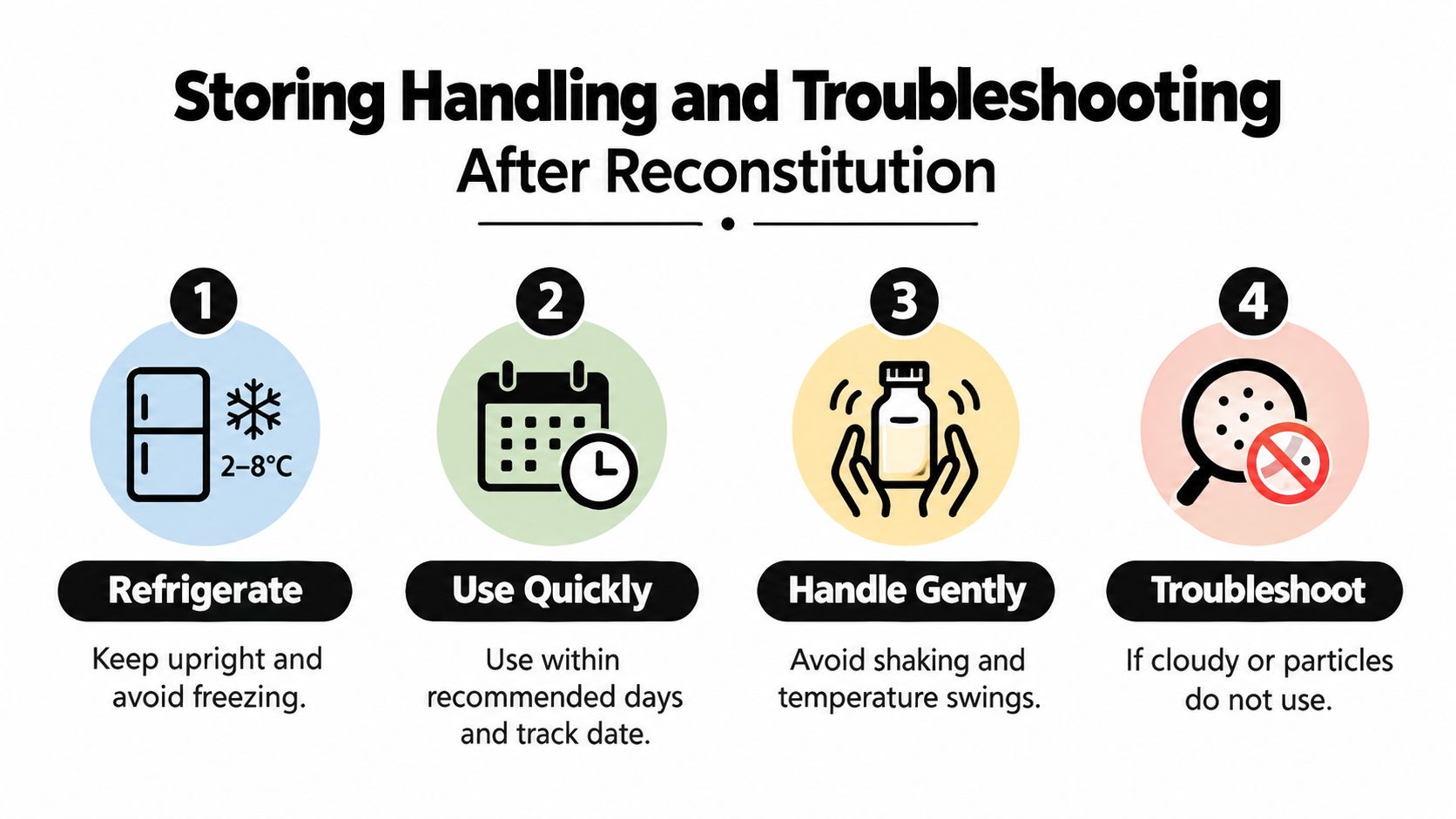
Once bac water has been entered, treat the vial and the reconstituted product as dated materials. The practical rule in many handling workflows is a 28-day post-puncture limit for bacteriostatic water, and the 2026 bacteriostatic water FAQ discusses that convention alongside storage guidance. The exact handling setup still has to follow the product and your documented process.
Appearance alone is a poor release check. A clear solution can still be outside your acceptable use window, and a vial with no visible change can still have incomplete records. Benzyl alcohol helps suppress microbial growth, but it does not justify loose storage habits or missing labels.
Store under the conditions specified for the material, keep the vial upright, and make the dating visible to the next handler without opening the tray or secondary packaging.
Handle the failure modes early
The useful troubleshooting signs after reconstitution are usually obvious if staff are trained to stop and assess them instead of pushing the vial through.
- Cloudiness: Hold the vial and review whether the material should be fully clear at the target concentration and storage condition.
- Visible particles or flakes: Treat as unresolved material or contamination risk until proven otherwise.
- Persistent foam: Mixing was likely too aggressive, or the diluent hit the powder mass too directly.
- Multiple punctures with poor documentation: The sterility and traceability risk may be higher than the vial appearance suggests.
- Label mismatch: If the stated concentration does not match the recorded reconstitution volume, quarantine it. Do not recalculate from memory and relabel casually.
In practice, I see one mistake more than any other after a good reconstitution. People trust what the vial looks like and ignore what the record says. For RUO inventory, the record wins.
Appearance is not a substitute for expiry discipline.
What to do when bac water is delayed
Delayed bac water puts pressure on purchasing, fulfillment, and bench staff at the same time. That is when bad substitutions happen. A reseller wants stock out the door, a tech wants to keep prep on schedule, and someone starts asking whether sterile water can stand in without changing the record.
That decision has to be tied to the target product instructions and the intended use window. If the documented workflow calls for bacteriostatic water, hold the prep until the correct diluent is available rather than changing diluent type, concentration assumptions, and storage expectations in one step. Independent reporting in 2026 described real market tightness during 2025 and 2026 even without an official FDA shortage listing, as summarized in this 2026 bac water shortage analysis.
For wholesalers and resellers, the operational response is straightforward:
- Set a written substitution policy before supply gets tight.
- Pause reconstitution when the approved diluent is unavailable.
- Reserve compliant stock for lots already committed in batch records.
- Log delayed orders and partial allocations by lot, not just by SKU.
- Review whether customer-facing inventory promises are creating preventable bench pressure.
That last point matters. Procurement risk does not stay in procurement. It shows up as undocumented substitutions, mislabeled concentration, and preventable discard.
Herbilabs supplies RUO bacteriostatic water, sterile diluents, and reconstitution-ready labware for buyers who need reliable handling workflows rather than improvised sourcing. For wholesalers, resellers, and research teams managing concentration control, sterility, and supply continuity, Herbilabs offers product formats that fit documented reconstitution and inventory compliance.


