Private Label, White Label, Wholesale partnerships available - EU, USA and UK - Free shipping from €75
2ml of Water Explained Volume Mass and Lab Uses
A protocol calls for 2ml of water, and the amount looks almost too small to matter. A researcher reaches for a syringe, a reseller checks a product specification, or a lab buyer tries to decide whether a pipette or graduated cylinder is appropriate. The number seems simple, yet a slight difference in delivery can affect the mass transferred, the concentration prepared, and the repeatability of the workflow.
The useful question isn't only “How much is 2ml?” It's also what does that volume represent under the conditions being used, and can the chosen device deliver it reliably? The answer begins with everyday volume intuition, then moves through density, temperature, instrument choice, and concentration calculations. That progression helps new researchers, laboratory buyers, wholesalers, and resellers treat 2ml as a practical control point rather than a conversion trivia question.
Table of Contents
- Introduction to What 2ml of Water Really Means
- How Much Is 2ml of Water in Everyday Terms
- Understanding Mass and Volume for 2ml of Water
- How to Measure 2ml of Water Accurately in the Lab
- What Happens When You Use 2ml for Reconstitution and Dosing
- Quick Reference and Next Steps for Working With 2ml
Introduction to What 2ml of Water Really Means
A small vial sits beside a worksheet. The instruction says to add 2ml of water, but the researcher has several possible tools nearby: a syringe, a pipette, and a measuring cylinder. The amount is visibly modest, yet the workflow may depend on adding the correct final volume. Confusion often starts because volume, mass, and dosing are related, but they aren't interchangeable in every situation.
At standard laboratory reference conditions, 2ml of pure water has a mass of about 2g, because water is commonly treated as having a density of approximately 1.0g per millilitre. That shortcut works well for rough preparation and everyday understanding. It becomes less exact when a protocol requires analytical control, when the water isn't at the assumed temperature, or when dissolved substances change the liquid's density.
The physical volume itself is stable in metric terms. 2ml equals 2cm³ and 0.002L, making it a convenient benchmark for checking small-volume equipment and transfer technique. A technician can use that benchmark to think about pipette verification, syringe selection, and the effect of reading a meniscus slightly above or below the intended mark.
Practical rule: Treat 2ml as both a quantity and a decision. The quantity describes the target volume, while the decision concerns the tool, temperature, tolerance, and intended solution.
The sections ahead keep those questions separate. First comes a visual sense of the amount. Then mass and density explain why 2ml doesn't always weigh exactly 2g. Finally, measurement and concentration math show why the same nominal volume can produce different practical outcomes.
How Much Is 2ml of Water in Everyday Terms
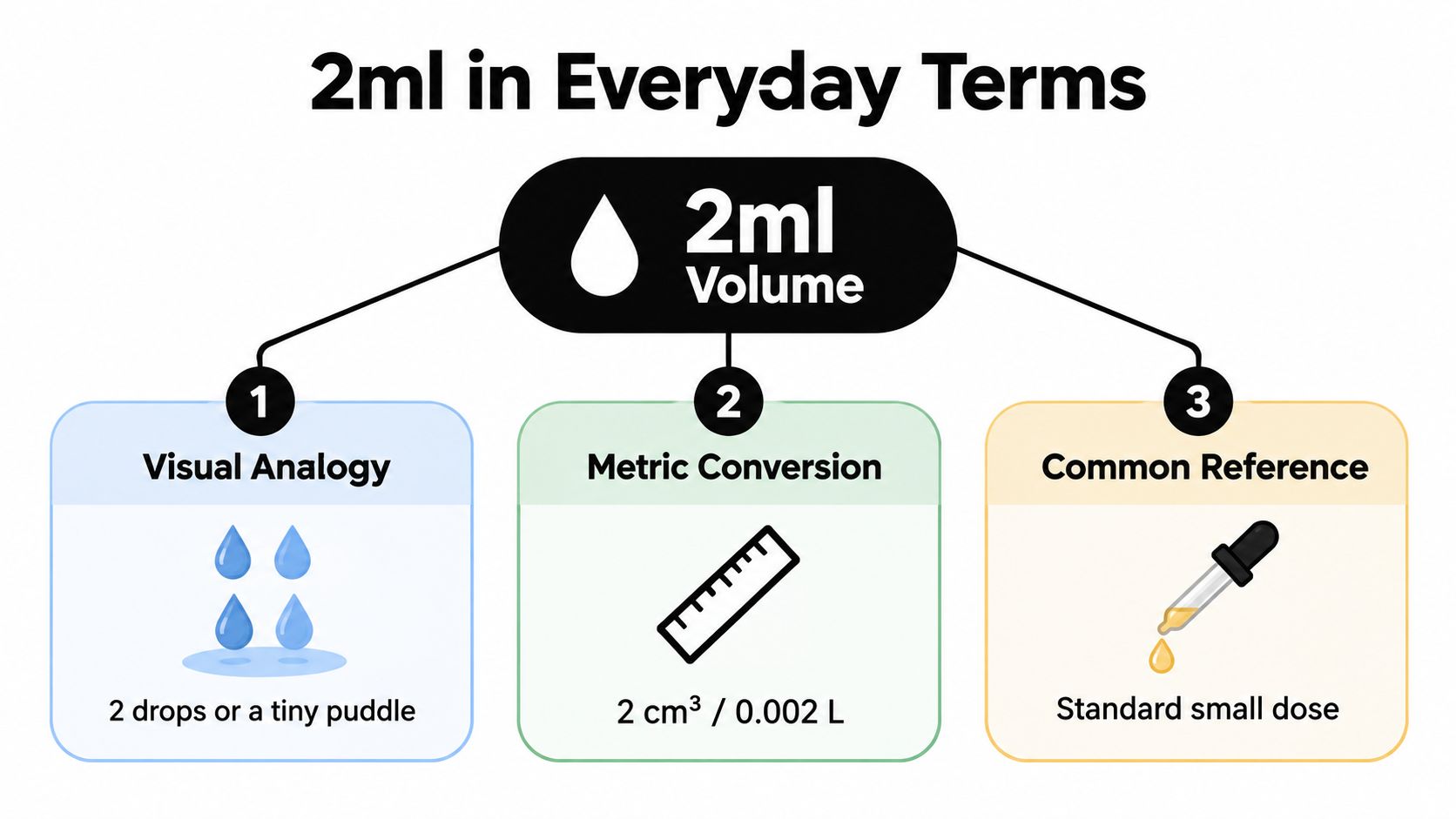
A technician preparing a small sample may see only a thin amount in a syringe, yet that amount can determine whether the final mixture is correctly prepared. 2ml is a very small volume, with exact metric equivalents that make it easier to identify and communicate. It occupies 2cm³, or two cubic centimetres, and equals 0.002L. These conversions matter when equipment displays different units or when a calculation uses litres rather than millilitres.
For a quick visual reference, 2ml is less than half a teaspoon. A kitchen spoon can help someone estimate the scale, but its shape and markings are not reliable enough for controlled laboratory work. A small dropper may feel more familiar, although each drop changes with the liquid, tip, angle, and dispensing technique. Drop comparisons therefore support intuition only. They do not define a controlled aliquot.
A simple mental model
The clearest mental model is a tiny measured aliquot. A syringe or pipette set to 2ml gives the operator a defined target. A spoon or dropper gives an approximation, so the device choice becomes part of the measurement rather than a minor detail.
Keep these references together:
- Volume: 2ml of water is exactly 2cm³.
- Metric scale: 2ml equals 0.002L.
- Workflow role: The amount can serve as a small-volume benchmark for pipetting and calibration checks.
- Visual aid: It is a little under half a teaspoon, but that comparison is unsuitable for precision work.
At this scale, a small visible error represents a larger share of the intended volume than it would in a larger container. Temperature and liquid composition can also affect later mass or concentration calculations, so 2ml is a decision point: select an appropriate device, read the meniscus consistently, and identify whether the protocol requires volume or concentration control.
A researcher can use 2ml as a practical reference for checking transfer technique, provided the equipment suits the range. The engineering reference on water density and volume relationships helps connect volume with the mass calculations used later. The quantity is easy to picture, but its delivered result still depends on the instrument and the purpose of the preparation.
Understanding Mass and Volume for 2ml of Water
A technician preparing a 2ml aliquot may record the volume, weigh the transfer, or calculate a concentration from it. Those actions describe different properties. Volume is the space occupied by the liquid, while mass is the amount of matter it contains. Density connects them: mass equals density multiplied by volume.
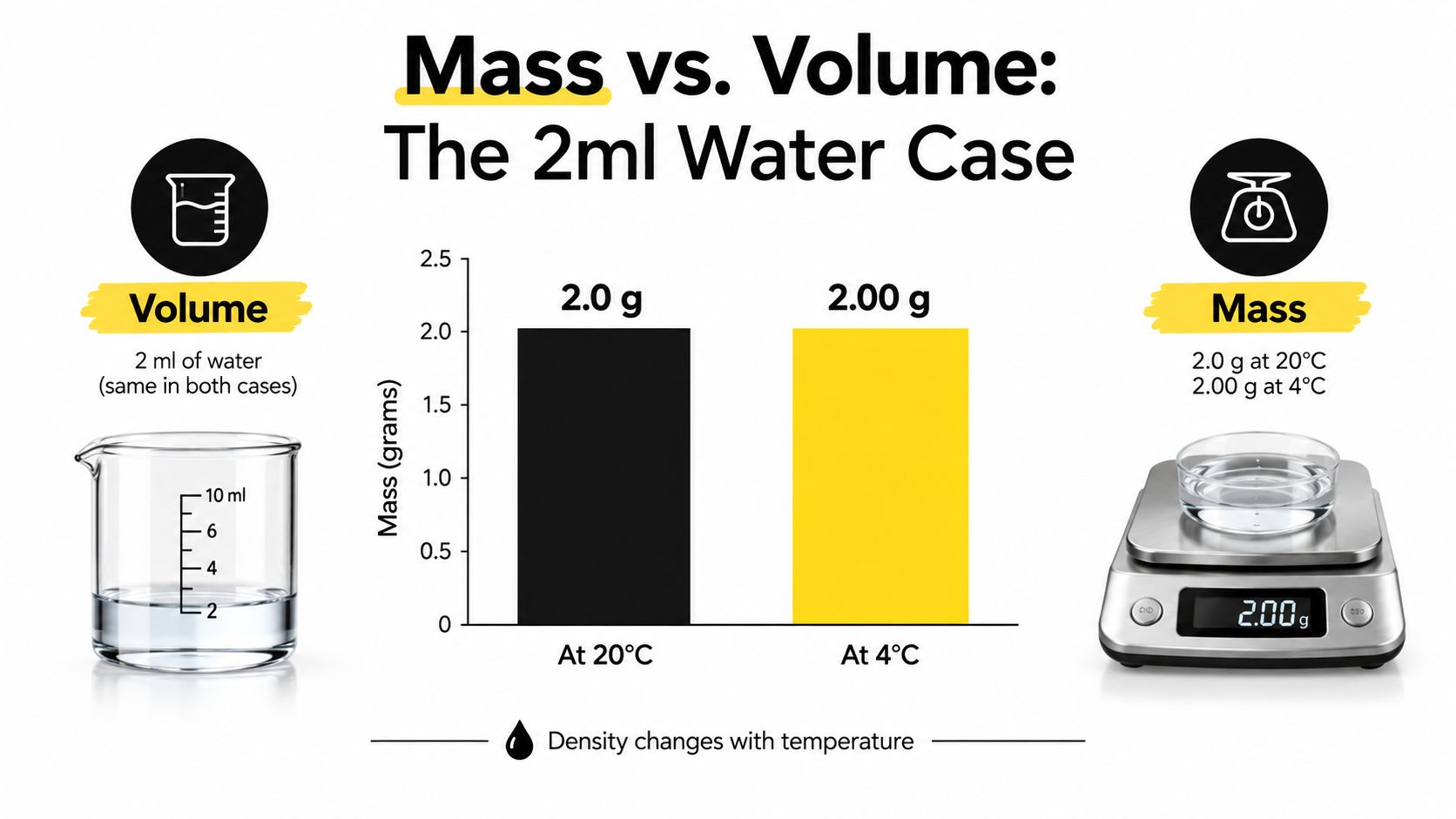
The quick laboratory estimate is familiar. At a reference density of about 1.0g/ml, 2ml of pure water weighs about 2g. That is a useful starting point, not a statement that millilitres and grams are interchangeable. Temperature changes the result. At 20°C, water has a density of about 0.9982g/ml, so 2ml weighs about 1.996g, as explained in the USGS explanation of water density.
Water is densest near 4°C. At 25°C, its density falls to about 0.9970g/ml, so the same measured volume has a slightly lower mass. The difference may be unimportant for casual handling, yet it can affect a formulation, an analytical transfer, or any calculation that turns volume into mass.
When the shortcut works
For rough preparation, teaching demonstrations, and ordinary handling, “2ml equals about 2g” is usually adequate. It gives the operator a fast estimate while keeping the distinction between volume and mass clear.
Precision work needs the working temperature and the calculation basis recorded. The published water-density table from Engineering ToolBox lists water at about 0.99997g/ml at 4°C and 0.99705g/ml at 25°C. Across those conditions, a 2ml transfer is roughly 1.9999g to 1.9941g.
Use the quantity according to the question being asked:
- Volume-led work requires a suitable volumetric device and consistent meniscus reading.
- Mass-led work may require weighing the delivered water instead of applying a fixed conversion.
- Temperature-sensitive work requires a density value that matches the actual conditions.
- Solutions containing dissolved material require the solution's density, not an automatic water assumption.
A 2ml aliquot remains useful when the method states what must be controlled. For preparations involving a specified diluent, the water-for-injection reference helps distinguish the material being used from the separate question of how its volume, mass, and resulting concentration should be assessed.
How to Measure 2ml of Water Accurately in the Lab
The measurement question is not whether 2ml can be described. It's whether a chosen device can repeatedly deliver 2ml within the workflow's acceptable tolerance. Laboratory guidance notes that every measurement carries uncertainty from the instrument and the user, while research on small-volume delivery reported that, for a 1ml syringe, accuracy below 0.2ml was only 0.07ml, as described in the small-volume syringe study.
That finding doesn't mean every syringe is unsuitable for 2ml. It means device scale, operating range, user technique, and required tolerance must be considered together. A syringe with clear graduations may suit a transfer where sterility and controlled handling matter, while a calibrated pipette may be preferable when repeatability is the primary concern.
Choosing the right tool to deliver 2ml
| Device | Best Use for 2ml | Typical Uncertainty | Watch Out For |
|---|---|---|---|
| Graduated syringe | Small transfers where direct drawing and controlled dispensing are useful | Depends on graduation scale, fit, and technique | Plunger position, dead space, and reading angle |
| Serological pipette | Repeated laboratory transfers with compatible pipette aid | Depends on pipette class and operator technique | Correct seating, drainage technique, and calibration status |
| Micropipette | Controlled low-volume work within the instrument's validated range | Depends on model, setting, tips, and technique | Using it outside its intended range or with poor aspiration speed |
| Graduated cylinder | Quick approximate measurement when fine precision isn't required | Generally less suitable for a small target than dedicated pipetting equipment | Meniscus reading and coarse graduations |
A syringe can be practical for sterile handling, but the barrel should provide a clear view of the liquid and a graduation appropriate to the target. A pipette requires consistent aspiration, a vertical orientation, and correct meniscus alignment. A cylinder may be convenient, but its broad scale can make a small target harder to read precisely.
The Herbilabs 1cc syringe with Luer lock is one example of a small-volume laboratory supply that may fit certain transfer workflows, although the selected device must still match the required volume and tolerance. Researchers should also check whether the container, needle, and connection introduce dead space or make complete delivery difficult.
Technique controls
- Read the meniscus consistently: For clear water, align the lowest point of the meniscus with the target mark at eye level.
- Control temperature: Let the liquid and equipment reach the intended working condition before a high-accuracy conversion.
- Check calibration: Use documented calibration or verification procedures when the result affects concentration or assay preparation.
- Repeat the transfer: Repeated checks reveal whether an error is random or systematic.
- Match sterility to the workflow: A sterile transfer requirement changes the equipment decision, not just the volume decision.
A device that reaches the 2ml line once isn't automatically a device that delivers 2ml reproducibly.
What Happens When You Use 2ml for Reconstitution and Dosing
In reconstitution, 2ml is not a universal recipe. The final concentration depends on the amount of material divided by the final volume. The OpenStax explanation of measurement uncertainty, accuracy, and precision provides the foundation for treating the volume measurement as part of the calculation rather than as an isolated instruction.
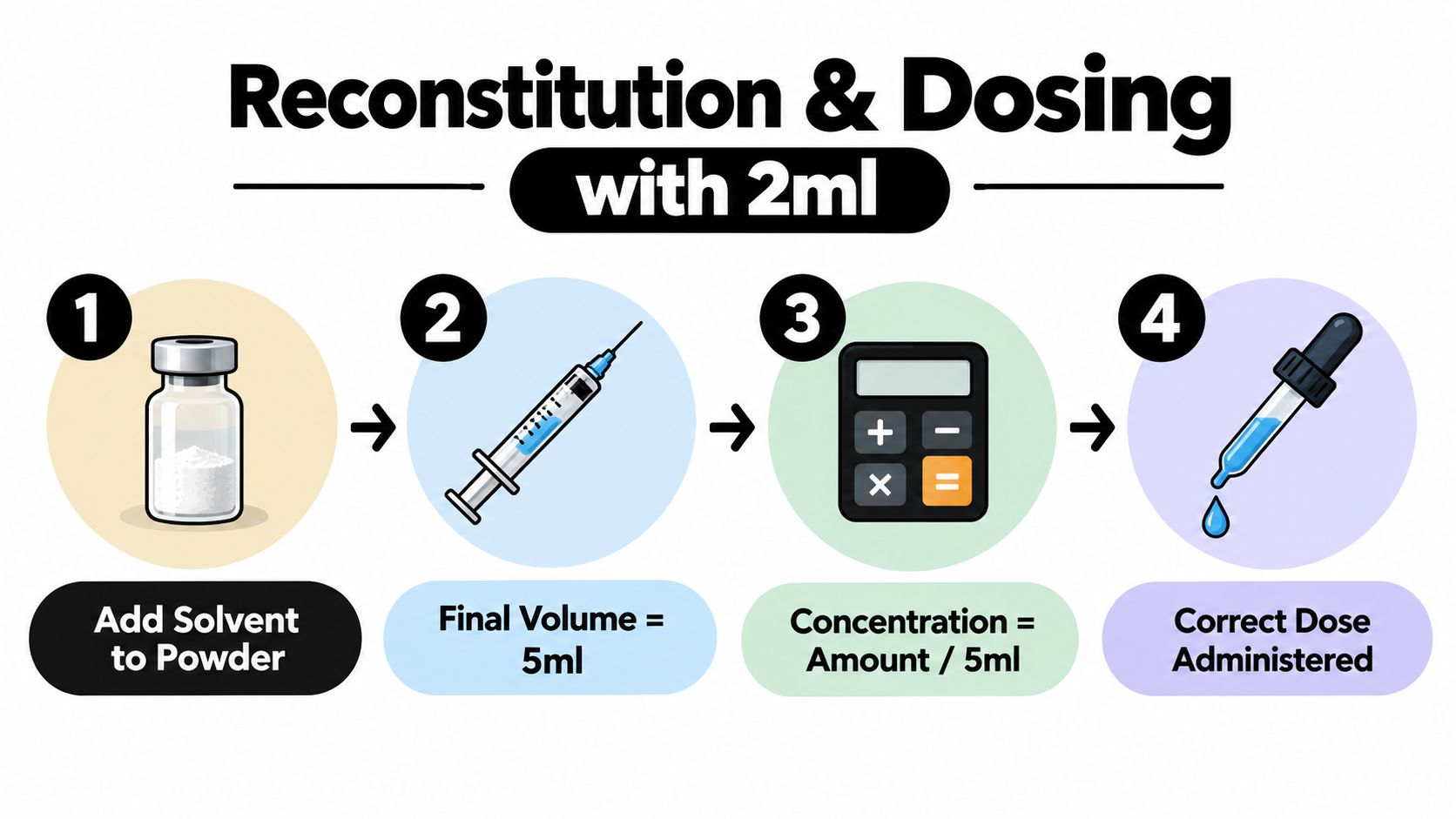
A simple example makes the relationship clear. If a vial contains a known amount of material and the final solution volume is 2ml, the concentration is calculated as:
Concentration = amount of material ÷ final volume
If the intended final volume is 2ml but the operator delivers slightly more or less, the concentration changes. An under-delivered volume produces a more concentrated solution, while an over-delivered volume produces a more dilute solution. The material amount hasn't changed, but the amount present in each millilitre has.
From concentration to drawn volume
Once concentration is known, a target dose is calculated from that concentration:
Drawn volume = desired amount ÷ concentration
That formula is more reliable than treating 2ml as a fixed dosing instruction. A protocol, certificate of analysis, product datasheet, or validated laboratory method should define the material amount, solvent, final volume, and handling conditions. The practical guide to reconstitution for experimental work can provide workflow context, but it shouldn't replace the governing protocol or institutional requirements.
Sub-0.1ml draws deserve special attention. At that scale, a device's graduations and plunger geometry can make the intended volume difficult to distinguish, especially if the operator reads from an angle or works with a syringe that is too large for the task. The appropriate syringe or pipette should make the target visible and repeatable, and any unit system on the barrel should be interpreted through the actual millilitre volume and calculated concentration.
Wholesalers and resellers should communicate this clearly. Listing “2ml included” without explaining whether that means added solvent, final solution volume, or a suggested preparation volume can leave users with an incomplete calculation. A precise product description should identify the intended research use, container format, sterility information, and the need to calculate concentration from the actual material amount.
Calculation first: The correct drawn volume comes from concentration. The number 2ml only defines one part of the preparation.
Quick Reference and Next Steps for Working With 2ml
A reliable 2ml workflow rests on three decisions. First, the researcher should visualize the amount as 2cm³ or 0.002L, not as an informal spoon or drop count. Second, mass conversion should account for density when temperature or formulation accuracy matters. Third, the device must be capable of delivering the target consistently.
A short verification checklist keeps the process practical:
- Confirm the target: Check whether the protocol means added solvent volume or final solution volume.
- Select the device: Use a syringe, pipette, or cylinder whose graduations suit the required tolerance.
- Read at eye level: Align the bottom of the meniscus with the 2ml mark for clear water.
- Control conditions: Record temperature when a volume-to-mass conversion affects the result.
- Verify performance: Use calibration records or a repeat-transfer check for critical work.
- Check documentation: Review the COA, datasheet, and approved method before reconstitution or dilution.
- Recalculate concentration: Treat any change in final volume as a change in concentration.
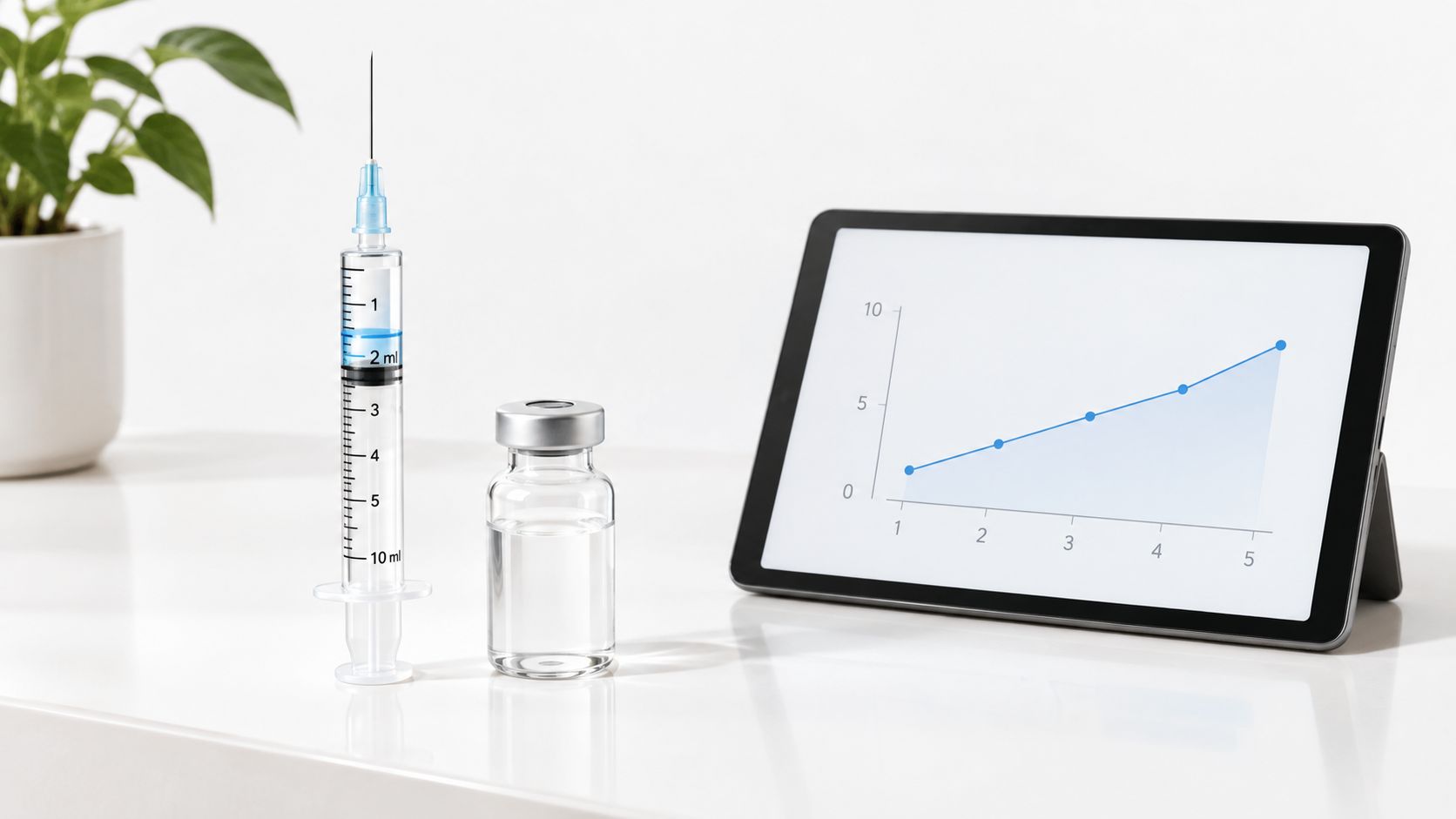
The central lesson is simple: 2ml of water is a defined volume, not a guaranteed mass or dosing outcome. Temperature, density, instrument design, meniscus technique, sterility requirements, and concentration math determine what that volume delivers in practice. Researchers who document those factors can make small-volume work more reproducible and easier to audit.
For workflows that require sterile diluents and laboratory-oriented reconstitution supplies, review the relevant product documentation, confirm the intended research use, and choose packaging that supports controlled handling. Herbilabs offers sterile diluents, bacteriostatic water, reconstitution solutions, syringes, COAs, and individual or multi-pack formats for research workflows. Visit Herbilabs to compare available supplies and select a documented solution for accurate 2ml handling.


